
by Angie E.
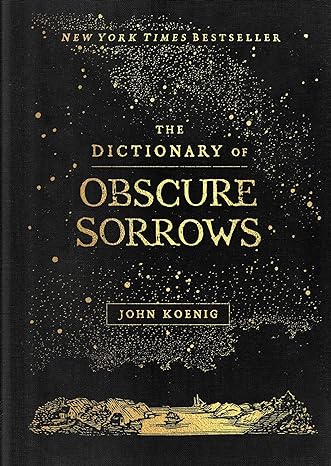
In The Dictionary of Obscure Sorrows, John Koenig goes deep into feelings that often have no definition. The words aren’t just definitions; they’re like secret passageways to whole new worlds of feelings. It’s like they are saying: “Hey, check out these emotions you never knew you had names for!”
Each entry is like a mirror showing emotions we didn’t know we had. “Sonder,” for instance, is the sweet yet sad realization that every random person out there has a life as wild and complicated as yours. There’s also “opia,” that vulnerable moment when eye contact makes you realize that there’s a whole universe of unspoken stuff between souls.
But the one that hits me the hardest is “moledro: a feeling of resonant connection with an author or artist you’ll never meet, who may have lived centuries ago and thousands of miles away, but still can get inside your head and leave behind morsels of their experience.”
Koenig’s ambiance is all about busting out of the silent jail that locks up our feelings, pushing us to chat about the gaps between us. In a world where tech connects and disconnects us, The Dictionary of Obscure Sorrows is like a rock, keeping us grounded in the crazy, beautiful ride of being human.
With every page turn, Koenig holds our hand, guiding us on this epic trip—a journey of connection, finding ourselves, and realizing that we’re all on the same ride in the wide world of feelings. At the end of the day The Dictionary of Obscure Sorrows isn’t just a book; it’s like this crazy venture into what makes us human. It’s like having a quiet chat with your soul, an invite to get cozy with all the feelings that make us who we are.
As the author writes in his introduction: “It’s a calming thing, to learn there’s a word for something you’ve felt all your life but didn’t know was shared by anyone else. It’s even oddly empowering—to be reminded that you’re not alone, you’re not crazy, you’re just an ordinary human being trying to make your way through a bizarre set of circumstances. That’s how the idea for this book was born, in that jolt of recognition you feel when learning certain words for emotions, especially in languages other than English: hygge, saudade, duende, ubuntu, schadenfreude.”
The Dictionary of Obscure Sorrows is available in print, e-book, and e-audiobook.
Angie is an Instructor & Research Specialist at Central Branch and is a co-facilitator for Reads of Acceptance, HCLS’ first LGBTQ-focused book club. Her ideal day is reading in her cozy armchair, with her cat Henry next to her.
 CHAPTER CHATS