Damascus Station by David McCloskey

Broad red banners with the title and author in black lettering appear acroos the image of a minaret.

by Kristen B.

It’s been awhile since I’ve read a really good stand alone spy thriller. Damascus Station kept me on the edge of my seat, wondering how it was all going to end. Sam Joseph is a CIA agent, with a specialty in recruiting assets and a penchant for high stakes gambling in Vegas. He’s managed not to become too cynical about his work. We meet him while he’s trying to get another CIA agent and a scientist out of Syria before the scientist is arrested. The operation goes bad, and it fuels the rest of the story.

Mariam Haddad is the privileged daughter of a Christian family who works in Assad’s government in Damascus, but not entirely happily. She’s aware enough to understand the deal with the devil her family has made for its own survival. When she is asked to coerce an opposition member to come back to Syria, mostly by threatening the woman’s family, Mariam begins to ask serious questions about what she’s doing with her life.

The book spends close to the first hundred pages setting all the pieces on the board, and there are a lot of them beyond our two main characters. Author McCloskey does a great job of making the secondary characters well drawn and interesting, from Mariam’s rebellious cousin to the CIA station chief. My favorites are the three BANDITOS brothers who help Sam run surveillance. The Syrian players are equally interesting, including rival factions within the regime’s security offices and a pair of Sunni rebels from Douma who carry out assassinations. Ali Hassan is a top level Syrian counter-intelligence operative, who is feuding with his brother Rustum, the man in charge of secret prisons and political interrogations. Ali is a good man caught in a bad situation, whereas Rustum is a monster planning to use sarin gas against his fellow Syrians.

The ever increasing stakes are ratcheted by questions of who has been “made” and who is safe. The emotional stakes are high, too, as Sam and Mariam have an immediate, mutual attraction. The rules forbid their entanglement, but their hearts know differently. The book moves quickly, from Syria to the US to France and Italy, then back again. As the plot moves from setting up the board through to the fast-paced, brutal end game, you have to race to keep up with all the characters and figure out what’s really happening. The payoff is worth it!

The author leavens the tension with enough humor and personality that I really invested in the story and the characters. Station Chief Artemis Proctor is a Class-A Character! She seems to be the recurring character in other books by McCloskey (Moscow X and The Seventh Floor), which are now at the top of my summer reading list. His background with the CIA informs his novel with detailed spycraft and knowledge of how things work, but doesn’t slow down the story too much. After all, the trade of espionage is part of what makes the genre so much fun to read.

Damascus Station by David McCloskey is available in print.

Kristen B. is a devoted bookworm lucky enough to work as the graphic designer for HCLS. She likes to read, stitch, dance, and watch baseball (but not all at the same time).
The Secret Hours by Mick Herron

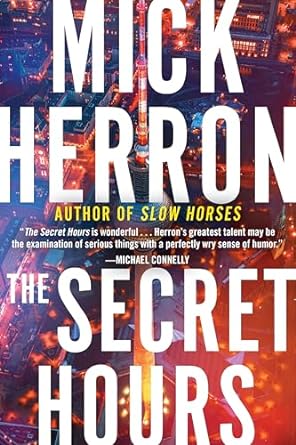
The image depicts a cityscape lit up at night, from above, as if viewing from an airplane or helicopter.

By Julie F.

The Secret Hours opens with a thrilling pursuit: Max, a retired academic living in remote Devon, experiences a home invasion. The reader is privy to Max’s thinking in this first scene; he’s calm and collected enough to evade capture, at least immediately, and it’s clear that he has some background with the intelligence services. Max is now on the run, and the reader’s task is to figure out how his story matches up with the other tale author Mick Herron is telling – a look into what, at first, seems like ancient history.

In 1994, a newly-minted MI5 agent, Alison, is sent to cold war Berlin by David Cartwright to oversee and report back on the work of a somewhat abrasive, difficult agent named Miles. Cartwright is second-in-command in the Service and Alison isn’t sure why he distrusts Miles. In the present day, decades later, Alison is telling the civil servants on the nearly-defunct, investigative Monochrome commission the story of her sojourn in Berlin – how agents died and how the situation was rife with betrayals. The reader gradually comes to realize that her story might have something to do with Max and his pursuers. Of course, all the threads come together at the end and we get a glimpse of the manipulators behind the curtain who pull them for their own benefit. Herron’s unpredictability is one of his strong suits; the good guys don’t always come out on top, so it’s interesting to learn whether those maneuvering behind the scenes will get their comeuppance.

Mick Herron is a master – of character development, of mood and theme, and of plotting above all. I’ve loved the Slough House books in varying degrees, but this book – which is really Slough House-adjacent, involving none of Jackson Lamb’s present-day agents but clarifying many important questions from prior books – is utterly fantastic. If the acclaimed Apple TV series tackles this novel, it will be fascinating to see how they handle the flashbacks and resolve them in the modern storyline that features Lamb and his motley crew.

The tagline from Lee Child on the book cover says it better than I could: “Great Britain has a long, rich history of how-it-really-works espionage fiction, and Mick Herron – stealthy as a secret agent – has written himself to the very top of the list.” I’ve reread Slow Horses already, but as I’ve worked my way through the series, I’ve become convinced that there are so many little details and asides that are easily missed yet turn out to be consequential later on. I rarely re-read series (just because there is so much new fiction out there to discover), but this is one that is worth a second go – not just The Secret Hours, but all nine of the Slough House novels to date, as well as the excellent collection, Standing by the Wall: The Collected Slough House Novellas.

My favorite quote, from Miles to Alison: “You want to serve your country, right? What did you think that involved, dressing up and playing parts? This job is about betrayal. About persuading people to betray other people. Their countries, their friends, those they work for. And in return, we betray them too in the end” (295). It’s worth noting that, despite what he says about playing parts, the narrator tells us at the end that “for a moment they were back in their old lives, the ones that had turned out to belong to other people, or at any rate, to no longer belong to them” (349). Everyone has a hidden identity or motive; everyone is playing a part.

If you’re already a Slough House aficionado, good news: the wait will be up next year. Soho Crime currently plans to publish Clown Town, the tenth book, on September 2, 2025. And if you need something between now and then and have run through the entire series, Herron wrote two standalone novels that, like The Secret Hours, are set in the world of MI5 and MI6 concurrent to the adventures of Jackson Lamb’s Slough House crew: Reconstruction and Nobody Walks.

Julie is an instructor and research specialist at HCLS Miller Branch who finds her work as co-editor of Chapter Chats very rewarding. She loves gardening, birds, crime and espionage fiction, all kinds of music, and the great outdoors.

Alias Emma by Ava Glass

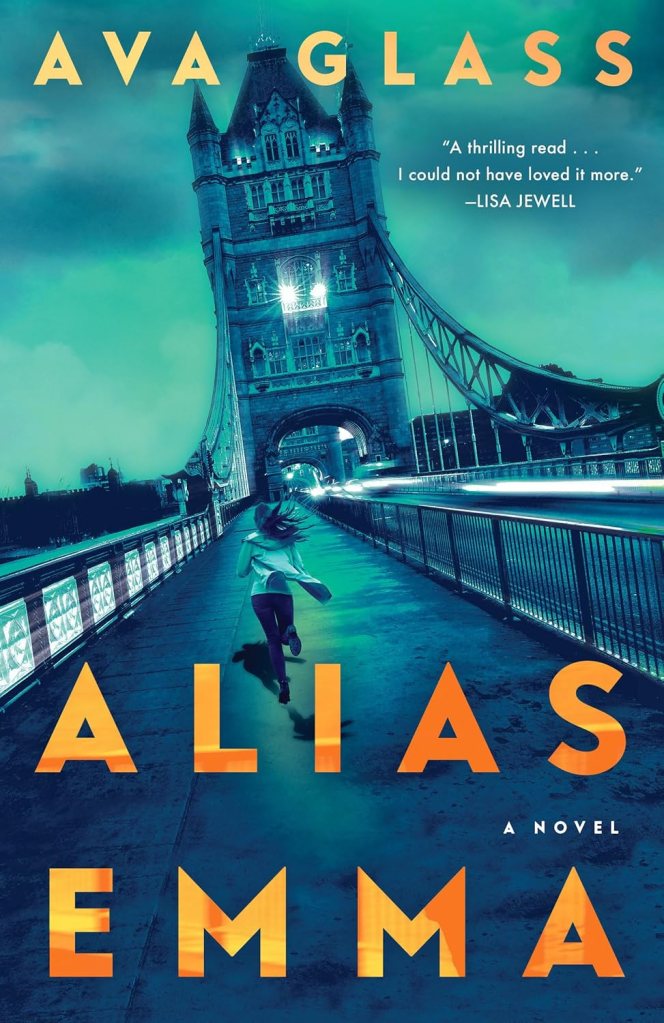
The book cover depicts a woman running across London Bridge at night, with her coat and long hair flying out behind her and several bright lights emanating from the bridge above her, shown against a cloudy, dark blue-green sky.

By Julie F.

Alias Emma by Ava Glass is a strong debut novel, a spy thriller with a lot of clever nods to the history of the genre. Even though Kim Sherwood has recently published two books in her series about a woman in the double-O universe (Double or Nothing and A Spy Like Me, both authorized by the Ian Fleming estate), you could reasonably consider Glass’s main character, Emma Makepeace, as part of a tradition of propulsive action and daredevil exploits reminiscent of Fleming’s James Bond. In terms of Emma’s quick thinking and survival skills, there are also shades of Emma Peel from The Avengers. Finally, Emma’s handler, Ripley, might make you think of two disparate characters who nonetheless pull all the strings and hold most of the cards in their respective fictional espionage worlds: the enigmatic George Smiley from John Le Carre’s novels and Mick Herron’s obnoxious but brilliant head of Slough House, Jackson Lamb. (Side note: It’s a testimony to the acting skill of Gary Oldman that he has portrayed both Lamb (Slow Horses) and Smiley (Tinker Tailor Soldier Spy) to great acclaim. Both are fantastic performances and well-crafted productions.)

Ava Glass sets a remarkable pace from the start in this non-stop story of a day in London, with Emma working to avoid compromised CCTV cameras (and the Russian spies who are monitoring them) as she tries to get across the city to the headquarters of the covert agency that secretly employs her. She’s towing a reluctant traveler along with her: Michael Primalov, a doctor whom the enemy has already attempted to kidnap or kill. Michael needs to be in witness protection because of his mother’s past history as a Russian scientist who traded secrets. Emma uses all of her smarts, tradecraft, gadgets, and skills to outwit the villains at every turn. The duo hope to connect with Emma’s supervisor, Ripley, but when they don’t know who to trust, even communication via regular secret channels is fraught with danger. At moments, this wild tale might make the reader feel like the pair couldn’t possibly cope with one more setback as Emma and Michael avoid explosions, are chased by Russian assassins, and even take a detour into the famous tunnels of subterranean London. If the reader is willing to suspend their disbelief a little bit, a fun thrill ride full of bravery and energy also reveals something meaningful about the two people at the heart of the tale and the changing dynamic between them. Emma takes the lead, but Michael makes improvised use of his physician’s skills as well, and they grudgingly learn to trust one another – at least enough to get them through this arduous journey across the city.

The book cover depicts the Shaftesbury Memorial Fountain in Piccadilly Circus, London, surmounted by a winged statue of Anteros and popularly known as Eros. There are silhouettes of people standing and moving around the fountain, dressed in 1940s-style clothing, and a hazy blue fog permeates the illustration.

If you like spy stories with women protagonists, I highly recommend the following novels:

Restless by William Boyd

Red Widow and Red London by Alma Katsu

Transcription by Kate Atkinson

Sweet Tooth by Ian McEwan

American Spy by Lauren Wilkinson

And if you read Alias Emma and enjoy it, there’s great news: Ava Glass has already published a sequel, The Traitor, and there’s a third book (The Trap) coming in fall 2024. Sounds like a series that’s ripe for a film adaptation – perhaps Gary Oldman will be available to play Ripley!

Julie is an instructor and research specialist at HCLS Miller Branch who finds her work as co-editor of Chapter Chats very rewarding. She loves gardening, birds, crime fiction, all kinds of music, and the great outdoors.

The Whalebone Theatre by Joanna Quinn

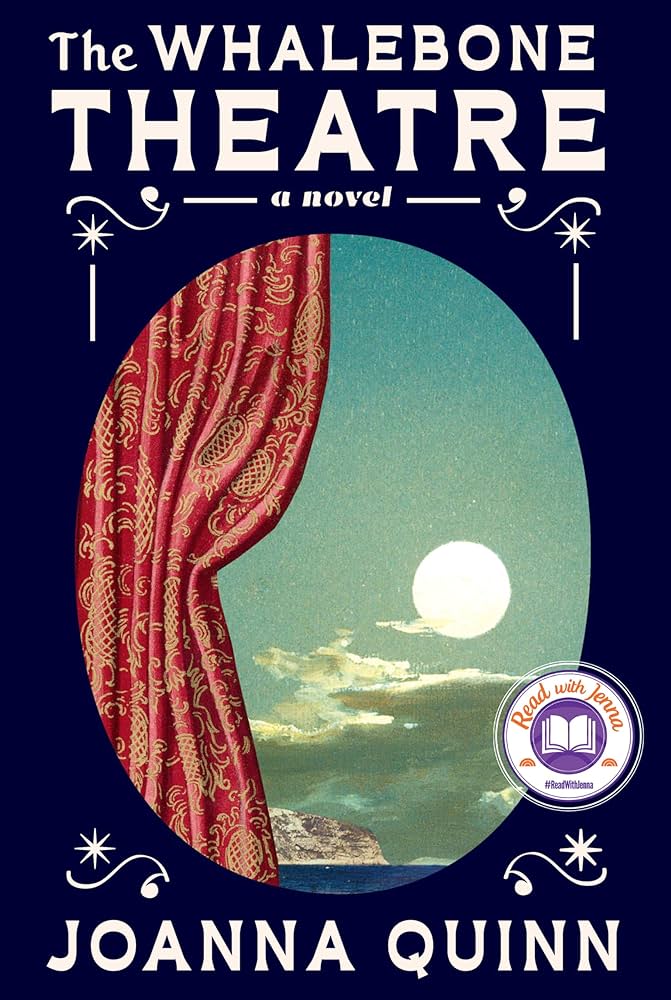
Within an oval frame, a red curtain pulls back to the left to show the cliffs of Dover beneath t

by Kristen B.

A friend suggested a good rule for reading: only one World War II-adjacent book each year. Well, I’ve already spent this year’s allowance, and it was a good one!

The Whalebone Theatre by Joanna Quinn begins during the interwar period, set at a grand country estate, Chilcombe, on the southern coast of England. Cristabel Seagrave is a lonely little girl with an immense imagination. Her mother died in childbirth, and the story gets underway with her father bringing home a new bride. England’s laws being what they are, the family needs a male heir to keep the estate. A set of minor tragedies and expected resolutions ensue, all of which lead up to the day that Cristabel discovers a dead whale on Chilcombe’s beach.

With this highly cinematic scene, set against a quiet sea and a rising sun, the book finally gets underway. Cristabel hauls herself up the side of the leviathan and plants her flag, literally, in its blubber as her two younger stepsiblings turn up to watch and cheer her on. It’s clear that the trio of Cristabel, Flossie, and Digby make a minor clan in and of themselves, running mostly feral as their adults are caught up in the bohemian lifestyle of the rich and entitled in the Roaring Twenties. Interestingly enough, her stake cannot stand because all sea-washed flotsam automatically belongs to the Crown. In the end, the Crown doesn’t want it and the poor whale spends the rest of the summer slowly rotting upon the shore, much to the entertainment of the children.

Also discovered upon the beach that day is Taras – an itinerant Russian painter living a risque, socially liberal life-style. His paramours are old friends with Flossie and Digby’s mother, and so ensues a longstanding relationship between both parents and children. Taras eventually has the grand idea of moving the whale’s ribs to build a theater within Chilcombe’s estate. Under Cristabel’s direction, the children, their adults, and other willing locals stage a variety of plays, including a retelling of the Iliad and Shakespeare’s The Tempest. One of the Bard’s final plays, The Tempest carries certain themes throughout the book – including shipwreck and exile, civilization and monstrosity, and power and integrity. The book glosses over the 1930s with a set of newspaper clippings detailing the annual summer performances at the theater.

When the story recommences, World War II is well underway. One of the adults who came and went from Chilcombe turns out to be a high-ranking member of the British intelligence ministry. He enlists first Digby, then Cristabel into becoming agents in occupied France. Meanwhile, Flossie maintains the home estate and becomes a Land Girl as the war rages on. The story careens through the final years of the conflict, with uncertainty and anxiety at every turn as our intrepid trio make their separate, but always inter-connected, ways in the world.

In the end, it all comes together back at Chilcombe. No one is quite the same in the aftermath of war – family, friends, servants, and locals. I greatly enjoyed the book with its gorgeous language, despite its quiet devastations that rang absolutely true to me. At the end of The Tempest, Prospero says, “Now my charms are all o’erthrown, And what strength I have’s mine own.” What strength remains belongs solely to the women of this story, home at last. I suspect this is a title I will linger over and think about at odd moments. Certainly, it resonated with other recent books adjacent to WWII where the smaller stories and sacrifices carry the story.

The Whalebone Theatre by Joanna Quinn is available in print, e-book, and e-audiobook.

Kristen B. is a devoted bookworm lucky enough to work as the graphic designer for HCLS. She likes to read, stitch, dance, and watch baseball (but not all at the same time).
Madame Fourcade’s Secret War

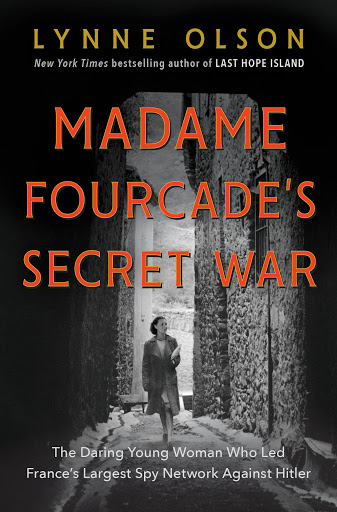
The cover shows a woman in 1940's-era clothing, carrying a package under her arm and walking down a deserted alley surrounded by stone walls.

Review by Julie F.

Imagine running the largest spy organization in Vichy France – setting up safe houses and networks, negotiating the tensions between de Gaulle’s Free French and the anti-Gaullist General Giraud, and helping to spirit spies and messengers from France to England in the dead of night on dangerous Lysander plane trips. Never staying in one “safe” location for too long; never knowing who has your back or who might stab you in the back.

Now imagine doing all of that as a woman, a mother of two young children and an infant, in a society where, as author Lynne Olson describes it, “Men fought, and women stayed home” (525). Marie-Madeleine Fourcade resisted both the German occupation and the gendered expectations of a military and espionage apparatus designed for and perpetuated by men. When the life of a spy in occupied France was reputed to be six months at the most, her success is a credit to her resourcefulness, daring, and people skills. The colleagues she trusted and led knew her worth. In the words of Léon Faye, her dependable lieutenant and the father of her youngest child, “A woman…But not just any woman!  She’s an indisputable and undisputed leader. Even the English have accepted her” (201).

Readers who enjoy tales of espionage will be amazed that Marie-Madeleine’s story is real and not more widely known. The scenes depicting her captures and escapes, and those of her Resistance colleagues, are riveting – sometimes by simply talking her way out of the hands of the Gestapo, or waiting until their backs were turned to climb out of a window and make a run for it. Not all went according to plan; she lost friends and companions, and their stories, and her anxiety for their safety and grief over their losses, are powerfully depicted. Her devotion to a cause greater than herself and her family is heroic – even after the war, when she advocated for remembrance ceremonies, official honors, government pensions, and medical care for Alliance agents, as well as benefits for the families of those the German executed. Read this fascinating account of her dedication and defiance of societal norms, and be riveted by her exploits and those of her spy network.

Adult nonfiction. Available in eaudio through CloudLibrary and in ebook and eaudio through Libby.

Julie is an instructor and research specialist at HCLS Miller Branch, where she facilitates two book discussion groups – Spies, Lies, and Alibis and Bas Bleu.