How to Do Nothing: Resisting the Attention Economy by Jenny Odell

The title and author's name nestle into groups of color

by Eric L.

How to do nothing. I want to know. 

Jenny Odell is an interesting person and quite a writer. Let me give the caveat that we have a similar worldview, so perhaps I’m biased. In How to Do Nothing: Resisting the Attention Economy, she cites numerous writers with whom I also seem to share beliefs and an ethos, including Rebecca Solnit and Jia Tolentino. (Check out their books and articles; both are worth your time.) I am now reading Odell’s latest work Saving Time: Discovering a Life Beyond the Clock

The title of How to Do Nothing is a bit of a misnomer. (The book cover is beautiful, by the way.) It’s not about doing nothing, but about a sort of resisting in place and trying to distance yourself a bit, not completely, from technology and productivity as the subtitle suggests. Two things that have come to dominate American culture, as well as are inextricably linked in many cases. 

Odell likes labor, a lot, both as a movement and a concept. Her brief anecdotes about the history of the labor movement in the United States alone make the book worth reading. Odell also mentions interesting art and literature throughout the text. These are things that interest me a great deal, and Odell made me think that I don’t know nearly enough about them. It’s a feeling I like, and one of the many reasons I read books. 

Odell suggests that instead of dropping out, we should rather “resist in place.” She devotes a section of the book to the various movements to start a new “society” outside of mainstream society and the reasons for their failures. Starting a new society is something I’ve considered, intellectually at least, as it is a common trope in both books and films. Unfortunately, problems of equality and politics tend to persist in any sort of human organization, as is the case in Odell’s examples. This reality is also often borne out in the history of any political revolution. Animal Farm, although appearing to be about the Russian revolution, is really a satirical allegory of this concept. 

The actual world and humans are much easier to avoid than ever as we work remotely, stare at screens, and seemingly try to avoid one another. Odell offers us a simple solution; observe the world around us, the local, the quotidian moments of each day as a form of resistance. Take a longer look at your real surroundings and your fellow humans. For example, she recommends that you go to the park and just sit or be. Truth be told, I’m already pretty good at this sort of thing, however I could probably observe the world around me better. (I plan to work on this.)

It may sound cliched at this point, but Odell implores us to get back to nature and each other. I do believe these things could drastically change society for the better. She does concede, and I agree, this is a privilege and requires time. In other words, many of us are squeezed for time and the specter of economic precariousness looms large for far too many. That said, this is a sort of a circular reinforcement to her argument, and it’s certainly easier said than done. However, she successfully bolsters her argument with historical examples of how the US labor movement took back their time. In short, people working in solidarity improved not only conditions and pay, but their amount of free time. I have no doubt we’re all the better for that. But let me be clear, this doesn’t happen easily or quickly, and there are very powerful forces that will push back. 

Some folks in my book discussion group (Read. Think. Talk.) didn’t care for the book’s style. They found it disjointed and posited that the book seemed like a series of essays. This is a fair criticism; however, I recognized the overarching theme and liked the disjointed style. They suggested that Orwell’s Roses by Rebecca Solnit has a similar style, I agree, but I also love that book. (read a review)

In sum, I found the book packed full of interesting information and great commentary on our society. I like the simple way Odell recommended how we could improve our coexistence with others and the planet. Actions that may be necessary at this juncture. 

How to Do Nothing: Resisting the Attention Economy by Jenny Odell is available in print, e-book, and e-audiobook.

Eric is a DIY Instructor and Research Specialist at HCLS Elkridge Branch. He enjoys reading, films, music, doing nearly anything outside, and people.

Author Works: Anna Gifty Opoku-Agyeman

Head shot of author, a Black woman with her long hair straight, wearing black, smiling.

Wednesday, Jul 27; 7 – 8 pm
Equity Resource Center, second floor of HCLS Central Branch

Register at bit.ly/boldsolutionshcls

The Black Agenda: Bold Solutions For a Broken System features Black voices across economics, education, health, climate, and technology, speaking to the question “What’s next?” as it pertains to centering Black people in policy matters in our country.

Black background with title in slightly distressed large block letter, "agenda" in red.

Essays by Dr. Sandy Darity, Dr. Hedwig Lee, Mary Heglar, Janelle Jones, and others present groundbreaking ideas ranging from Black maternal health to reparations to AI bias to inclusive economic policy, with the potential to uplift and heal not only Black America, but the entire country.

Anna Gifty Opoku-Agyeman is an award-winning Ghanaian-American researcher, entrepreneur, and writer. Her new book, The Black Agenda: Bold Solutions for a Broken System, is the first collection to exclusively feature Black scholars and experts across economics, education, health, climate, criminal justice, and technology. She graduated from the University of Maryland, Baltimore County in 2019 with a Bachelors of Arts in Mathematics and a minor in Economics. Currently, she is a graduate student at Harvard Kennedy School studying public policy and economics. Her advocacy, research, and commentary are featured widely by media outlets such as Bloomberg, NPR, Teen Vogue, Slate, and The New York Times.

She will be in conversation with Dr. Sheri Parks, the vice president for strategic initiatives for Maryland Institute College of Art. A noted public intellectual, Parks has appeared frequently in national and international media and is a regular cultural critic for WYPR-NPR and the Baltimore Sun podcast, Roughly Speaking. Her research specializes in public aesthetics, particularly the ways in which people find and create meaning and beauty in their everyday lives, with specific emphasis on race, gender, social class, sexuality, popular culture, and media. Her most recent publication is Fierce Angels: Living with a Legacy from the Sacred Dark Feminine to the Strong Black Woman. In all of her work, Parks strives to explain the deeper cultural histories that inform the expectations, attitudes, and relations that individuals in our country have with each other so that richer understandings will lead to more sophisticated and mutually rewarding interactions.

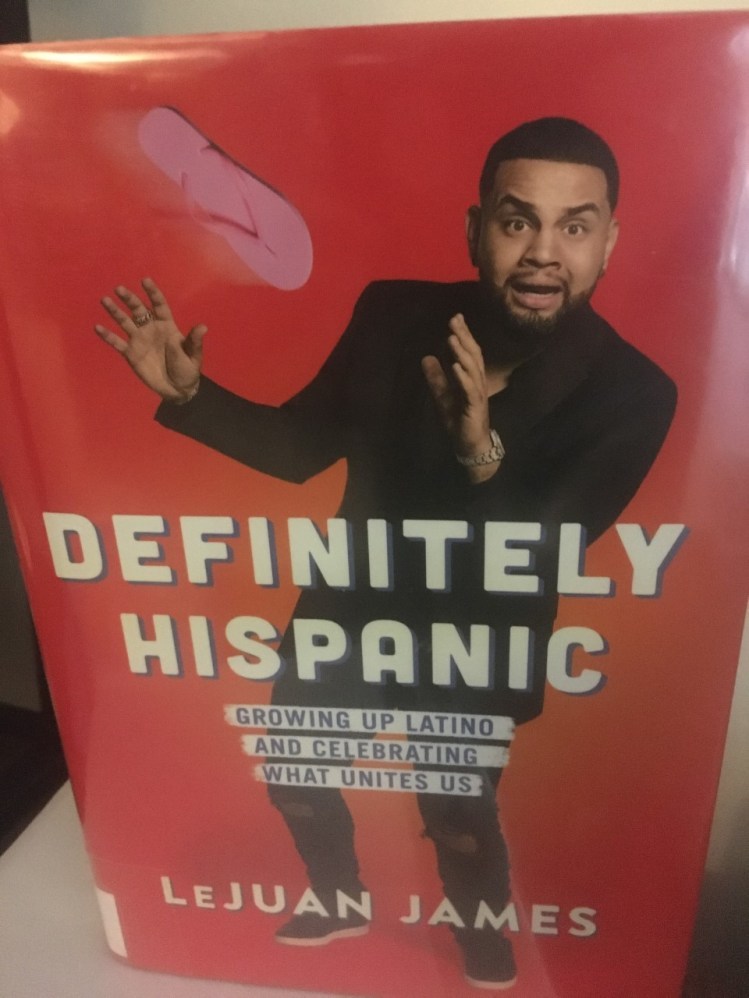
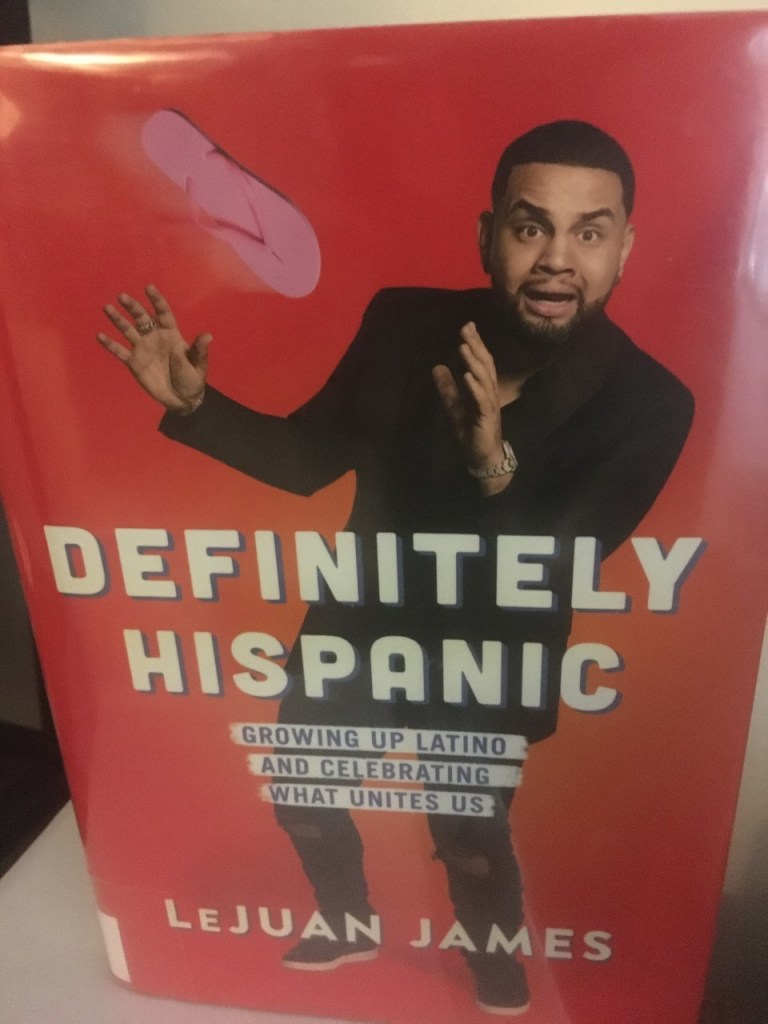
Definitely Hispanic by LeJuan James

The book cover shows the author in a black suit and sneakers with a startled expression on his face, about to catch a pink flip-flop that is flying towards him through the air. He is posed against a red background.

By Carmen J.

With racial equity at the forefront for the library and the county, a much-needed read on Hispanic life crossed my path recently. 
For those who may not know, I’m Cuban American. I’m in that nice little hybrid world of always exploring my Cuban-ness amidst my American-ness. I’m often torn between both worlds and questioned if I was Cuban enough for not speaking enough Spanish and not having a plethora of Hispanic friends. Yet my childhood and its lasting effects on my family orientation, personality, and work ethic set me apart from some of my “American” counterparts.

Long story long – another lovely Hispanic trait – I’m recommending Definitely Hispanic: Growing Up Latino and Celebrating What Unites Us by comedian and YouTuber LeJuan James (in homage to Lebron James, with his real name: Juan Atiles) for your primer on Hispanic and Latino life. James started as a Vine creator and moved on to YouTube with his hilarious parodies of his parents. The short, family-friendly videos highlight the realities of Hispanic culture in a good-natured format with himself acting out all of his characters (including his mom while keeping his signature beard, no less).

This engaging and honest book of essays brings to light all of the memorable things I appreciated while growing up Hispanic, including celebrating holidays dressed in all of our finery with an open door of family and friends; enduring the family gossipers and “roasting” (such as comments on weight gain or a less-than-becoming outfit) by relatives; escaping spankings via “la chancla” in a thrilling game I’d refer to as dodge-belt; watching telenovelas;  and the comical list goes on and comically on.

James’ musings focus on the funny as well as tender-hearted moments surrounding his nomadic upbringing between the Dominican Republic, Florida, and Puerto Rico. In addition, he beautifully shares the strong influences of his mother and grandmother and their impacts on his work as a YouTuber. The book serves as an education on Hispanic culture, without falling into caricature or stereotypical territory. The essays are detailed and full of heart. They served as a reminder to this Cuban American that the joys of being and growing up Hispanic involve more than language.

I encourage you to check out his short and funny posts on YouTube. Here is one of my recent favorites: 
https://www.youtube.com/watch?v=czUIhnOwAE0

Definitely HIspanic is also available as an ebook and an eaudiobook from Libby/OverDrive and as an eaudiobook from CloudLibrary.

Carmen J. is a teen instructor at HCLS East Columbia. Among her favorite things are great books, all things 80s, shamelessly watching The Bachelor, gardening, and drinking anything that tastes like coffee.

Intimations by Zadie Smith

The book cover shows a gray hallway with slotted windows and light coming through them to land on the floor and the opposite wall, which curves away from the viewer toward a dark entryway.

By Eric L.

I recall the first time I read something in the New Yorker by Zadie Smith nearly a decade ago. It was a nonfiction story about Joni Mitchell entitled “Some Notes on Attunement: A Voyage Around Joni Mitchell.” It was a nonfiction personal reflection about how she, a woman of color, had no interest in the music of a white folk singer, who on the surface would have nothing at all in common with her despite her friends’ incredulous responses concerning her cluelessness.

Smith describes how she realized her youthful stubbornness and closed-minded self as the culprit. The essay was about her own change and growth and the change of Joni Mitchell as an artist (she is pretty great by the way). Probably much like all people that love books, artists, writers, and the like, I felt a connection to Zadie Smith. I liked her style, her attitude, and her contemplative nature. And I can certainly relate to the glib rejection of things I didn’t think were for me. I subsequently realized we’re the same age, although other than that, we are very different on the surface I may not have guessed her writing was the sort of thing I’d love, but I do.

At any rate, her new essay collection, Intimations, is a book of very short essays written just prior to and during the beginning of the Coronavirus pandemic. The essays include the commonplace and ordinary events of everyday life, set into a broader, more abstract context. Obviously, I have a bias in this matter, but her essays and style are perfect for this moment. Smith’s ability to relate everyday individual experiences into a much more abstract concept is nonpareil. I found the essays particularly poignant now that I miss, and have ample time to ruminate about, the quotidian things of my pre-socially distant life.

There is an essay about our desire, or our need, to fill up time with things to do. One entitled “Suffering Like Mel Gibson,” (I’m a sucker for a strange title) that is hardly at all about the actor. Instead, it’s a piece about suffering and privilege, and how we ought to consider these separately, and not discount the feelings of others. Smith even describes the moment when she recognized her own class privilege. She has a series of very short character sketches about the people in her neighborhood and their respective reactions to the looming pandemic in America. “Peonies” is a very entertaining piece about flowers, control, aging, being a woman, and the coronavirus. The penultimate essay, “Postscript: Contempt as a Virus,” is arguably the best: it begins with a description of the global pandemic, her experience in England (where she has gone after leaving New York), and “herd immunity,” then gets into the murder of George Floyd and racism as a virus we all spread and suffer. It’s a masterfully done and moving piece. All the essays are excellent, but this one alone is worth picking up the book.

Since that first essay, I’ve read almost all of her essays. However, I must admit that I liked, but did not love, her most famous fictional work, White Teeth. No matter; for me, she excels in the essay genre. I’d highly recommend Grand Union and Feel Free (which includes a great story about a library), as well.

Smith’s ability to display so much humility and not only admit, but describe in detail, her foibles and ignorance is something I really respect. Perhaps this is the very opposite of the cultural atmosphere in the United States.

Intimations is available at HCLS in print, in large print, and in eBook and eAudiobook format through OverDrive/Libby.

All royalties Smith earns from this book are donated to The Equal Justice Initiative and The COVID-19 Emergency Relief Fund for New York.

Eric is a DIY Instructor and Research Specialist at HCLS Elkridge Branch. He enjoys reading, films, music, doing nearly anything outside, and people.