

by Tony B.
Ever wondered what an intelligent security robot would do without a functioning governor module? Murder? Watch Netflix? Save innocent lives? Contemplate sentience?
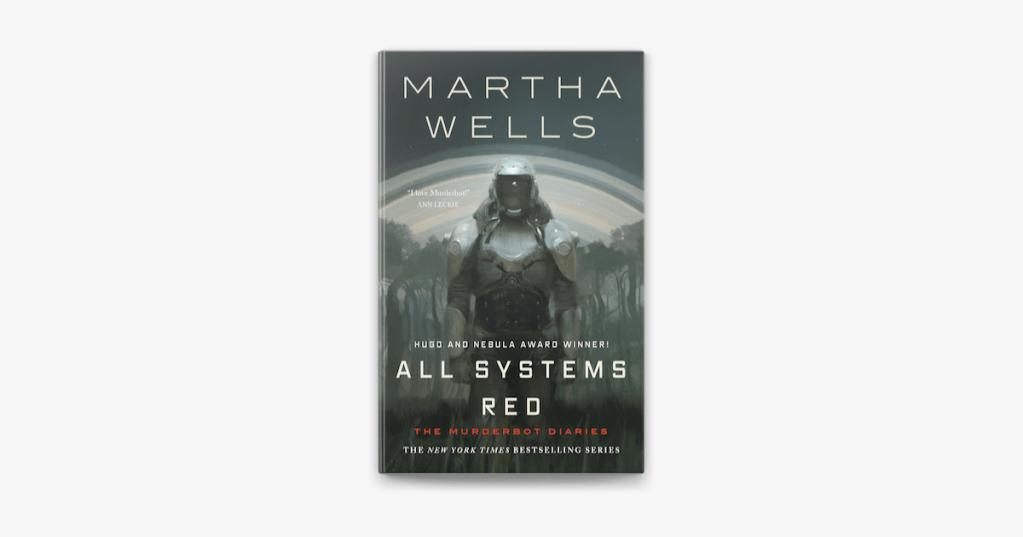
The Murderbot Diaries, a series by Martha Wells, explores answers to all these questions. Free of their governor module, the eponymous Murderbot leads us through their adventures with corporate warfare, angry megafauna, the (mostly) human experience, and the need for a nice quiet spot to watch interstellar tele-novellas. The first four novellas operate as a one long story arc, even with each book being a complete story, about why Murderbot has named themself in such a way and the repercussions from that particular episode. Along the way, Wells introduces Dr. Mensah and her family, who become important, along with ART – another high functioning artificial intelligence.
Originally a normal Security Unit (SecUnit for short) deployed by The Company, a security bond corporation, Murderbot hacks and destroys their controlling governor module which normally would zap the brain of any SecUnit displaying less-than-utterly-obedient behavior. Now free to do whatever they want, MurderBot inexplicably keeps working for the corporation but with newfound access to the wider net of media with which to distract themselves.
The Murderbot Diaries are full of dry wit and snarky observations of the human condition, notably that humans tend to put themselves in a lot of unknowing danger. Compound that with galactic dangers and MurderBot ends up as one very busy SecUnit. The series now has six installments (four novellas and two novels) that follow Murderbot and a recurring cast of characters.
MurderBot’s interaction with risk-averse humans is one of the driving issues, beginning in All Systems Red. To MurderBot, the clash between how humanity is portrayed through their favorite space soap operas and how humans actually behave is a constant dissonance which leads to a healthy distrust of the human condition. Hence their thoughts along the lines of, “freedom to be treated like a real human? No thanks.”
Seeing sci-fi action through the lens of a non-human thought process is interesting, where priorities are generally “protect the weak humans from whatever stupid situation they find themselves” and less “be the hero.” SecUnit often ends up being a hero in the end despite themself and equally isn’t sure how to feel about it. MurderBot experiences emotion rather strongly at times but codes, to some degree, as being on the autism spectrum. They have a difficult time expressing those emotions and processing others’ emotional states, as well as the confusion at not always being able to control emotions that well up within them.
As a series, I give it a 9/10. Obvious tropes are usually immediately made fun of a la “oh that’s what the space soaps would do.” MurderBot also reminds me heavily of the 2015 movie CHAPPiE, about a robot who gains independence, but who is perhaps more impressionable in relation to humans than MurderBot ever is.
The Murderbot Diaries, a Hugo and Nebula award-winning series, consists of the following books, available from HCLS in these formats:
- All Systems Red in print, e-book, and e-audiobook.
- Artificial Condition in print, e-book, and e-audiobook.
- Rogue Protocol in print, e-book, and e-audiobook.
- Exit Strategy in print, e-book, and e-audiobook.
- Network Effect in print, e-book, and e-audiobook.
- Fugitive Telemetry in print, e-book, and e-audiobook.
The seventh book, System Collapse, is due to be published in November 2023.
Tony is a Customer Service Specialist at HCLS Elkridge Branch. He has a degree in history and a renewed interest in science fiction.
 CHAPTER CHATS