One Hundred Years of Solitude by Gabriel Garcia Marquez

The Illustrated cover in many shades of green with a yellow snake and a purple bird evokes the tropical setting of the book.

by Kristen B.

My book club (Books on Tap) left for our August summer break on something of an odd note. At a previous meeting, we had a discussion about adapting books to TV shows and movies. I had recently read glowing reviews of the Netflix adaption of One Hundred Years of Solitude, and I proposed reading the Latin American classic. Everyone agreed that it had been awhile since we tackled something, perhaps, weightier, and – per usual for this great group of people – they were game to try.

I had read and loved this book in college, when I was in the practice of reading complicated, challenging material. While I still enjoyed the book this time around, I definitely found it more difficult to read decades later. The full immersion into the Buendia family and the village of Macondo remained the same, enchantingly so. Gabriel Garcia Marquez is credited with inventing modern magical realism, where the odd and inexplicable are part of every day life.

The family was trickier this time around, with the generations sharing names and attributes. I – and my book club folks – got too caught up in trying to keep everyone straight. In talking about it, though, we realized that’s one of the joys of this inter-generational story. It’s as though your grandma or some other older relative is telling you the family history, with asides and doubling back and other random diversions before actually getting to the point. It’s not really necessary that you keep the Aurelianos, Jose Arcadios, and Ursulas straight because the novel moves in circular patterns more than as a linear “and then” plot. We were less thrilled with a rather dated assumption that the patriarchy meant that men could marry whomever they pleased, even barely adolescent girls and despite mistresses.

The particular smaller stories, though, share in all of humanity’s troubles and joys, often humorously so – the insomnia plague, the visiting gypsies who bring the miracles of magnets and ice to Macondo, the coming of the railroad and banana company, the feuds, and the love affairs. All of it mixed into a sort of memory soup filled with revolution, politics, and the destructive nature of colonialism and classism. It’s been called the Great Novel of the Americas, and I would agree with that assessment. There’s something quintessentially Latin American about the story, and absolutely universal about the way it is told. I was reminded of the spider from my family’s camping trip with Scouts that gets a little bit bigger every time the story is recounted, or the number of pies my grandmother would bake during the summer, or any other number of embellishments to tried-and-true chestnuts of familial tales.

If, however, the book doesn’t suit your current reading tastes – as many people found at book club – Netflix recently released the first half of an almost perfect adaptation of the book, with the second season coming soon, hopefully in 2026. Being able to see Macondo and its inhabitants helps keep it all straight, without losing any of the wonder or weirdness of the book. The voiceover of descriptions and commentary are taken directly from the original text, and it’s a perfect way to meld the classic novel with the new medium. The cast does a perfect job of inhabiting the characters and their often exasperated relationships. While the show’s original language is Spanish, the dubbing was not distracting. It’s also a rather frankly spicy (would be R-rated) depiction of various lovers and marriages. I hope it becomes available on DVD or via Kanopy soon, as it’s the perfect complement to the book.

Re-examining classics is always worthwhile to me, because the books may not change but we do as readers. I had memories of enjoying One Hundred of Solitude but couldn’t remember why. The town of Macondo, isolated in the jungle, and the Buendia family once again live in my imagination, and I am glad for it – if for different reasons than when I was in college.

One Hundred Years of Solitude by Gabriel Garcia Marquez is available in translation to English in print and as an e-audiobook. It is also available in Spanish.

Kristen B. is a devoted bookworm lucky enough to work as the graphic designer for HCLS. She likes to read, stitch, dance, and watch baseball (but not all at the same time).

Starling House by Alix E. Harrow

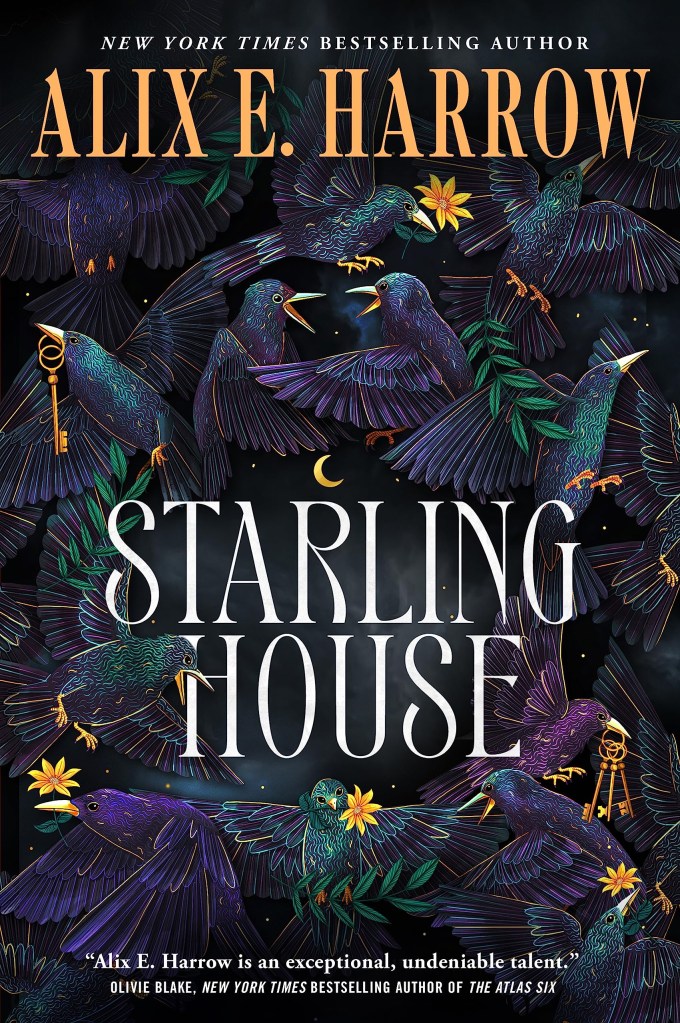
The dark cover shows a pattern of birds in purples holding a variety of golden keys.

by Kristen B.

A good Gothic novel practically requires a spectacularly weird house with supernatural tendencies. Starling House might be the main character of its own novel – not quite but close. Our actual main character, Opal, routinely walks the long way home from her going-nowhere-fast job just to wander past the house. She dreams of it and its mysterious amber light. Opal is an unlucky high school dropout trying to make ends meet for herself and her academically talented younger brother, Jasper. They live in a room at the local motel, subsisting on Pop-Tarts and bad pizza. Their mom died in a car accident on a cold night when the mists rose off the Mud River, which is when bad things happen in Eden, Kentucky.

The Starling family is one of strays and orphans, who take the name and the ownership of the house. Arthur is the last in a long line of Starlings, although his parents raised him in the house before he ran away looking for a more normal life. The only major employer in Eden is the Gravely Power company and their coal mines, and the Gravelys and Starlings have a long, complicated history. When Opal finagles a high-paying housekeeping job from the anti-social Arthur, she finds a decades long domestic disaster. As Opal cleans, she realizes that the house has its own sort of sentience – and that it seems to like her. But rooms rearrange and corridors form mazes, and sometimes the space seems to move her to where she needs to be (like Casita in Encanto, but not as friendly).

The story trades points of view between Opal and Arthur, both of whom are disillusioned and suspicious of each other and the entire situation. The book intersperses their hostile encounters with different versions of the town’s past – about Eleanor Starling, her children’s book The Understory, and the house she built. There’s also a set of unscrupulous business consultants with an unwholesome interest in the Starling property and mineral rights, and they target Opal. Untangling the nest of rumor, legend, and sordid tales holds the key (literally) to resolving the tragedy that haunts the town, Opal’s family, and Starling House.

The book has a powerful engine of a plot, along with its engaging characters. I couldn’t help but root for Opal, despite her ingrained need to keep the world at arm’s length. Her carefully guarded heart sometimes misses the loving connections in her world in its desperation to remain stoically independent. Arthur isn’t much different, and these two lost souls truly need each other. The supernatural elements are just creepy enough to give the entire proceedings a sideways edge, which kept me wondering if the author was going to be able to pull it all off. I thought this was her best book yet (although I also loved Once and Future Witches) – it’s a lean, mean, twisty tale, where all the components are necessary to make the story work.

Starling House by Alix E. Harrow is available in print, e-book, and e-audiobook.

Kristen B. is a devoted bookworm lucky enough to work as the graphic designer for HCLS. She likes to read, stitch, dance, and watch baseball (but not all at the same time).

Real Americans by Rachel Khong

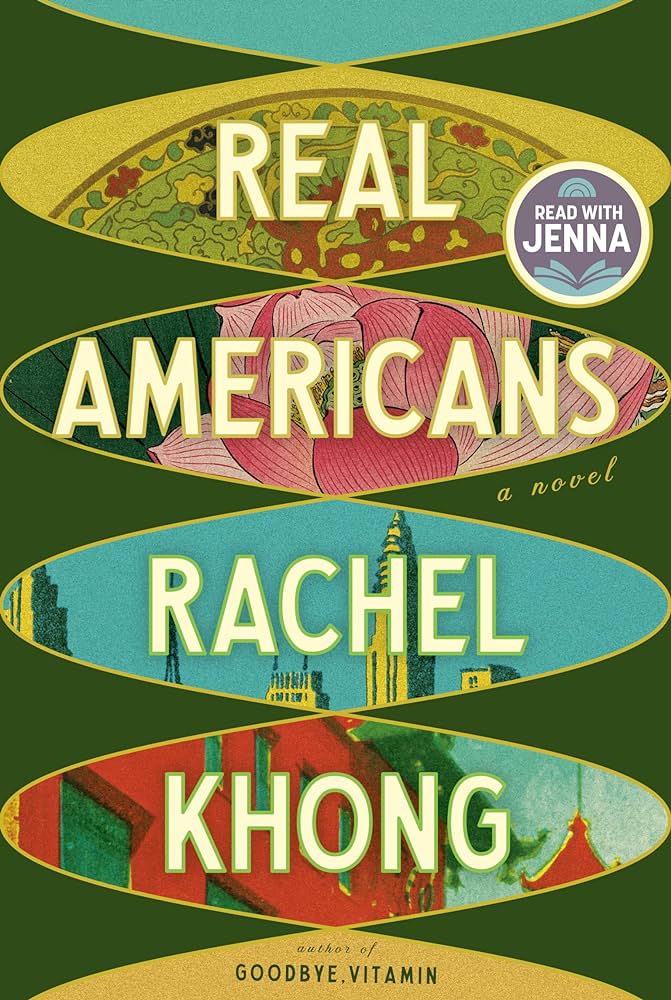
A series of four long ovals stretch horizontally show Asian motifs in first, second, and fourth shapes. The third shows skyscrapers against a bright blue sky.

by Eliana H.

Nature versus nurture is a discussion that has been happening throughout most, if not all, of our scientific history. What are the components that form us as people – who we are and who we become? In Real Americans, author Rachel Khong explores this age-old argument in a new way, spanning across three generations of a single family. 

After a scene-setting prologue that is explained in more depth toward the end of the book, readers meet Lily Chen, who is barely eking out a life in New York City as the world braces for a new millennium and the potential hazards of Y2K. She grew up in Florida, raised by scientists who fled China during the Cultural Revolution. At a holiday party hosted by the media company where she is an unpaid intern, Lily unexpectedly meets Matthew, her boss’ nephew. Despite their many differences and Lily’s hesitations over these differences, Lily and Matthew fall in love. Only as they are poised to get married does Lily learn just how wide the gulf is between her own upbringing and Matthew’s. He is not only wealthy; Matthew is the heir to a pharmaceutical family fortune and has been using a different last name to distance himself from them. After a number of miscarriages, Lily and Matthew are able to use IVF to conceive, but shortly after their son is born, Lily discovers a secret connection between her mother and Matthew’s father. She refuses to remain connected with either of their parents and forces Matthew to choose between them. 

The book then jumps to 2021, shifting to the perspective of Nick, the child Lily has moved across the country and raised on her own, now 15 years old. After growing up believing that his father wants nothing to do with him, a turn of events leads to Nick suddenly being able to connect with the father he’s never known. As he deals with growing up, coming of age, and choosing a college, Nick finds himself lying to his mother with barely a thought while struggling to find his place and identity. Events come to a head with Nick confronting both of his parents, and eventually choosing to disconnect from each of them in turn. 

The final section of Real Americans moves further forward to 2030, where readers find Mei, Lily’s mother, following her grandson around San Francisco. Nick is working for a biotechnology startup, and Mei is reflecting on her own life and the choices that have brought her to this point. After an encounter in a drug store, Nick begins spending time with his grandmother. Mei shares her story with Nick, asking him to pass along her words to Lily in hopes of reconnecting. Mei’s tale brings the family’s story full circle, and lingering questions are answered. 

Throughout each generation, members of the Chen family find themselves grappling with what level of choice and control we should have over genetic characteristics in ourselves and future generations. What would it look like to be able to screen out “undesirable” traits? What would the repercussions be? What are our responsibilities? An element of seeming magic, particularly relating to time, also threads through the book. Although portions of the story are somewhat predictable, Real Americans offers a sweeping family epic that invites readers to consider ethical questions which may become pressing sooner rather than later. If you are able to suspend some disbelief, you will find yourself carried along through the ebbs and flows of a multifaceted family as you ponder the origins of fortune for each of us. 

Real Americans by Rachel Khong is available in print, large print, e-book, and e-audiobook.

Eliana is a Children’s Instructor and Research Specialist at the Elkridge Branch and co-chair of the HCLS Equity Committee. She loves reading, even if she’s slow at it, and especially enjoys helping people find books that make them light up. She also loves being outside and spending time with friends and family (when it’s safe).

Our House by Louise Candish

An elaborate brick house with railed porches on the second floor and turrets, with a blooming pink cherry tree in the bottom right. The sky appears to have storm clouds piling above, with the title in fine white type.

by Angie E.

Louise Candlish is known for her domestic suspense and intricately woven stories. With a keen eye for detail and a talent for exploring the complexities of human relationships, she immerses readers in suspenseful tales that often blur the lines between right and wrong. Her ability to create relatable characters facing moral dilemmas resonates deeply with audiences, drawing them into a world where secrets and betrayals lurk just beneath the surface. Candlish’s skillful storytelling and gift for plot twists have earned her a devoted following, making her a standout voice in contemporary fiction.

Our House, which won the 2019 Crime & Thriller of the Year award at the British Book Awards, blends psychological tension with a fresh narrative construction. Fiona Lawson returns home one day to find strangers moving into her South London house. The shock of discovering that her estranged husband, Bram, has sold their family home without her knowledge sets off a chain of events that spirals into a nightmare.

Candlish stands out in creating a claustrophobic atmosphere, making readers feel the protagonist’s growing sense of helplessness and desperation. The novel delves deep into themes of trust, betrayal, and the fragility of relationships. Fiona’s journey is not just about reclaiming her home but also about uncovering the layers of deceit within her marriage. Our House’s exploration of the concept of “bird’s nest custody,” where parents rotate living in the family home to provide stability for their children, is both innovative and thought-provoking. This arrangement, meant to protect the family, ironically becomes the catalyst for the unraveling of their lives.

While the novel is undeniably suspenseful, it also offers moments of introspection and empathy. Fiona’s character is complex and flawed, making her empathetic and human. Her journey from a seemingly perfect wife and mother to a woman fighting to reclaim her life is both heart-wrenching and empowering. The pacing is perfect, balancing moments of quiet reflection with heart-pounding revelations that leave you gasping. Just when you think you’ve pieced together the truth, the narrative flips, leaving you questioning your own assumptions. Candlish’s ability to weave in social commentary—particularly regarding the implications of social media and the concept of ‘home’—adds an extra layer of depth, prompting readers to consider how well they truly know the people closest to them.

Our House by Louise Candlish is available in print and e-audiobook.

Angie is an Instructor & Research Specialist at Central Branch and is a co-facilitator for Reads of Acceptance, HCLS’ first LGBTQ-focused book club. Her ideal day is reading in her cozy armchair, with her cat Henry next to her.

Ink Blood Sister Scribe by Emma Torzs

A deep purple background shows a plant and fountain pen, with the four words of the title interlaced in light yellow.

by Kristen B.

There seems to be a trend these days that recognizes the inherent magic of books. I mean, what’s more magical than a book? A bound set of white paper pages, set with solid black type that absolutely transports you via your imagination. Maybe you’re sleuthing for clues to solve a crime? Maybe you’ve stepped through the back of a wardrobe into a snowy woods? (still waiting for this to happen, honestly) Maybe you’re falling in love with your worst enemy from high school? So many books, so little time!

Ink Blood Sister Scribe by Emma Torzs takes the magic of books one step further, giving us spell books and the scribes who write them. It’s an entirely enthralling concept in a debut novel that reads as part family saga and part thriller, with a bit of romance thrown in to keep things fun. The three alternating POV main characters are desperately trying to figure out what’s going on in their world, and I enjoyed putting together the pieces with them.

The book opens with Esther loving her life and falling in love at the scientific station in Antarctica. She moves every year, trying to stay hidden from the people who killed her mother. Only this time, she likes the work and she has a girlfriend, and she’s literally at the far end of the earth. What could go wrong? Then, a new batch of researchers arrives and bad things start to happen, like people disappearing on the ice fields. She notices that mirror magic seems to have found its way into the dormitories. Esther knows about magic but is immune to it. She flees, terrified by an attempt on her life and anonymous notes that reach her through a mirror at the station.

Joanna, Ester’s half sister, lives a completely home-bound life in New England, as compared to Esther’s constant movement. She has an obsessive routine that protects the books her father collected throughout his life, books that led to her parents’ divorce and an almost complete estrangement with her mother. Joanna can perform the spells in their family’s magical library to maintain the protective wards on the estate. Before events get underway, Joanna found her father dead in the front yard, bleeding from one finger into one of the spell books. Her personality and life seem as opposite from Esther’s as possible, but the sisters miss each other terribly.

Nicholas is the poor, little, rich kid that no one feels terribly sorry for – until you do. He seemingly has an enchanted life of parties, limos, bodyguards, and a huge family estate in the English countryside. Nick is one of the last known living Scribes, a person who can write spells. There’s a catch, though – a scribe has to use their own blood as the ink. It turns out that Nick’s guardian and mentor is not (surprise surprise) an entirely ethical person, despite family ties. Uncle Richard has some fairly classic failings. When Nick runs away with his grumpy bodyguard Collins, they meet Esther on her way out from Antarctica. This coincidence has been carefully engineered – but I don’t want to give away more than that. Also, Collins is one of the best side characters ever, along with Nicholas’ dog Sir Kiwi.

From there on, it’s a flat out race to save the three protagonists, foil nefarious plans, and make magic accessible again. I don’t want to spoil any of many plot twists and turns, some of which are well telegraphed and others are more surprising. The interlocking story lines take a while to resolve, but I loved every word of discovering hidden libraries, teasing out the meaning of long-lost spells, and unraveling family secrets. The conclusion is satisfying, if a little rushed after the prolonged setup. I would love to read more about these characters in the future.

Ink Blood Sister Scribe by Emma Torzs is available in print, e-book, and e-audiobook.

Kristen B. is a devoted bookworm lucky enough to work as the graphic designer for HCLS. She likes to read, stitch, dance, and watch baseball (but not all at the same time).
Hello Beautiful

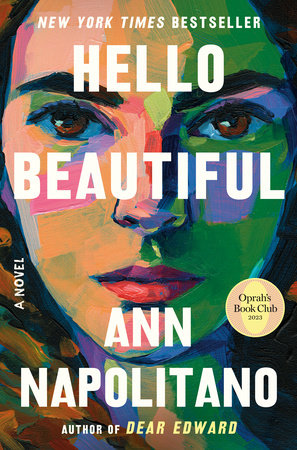
A woman's face painting in bold swatches of color. The shape of the face is a perfect oval with strong brows, brown eyes, and deep pink lips.

by Cherise T.

End of year “best of” lists provoke debate and motivate future selections. What have I read and seen that are on the list? Do I agree with the reviews? Which choices will I add to my precious “I want to read” file? 

One of my book clubs is so longstanding that it was originally an “Oprah book club.” When it was time to celebrate our over-20-year anniversary, we decided on a girls’ weekend. Hello Beautiful by Ann Napolitano was already scheduled for that month, and we could not have chosen a better capstone read. Not only was the discussion more content than neighborhood gossip, more talking than drinking, more debate than segue, we continued to consider the book throughout the weekend. 

All families bear hurt feelings, grudges, and anger. Because the four Padavano sisters (yes, think Little Women) are so close and have such distinct personalities, the emotion in Hello Beautiful runs deep and long. Add a strong mother, a devoted father, and a young man with essentially no family, and you’ve got a multi-generational literary novel that reads like a page turner. 

Beginning in 1960, we meet William Waters whose absent parents contrast with the Padavano parents. Always on his own, William dedicates himself to excelling at basketball. In college, he meets Julia, the oldest Padavano sister, who is his opposite in every way. Now William finds himself enveloped in the love of Julia’s family, including her three sisters, especially Sylvie.  

Throughout, the sisters compare themselves to the March girls in Little Women, and there are many parallels, but this book shines on its own plot twists. Be prepared for love stories, loss, mental illness, and estrangement. We want all the best for this family, but with Napolitano’s skill as a writer, we travel the complicated paths of realistic, complex characters. We see life through the eyes of each of the sisters as well as their children. 

One of my favorite aspects of the book is the empathetic portrayal of William’s teammates and the contrasts between the social world of women and that of men as we move through the end of the 20th century. Napolitano effectively portrays the sisters as a team as well, but a very different team who can hurt each other in only the ways that sisters can. Often, the characters seemed walled off between those who can compartmentalize their emotions and ambitions and those who can’t. 

Truly a novel that has earned a “best of 2023,” Hello Beautiful merits a holiday read or a book discussion’s scrutiny. It holds epiphanies and small miracles. May you have those who greet you throughout your life with “Hello, beautiful.” 

Hello Beautiful by Ann Napolitano is available in print, large print, e-book,and e-audiobook.

Cherise Tasker is an Adult Instructor and Research Specialist at the Central Branch. When not immersed in literary fiction, Cherise can be found singing along to musical theater soundtracks. 

Maame by Jessica George

A bold flower pattern in red, pink, and green along side a geometric pattern in the same colors sits behind the bold white type.

By Piyali C.

Maddie Wright is a 25-year-old British woman of Ghanaian descent who feels like her life is somewhat stagnant. She works as a personal assistant in a theater company where her boss suffers from depression. She is tired of being the only Black person at work and keeping a low profile so as not to attract attention. After exhausting days at work, she comes home to take care of her father, who suffers from advanced Parkinson’s disease. Maddie’s mother lives mostly in Ghana and her older brother James hardly chips in to help, leaving Maddie as the primary caregiver of her ailing father. When Maddie’s mother finally agrees to return home to London for a year to take over her husband’s care, Maddie jumps at the opportunity to move out and live life as an adult. She finds a flat to share, goes out for drinks after work with flatmates, tries to make her voice heard at work, and experiments with internet dating. However, when tragedy strikes, Maddie realizes that her family, rooted in Ghanaian traditions, is different and has its own unique needs and expectations. Maddie must come to terms with her identity as a Ghanaian British woman who struggles to straddle two cultures and make it work.

For me, the book was interesting for many reasons. First, it was amusing to read how Maddie, this young woman, navigates through some tough life questions by asking Google. Secondly, the significance of the book’s title made me think of my own Bengali culture and the practice of giving pet names (daak nam) to babies. Maddie is affectionately called Maame by her close family members, which means woman in Twi. And Maddie feels that she has had to be the caring, responsible, compliant, non-complaining person who took up the burden of her family’s responsibilities on her shoulders from childhood, because women are expected to do just that. At times, as a young adult left to care for her father or pay bills for family expenses, Maddie detested the name because it came with expectations. Gradually, with some help, she realizes not just responsibilities and expectations, but her name ‘woman’ is also emblematic of immense strength. Through self-introspection, help from her friends, and a candid conversation with her mother, Maddie comes to recognize the power of her name and understand the richness of her parents’ culture. And for the first time, she also understands that her mother is more than just her mother. She is a mother, a career woman, a wife, and most importantly a woman.  

In Bengali society, a common pet name for girl babies is different connotations of the Bengali word ma which means mother. Often, baby girls are named Mam, Mamon or Mamoni. This book made me wonder about the significance of those pet names and if there are expectations of motherhood associated with those names, but that debate is for another day. 

Maame, Jessica George’s debut novel, is a smart and funny exploration of the poignant themes of our times – relationships, loneliness, racism, adulthood, filial duty. I really enjoyed the growth in Maame’s character and found it to be a privilege to watch Maame figure out the significance of her name, grow comfortable in her skin, and ask for recognition in her work and society. 

Maame is available in print, e-book, and e-audiobook formats.

Piyali is an instructor and research specialist at HCLS Miller Branch, where she facilitates Light But Not Fluffy and co-facilitates Global Reads. She keeps the hope alive that someday she will reach the bottom of her to-read list.

All the Beauty in the World: The Metropolitan Museum of Art and Me by Patrick Bringley

At the top of a grand staircase, surrounded by columns and arches, a man in blue suite stands in front of a large, classical painting.

by Kristen B.

As a native to central Maryland, I grew up regularly visiting some of the best museums in the country. My parents would herd us onto the Metro, and we would spend long days at the various Smithsonian Institution buildings – American History, Natural History, the Zoo – along with the National Gallery of Art. Everything was free and fascinating. To this day, I love to spend time in a museum. So, when I heard about All the Beauty in the World: The Metropolitan Museum of Art and Me, read by the author, it seemed like a good choice for an audiobook for my commute. I was right about that!

Patrick Bringley turned a similar childhood love of museums into a job during a particularly stressful period of his life. When, as a young man just out of college and working for The New Yorker, Patrick got the news that his beloved older brother was diagnosed with an aggressive form of cancer, he re-evaluated many of his choices. To be able to spend as much time as possible taking care of Tom, Patrick found a less demanding job as a security guard at The Metropolitan Museum of Art.

This memoir illustrates ten years of Patrick’s life, in which he grieves his brother, falls in love, works in close proximity to some of the world’s most famous fine art, and moves from being a novice to a veteran at the museum. It’s a loving look at family, and a fascinating, up close view of what it’s like to spend 8-10 hours of every working day on your feet among both ancient and contemporary art. He details some of his favorite pieces, including Fra Angelico’s Crucifixion and Peter Bruegel’s The Harvesters, and he spends the better part of one chapter mesmerized by quilts and their makers. Bringley recounts camaraderie with his cohort along with amusing interactions with visitors, including the tourist parents who are looking for the dinosaurs (oops, wrong museum … will mummies do?).

This slim, beautifully written volume presents an interesting cross-section of Bringley’s life, one that reminded me of why great works of art exist – to help people of all generations and historical eras express faith, love, grief, and the human condition. The most lovely part of this book seems to be the author himself, who embodies a sort of Midwestern niceness and willingness to take the world at face value. He approaches and interacts with the art surrounding him from a genuine humility of spirit, looking for the author’s intent and the common human truths to be found. I don’t read a lot of nonfiction, but I do enjoy the occasional memoir. This was one of the best, told in a self-deprecating style that focused on the wonders (personal and creative) around the author as much as on the author himself.

The title is available in print, e-book, e-audiobook, and audiobook on CD.

Kristen B. is a devoted bookworm lucky enough to work as the graphic designer for HCLS. She likes to read, stitch, dance, and watch baseball in season (but not all at the same time).

Apocalypse and Heartbreak: Atmospheric Tales of Horror

Deep red slats of wood with title set in single word lines, emphasizeing Cabin, End, World.

by Angie E.

Good horror scares me, but great horror breaks my heart and mind, seeping into me and playing in my head like a found footage trope.  I find solace in horror somehow, and I know I’m not alone because others feel this way, too, even if they are quiet about it (“Why do anxious people love scary movies?”).

The first horror fiction I ever read was The Mist by Stephen King (e-book on Libby), which first appeared in a 1980 anthology called Dark Forces (an outstanding collection of stories I cannot recommend enough). It is hard to come by these days, but you can check interlibrary loan. Director Frank Darabont took The Mist and gave it an unimaginable, twisty, emotionally devastating ending – hence the heartbreak.

The Cabin at the End of the World by Paul Tremblay evokes similar feelings of heartache, and, like The Mist, captures themes such as faith and trust and how both can be warped by strangers we have the fortune (or misfortune) to meet under trying circumstances. Do we take a chance on others, or ourselves, or possibly a mash-up of both? A contributor to the website Bloody Disgusting sums up what could easily be said about both Tremblay’s and King’s novels, saying that a complete lack of faith can be just as insane as a fanatical sense of faith.

The novel invites readers into the lives of Eric and Andrew, a couple vacationing at a remote cabin with their young daughter Wen. Tremblay’s sensitive storytelling allows us to witness their love and vulnerability, amplifying the impact of the anguish that unfolds. Their journey takes an unexpected turn when a group of mysterious strangers appear at their door, whose mission (they say) is to save the world from an impending apocalypse. Their ominous beliefs shatter the tranquility of the cabin, leaving the family trapped and frightened. 

The strangers demand an impossible choice: sacrifice one of their own to stop the apocalypse. As fear and uncertainty overcome them, the bond between Eric, Andrew, and Wen deepens, revealing the strength of their love and the resilience of the human spirit. You’ll find yourself empathizing with the family’s plight, feeling their fear, and grappling with the moral dilemmas they face. 

Ultimately, The Cabin at the End of the World is not just a horror story; it’s an exploration of family ties, sacrifice, and the will to protect those we love. Like The Mist, The Cabin at the End of the World has a haunting film based on it: Knock at the Cabin. Both novel and film create an air of mystery and seclusion, but they do so subtly, evoking different atmospheres. 

Knock at the Cabin may appear superficial, but it carries a sense of abruptness, brevity, and vagueness distinct from Tremblay’s novel. The former hints at the story’s initiation and leaves us questioning, “Who’s there?” The Cabin at the End of the World explicitly suggests apocalyptic themes. Both titles succeed in unique ways, captivating the audience with their enigmatic allure. 

I could go on about both Tremblay and King, but I won’t. If you also seek out heartbreak in your reading, though, consider the following: 

  1. Frankenstein by Mary Shelley: Published in 1818, this classic Gothic horror novel tells the tragic story of Victor Frankenstein and his creation. The creature’s isolation, rejection, and search for acceptance evoke profound empathy from readers. 
  1. Dracula by Bram Stoker: From 1897, the epistolary novel delves into themes of loss, love, and the consequences of immortality. The tragic fate of some characters, such as Lucy Westenra, leaves a lasting impact on readers. 
  1. The Road by Cormac McCarthy: This post-apocalyptic novel from 2006 depicts the journey of a father and his young son through an ashen landscape. The bleakness and desolation of their surroundings combined with the father’s love and determination to protect his son create an emotionally compelling narrative. 
  1. Beloved by Toni Morrison: While not typically thought of as a horror novel, the 1987 Pulitzer Prize-winning work incorporates ghostly, supernatural elements. Set in the aftermath of slavery, the book explores the haunting effects of past trauma, loss, and the desperate longing for freedom. 

These masterpieces blend elements of horror with deep emotional resonance, leaving readers with a poignant sense of heartbreak and empathy for the characters’ experiences. 

Angie is an Instructor & Research Specialist at Central Branch and is a co-facilitator for Reads of Acceptance, HCLS’ first LGBTQ-focused book club. Her ideal day is reading in her cozy armchair, with her cat Henry next to her.

At the Table Together

by Brandon B.

The book cover is a photograph of a roasted turkey on a white china platter, with silverware in front and garnished with greens.

The Thanksgiving holiday is an opportunity for families to gather at the dinner table, express their love, enjoy each other’s company, and give thanks for what life has to offer. On Thanksgiving Day, people watch the parade in New York, the national dog show, and football games, but the holiday feast is the main event. Many families showcase a variety of food choices from their respective regions or countries.

Some families could decide to have mashed potatoes with their turkey instead of macaroni and cheese. Many people prefer collard greens to green bean casserole, or sweet potato pie over pumpkin pie. Apple, cherry, and blueberry pies might also make an appearance. Even though turkey, ham, and other meats can be served during Thanksgiving, plenty of plant-based or meatless options are now available for vegans and vegetarians. Many pescatarians will have seafood as one of their main entrees for their feast.

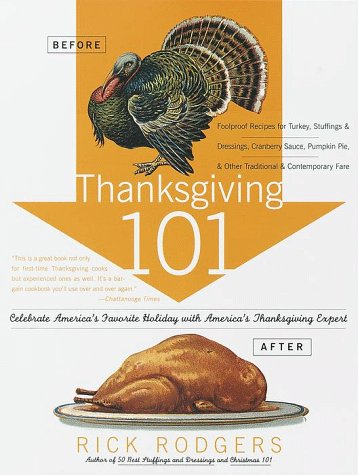
The book cover depicts an illustration of a live male turkey at the top, superimposed above a maize-colored arrow that points to a roasted turkey on a platter at the bottom.

We can help you plan for Turkey Day with a wide variety of cookbooks from our collection. Fine Cooking Thanksgiving Cookbook: Recipes for Turkey and All of the Trimmings, from the editors of Fine Cooking magazine, will help prepare your holiday feast. With Rick Rodgers’ Thanksgiving 101: Celebrate America’s Favorite Holiday with America’s Thanksgiving Expert, you can explore timeless dishes and helpful holiday tips. Preparing for a plant-based meal presents certain challenges; Vegan Holiday Cooking from Candle Cafe offers celebratory menus and recipes from New York’s premier plant-based restaurants.

The book cover depicts a variety of fruits and vegetables, vegan cheese and crackers, and three cocktails on a platter, all resting on a white table.

Being thankful for the time that you spend with your family and friends is vital. Our society has had its recent share of trials and tribulations, especially with the Covid-19 pandemic. We as a nation have a lot to be thankful for. So please, cherish the people you love and the time you have to celebrate together during this holiday season.

Brandon is a Customer Service Specialist at HCLS Central Branch who loves reading, football, and taking nice long walks around his neighborhood.