
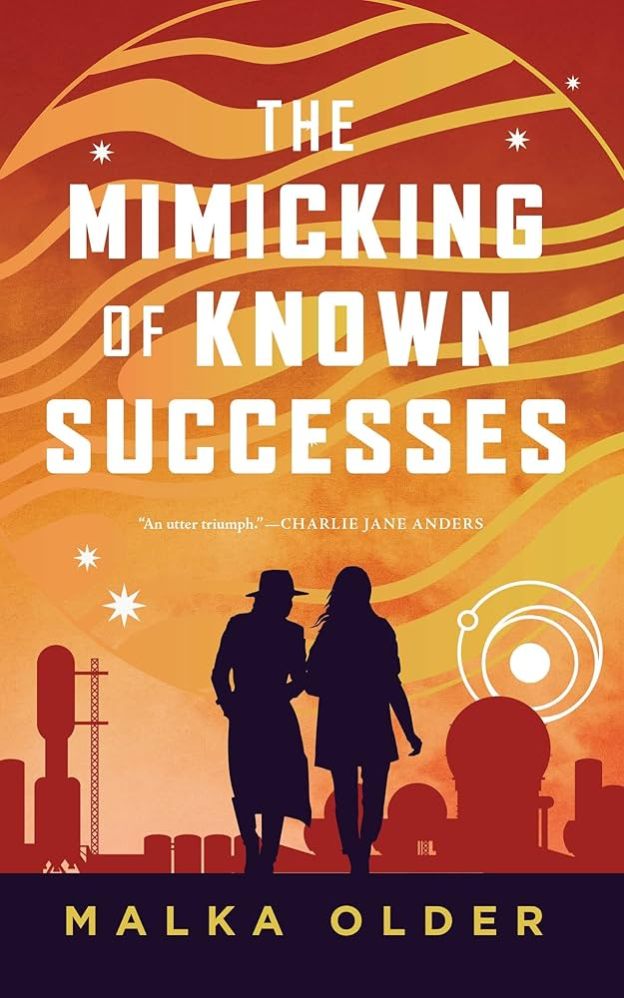
Mossa and Pleiti series by Malka Older

by Kristen B.

The first two books in a series by Malka Older take place about 500 years in the future. Humanity no longer lives on Earth, a planet we have rendered uninhabitable. Instead, we colonized Jupiter – known as Giant – and some of its moons. A series of platforms and railways encircle the big gas planet, on which farms, businesses, and Valdegeld University exist (or in some cases, subsist). There are three major schools at the university: Classics, Modern, and Speculative. Classics studies literature, history, biology, and more from our planet of origin, trying to figure out how the pieces of well-balanced biospheres (ones not continually in crisis) operate. Modern looks at the issues facing the populace where they are now. Speculative also looks to return to Earth, among other goals, but not (necessarily) to restore it to its former glory. University-level research appears to be the biggest enterprise and employer, upon which the survival of the species relies. It’s rather a pointed observation, given the modern American penchant to argue with experts and deny scientific advancement.

I pieced together most of this synopsis from the information around the edges of Older’s first two short novels in a mystery series that is planned to run for at least five books. Pleiti is tenured faculty at Valdegeld, with a specialty in classic literature. Mostly, she researches how the various elements of biospheres worked together by reading books published when those animals lived on Earth. Mossa is an Investigator, the equivalent of a police detective, who spends most of her time searching for lost people. The two were lovers in their past, who, as the series begins, perhaps look to rekindle their romance.

The two installments to date are a lovely combination of science fiction, college politics, and detective mystery. Pleiti and Mossa are enigmatic people, but you find yourself wanting to know more about them as individuals and a couple.

The Mimicking of Known Successes: A man from the university takes a railcar to a remote platform, then promptly disappears. Mossa is pretty sure that he didn’t jump to his death into the planet, and she ends up at Pleiti’s campus asking questions and looking for help. University politics and personalities mix badly with personal ambitions to see Earth restored. Favorite pieces include atmoscarves, the sheer quantity of scones and tea consumed, and the existence of the mauzooleum where “ancient” breeds of animals are carefully bred and studied. I had to make an effort to keep reading through a fairly slow set-up and was rewarded with an exciting, and rather unexpected, conclusion.

The Imposition of Unnecessary Obstacles: I enjoyed this one more, when I could enjoy the mystery without working to understand the world-building. Mossa and Pleiti once again join forces to solve a case involving missing persons – and a subsequent murder – that requires them to do a fair amount of traveling, including to the moon Io and the far side of Giant. Gourmet snacks once again play a not-inconsiderable role as our valiant pair completes some quality sleuthing. There’s also the mention of an opera named Murderbot, which was a high-quality tidbit. I gobbled up this book over a weekend and appreciated the slightly faster pacing and tighter timeline.

A third installment is scheduled to be published in June, The Potency of Ungovernable Impulses, and I’m already looking forward to it.

Kristen B. is a devoted bookworm lucky enough to work as the graphic designer for HCLS. She likes to read, stitch, dance, and watch baseball (but not all at the same time).

The Expanse: Book and TV series

The covers of the first and last books in the Expanse series by James S.A. Corey, Leviathan Wakes and Leviathan Falls. Both covers feature space ships: the first in blues and greys and the last in fiery yellows.

By Kristen B.

James S. A. Corey (pen name of writers Daniel Abraham and Ty Franck) has written a nine-book sprawling science fiction series about humanity among the stars and first contact (and beyond!). It all begins in Leviathan Wakes, with James Holden and the crew of (eventually) the spaceship Rocinante. You could say it’s an apt name, as Holden has a tendency to tilt at metaphorical windmills.

In this far-future novel, humanity populates Earth, Mars, and the asteroid belt beyond Mars where lucrative, dangerous mining takes place and people live mainly on ships and stations. Earth is ruled by the United Nations, which provides the bare basics to an overpopulated, under-resourced planet. Mars is still undergoing massive terraforming, so its population lives in a constrained and almost martial society. The Belters are the under-appreciated scruffy lower class of the solar system, and they are ready to change things – with revolution if necessary as the OPA (Outer Planets Alliance) flexes its muscles. The OPA’s politics walk the line between a new nationalism and terrorism, often depending on a character’s point of view.

In this strained atmosphere, the ice-hauling ship Canterbury, aboard which Holden is the executive officer, responds to an emergency beacon. To say nothing goes right about the situation is a massive understatement – as the Cant is destroyed, the Martian Navy is implicated, and its shuttle limps into Ceres Station with a crew of reluctant heroes. Meanwhile on station, Detective Joe Miller has been hired to locate Julie Mao, missing daughter of an interstellar magnate. Julie Mao is the thread that binds all the mysterious doings together, including the Cant‘s destruction, the OPA’s aggression, and a strange, deadly organism known as the “protomolecule.” This sounds complicated but is really just the set-up for the rest of the excellent, thrilling series.

Many smaller, personal stories held my attention within the larger framework, which helps make this massive undertaking worth the effort. Usually science fiction gives you a plot driven by big ideas or by identifiable characters to root for in strange situations – this has both! Naomi Nagata, Belter and engineer extraordinaire, stole my heart early and remained my favorite character with her deep backstory and good heart. I also love straightforward (blunt) mechanic Amos, who sees the world in simple terms of survival but who always has his crewmates’ backs. The list goes on as the world expands.

But wait … maybe you’re not ready to commit to nine books, all in excess of 500 pages? I mean, it’s a great way to lose track of time and what’s going on in the “real world.” Or maybe you’re a fan and want to experience the story via another medium? In that case, I highly recommend the TV series from SyFy channel and Amazon Prime, with the first four (of six) seasons available on DVD. The show follows the first few books to a remarkable degree, probably because the authorial team acts as producers. In some ways, the streamlined show moves even faster than the books, which is a feat. I love switching between Earth, Ceres Station, various ships, and other locales. Each separate set is completely realized and feels lived in. Also, the casting choices are, pardon the pun, stellar! There’s real chemistry among the Roci’s crew, as well as the folks who seem fully invested in the stakes of their individual story.

It’s a completely binge-able series, however you choose to interact with it – books, screen, or both.

Kristen B. is a devoted bookworm lucky enough to work as the graphic designer for HCLS. She likes to read, stitch, and make soup in the winter.