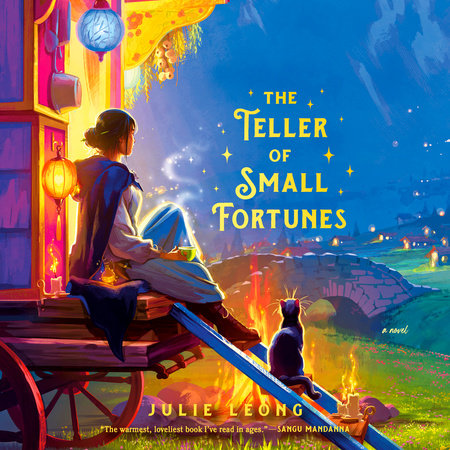
The Teller of Small Fortunes by Julie Leong

The colorful cover illustration shows a young woman sitting on the back of a caravan, with a cat at her feet, in front of a small campfire gazing out at a small town and a night sky.

by Kristen B.

Cozy fantasy is such a wonderful antidote to real life stress and chaos. The Teller of Small Fortunes brings all the good vibes. It’s a story full of found family and small stakes – but ones that become more important as the story progresses. Sometimes, one person making good decisions at the right inflection point can truly make a difference. I really need to believe that these days.

Tao travels in her custom-made wagon with her mule as her sole companion, setting up shop to tell regular people their small fortunes. Nothing too momentous, but important just the same. She brings a little happiness and diversion from mundane days. It’s a good life, if at times a little lonely. When she finds her road blocked by a tree, two new friends come into her life who also provide a little extra security – Mash and Silt, who used to campaign together and now are life-long friends. They are looking for Mash’s missing daughter and happen to be traveling in the same direction. Silt is a bit of a rogue, and Mash is one of the best friends anyone could wish for.

At their next stop, they meet Kina, the baker’s apprentice whose wares taste delicious but don’t always look particularly polished. She wants to see the world, or at least more than her seaside town that smells overwhelmingly of fish. Eventually, the group picks up a stray cat – who might be magical or might just be a cat. In one of my favorite episodes, Kina and Tao invent fortune cookies to sell in places where Tao’s magic might be less welcome.

As the travels continue, the small group forms tight friendships. It also becomes clear that there’s more to Tao than just small fortunes as their group is hounded by a representative from the kingdom’s official magicians. Tao doesn’t want to be involved in large scale politics, mostly because of bad childhood memories and her mother’s reaction to her magic. She just wants to be left alone to live her chosen life – but sometimes, friendship encourages us to overcome our fears and work for the greater good. For every problem introduced, a resolution comes along through a combination of good will, assuming the best, and being a good friend. If only it worked as well as that in real life.

The Teller of Small Fortunes by Julie Leong is available as a book, e-book, and e-audiobook.

Kristen B. is a devoted bookworm lucky enough to work as the graphic designer for HCLS. She likes to read, stitch, dance, and watch baseball (but not all at the same time).

Our next chapter starts soon when the blog moves to the newly redesigned hclibrary.org. All the same great reviews and news, plus more library information!

The Stars Too Fondly by Emily Hamilton

The Book Cover depicts two young people, one wearing blue and one wearing brown and gold, reaching out for each other while moving through space in front of a bright heavenly body., with distant stars in the background.

by Eliana H.

What makes someone a person? What is needed to fall in love? How might society grapple with a significant and mystifying setback in their efforts to secure a safe new home for humanity? What might another dimension be like? What are the moral ramifications of destroying a sentient species we can’t begin to comprehend if it means saving humanity? Readers of The Stars Too Fondly by Emily Hamilton may find themselves pondering these and other questions, while also laughing, crying, and maybe falling a little bit in love themselves.

Twenty years ago, humanity’s hope suffered a huge blow. The Providence I, a spacecraft powered by a dark matter engine, was supposed to take its crew of more than 200 people to a planet orbiting Proxima Centauri, where they would establish the first human colony on an exoplanet. Instead, the entire crew vanished at the moment of launch, leaving the empty ship and a very confused populace behind. Cleo McQueary and her best friends were children when the Providence I crew was preparing to launch and then disappeared, and they have grown up under the shadow of the mystery, wondering what happened. 

Due to a troubled relationship with her father, Cleo spends most of her time with those best friends who have become her chosen family, Abe, Kaleisha, and Ros. Each of them was profoundly influenced by the anticipation of the Providence I launch and the disaster of the crew’s disappearance. Now adults, they have spent the past two decades frustrated by Earth’s abandonment of space exploration after being unable to determine what happened to the Providence I crew. And of course, the situation on Earth has continued to deteriorate since then as well. 

Cleo’s insatiable curiosity has led the four friends to devise a “space heist,” where they will break into the abandoned facility owned by now-defunct Erebus Industries and explore the Providence I for themselves. The friends are able to reach the ship surprisingly easily, but things do not go according to plan from there. The dark matter engine activates at Cleo’s touch, and they find themselves heading toward Proxima Centauri B. None of them are trained astronauts, and they haven’t even said goodbye to their families. Thankfully, their topics of expertise are fairly relevant. They also have unexpected help from a holographic version of the original mission’s captain, Wilhelmina Lucas. Captain Lucas looks just the same as they remember, but she’s 20 years behind on what has been happening. And, of course, she’s a computer construction of the real Captain Lucas’s consciousness. 

This particular computer has a lot more personality than readers may be used to, and the book invites readers to consider what constitutes consciousness and sentience – is this version of Billie, as Captain Lucas invites her unexpected passengers to call her, a person? Cleo and her friends certainly come to see her as one, even without ever being able to physically interact with her. The relationships they develop with her certainly push the boundaries of what one would imagine might develop between a human and a hologram. As the group tries to solve the problem of returning home to Earth, they also work to unravel the mystery of exactly what happened on the Providence I all those years ago. Will they be able to find the missing crew? Will they make it home themselves? What else will they discover on their travels? To learn the answers, check out The Stars Too Fondly, a debut described by the publisher as “part space odyssey, part sapphic rom-com.”

Eliana is a Children’s Instructor and Research Specialist at the Elkridge Branch and co-chair of the HCLS Equity Committee. She loves reading, even if she’s slow at it, and especially enjoys helping people find books that make them light up. She also loves being outside and spending time with friends and family (when it’s safe).

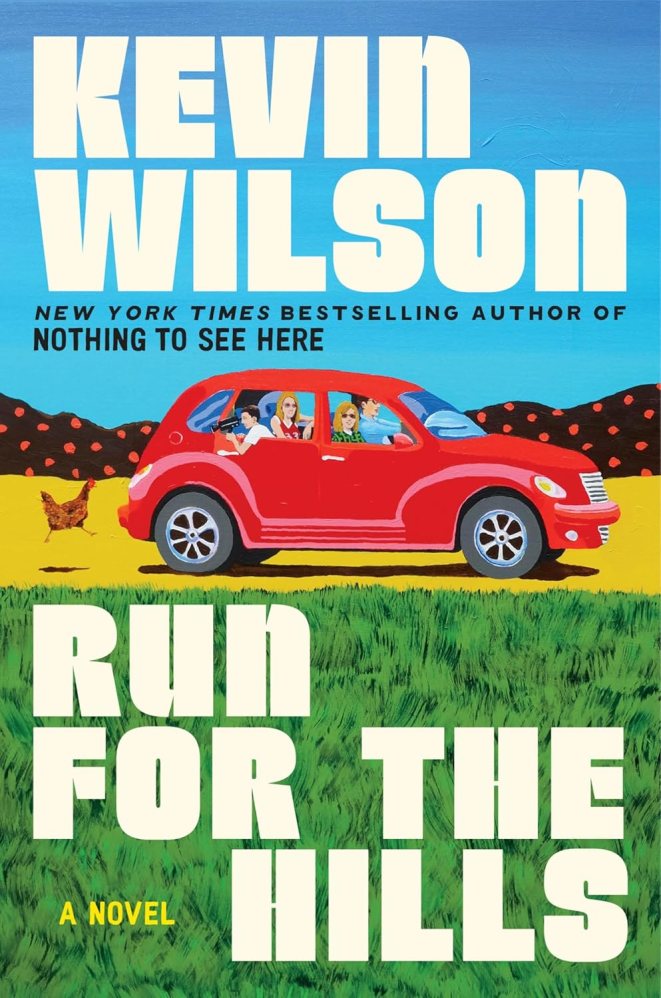
Run for the Hills by Kevin Wilson

The book cover depicts the four half-siblings in the story on their road trip in a red Volkswagen bug. One of them holds a handheld video camera as he is leans out of the window and is filming a chicken who appears to be following the car.

by Kristen B.

Run for the Hills by Kevin Wilson is the story of what might be the weirdest road trip ever conceived. If “found family” is a popular theme in books these days, what do you call it when you actually find your family? As in siblings you never knew existed.

Reuben Hill drives a rented PT Cruiser and is on a quest to locate his father, who disappeared when he was a child, and his half-siblings who live across the United States. Here’s the catch: the siblings don’t know that each other exists. Rube (nicknames are a thing) hired a private investigator after his mom died to get some answers to his life’s mysteries. He finds Madeline Hill (Mad) working the roadside stand at the organic farm in Tennessee where she and her mom live. From there, they head to Oklahoma to find the next sister (Pep, which is short for Pepper), who plays women’s collegiate basketball at the highest level. Then, on to Utah and finally to California.

It’s a quirky setup, filled with snacks and shared life experiences. Their mutual father (Chip, Chuck, Charlie, Carl Hill) left each of his families, although he still keeps in contact with the moms, as he headed ever further westward. The Hill progeny are all blessed with strong mothers – not perfect, but certainly able single parents. Each child has mostly fond memories of their father, but also justifiable frustration and anger over his abandonment of them. With each new family, Mr. Hill became an expert enthusiast in a different area – from writing to farming to basketball to film.

When the book wraps up at a wealthy wilderness retreat in California, the Hill half-siblings really, truly feel like family to one another. Sometimes exasperated, but always lovingly so, they realize that their connections to each other matter – maybe more so than the relationship to their missing parent. They have each already grieved and processed that fact of life to greater or lesser extents. About that missing parent: I will give author Wilson full credit for NOT redeeming him entirely. While I was left wanting more about this bunch of cool, nerdy, confused but ultimately good-hearted folks, it was a lovely summer read filled with good emotions and hope. There’s nothing weird about that.

Run for the Hills is available from HCLS in print and as an e-book and an e-audiobook from Libby/OverDrive.

Kristen B. is a devoted bookworm lucky enough to work as the graphic designer for HCLS. She likes to read, stitch, dance, and watch baseball (but not all at the same time).

The Spellshop by Sarah Beth Durst

A warm painting shows a cozy cottage in dappled sunshine at the top of steps, on which a winged cat lounges.

by Kristen B.

Some books have it all: A courageous librarian, an ambulatory talking spider plant, winged cats, cloud bears, and a romantic interest who rides sea horses. The Spellshop by Sarah Beth Durst gives you a warm hug in the form of a book. That’s not to say it’s only cozy vibes and no plot – there’s plenty of story to keep you reading.

Kiela and her assistant Caz (the sentient plant) flee political unrest that sets fire to the Great Library of Alyssium. Kiela, who has been preparing for this unfortunate reality, packs as many books as she can, herself, and Caz into a boat and sets sail for the island where her family originally came from. She makes it across open waters to Caltrey, where the cottage she remembers from childhood still stands.

It turns out that the political upheaval in the capital city has also had consequences on this faraway island. Imperial sorcerers no longer travel, and magic has become unbalanced, causing huge storms and other troubles. However, the books Kiela rescued are mostly magical spellbooks. The chapters where she and Caz test spells through pure trial and error are delightful. The drawback is that unlicensed magic is illegal, so Kiela ends up opening a jam shop and providing “remedies” on the side (fooling no one).

As she settles in, Kiela makes all sorts of wonderful friends. She also reconnects with Larran, a childhood friend who now happens to be a helpful, handy, and handsome neighbor. Although a natural introvert, Kiela soon discovers the importance of connections and trust within a small community. The found family at the center of the book comes together to see everyone through a series of mishaps and misfortunes, including a suspiciously behaved Imperial citizen who washes up during a big storm. Sorting out the unexpected visitor drives the second half of this gentle book.

The joy of this sort of cozy fantasy is that even though stakes are high, and certainly Kiela feels as though her world is ending, people help each other and make it through. Cozy fantasy is the counterweight to all the dread-full, grim-dark fantasy that has been dominating the genre in recent years. The Spellshop might be as far from A Song of Ice and Fire as a reader can get and still be reading in the same fantasy genre. And that’s okay. It’s good to have a wide variety of books to suit all different readers and moods. Honestly, while it might not make sense if you use strict logic, The Spellshop makes perfect sense to your heart with its hopeful outlook on a world in turmoil.

I am looking forward to reading the second book, The Enchanted Greenhouse, about the magician who created Caz and the second chances she is given.

The Spellshop by Sarah Beth Durst is available in print, e-book, and e-audiobook.

Kristen B. is a devoted bookworm lucky enough to work as the graphic designer for HCLS. She likes to read, stitch, dance, and watch baseball (but not all at the same time).

The Very Secret Society of Irregular Witches by Sangu Mandanna

A blue cover shows a large white house on a hill. Accents in yellow include a sliver moon, a woman on broom, a car, and the shirt on a man holding a pile of books.

by JP Landolt

When I was four years old, I told my brother that I was a 5,000-year-old witch. For nearly every Halloween thereafter, I was a witch. My truest form. As a child, every book I chose was unusually supernatural. A little dark. A little different. A lot like me. Indeed, this little Guamanian girl’s house was strewn with interesting reading material. Little did I know my witchy fascination would stick with me well into adulthood. When I say I was delighted to find that “witchy” books were gaining popularity among my (now adult) peers, you understand I was beyond ecstatic!    

The Very Secret Society of Irregular Witches by Sangu Mandanna is cozy, sweet, and a lovely listen. Samara MacLaren’s voice perfectly conveys a romanticized, present-day UK filled with worldly, contemporary witches. We follow Mika Moon, an orphaned witch from India who was brought to the UK and raised by Primrose. Primrose is a strict (regional manager type) witch who believes witches must live by the rules or risk persecution, or worse still – death. The most important of these rules dictates, “Alone is how we survive.”  

Mika is the very embodiment of this forced loneliness. Cursed from birth (like all witches), she is motherless, untethered, and yearning for family. A loveless, rootless existence is complicated by the necessity to live with magic in the world without being discovered. Her story demonstrates how witches experience the same kind of childhood trauma, feelings of insecurity, and a need for belonging much like any mere mortal.

Mika seeks connection so desperately that she creates an alter-ego (and a humble online following) where she “pretends” to be a witch concocting magical teas in her cauldron for all to see and enjoy. A safe and clever way to hide in plain sight. She is soon sought out by a group of characters inhabiting Nowhere House seeking a real witch to care for three young witches. She finds herself at the doorstep of Nowhere House interviewing to be a live-in tutor and her life is turned upside-down yet again, but in the best way. Shenanigans ensue, as can only be expected with young girls and spellcraft. The staff at Nowhere House only add to the story’s magic.

This story is brimming with magic, love, and found family. There’s an honest vulnerability that weaves through Mika’s character. You can’t help but see the gilded glitter of magic swirling in the landscape and the witches. You can’t help but be mesmerized by the lure of magic and the desire to control what is sometimes uncontrollable. And you can’t help but to empathize with Mika’s unrealized grief or cheer on her personal growth. My goodness, also to wish the brooding librarian to give her a kiss! Heavens!  

If anything, this book proves that magic not only lives in everyday places, but the most powerful magic wants to be used just as much as each of us deserves and wants to be loved. Read this book and embrace all the good there is in life, love – and feel magic again.  

The Very Secret Society of Irregular Witches by Sangu Mandanna is available an e-book and e-audiobook. There’s a bit of a wait, but it’s worth it.

JP has worked for HCLS since 2006. She enjoys gallivanting, Jollibee, and all the halo-halo she can eat.

Skye Falling by Mia Mackenzie

The book cover shows a cityscape with multicolored homes in the foreground, trees in the middle ground, and a skyline view of tall skyscrapers in the background.  People are in purple silhouette walking along the street, sitting or leaning on their porches, and looking out of windows.  The whole cover is done in shades of blue, purple, pink, and peach.

by Ash B.

If you’re looking for a heartwarming read that is thought-provoking, discussable, and hilarious, look no further than Skye Falling by Mia McKenzie. 

Skye is an elder millennial who is quickly approaching her 40th birthday, and she has no interest in ‘settling down’ or having any deep sort of meaningful human connection. The successful founder of a small travel company, Skye has spent years adventuring around the world in the fleeting company of strangers… which has provided her the perfect opportunity to avoid lasting relationships of any kind.  

In short, Skye has an impressive career but she is a hot mess when it comes to her personal life. 

Her brief returns to her hometown, Philadelphia, usually consist of crashing at her friend’s B&B, dodging her brother’s calls about their chronically ill mother, and planning for upcoming trips she will lead for work. She typically does not spend this time reflecting on the past or dredging up emotions that she has long since buried. 

So, when she finds that the egg she donated over a decade ago has actually developed into a real human child – now a twelve year old girl, to be exact – her initial reaction is to run. Literally. Skye tries to run and hide from this girl, Vicky, who introduces herself as “your egg.” But it turns out Vicky is actually pretty cool… so cool that Skye might want to stick around and try to be responsible for the first time in her life.  

However, this is complicated by the fact that Vicky’s aunt and caretaker is not a big fan of Skye, at least not at first. But, as they get closer, let’s just say the tension between these two women isn’t solely about their different approaches to parenting…  

In the interest of avoiding spoilers, believe me when I say McKenzie is a master of comedic writing. The outrageous situations she puts her characters in, and the figurative language she uses to describe them, is top tier. Not to mention her hilarious one-liners, too! 

This novel isn’t just funny, though – it is emotionally rich and insightful about a range of issues from family trauma and fractured friendships to gentrification and policing. McKenzie creates an engaging balance between humor and tragedy, joy and anger, fear and love. The result is a feel-good, fun book that holds space and respect for serious topics that are part of everyday life. 

This is ultimately what makes Skye Falling one of my favorite 2021 releases, and I believe it is also what makes it a great choice for book club discussions – which is why I included it on the HCLS 2022 Books for Discussion list (which you should take a look at for more reading suggestions). 

While I think Skye Falling can appeal to a variety of readers, I would particularly recommend this title to lovers of Honey Girl by Morgan Rogers. Both novels center queer Black women who put pause on their careers in order to sort out personal relationships, figure out what they are doing with their lives, and eventually begin to process their complicated relationships with their parents. They each have rom-com elements without that being the entire plot, are full of millennial humor (albeit on different ends of the generation), and celebrate friendship and chosen family. I wholeheartedly recommend both! 

Skye Falling is available to borrow from HCLS in print and is one of the many titles included in our Equity Resource Collection.  

Ash is an Instructor & Research Specialist at Central Branch and is a co-facilitator for Reads of Acceptance, HCLS’ first LGBTQ-focused book club. This time of year, they are especially fond of reading while cuddling with their golden retriever and sipping hot cocoa or tea.

One Last Stop by Casey McQuiston

The cover, in shades of pink and lavender, shows the two main characters looking at each other; Jane is on the subway, dressed in a black jacket, torn jeans, a white t-shirt and orange sneakers; August is walking alongside the subway station, wearing a white t-shirt and black jumper and boots, carrying a cup of takeaway coffee with a purse slung over her shoulder.
Book cover of One Last Stop.

by Ash B.

If you’re at all aware of contemporary LGBTQ romance fiction, then you’ve no doubt heard about Red, White & Royal Blue by Casey McQuiston. I’ve honestly yet to read it, but I can confirm there is no sophomore slump for McQuiston with their second novel One Last Stop. 

One Last Stop follows August, a cynical 23-year-old college student, as she adjusts to life in New York – trying out yet another college in another city – complete with quirky roommates, a job at a pancake diner that she may or may not be qualified for, and a subway route that she happens to share with the most attractive girl she’s ever seen. The aforementioned “Subway Girl” goes by the name Jane, she is equal parts kind and fierce, and… well, her existence may defy reality as we know it. 

I leave this intentionally vague for a reason: I likely would have found the book even more enjoyable if I had no idea of the plot before I started reading, given that McQuiston spends quite some time building up the mystery of who – or what – Jane actually is. Therefore, I will refrain from going into detail about the book’s premise. Honestly, if this review piques your interest in the title, then I recommend that you simply dive into the book for yourself without reading the summary! 

However, I will divulge that, in my opinion, One Last Stop is an example of speculative fiction at its most accessible, and I absolutely loved it. In a recent interview, Casey McQuiston explains how they “have always loved that genre that’s sort of one step away from sci-fi, one step away from magic or fantasy. It’s a type of romcom that I think was really popular in the late ‘90s and early 2000s,” referencing films such as 13 Going On 30 and Freaky Friday. These are not stories typically considered sci-fi or fantasy – at least, not in the same way as Star Wars or Lord of the Rings – but they absolutely exist within the realm of speculative fiction, incorporating fantastical elements while allowing the author to set the story in an otherwise ‘normal’ contemporary world. The reader can take comfort in the familiarity of the overall setting but can be surprised, or at very least entertained, by the circumstances that arise from the speculative elements employed.  

Whereas these elements are often used for comedic potential in Hollywood movies, McQuiston is able to use them in a way that enriches One Last Stop with queer history and profound examinations about social differences between the past and present. And, of course, the situations created by the speculative elements are also well-suited for romantic tension and drama, which makes for a very engaging story.

I’ve found that a book is a particularly good read for me personally if it reminds me of other books I’ve loved, automatically encouraging my brain to go into “let’s compare these parallels!” mode while simultaneously being an enjoyable narrative on its own. One Last Stop is a perfect example of this! At the beginning, I found myself thinking of An Absolutely Remarkable Thing by Hank Green, as both of these novels feature mystery-loving bisexual female protagonists in their early twenties, living in present-day NYC, that end up being caught in the middle of seemingly unreal circumstances. McQuiston’s lovable cast of characters, development of a queer found-family trope, and flirtation with the “star-crossed lovers” trope (but with a happy ending!) reminded me of Cemetery Boys by Aiden Thomas. And by the end, as hidden family histories and unexpected connections between characters are revealed, I excitedly reminisced about The Seven Husbands of Evelyn Hugo by Taylor Jenkins Reid. Other than being some of my favorite reads in the past few years, I would not think to compare any of those three titles with each other… yet they fit perfectly in comparison to One Last Stop. 

In its best moments, One Last Stop is so tenderly written that it makes me yearn for a life in New York City – and that’s saying something, considering I’m a lifelong suburbanite who’s always been more drawn to the countryside than the city. McQuiston crafts likable characters who speak realistically about life in their city, honoring both the beauty and the struggles of the world which they inhabit. Not only that, but the city itself – and certain destinations within it, such as August’s apartment and the pancake diner where she works – feel like characters too. McQuiston writes them all with such care, I couldn’t help but feel connected to them, want to visit these places, want to be friends with these people and experience life alongside them. This makes for a wonderful book to escape into, and I strongly recommend it to anyone looking for a feel-good read about falling in love, finding one’s community, and growing into the best version of one’s self.

One Last Stop is available to request from HCLS in print as well as an eBook and eAudiobook from Libby/OverDrive.

Ash is an Instructor & Research Specialist at Central Branch and is a co-facilitator for Reads of Acceptance, HCLS’ first LGBTQ-focused book club. Ash is an eternal lover of coming-of-age stories, especially those that center queer and trans joy.

Author works: Gail Tsukiyama

The book cover depicts the small town of Hilo at the shoreline, with buildings in shades of white and brown against a foreground and backdrop of turquoise sea and sky; in the distance, Mauna Loa is erupting into the sky, with yellow flame and reddish clouds above the silhouette of the mountain.

JOIN US! Author presentation: Thursday, Aug 5 from 7 – 8 pm, online
Register via this link or at hclibrary.org > classes & events. Once you register, a Zoom link will be emailed to you.

By Julie F.

The beloved bestselling author and recipient of the Academy of American Poets Award and the PEN Oakland/Josephine Miles Literary Award, Gail Tsukiyama returns with The Color of Air. A novelist whose dual Chinese and Japanese background features prominently in her writing, Tsukiyama presents a novel whose prose flows like the lava threatening her characters, with the grace of stringing leis with fragrant jasmine, kukui nuts, and ti leaves. The literal and figurative emblems of Hawai’i leap off the page and into the vision, sounds, taste, and touch of readers as they live alongside the Hilo locals, and hear the voices of the ghosts they cannot let go.

The residents’ stories move through alternating sections from 1935 to the even deeper past — a rich, vibrant, bittersweet chorus which tells the interweaving stories and a lifelong bond to each other and to others in their immigrant community. Even as the eruption of the Mauna Loa volcano threatens their lives and livelihoods, it also unearths long-held secrets that have been simmering just below the surface.

What I love about the book is that there is a subplot for everyone. If you’ve had a relative challenged by dementia or Alzheimer’s, you see how Mama Natua’s family tries to cope with the help of Daniel, the Hilo native and urban Chicago doctor who has returned to the island to work among his people. Daniel himself wrestles with paternal abandonment, maternal loss, and the guilty sting of feeling that he failed a patient on the mainland. His high school sweetheart, Maile, has an abusive relationship in her past and is tentative about finding happiness again. Razor, the best friend of Daniel’s uncle Koji, tries to unionize the immigrant workers who are taken advantage of by the sugar and pineapple plantation owners and overseers. Each person has their secrets and struggles, yet all come together to find solutions. That’s one of the best things about Tsukiyama’s novels: the sense of love, community, and found family that permeates each page, with characters who learn to face and overcome their fears in order to adapt and grow.

Another strength is the remarkable visual and sensual imagery of the island, which is like a living being itself: “just as volatile and unpredictable as anything a big city could offer” (48). The native Hawaiian words interspersed throughout give the reader a sense of the geology, the fruit, the pikake blossoms, the music of the Filipino bands in the town, and the diversity of languages spoken on the island (at one point, she notes that signs on the street were printed in Tagalog, Portuguese, and Japanese). Hawai’i is truly a distinct cultural melding of sounds, sights, and scents, and Tsukiyama’s descriptive language conveys its unique beauty.

In her years aside from writing, Tsukiyama co-founded the nonprofit WaterBridge Outreach: Books + Water. Alongside bestselling authors Ann Patchett, Gillian Flynn, Karen Joy Fowler, Mary Roach, and Lisa See, the foundation’s mission is to give children in developing communities hope for the future through nourishing their minds and bodies with books and water.

Gail Tsukiyama was born in San Francisco, California to a Chinese mother from Hong Kong and a Japanese father from Hawai’i. She is the bestselling author of Women of the Silk (available from HCLS in eAudiobook format from Libby/OverDrive) and The Samurai’s Garden, as well as the more recent A Hundred Flowers (also available as a book on CD and as an eAudiobook from CloudLibrary).

Julie is an instructor and research specialist at HCLS Miller Branch. She loves gardening, birds, books, all kinds of music, and the great outdoors.

Found Family in Speculative Fiction

By Kristen B.

There’s an old saying that while you can’t choose your family, it’s lucky that you can choose your friends. Some of my favorite stories include found family, where the characters forge tight bonds that go beyond simple friendship into family feeling. These are often the books that live on my comfort reads shelf. It’s also one of the oldest tropes in existence: the band of brothers (or maybe just the band) who live and die for each other. If it can’t actually save the world, friendship can at least make it a better place.

This mostly brown cover features a planet in the background and a chunky spaceship in the front. The title appears in shaded block letters which gradually increase in size.

The Long Way to a Small, Angry Planet by Becky Chambers (also available as an eBook and an eAudiobook from Libby/OverDrive)

This is the book I hand to people who tell me they don’t really like science fiction, but want to try something new. If you ever enjoyed the show Firefly, this novel will feel familiar. Set on an older, slightly beat-up spaceship, the crew represents a wide range of galactic species who pull together as a team, a ragtag group of political and social misfits. The fairly minimal plot focuses on the need to push a new wormhole/jump, which means that one ship has to take the slow voyage to anchor the jump points. It may sound tedious but it’s never boring with all that time to get to know the quirky crew of the Wayfarer. Two of my favorites are the pacifist chef who comes from a species that essentially committed self-genocide through endless war, and Lovey (short for Lovelace), who is the ship’s AI. While not so heavy on forward action, The Long Way to a Small, Angry Planet provides an interconnected set of character studies that leaves you feeling more than a little warm and fuzzy.

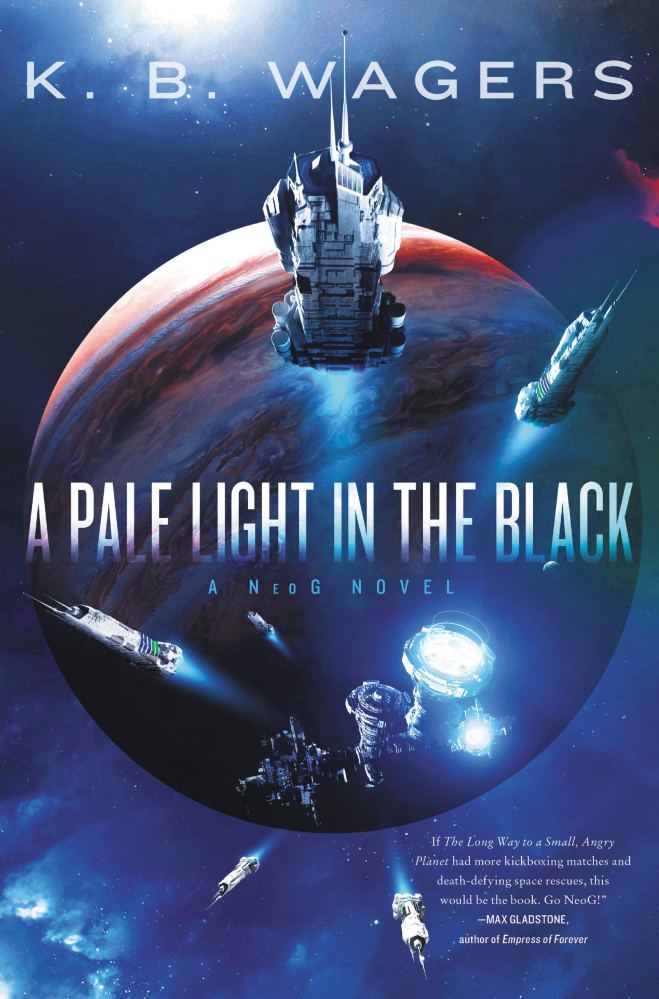
A blue cover with an image of Jupiter in the background features a flotilla of different spaceships framing the title across the middle of the image.

A Pale Light in the Black by K. B. Wagers

Some of the most enduring found family stories tell about military outfits whose bonds are stronger than blood – kinda like the A-Team. Meet Max and Jenks, officers (commissioned and non-com, respectively) on the NEO-G ship Zuma’s Ghost. A sort of space-based Coast Guard, NEO-G (Near-Earth Orbital Guard) Interceptor teams run counter-smuggling interdiction operations and rescue missions. Max has recently joined Zuma’s Ghost, after Jenks’ brother is promoted off the ship. Part of the story revolves around Max and Jenks finding a good working relationship during various military actions. Part of the story concerns the Boarding Games annual competition, which happens among teams from all military service branches and which Zuma’s Ghost just missed winning the previous year. Jenks is the all-time champion cage fighter, and Max, navigator extraordinaire, is still discovering what skills she contributes to the team. Underlying all this surface fun, something more sinister lurks that threatens Max, Jenks, and all of Earth. This book rolls with a ton of space opera fun, hitting all the beats you expect and some you don’t. It’s also one of the most inclusive set of characters ever thrown together to save the solar system!

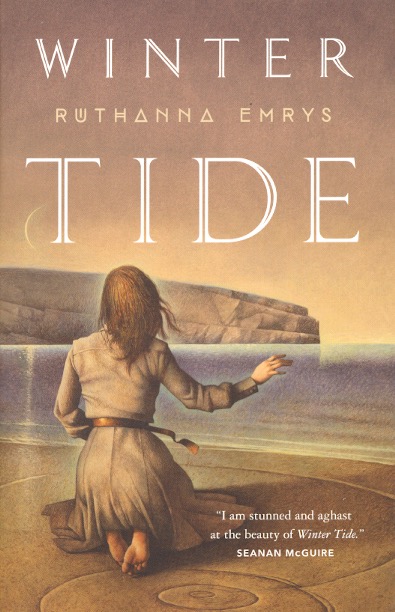
A woman kneels upon a beach gesturing with her right hand toward a flat sea, with symbols traced on the sand beneath her. The palette is muted beiges and blues.

Winter Tide by Ruthanne Emrys (also available as an eBook from Libby/OverDrive)

I must admit to avoiding this title for longer than I should have given its association with the Lovecraft mythos. Lovecraft’s opinions and bigotry have not stood the test of time well, and I was a little apprehensive about diving into the deeps with a Cthulu-inspired novel. How wrong I was! Emrys reconstructs the Lovecraftian milieu into a family saga that demands empathy for the Other. Set in Innsmouth along the shore of the Atlantic Ocean, down the road from Miskatonic University (home to lots of unhelpful white men), Aphra Marsh and her brother Caleb look to reclaim their heritage that was stolen when the government interred her people away from the sea in the desert. The Innsmouth community comes from People of the Water (as opposed to Air or Earth), who eventually leave dry land and evolve to live as Deep Ones in the sea. Aphra needs to find trusted friends and colleagues to re-establish a home at Innsmouth before developers demolish what little remains and to reclaim her people’s heritage from the dim reaches of the university’s library. This quiet, personal novel focuses on staying true to yourself and trusting others who travel the path with you – even if one of them happens to be an FBI agent.

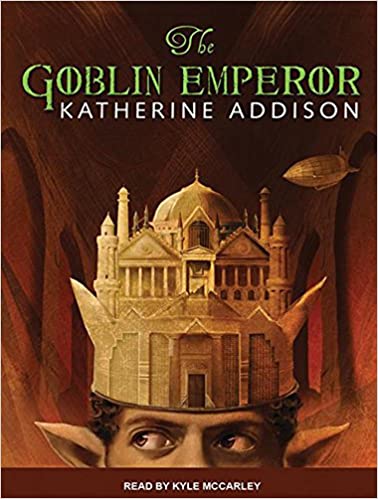
A face with long ears peeks over the bottom of the cover wearing a crown shaped liked a palace.

The Goblin Emperor by Katherine Addison (also available as an eAudiobook from Libby/OverDrive)

Do you love pauper to prince stories? Heroes that go from the kitchen or the farm to the throne? Me too! Half-elf, half-goblin Maya grew up in almost total isolation after the death of his mother, living in a remote marshy estate with an equally outcast, abusive tutor. His father, the Emperor of Elfland, had come to regret his political marriage, exiling Maya and his mother from court. This book opens with Maya receiving news that he is the only remaining legitimate heir after his father and older brothers are killed in a terrible accident. Promising himself to be true to his mother’s precepts of kindness and generosity, Maya tries to maneuver in an imperial court for which he has no frame of reference or requisite education. He makes his way tentatively toward a previously unimaginable royal future, grounded in the adamant idea that he will not continue the cycle of abuse levied against him. Along the way and despite assassination attempts, he finds kindred spirits – helpful councilors, his maternal grandfather (who rules the goblin empire), long-lost aunts and sisters, and devoted bodyguards – to ease the burden of royal privilege and deference. I love this book to pieces, and it only improves with re-reading. The language can be a little dense at first, but stick with it and you will be greatly rewarded with a story of courtly politics and the power of kindness.

Kristen B. is a devoted bookworm lucky enough to work as the graphic designer for HCLS. She likes to read, stitch, and take walks in the park.

The House in the Cerulean Sea by T.J. Klune

An illustration shows a raggedy spit of land above a blue sea, with a red house with lots of windows at its very edge. Windswept trees and a blue and pink sunset sky frame the house.

by Sarah C.

Have you ever read a book that feels like a warm hug? Not just certain scenes either, like the entire story overall, start to finish, feels…happy. Comforting. Wholesome. And despite containing a large variety of themes, concepts and emotions, highs and lows, and a bit of magic, the book still manages to wrap itself around you like a soft, well-loved quilt?

Me neither…until now! To be fair, my preferences are usually hard-hitting realistic teen fiction with some fantasy and sci-fi thrown into the mix, and I tend to avoid gentler, softer stories. Maybe that is why this particular book was so surprisingly engaging for me. Regardless, let me tell you about this charming modern fairy tale of a novel that I had the absolute pleasure of reading.

The House in the Cerulean Sea by T.J. Klune (also available in eBook and eAudiobook format from Libby/OverDrive) was recommended by a colleague who is always on point with their choices, so I assumed I’d enjoy it, but was not prepared to fall in love like I did. Utterly and completely head over heels in love. After staying up late on a weeknight to finish this page turner, I then re-read it slowly over the weekend to savor it…then demanded my friends, my book club, my social media groups, my co-workers, and my family read it. Then I bought it, AND I requested it again from the library because at this point there was a decent waiting list but my copy was almost overdue. I proceeded to suffer greatly waiting for the copy I bought to arrive, so I began reading it yet again, together with my 11-year-old in the evening..and so on and so forth.

Perhaps you might like to hear about the actual book at some point, as opposed to my swooning?

Right, well this is the story of a group of misfit children with different special abilities and backgrounds, and the “normal” adults who play certain roles in their lives. Some try to raise and protect them, some try to control and contain them, while others fear and scorn them. Our main character, Linus Baker, is confused by them but curious and good-hearted, and throughout the book learns to see them for who they truly are and love them more for it. A lonely, rule following caseworker for the Department In Charge Of Magical Youth, Linus lives a dull and dreary life, until he is given a mysterious assignment to investigate the “dangerous” children being cared for at the Marsyas Island Orphanage and identify their threat levels. Without much information to go on, Linus embarks upon what becomes a life-changing adventure, filled with unexpected beauty and memorable characters. There might also be a sassy and insufferable pet cat, which is an added bonus.

Themes include found family, celebrating differences, facing bias and prejudice in ourselves and others, accepting help and love, and recognizing true bravery and learning that it’s never too late to start over or discover something new, with many parallels to today’s world. Darkness lurks around corners in Cerulean Sea as well as our own lives, and the author skillfully acknowledges this, lest the story become too unrealistic.  

As I finish this book for the third time, I am left with a renewed sense of hope for the future. I invite you to fall in love as I did with this intergenerational “must read” for 2021.

While you will have to request the title because it’s so popular right now, the wait will be worth the while!

Sarah is the Teens’ Instructor and Research Specialist at the Savage Branch, where she can be found geeking out over new graphic novels, spotting rainbows and drinking day-old coffee.