
The Ministry of Time by Kaliane Bradley

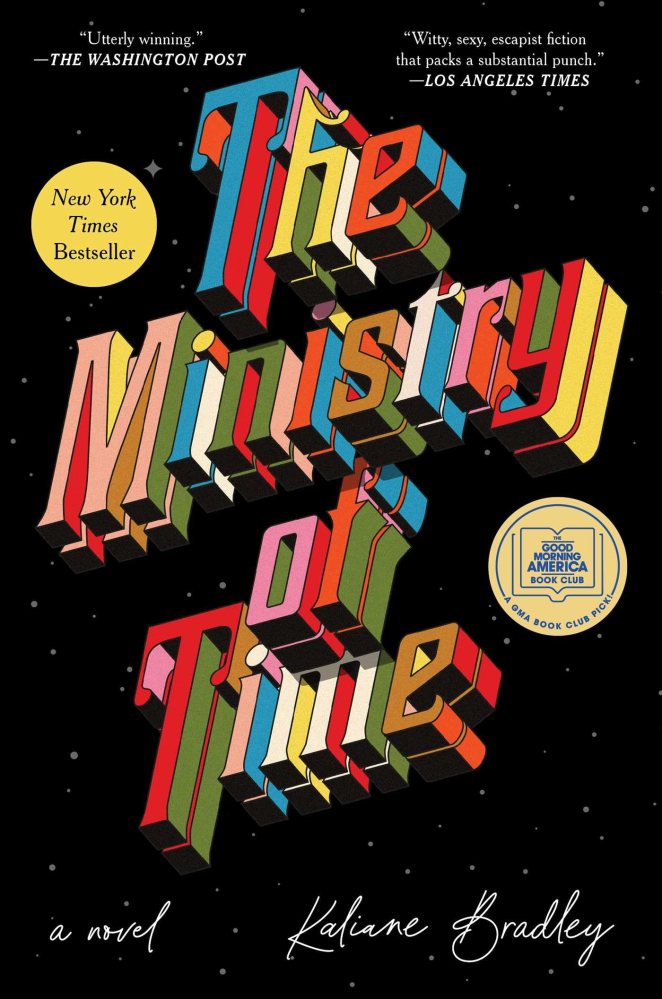
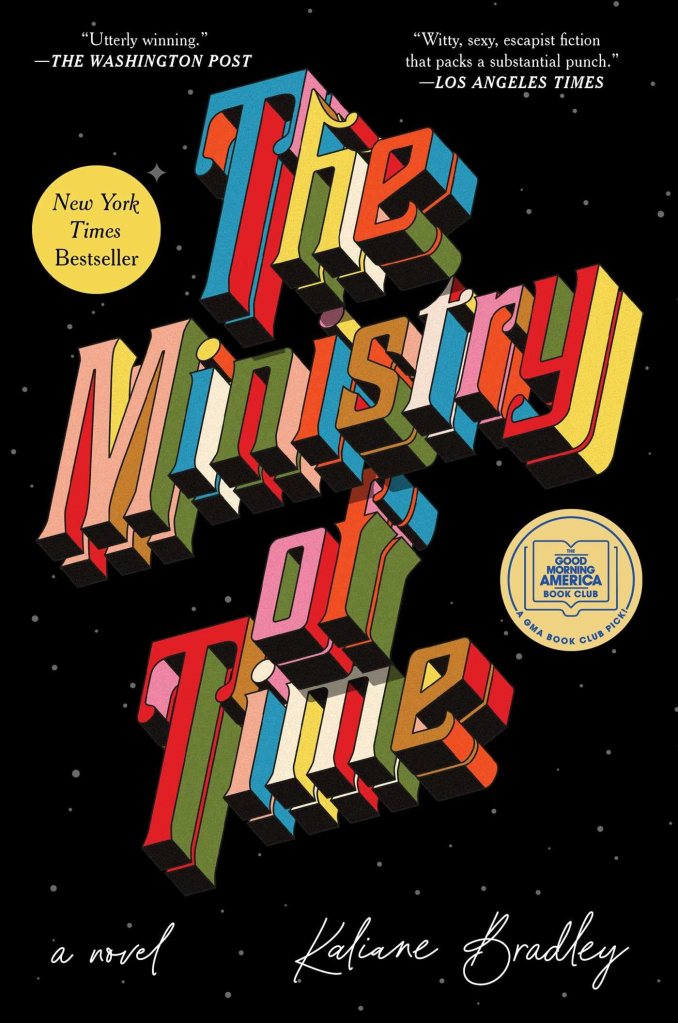
Brightly colored, large italicized lettering appears doubled on a black cover. Stickers added for New York Times best seller and the Good Morning America Book Club.

by Kristen B.

As the story begins, the main character is finishing a series of rather hush-hush job interviews. When she learns she got the new position, she hears the words, “We have time travel.” Welcome to The Ministry of Time by Kaliane Bradley, which plays with the notion that sometime in the future, we figure out how to travel in time.

It’s one of the biggest question about time travel: Can we improve the present – avert some disaster – by changing the past? This story seems a little different, more scientific at the start – wondering if it’s even possible for humans to exist outside of their own time. The Ministry devises an experiment where they “rescue” certain individuals known to have died in tragic or terrible ways: a doomed trip to discover the Northwest Passage, a plague house in the 1600s, the trenches of WWI, and other such horrible histories. Those individuals feel more like they’ve been kidnapped than rescued.

The book’s narrator, who gets that job with the Ministry (but never a name), is assigned to be a bridge between Graham Gore, officer of the Royal Navy in the early nineteenth century, and her time period in near future London. She insists on referring to him as being Victorian, but his time was actually just before Victoria’s reign began. The first third of the book delights in Gore’s observations of modern life and conveniences. But clearly, something is amiss in the Ministry. The main character just can’t quite figure it out but strange happenings keep occuring, like her handler being assassinated at a public event and certain time travelers being invisible to scanners. Other things don’t add up either, although it becomes clear there are warring factions within the Ministry. No one is quite sure who to trust.

Graham and our narrator spend almost all their time together: learning modern skills like riding a bike (which eventually improves to a motorcycle), touring museums, and going to pubs with other time traveler/bridge pairs. One session admiring a Turner exhibit at the Tate is particularly insightful. Graham becomes good friends with two other people out of time, one of whom is my favorite character. Maggie was left to die in a plague house, but she comes to embrace London’s club scene and dating apps where she can be openly gay. These friendships prove to be crucial not only to the characters’ well-being, but to the ultimate resolution of the story.

On top of the fascinating premise, the author has a gorgeous way with words. One character is described as, “Despite being out of uniform, he looked oddly formal, as if he was as the sole person in serif font.” I don’t want to spoil the surprise of this excellent debut. What ensues in the second half of the book is a complete mash-up of time travel, spy thriller, and romance into a beautifully written novel about the dangers of colonialism. Bradley really does tell you everything you need to know in the first chapter, only I didn’t realize it until I re-read it after the devastatingly bonkers ending. This is a book I’ll think about often and already have plans to re-read.

You can borrow the book in print or large print now, but there’s a bit of wait for the e-book and e-audiobook versions.

Kristen B. is a devoted bookworm lucky enough to work as the graphic designer for HCLS. She likes to read, stitch, dance, and watch baseball (but not all at the same time).

The Actual Star by Monica Byrne

A black and gold swirl centers on a pinpoint of a star. Two blue bands stripe the book vertically, while the text appears in orange horizontal bars.

By Sahana C.

It’s hard to find a good place to start with this book, so I’ll start at the end, in the year 3012. Society is different, and so are the people as the result of hundreds of years of war and compromise and cultural evolution. As a species, we are a genderless and raceless band of nomads, with a blatant disdain for those who settle down in nuclear family units.  

So yeah, there’s a lot going on. The above phrasing makes it seems starkly unnatural, but somehow, Monica Byrne’s weaving together of three different stories across time makes the future version of us feel tangible. Despite all of the modifications and the general foreignness of the shape of this future society, the basics of humanity remain the same. We are emotional and community oriented, no matter when we are in history. We follow patterns that remain, no matter how far we try to stray outside the bounds of history.  

The ripple effects from past to present to future were incredible. Seeing names and places that were mentioned briefly in the past become more important in the future was almost an exciting reward for paying close attention through the timelines. And this book does reward close attention. It is obvious that Byrne put immense time and research into all aspects of the novel, going from the Maya, to modern Belize, to what made sense for the future based on the results of the events she described in the first two timelines. Most importantly, the story of the Hero Twins, some of the most important figures in the Maya mythos, is described and adapted in such a faithful light that Byrne has room to play with the elements of the mythology.  

The story of the Hero Twins is one that Byrne explains in the novel, but, like the rest of Maya mythology, it is complex and bears repeating. The Hero Twins were the central characters of one of the oldest preserved Maya works, the Maya equivalent of the Epic of Gilgamesh, with just as much adventure. They were often portrayed as complementary forces, the sky and the earth, the sun and the moon, the masculine and feminine, life and death. All in all, the Hero Twins were born to represent the two sides of a single entity. The shortest way to explain their greatest triumph is that they defeated the lords of Xibalba, the Maya equivalent of the realm of the dead, in a ball game, essentially representing that together, they had conquered death and diminished the power of all Xibalba. 

In the first of the three timelines in the novel, the year 1012, we are introduced to Ixul and Ajul through the point of view of their little sister, Ket. They are royalty and are said to be the reincarnation of the Hero Twins, with all the strength, power, and greatness that entails. The second timeline in 2012 follows Leah, a nineteen-year-old half Maya girl from Minnesota who goes to Belize to reconnect with her heritage. While she is there, she explores sacred caves and meets Javier and Xander, another set of twins, who work as tour guides. Business is booming, because in 2012, at the end of one Maya calendar, the Western world had decided the world was going to end. And then, in 3012, we follow Niloux, someone who is speaking out about the way society has evolved. She is embroiled in debate about the very nature and purpose of humanity, a thousand years after the change in the Maya cycle.  

Each of these timelines finds the characters on the precipice of a great and life altering change. The story is a blend of mythology, history, and sci-fi, and speaks, ultimately, to the way we use history to justify the present, and the way that our understanding of the past informs our future, no matter what we do.  

The Tor.com review called the novel, “one of the most effective examples of worldbuilding you’re likely to see on a page this year,” and I have to agree. Despite being longer than 600 pages, it’s somehow still a fast read. It’s a hefty book that tries to cover a lot, and sometimes just doesn’t have the space to explore all of the various threads it brings up, but when Byrne is allowed to go into detail on a subject, she does not miss.   

The Actual Star is available in print.  

Sahana is an Instructor and Research Specialist at the Savage Branch. She enjoys adding books to her “want to read” list despite having a mountain of books waiting for her already.