The Possession of Alba Díaz by Isabel Cañas 

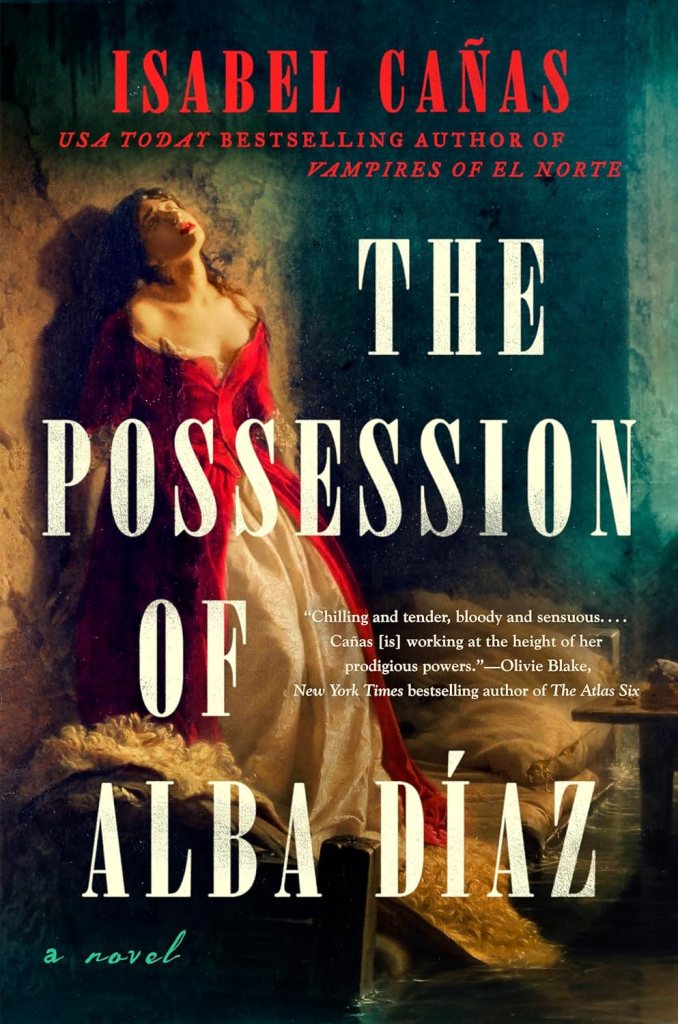
The book cover depicts a woman standing on a bed and leaning against a wall, with her eyes closed and face upturned towards the ceiling. Her lips are red and match her red dress, fastened over a white underskirt. Her long brown hair tumbles around her bare shoulders. The dress is in the style of the 1700's and the scene has a dark, Gothic feel, although she appears to be lit by natural light from a nearby window.

by Alex H.

If you’re anything like me, September 1 marks the start of Halloween season (yes, season). There’s no better way to celebrate the start of all things scary and ghoulish than by reading a horror novel, and that’s what I did when I picked up Isabel Cañas’ newest book, The Possession of Alba Díaz. If you like ghosts, Mexican history, and gothic romance, this is the story for you!

The Possession of Alba Díaz is set in Zacatecas, Mexico in 1765. When a plague descends on her city, a young woman named Alba and her family retreat into the mountains. They take refuge at a mine owned by Alba’s fiancé and his family, but it is not the safe haven they were promised. Alba starts sleepwalking and hearing strange voices from deep in the mine, but most worrying of all is how she no longer feels alone in her own head. 

Meanwhile, Elías, the black sheep of her fiancé’s family, has arrived in the New World hoping to quickly make his fortune and escape his greedy family. His plan falls apart when he meets Alba and the two are drawn to one another, despite her rather inconvenient engagement to his cousin and the demon lurking under her skin. Lucky for Alba, Elías knows a thing or two about demons… 

I raced through this book. Cañas does a wonderful job of blending history and the paranormal to create a rich, fully lived-in world. Her two narrators, Alba and Elías, have voices that are distinct and wholly compelling, which makes for an electric romance. As for the horror aspect, Alba’s possession takes up a large chunk of the novel and there are more than a few creepy scenes. I’d say they lean more towards unsettling than scary, but your mileage may vary. 

Come for the haunted mine and angry demon, stay for the gothic romance and a delightfully wicked ending that’ll have you desperate for more historical horror this Halloween season. 

The Possession of Alba Díaz is available in print from HCLS in English and Spanish, and as an e-book and an e-audiobook from Libby/OverDrive.

Alex is a Teen Instructor & Research Specialist at the Glenwood Branch. When she’s not at the library, she likes to crochet cute animals, read all the horror and romance books she can get her hands on, and write stories about things that go bump in the night. 

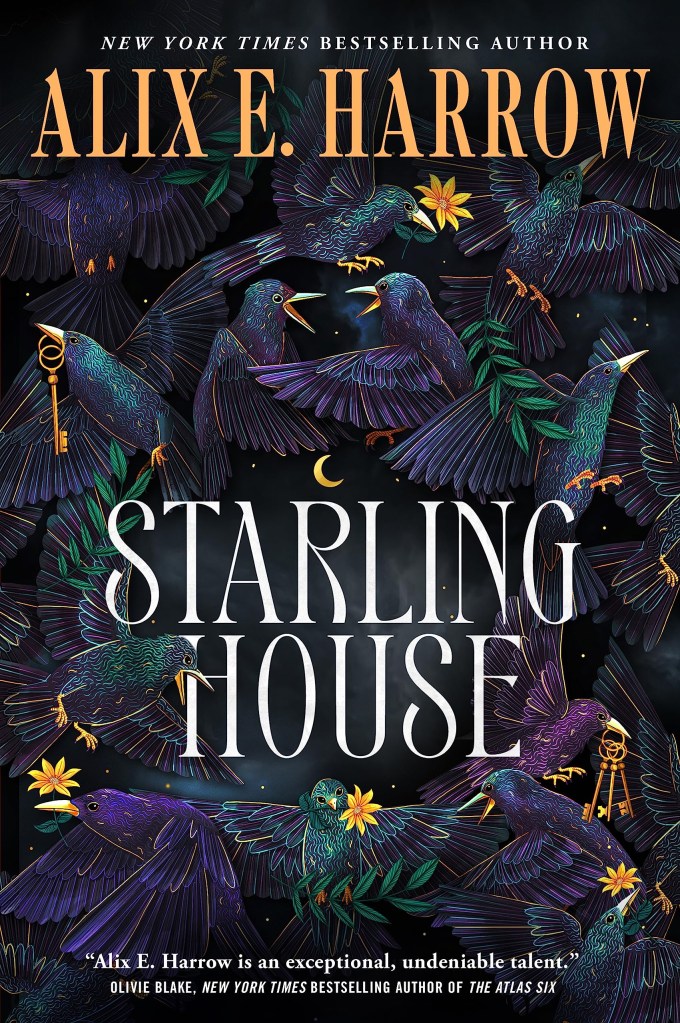
Starling House by Alix E. Harrow

The dark cover shows a pattern of birds in purples holding a variety of golden keys.

by Kristen B.

A good Gothic novel practically requires a spectacularly weird house with supernatural tendencies. Starling House might be the main character of its own novel – not quite but close. Our actual main character, Opal, routinely walks the long way home from her going-nowhere-fast job just to wander past the house. She dreams of it and its mysterious amber light. Opal is an unlucky high school dropout trying to make ends meet for herself and her academically talented younger brother, Jasper. They live in a room at the local motel, subsisting on Pop-Tarts and bad pizza. Their mom died in a car accident on a cold night when the mists rose off the Mud River, which is when bad things happen in Eden, Kentucky.

The Starling family is one of strays and orphans, who take the name and the ownership of the house. Arthur is the last in a long line of Starlings, although his parents raised him in the house before he ran away looking for a more normal life. The only major employer in Eden is the Gravely Power company and their coal mines, and the Gravelys and Starlings have a long, complicated history. When Opal finagles a high-paying housekeeping job from the anti-social Arthur, she finds a decades long domestic disaster. As Opal cleans, she realizes that the house has its own sort of sentience – and that it seems to like her. But rooms rearrange and corridors form mazes, and sometimes the space seems to move her to where she needs to be (like Casita in Encanto, but not as friendly).

The story trades points of view between Opal and Arthur, both of whom are disillusioned and suspicious of each other and the entire situation. The book intersperses their hostile encounters with different versions of the town’s past – about Eleanor Starling, her children’s book The Understory, and the house she built. There’s also a set of unscrupulous business consultants with an unwholesome interest in the Starling property and mineral rights, and they target Opal. Untangling the nest of rumor, legend, and sordid tales holds the key (literally) to resolving the tragedy that haunts the town, Opal’s family, and Starling House.

The book has a powerful engine of a plot, along with its engaging characters. I couldn’t help but root for Opal, despite her ingrained need to keep the world at arm’s length. Her carefully guarded heart sometimes misses the loving connections in her world in its desperation to remain stoically independent. Arthur isn’t much different, and these two lost souls truly need each other. The supernatural elements are just creepy enough to give the entire proceedings a sideways edge, which kept me wondering if the author was going to be able to pull it all off. I thought this was her best book yet (although I also loved Once and Future Witches) – it’s a lean, mean, twisty tale, where all the components are necessary to make the story work.

Starling House by Alix E. Harrow is available in print, e-book, and e-audiobook.

Kristen B. is a devoted bookworm lucky enough to work as the graphic designer for HCLS. She likes to read, stitch, dance, and watch baseball (but not all at the same time).

Affinity by Sarah Waters

The lettering appears large and wavy against a deep teal background. There's a set of manacles in grey at the bottom.

by Angie E.

I doubt I can do Affinity justice with a traditional review, although I’ll certainly try. Sarah Waters broke my heart by writing this book, and I went through several tissues, basically just ugly crying all over the place. My heart also skipped several beats as I journeyed through the twists and turns the novel took. 

Affinity transports readers to 1870s Victorian England, weaving together elements of gothic mystery, psychological exploration, and heart-wrenching drama. Margaret Prior, an unmarried woman from an upper-class family, grapples with inner demons. She’s recovering from her father’s death and a subsequent suicide attempt. Despite being almost 30, she feels powerless living at home with her over-involved mother. 

Seeking consolation and purpose, Margaret becomes a “Lady Visitor” at  Millbank Prison, one of Victorian London’s grimmest jails. Her goal is to guide and support the female prisoners. During her visits, Margaret encounters Selina Dawes, a mysterious and infamous medium of spirits. Selina has been imprisoned for two years, accused of causing the death of the wealthy woman she lived with. 

The relationship between the two women evolves, blurring the boundaries between friendship, desire, and the inexplicable. Is Selina a fraud or a genius? And can Margaret find redemption through their connection? The novel’s spooky atmosphere and psychological tension keep readers mesmerized until the very end. 

If you crave a blend of historical richness, mystery, and heartache, Affinity is a must-read. Whether you’re drawn to magic, tragedy, or forbidden connections, this novel will leave an indelible mark on your heart. 

Affinity by Sarah Waters is available in print and e-book.

Angie is an Instructor & Research Specialist at Central Branch and is a co-facilitator for Reads of Acceptance, HCLS’ first LGBTQ-focused book club. Her ideal day is reading in her cozy armchair, with her cat Henry next to her.

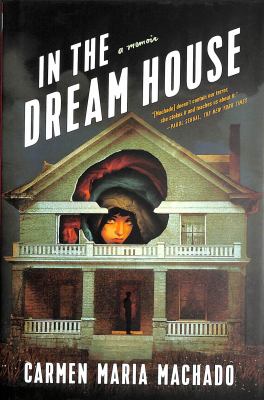
The Works of Carmen Maria Machado

An illustrion of a big house with wrap around white porches appears burnt through to show a figure peering through the hole.

By Angie E.

Machado’s narratives delve into the emotional and physical vulnerabilities of characters, challenging traditional notions of strength and weakness. Her stories often blur the lines between reality and fantasy, creating a space where vulnerability is not a flaw, but a powerful force in its own right.

“Especially Heinous: 272 Views of Law & Order SVU” is a novella written by Carmen Maria Machado in 2013. It unfolds through 272 synopses, each encapsulating a distinct perspective from the initial 12 seasons of the police procedural series of the same name. Originally published in The American Reader in May 2013, “Especially Heinous” features parallel universe versions of Elliot Stabler and Olivia Benson and is included in Machado’s 2017 short story compilation, Her Body and Other Parties.

Carmen Maria Machado’s Her Body and Other Parties dissects power imbalances in various forms. Through a series of surreal and haunting tales, Machado explores the ways in which power is wielded, misused, and resisted, often using the female body as a focal point for her narratives. The stories challenge societal norms, inviting readers to reconsider their understanding of power and its implications. Despite the unusual nature of “Especially Heinous” (and how it deviates from the actual SVU), the story fits perfectly within the anthology. Law and Order: SVU itself and Her Body and Other Parties may exist in different realms of storytelling, but their thematic resonance is undeniable.

Moving from short story collection to memoir, Machado has also written In The Dream House, which takes readers on an intimate journey through the author’s experiences. She opens up about her past relationship with an abusive partner, exploring the complexities of domestic abuse within the LGBTQ+ community. Structured as a series of interconnected essays, In The Dream House defies traditional memoir conventions. Machado employs various literary forms, from folklore to lesbian pulp fiction, to recount her harrowing experiences. The result is a poignant and powerful narrative that sheds light on the often-overlooked issue of abuse within queer relationships.

Machado’s exposed and raw honesty are palpable in every page, inviting readers to confront the uncomfortable realities of abuse. In The Dream House not only serves as a personal catharsis for Machado, but also as a vital contribution to the ongoing conversation about abuse within the marginalized.

In The Dream House is available in print, e-book, and e-audiobook.

Angie is an Instructor & Research Specialist at Central Branch and is a co-facilitator for Reads of Acceptance, HCLS’ first LGBTQ-focused book club. Her ideal day is reading in her cozy armchair, with her cat Henry next to her.

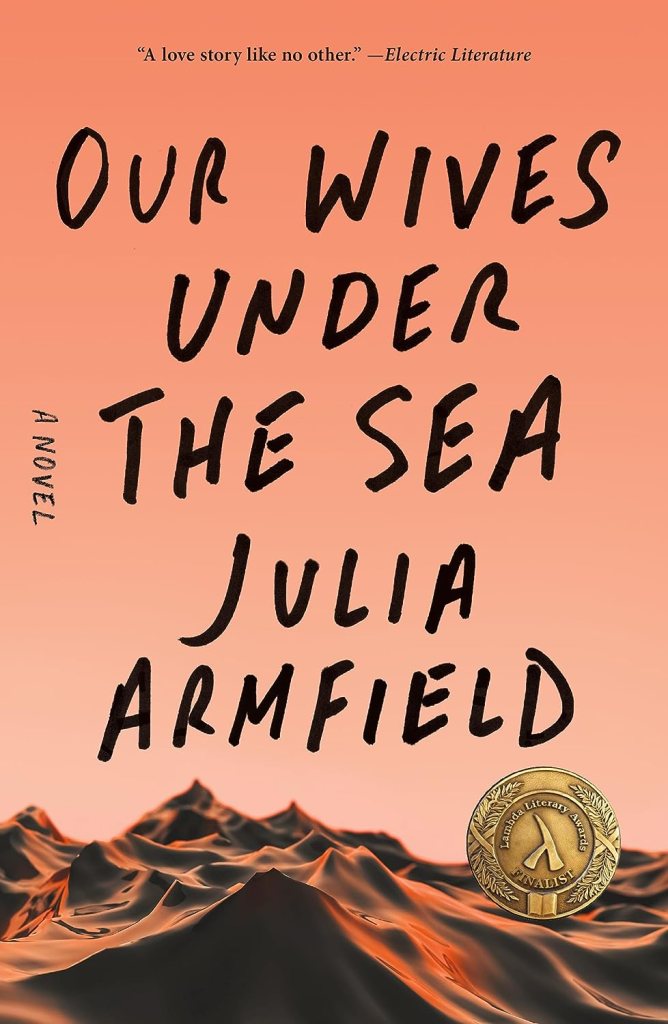
Our Wives Under the Sea by Julia Armfield

The book cover depicts waves against a reddish-orange background, possibly as if the sun is shining down on them.

By Sahana C.

There are books that belong in discussion, that beg to be read in community. Then there are books like this, that I don’t know if I’ll really be able to talk about in a meaningful way. But you deserve to know about it, so I’ll try my best.  

I’ll tell you first that I read this in one sitting. Each turned page made it evident that this book was heart-wrenchingly, desperately, tenderly romantic, and just as tragic. I was reminded of Rebecca by Daphne du Maurier in a lot of ways – the story of the protagonist, Miri, starts in the middle of an existing tragedy, with fog and haze over the order of events in such a way that everything feels like a dream. The classic gothic element where the setting acts as a main character is incredibly present as well – the sea takes its due, from Miri and from her partner Leah, and it is greedy with what it has. The home is a center, as in most gothic tales, and the sea takes the place of home for both Miri and Leah. Armfield writes, “To know the ocean, I have always felt, is to recognize the teeth it keeps half-hidden.”  

Miri thinks something is not quite right about her marine biologist wife, Leah, who has just returned from six months on a deep sea mission that did not end well. Despite Miri’s best efforts, Leah cannot seem to return to life as normal. Miri does what she can, but she can’t escape the fact that she feels she is losing Leah to the sea, somehow, inexplicably. There is a real sense of the liminal throughout the book, but especially in the first chapters as Miri begins to tell the story. Armfield herself says it perfectly, writing about loss but inadvertently summarizing the themes of the novel: “It’s not grief…it’s more like haunting.”  

This idea of haunting is compounded by the ways we learn about Miri and Leah’s relationship throughout the story, in fleeting moments and flashbacks, woven together with this real sense of longing for a time that cannot return, with desperation mounting, and mounting, and mounting, as we need to know what has happened, what will happen, what’s next.  

At some points, this book had a similar energy to one I’ve written about before, Emily Austin’s Everyone In This Room Will Someday Be Dead, with a smattering of “anxious” fiction interspersed among the more gothic notes. The characters are so unfortunately lovable, too, in their desire for one another, and that’s the real tragedy in the novel – Armfield wonders aloud “what happens when love isn’t enough?” The readers are left begging her to stop asking the question.

This book deserves to be read. I read a lot of books; I’m surrounded by them all day, and I can tell you, with full assurance, that this book will make you feel. You’ll bear witness to the love that was there, that was lost, that had something unbelievable change it, and instead of that love living on the paper, in the book, it will belong to you instead.  

Our Wives Under the Sea is available from HCLS in print and as an e-book.

Sahana is an Instructor and Research Specialist at HCLS Savage Branch. They enjoy adding books to their “want to read” list despite having a mountain of books waiting for them already.

Mexican Gothic by Silvia Moreno-Garcia

A woman with black hair, wearing an off the should red gown, holds bunch of flowers while standing in front of a green floral wallpaper.

by Kristen B.

Horrifyingly creepy. Creepily horrifying. Either way, it’s gothic. The author tells you right there in the title. I’m not a big fan of horror – gothic or otherwise. You can keep your atmospheric creepies to yourself.

This book absorbed me. I literally could not put it down.

Noemi Taboada is my kind of girl: smart and sassy. She’s contemplating an advanced degree in anthropology, if only she can convince her father that there’s more to a well-off woman’s life than marriage and family. In Mexico in the 1950s, this is a harder sell than it should be. She’s also something of a party girl, who enjoys dancing and smoking with her active social circle.

Her cousin Catalina, though, is cut from more traditional cloth. She is married and has moved to her new husband’s remote estate, away from the family in Mexico City. When the family receives troubling letters from and about Catalina, Noemi agrees to her father’s plan to visit her cousin and investigate the situation.

Catalina has married Virgil Doyle, oldest son of a family that immigrated to Mexico generations ago but have maintained an English sensibility, including not speaking Spanish. They came for the silver mines and stayed for reasons that become clear later. The house (in all honestly, a sinister mansion) is dark – literally with drapes pulled and limited electricity – decorated with overwrought furnishings in a variety of mythological motifs and loaded with tarnished silver. Gothic oozes out of the story’s rotting wainscoting.

Noemi is not a particularly welcome visitor. She smokes. She asks questions. She’s not particularly interested in being obedient to the Doyles’ odd rules. She wants to see her cousin. She visits town. She roams the family’s cemetery where she befriends younger cousin Francis, who helps her understand that not all is right or well at High Place – and not just because the family’s fortunes are dwindling with the mines being closed.

Francis has a fascination with fungus. Mushrooms are his main interest, and I don’t want to spoil too much – but it’s relevant. He also seems to spend plenty of time outdoors to get away from his overbearing family: Virgil who reeks of ambition and charisma but codes as emotionally abusive, and Florence, the strict maiden aunt who is the enforcer for Howard, the ailing patriarch with a keen interest in eugenics. Honestly, I’d spend as much time outside as I could, too.

Noemi’s questions reveal that the Doyle family has all sorts of secrets and scandals, including murder and incest. Things start to fall into place just as Noemi begins to demonstrate the same sort of worrisome symptoms as her cousin Catalina. Noemi’s vivid dream sequences contribute to the sense of impending doom and overall wrongness. When Howard and Florence forcibly insist that Noemi marry Francis, it all comes apart at the seams and a nightmare of truly gothic proportions ensues. The author fully embraces Latin magical realism as she dives into the deep end of the horror genre.

You should read it, preferably on a dank, rainy day in a spider-infested garret. Personally, I am glad I read it on a hot, summer day next to a window while traveling on a train. Mexican Gothic is available in print, ebook, and eaudiobook.

Kristen B. is a devoted bookworm lucky enough to work as the graphic designer for HCLS. She likes to read, stitch, dance, and watch baseball (but not all at the same time).

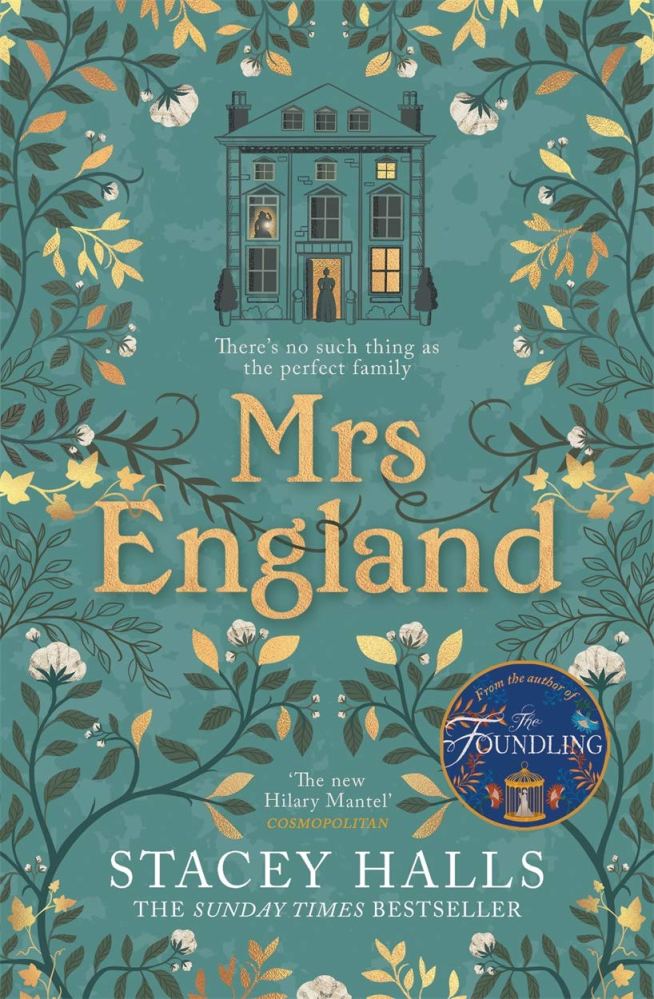
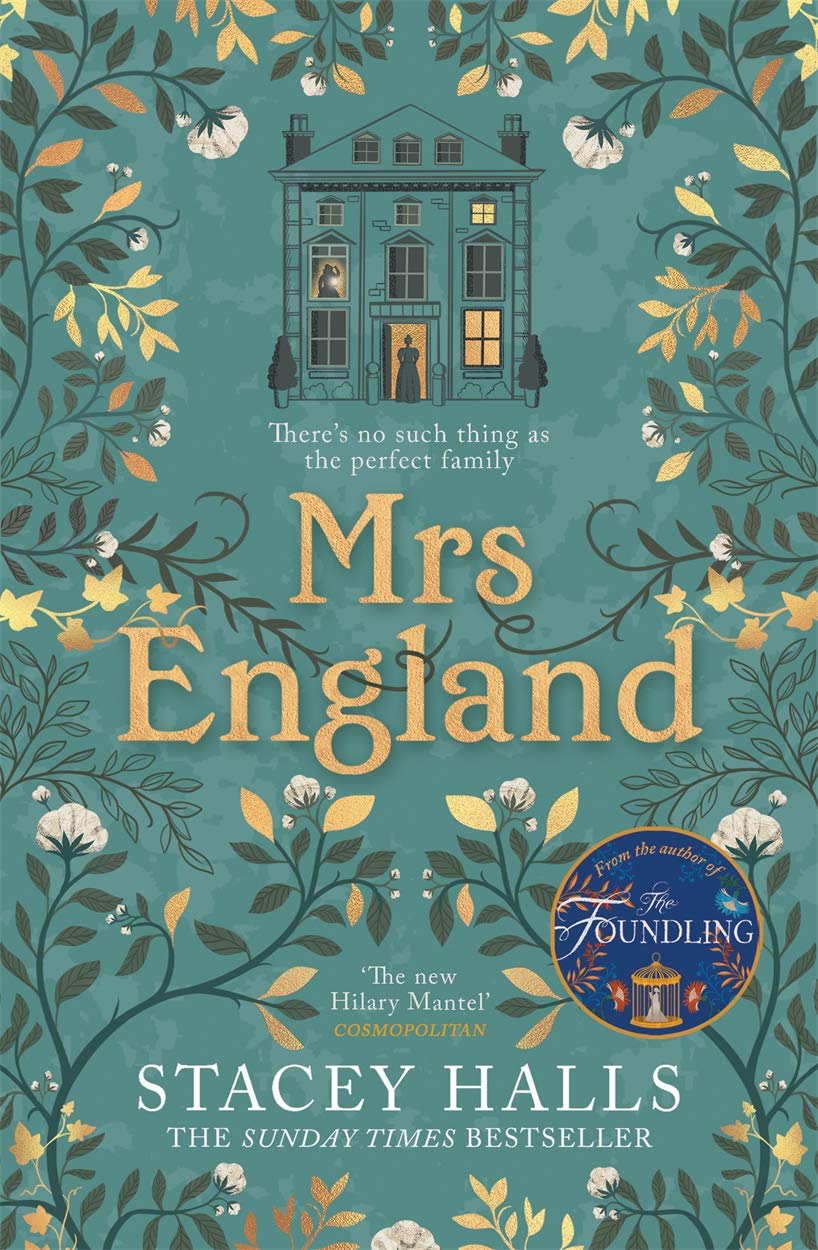
Mrs. England by Stacey Halls

A spruce green cover has botanical illustrations framing a manor house with a woman silhouetted in the doorway.

by Piyali C.

One of my favorite quotes about friendship is the famous one by C.S Lewis: “Friendship is born at that moment when one person says to another: ‘What? You too! I thought I was the only one.” My friendship began with my library colleague who introduced me to Stacey Halls in the same way. We bonded over Daphne Du Maurier, our mutual love for Jane Austen, historical fiction, and literary fiction. So, when she brought The Familiars by Stacey Halls to my desk and said, “Here read this. I know you will like it,” I knew I should drop everything and read it. I did not like it – I loved it.

The Familiars is a story of two women in early seventeenth century England, both fighting for survival. Mistress Fleetwood Shuttleworth is determined not to lose her fourth baby like the ones before and Alice Gray needs to prove she is not a witch during the infamous Pendle Hill witch trial of 1612. Alice is a skilled midwife with extensive knowledge of herbs, and Fleetwood needs her help to save her unborn baby as well as her own life. When Alice is accused of witchcraft and imprisoned, Fleetwood is ready to go to any lengths to prove her innocence. Not only is the story superbly written and well-paced, it shows tremendous character development of the protagonist. One may wonder if all the steps taken by Fleetwood in her quest to free Alice are plausible given the time period, but I embraced her actions wholeheartedly and willed her on to succeed. 

In Mrs. England, Norland Institute graduate Ruby May is looking for a fresh start after the family she worked for emigrates to United States. Although the Radlett family would dearly love their Nurse May to travel with them to America, she is unable to do so for a reason undisclosed at the beginning of the story. In 1904 women from the upper echelon in England are completely dependent on nurses for the care of their children, preferably from the prestigious Norland Institute. Nurse May gets her second assignment without much delay. However, she will have to travel to cold, foggy West Yorkshire to take charge of four children of a wealthy couple, the Englands of a mill dynasty. After reaching her destination, she is surprised to find that she is taking directions about the children’s routine from the friendly and easy-going Mr. England, while Mrs. Lilian England is aloof, cold, and withdrawn. While Ruby develops a nurturing and loving relationship with the children, she simply cannot figure out the mysterious couple for whom she works. When she feels the lives of the children are in danger, she must dig deep within her and ultimately face her fears. While caring for the England children and figuring out the power dynamic in the Edwardian marriage of the Englands, Ruby learns to make peace with her past and only then can she break free from the chains that hold her captive psychologically. 

Fans of Daphne Du Maurier will love this atmospheric, gothic tale and the shroud of mystery surrounding both Nurse May as well as Charles and Lilian England. Although Nurse May’s character is likeable, the readers know she is hiding a secret so a niggling doubt about her reliability as a narrator remains in the readers’ minds. When we get introduced to the England family, the readers have a challenging time believing the authenticity of Charles England’s affability. There is something inauthentic about his outward friendliness. Lilian England is easy to dislike due to her coldness towards her children. Yet there is a vulnerability in her which questions even our dislike for her. Readers vacillate between who to believe – the charming Mr. England or the aloof Mrs. England. And just when we think the mystery has been resolved, we read the last line – just one single line and get a jolt. All the twists and turns that captivated us and kept us turning pages, all that we believed was resolved gets thrown into question and as we finish the book, we start rethinking the whole mystery all over again. 

Mrs. England is available in print, in ebook and in eaudiobook. 

Piyali is an instructor and research specialist at the Miller Branch of HCLS, where she co-facilitates both Global Reads and Strictly Historical Fiction and keeps the hope alive that someday she will reach the bottom of her to-read list.