
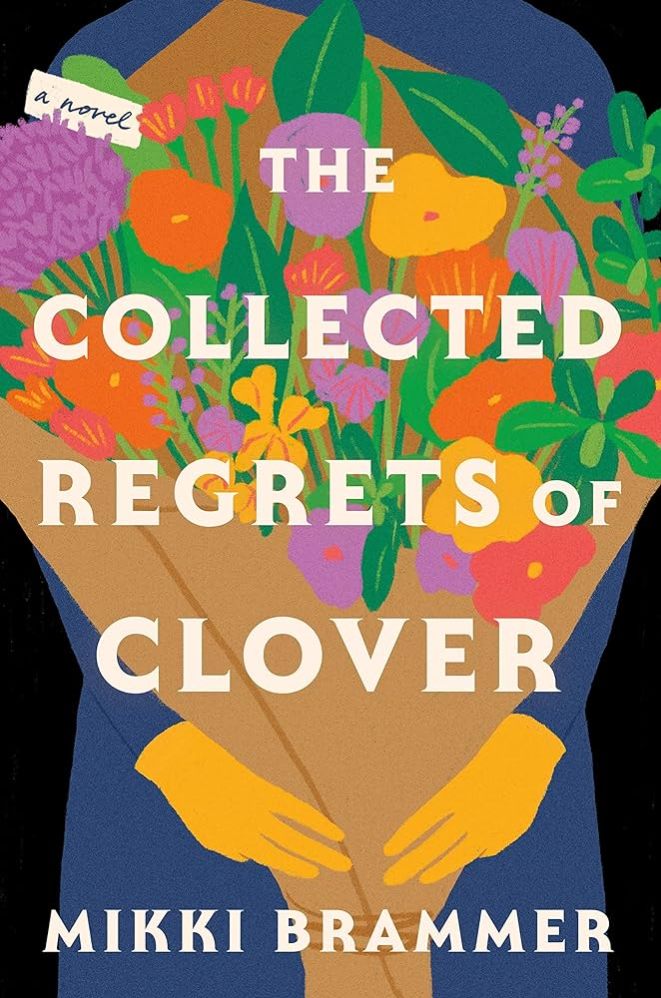
The Collected Regrets of Clover by Mikki Brammer 

A collection of flowers wrapped in florist paper hide the person holding them, so you really only see the hands and blue clothing. All done in pastel illustration.

by Piyali C.

Clover Brooks’ first encounter with death was when she was just five years old. Clover’s kindergarten teacher died suddenly in front of a roomful of kindergartners. The other children screamed and cried; little Clover gently touched the hand of the deceased teacher. At age 6, Clover lost both her parents in an accident overseas and was raised by her erudite grandfather in Manhattan, NY. Her quiet grandfather’s expression of love did not involve hugs or display of emotions, his love for Clover was of a deeper kind. He encouraged her to think, be curious, and love books. An introvert by nature, Clover embraced her grandfather’s love of solitude. She is perfectly content (or so she thinks) to spend her days reading in her apartment with her bulldog, George, and two cats, Lionel and Lola.

We meet Clover Brooks thirteen years after her grandfather’s death. She lives in the same apartment where she grew up, surrounded by her grandfather’s possessions that she does not want to get rid of, and almost friendless except for one 87-year-old neighbor, Leo, who was also her grandfather’s friend. After her grandfather died alone in his office while Clover was traveling the world, she chooses the profession of a death doula. Clover, who has a degree in thanatology (the scientific study of death and the practices associated with it), can bring solace to a tired and scared soul as they get ready to move on to eternal rest.

However, she cannot quite figure out how to connect with the living. 36-year-old Clover’s social life, when she is not sitting by the bedside of a patient, is limited to attending death cafes all around New York. Death fascinates her but not in a morbid way, as she sees death as a transition. This transition is often scary. Clover tries to ease it by being present, listening, and talking to the patient and their family. She is comfortable with the process of death. It is life that she cannot understand. How does one live their life meaningfully, without regret? At one such cafe, Clover comes across Sebastian who needs her help to prepare his grandmother Claudia for her imminent death. While Clover helps Claudia, an esteemed photojournalist, prepare for her transition, Claudia, along with a new neighbor, Sylvie, teach Clover how to live, connect with fellow humans, and even open her heart to love. 
 
The Collected Regrets of Clover by Mikki Brammer is about finding the courage to live one’s best life, which is only possible if one can let go of past regrets. This story is about showing grace not only to others but also to one’s own self. Clover’s loneliness, her yearning to understand other fellow human beings, her tentative attempts at friendship, her regrets, her compassion for the dying, and ultimately, her growth and her freedom from her past endeared her to me. I cannot say I loved Clover at the start of the novel but she grew on me. She came out of the pages of the book and became real. I believe Clover’s story would generate an interesting discussion in book clubs.

The Collected Regrets of Clover by Mikki Brammer is available in print, e-book, and e-audiobook.

Piyali is an instructor and research specialist at HCLS Miller Branch, where she facilitates two book discussion groups: Light But Not Fluffy and Global Reads. She keeps the hope alive that someday she will reach the bottom of her to-read list.

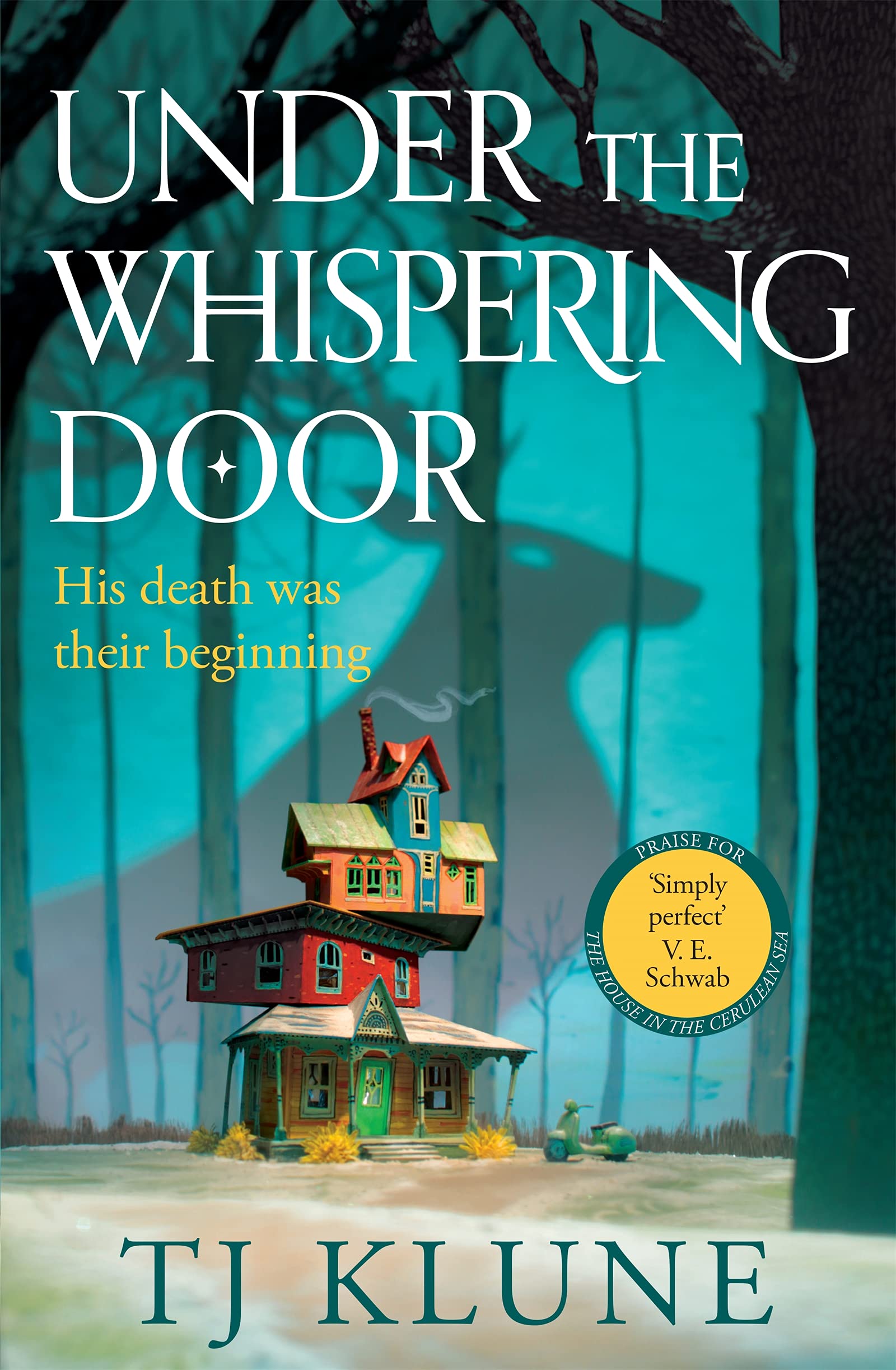
Under The Whispering Door by TJ Klune

The illustrated cover shoes a topsy-turvel house in the clearing of a large wood. The shadow of a large stag appears behind the house.

by Sahana C.

Loss is not an easy subject matter. The nuances of grief and grieving, mixed with the general sense of well-what-comes-next is hard to grapple with. And yet somehow, in Under the Whispering Door, TJ Klune has delivered another gentle reminder to readers that the best way to endure, survive, and eventually thrive through hardship is by finding your people, letting them help you and love you, and helping and loving them in return.  

An illustration shows a raggedy spit of land above a blue sea, with a red house with lots of windows at its very edge. Windswept trees and a blue and pink sunset sky frame the house.

Folks who know the author’s work after reading The House in the Cerulean Sea might be surprised, at first, by the level of angst present at the outset of this book. After all, if Cerulean Sea could tout the Antichrist as one of its main characters and still feel light, fluffy, and comforting, surely this novel about dead people can’t be that deep.  

Apparently, it can though.  

Most of that is due to the fact that Wallace Price, the main character, is simply obnoxious and unpleasant at the beginning. He is so unlikable in the very first chapter, so out of touch, that I wasn’t sure I wanted redemption for him. He got what he deserved, dying at the end of the first chapter. This is not a spoiler, the man is dead throughout the book. The main character is, in fact, a ghost-or-something the whole time. A fun time is had by all, except Wallace, when he dies.  

Seeing the other characters humor him and tease him was a relief because he was just so darn unpleasant that I didn’t much care how he’s feeling about being dead. Until, suddenly, I did. Without my knowledge or consent, I suddenly cared about Wallace, and that is precisely the magic that TJ Klune makes. He sneaks these strange characters on readers, makes it very clear that the characters are mostly a menace to society and not very good at being people, and then gently, steadily, these characters are shown how to be good people, how to care about others, how to crave belonging like they never have before.  

There is a tenderness with which Wallace is treated by Hugo, a man who is very important in Wallace’s undeath. Equally important are Mei, the Reaper who comes to collect Wallace’s soul-or-equivalent, Nelson, Hugo’s boisterous and larger than life grandfather, and Apollo, the dog.  

Difficult scenes force readers to confront loss in a very real way, and they are masterfully interspersed with incredible levity. Things like Wallace suddenly remembering he’s dead and sinking through the floor as the rest of the group does nothing to help but laugh are both incredibly funny and also the moments that Wallace is learning the most. The sad parts are to be expected, but as Wallace himself begins to use as a mantra: the real lesson is in unexpecting

This is a character driven novel, of course, because when considering something as deeply personal as loss, one must return to the people that are experiencing the emotion. The way that Klune uses all of the characters to fill in any gaps in Wallace’s story, but also allows them to have their own back stories, personalities, and flaws without detracting from Wallace’s growth, is a delicate balancing act that Klune has down to a science.  

Ryka Aoki, author of Light from Uncommon Stars , described the book beautifully, saying, “There is so much to enjoy in Under the Whispering Door, but what I cherish the most is its compassion for the little things―a touch, a glance, a precious piece of dialogue―healing me, telling me that for all the strangenesses I hold, I am valued, valid―and maybe even worthy of love.” 

This book is about healing and holding yourself accountable. It’s about always having more to learn, but having to be willing to learn it. It does not force, but gently asks a reader to consider, Am I happy? Am I doing what I want, surrounded by the people I love? What do I have to do to get there?  

And most of all, whatever you expect to happen here, wherever you think the story is going to go, unexpect it. Wallace was right. It’ll get you there faster.  

Under the Whispering Door is available in print, eBook, and eAudiobook.  

Sahana is an Instructor and Research Specialist at the Savage Branch. She enjoys adding books to her “want to read” list despite having a mountain of books waiting for her already.

The Solace of Children’s Picture Books on Death and Grieving

A collage of eight books. All Around Us depicts a woman's face, eyes closed, with a rainbow in the background. One Wave at a Time depicts a child with a sad expression on a beach with waves crashing in the background. A Map into the World shows a girl crouching to draw a house on the sidewalk. The Rabbit Listened shows a toddler clutching a toy rabbit. The Tenth Good Thing About Barney depicts a family of four looking out over a lake in the sunshine. Cry, Heart, But Never Break depicts the figure of Death having tea with a child who appears to be asking a question or imploring, with her hand on his arm. The Goodbye Book shows a fish in a bowl with a sad expression, and a picture of another fish, presumably a deceased friend, in a thought bubble over its head. Something Very Sad Happened shows a mother and child walking in the woods, with leaves falling all around. The child is clutching a robot toy.

by Emily T.

Sometimes there are just no words.  

For families talking with children about death and grieving, the words we want can be especially hard to find. But we are not alone. Heartfelt picture books are one of my favorite sources of solace. In aiming to speak clearly to children, the best ones are both simple and profound. They can help us open doors to deeply meaningful conversations. When we invite a child to read these stories together, we offer a special comfort.  

Fred Rogers described it this way:  

“Anything that’s human is mentionable, and anything that is mentionable can be more manageable. When we can talk about our feelings, they become less overwhelming, less upsetting, and less scary. The people we trust with that important talk can help us know that we are not alone.” 

Maybe a child is grieving the death of a pet, friend, or family member. Maybe they are struggling to understand the tragedy of the current pandemic. Even if death is not on the doorstep right now, the following books can help a child understand what death means, the emotions that can come with it, and how they can process it all with someone they trust.  

Read through these books before inviting your child to share them. See how they suit you and if they are appropriate for your child’s age and experience. Don’t be afraid to change up the stories to personalize them to your child’s circumstances. Or, simply look through the pictures while your child tells a story or talks about their own experience. Sometimes a child just needs someone to listen. 

Something Very Sad Happened: A Toddler’s Guide to Understanding Death by Bonnie Zucker 

Simple, direct language tells this story for the littlest ones. Notes to parents and caregivers are included to help guide the reading. (Ages 2-4) 

The Rabbit Listened by Cori Doerrfeld 

A tumbled tower of blocks represents loss in this sweet story of a grieving child searching for comfort. (Ages 3+) 

The Goodbye Book by Todd Parr  

A grieving goldfish demonstrates the various physical and emotional ways we might process the death of someone special to us. (Ages 3+) 

One Wave at a Time: A Story About Grief and Healing by Holly Thompson 

Poignant and beautiful, a young boy describes the waves of many different feelings he experiences after his father dies. (Ages 4+) 

The book cover depicts a grandfather and grandchild holding hands and walking outdoors in a colorful scene, with a tiger, peacock, kite, and assorted flowers in yellow, blue, and orange tones.

Grandpa’s Stories by Joseph Coelho 

When her beloved grandfather dies, a young girl’s cherished memories of all their seasons together help her grieve and honor their forever bond. (Ages 4+) 

A Map Into the World by Kao Kalia Yang  

When a child wishes to comfort a grieving neighbor, her own grieving process comes to include creative and supportive expressions of condolences and connection. (Ages 5+) 

All Around Us by Xelena González  

A young girl and her grandfather honor the many circles of life they see, placing birth and death in a bigger picture of nature’s cycles and family traditions. (Ages 5+) 

The Tenth Good Thing About Barney by Judith Viorst 

Through a backyard funeral ceremony for his cat, a young boy finds comfort in memories and the circle of life. Questions of the afterlife are raised and left open. (Ages 5+) 

Cry, Heart, But Never Break by Glenn Ringtved 

Death itself takes the personified form of a compassionate cloaked visitor in this gentle story of four siblings coming to terms with their grandmother’s imminent death. (Ages 5+) 

For further support for your child, please be sure to reach out to your child’s physician, school, religious or spiritual community, or a mental health professional.  

Additional resources 

Sesame Street in Communities | Helping Kids Grieve

The Dougy Center: The National Grief Center for Children & Families 

National Alliance for Grieving Children (NAGC) – GriefTalk Resource Guides (Birth – High School) 

Actividades del NAGC – Respondiendo al Cambio & Pérdida (Español) 

Emily is a Children’s Instructor and Research Specialist at HCLS Elkridge Branch. She enjoys reading, knitting, and sunshine on her shoulders.