The Frozen River by Ariel Lawhon

The book cover depicts a woman in a red coat from an overhead view, walking down a frozen path with icy trees on either side of the path.

By Piyali C.

Set in a small town called Hallowell in Maine, the year is 1789. Maine is in the throes of winter and the mighty Kennebec River has frozen, entombing a man in the ice. The midwife and healer of Hallowell, Martha Ballard, is called to examine the body and determine the cause of death. Several months ago, the wife of Hallowell’s pastor, Rebecca Foster, was allegedly raped by two prominent citizens of Hallowell; one of them, Joseph Burgess, is the man found dead, stuck in the ice. There are horrific bruises on the body of the dead man to indicate that he may have been murdered before being thrown into the river. This incident pushes the sleepy town of Hallowell into an intricate legal battle, full of conspiracy, power plays, and intrigue. The punishment for rape is death, but proving rape is almost impossible.  

Martha Ballard finds herself deeply entrenched in all of this, as she was the one who determined that Rebecca Foster had been raped after examining her bruised body. By doing so, Martha makes some powerful enemies, and they try to intimidate Martha by targeting her husband and children. But Martha, who has learned to read and write at a time when women were discouraged from doing either, kept records of the weather and her activities in midwifery every day of her life. She is called to be a prominent witness and her journal plays a pivotal role. Having read The Sewing Girl’s Tale by John Wood Sweet not too long ago, I knew that this trial to prove rape and hold the perpetrators accountable in the late 1800s would likely be an exercise in futility. 

This book, unlike Lawhon’s other ones, is inspired by true events but not based on them. She admits that she took real-life characters and while relying heavily on historical facts, she fictionalized certain aspects of the story to make modern readers completely immersed in the plot and the characters. Martha Ballard indeed kept detailed accounts of her daily life, profession, and weather throughout her life. She was called regularly to court to give her professional opinion on cases relating to rape, children born out of wedlock, murder, and female promiscuity at a time when women were not allowed to enter courthouses without the presence of their husbands or fathers. She was respected for her midwifery, and it has been recorded that she made no distinctions between White or Black mothers at the time. There were 12 free Black families living in Hallowell according to the census, and Martha delivered babies of every color. Martha Ballard is the great aunt of Clara Barton, founder of the American Red Cross. And according to the author’s note, “She is also the great-great-great grandmother of Mary Hobart, one of the first female physicians in the United States. She left a medical legacy in this country that is unmatched. And it is thanks to the diary she kept.” 

I had a difficult time putting this book down, not simply because of the mystery surrounding the death of Joseph Burgess or the rape case, but because of the courageous protagonist and her determination to tell the story of women at a time when they were subjugated. The characters are superbly etched. They came alive in my mind as I read the book and so did the frigid winter of Maine. The writing is beautiful, lucid, and atmospheric. I lived in Hallowell in the deep, dark winter, witnessing the events alongside the Ballard family as Ariel Lawhon navigated through the lives of the characters in this book, documenting their joys, sorrows, triumphs, and losses. 

The Frozen River by Ariel Lawhon is available in print and large print, as well as e-book and e-audiobook formats.

Piyali is an instructor and research specialist at HCLS Miller Branch, where she facilitates Light But Not Fluffy and co-facilitates Global Reads. She keeps the hope alive that someday she will reach the bottom of her to-read list.

Is the Future Bright? 

A bright yellow cover, with a Warhol-like pink and yellow face above the title in bold block letters.

By Cherise T.

The eyes. The hot pink. The electric yellow. The cover of Bright Young Women demands attention and so does its story. Attempting to avoid bias, I tend to barely scan flyleaves and reviews. I don’t want to know before I find out for myself. I read just enough words to get a hint of the plot. For this book, “serial killer” was all I needed to see for me to put the book back on the shelf. Although I’m a big Dexter fan, I did not want to volunteer for more sleep-disturbed nights and uneasy days. But then a coworker recommended it, so I took the plunge. 

The idea of writing about a serial killer from the perspective of an attack survivor is not innovative in and of itself. However, author Jessica Knoll has written a unique feminist perspective on the Ted Bundy story. The murdered and assaulted are bright young women living in the academically highest-achieving sorority governed by its formidable president, Pamela Schumacher. Pamela expertly controls all aspects of her sisters’ lives, from maintenance of the sorority house to fashion advice. On the fatal night when her closest friend is murdered, Pamela crosses paths with the killer (referred to only as “the Defendant”), becoming the only reliable eyewitness.  

Forty-five years later, Pamela, now an attorney, is notified that there is additional information on the crime, and so begins the reader’s journey between past and present. We follow the events of that 1978 night at Florida State University. We meet Tina Cannon who travels to Florida in 1978 to meet Pamela. Tina hopes to link the 1978 atrocities to the 1974 disappearance of her friend in Washington state. The detectives resist connecting the two events, and the many murders and attacks in between, to one killer. 

The triumphs of this novel emerge in Pamela’s and Tina’s narratives. While researching Ted Bundy after I finished this book, I learned even more about the significance of the decisions Knoll has made in crafting this historical fiction. She intentionally addresses how the police and university behaved in the wake of the murders. Knoll takes on the cavalier treatment of the students after the trauma and how they were expected to return to school without additional security or support. She describes the often absurd content of the trials and the cases’ news coverage. She includes the public’s ongoing fascination with the mysterious man who evaded capture and was eagerly embraced as intelligent and attractive despite factual evidence to the contrary. 

The concept of media manipulation of readers and viewers has contemporary resonance. This novel skillfully develops each character’s perspective without losing track of the timeline of evidence. Bright Young Women simultaneously exposes how far society has come and how far it has yet to go in addressing the ways facts are researched and presented.

Bright Young Women is available from HCLS in print and in e-book and e-audiobook formats.

Cherise Tasker is an Adult Instructor and Research Specialist at the Central Branch. When not immersed in literary fiction, Cherise can be found singing along to musical theater soundtracks. 

The Storm We Made by Vanessa Chan

A woman's face in profile, looking to the left, is blurred across the cover.

by JP Landolt

My sister-in-law recommended this book, and I’m glad she did! I could have read this book in one sitting if had I the time and stamina. It was one to be devoured. My SIL shared with me how she loved the descriptions and how she wished she had a little more background knowledge for some of the scenery or architecture described. I think that’s a fair desire, especially since when most people think about historical fiction during WWII, they tend to think about the European theater, not the Pacific. Then, when people do consider the war in the Pacific, it’s still in reference to American involvement with Pearl Harbor and the atomic bomb. Truly, your background knowledge depends on which side of the world you grew up and the history you were taught.  

I felt at home, in a way, because this book brought Guam back to me with its descriptions of the climate, flora and fauna, and customs. Malaysia is not all that different from the island, except that Malay is the main language and it is slightly hotter year-round. My father was eight years old when he had to flee his town in the Philippines and hide in the mountains. He told me how he hid in the back of a truck under packed bags and a blanket, eating peanut brittle. He shared with me some of the more frightening tales involving a shootout and watching a beloved caregiver dying while he was pulled away. Then, how he became unlikely friends with a couple of Japanese soldiers when he was 11 or 12 years old, trading fish for candy and playing games to pass the time. All his stories came to mind while reading this book, so it felt real and true to me.   

This debut novel is set in Bintang, Kuala Lumpur during the British rule and Japanese occupation of Malaysia. We engage in a kind of transformative-grief-time-travel that colonization and war bring through the experiences of a mother and her children. The descriptions and feelings in this story, told through the perspectives of four of the characters, are great. The nosy and gossipy neighbors, the heat and humidity that make clothes cling to skin, the internal anger and disgust that comes from being oppressed, the temptation and seduction of something dangerous and thrilling, and the pain and anguish of not understanding what is happening to you but knowing it’s still wrong.

Chan crafts a remarkable account of the characters who make up the Alcantara family, who are Eurasian and in and out of place simultaneously. Each person is struggling with their place in the family, in their community, and in the world. Grappling with their identity and belonging, they navigate the racism of the British rule only to later struggle with the treachery of war and subsequent Japanese occupation. No one is safe, not even the most innocent and blissfully unaware, who in the end also succumb to the impact of war.  

I appreciated the care with which the author, Vanessa Chan, treats the complexity of the various kinds of relationships within this story. I believe that is because she’s woven parts of her own family history into this fiction, making it feel so true to life. Perhaps you will come to understand how occupation and colonization are the same thing, if only for the difference of time and who you decide are the villains. No person is a perfect hero or a perfect villain. Everyone is human and suffers from the human condition.  

TLDR: I cried. That’s the review. I cried and it was worth it! 

The Storm We Made by Vanessa Chan is available in print and e-book.

JP has worked for HCLS since 2006. She enjoys gallivanting, Jollibee, and all the halo-halo she can eat.

Meet the Local Author: Ned Tillman

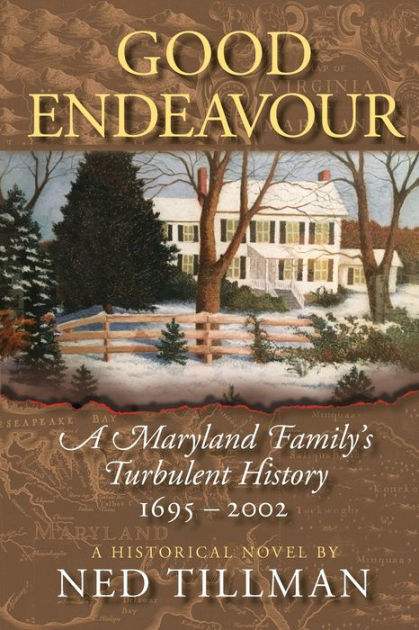
A snow covered white house sits behind a split rail fence, with a pine and winter bare trees in the yard. Old maps of the Chesapeake area are faded into the

Historical Fiction as a Lens for the Future

Monday, Oct 23
7 – 8 pm
Elkridge Branch
with book discussion at 6:30 pm
Registration recommended.


Award-winning author Ned Tillman discusses his new book, Good Endeavor, and how historical fiction provides perspective on the challenges we face today.

In this historical novel full of colorful characters, Ned Tillman conjures up five generations of his family in an engaging look at how they might have dealt with the critical social, economic, and political issues of their time. Centered on the 300-year-old Good Endeavor homestead (where the author grew up), the book incorporates a slew of family stories, unusual family traits, and artifacts passed down through time.

The protagonist discovers artifacts which incites a desire to know more about the past. The book takes the reader through the lives, loves, and losses of five generations, right up to the present day. Along the way the family members encounter vigilante justice, piracy, bounty hunters, abolitionists, suffragettes, land conservationists, barnstorming, union strikes, integration, and war and climate protests.

Tillman is the author of four books — two nonfiction and two fiction. He discusses the value of both genres for telling the stories of our past and how they can be used to get a sense of how life really was like over the centuries. For this book, he considers (per his comments on Amazon):

* What was life really like over the past 300 years?
* How have our key moral issues changed through time?
* How to tell our stories while breathing life and humanity into all of our ancestors.

The House of Eve by Sadeqa Johnson 

A woman in a blue shirt dress, wearing pearls, has her purse crooked into one elbow and an old fashioned suitcase in the other hand. She is walking away from a large house. She is pictured only from the ne

by Piyali C.

Sadeqa Johnson’s late grandmother became pregnant with her mom at the age of fourteen. Her grandfather, however, did not marry her grandmother since he was very light skinned, and he was from the ‘right’ side of the tracks. She was dark skinned and poor. Johnson writes in the Author’s Note that the idea for this book, The House of Eve, came to her as a what-if. What if her grandmother had the money and opportunity to have the baby in a home for unwed mothers, gave the baby up for adoption, and went on to fulfill her dreams?  

The House of Eve by Sadeqa Johnson is a beautiful, searing novel about two young Black women in alternating narratives. It is 1948. Ruby Pearsall is on track to be the first in her family to go to college and accomplish her dream of becoming an optometrist. Ruby struggles to find even the few cents for bus fare to get to her ‘we rise‘ program in school so she can earn a scholarship to college. She is from the poorest area of North Philadelphia and comes from an extremely impoverished family. Although her mother, Inez, is indifferent to her needs, she has her aunt and grandmother who support her with love, shelter, and encouragement even though they cannot help her financially. They want their girl to go to college, become someone important, and make the family proud. But a love affair threatens to destroy her dreams to rise out of poverty. It also threatens to perpetuate the cycle of abuse and financial desperation. 

Eleanor comes from a blue-collar family. Her parents have given their all to send her to Howard University to get a good education and rise up in life. Eleanor appreciates and values the sacrifices of her parents and is determined to excel in school. However, she falls in love with a medical student, William, whose family is one of the most successful Black families in the Washington, D.C. area. William Pride’s mother, Rose Pride, does not let anyone enter their elite circle. Eleanor wonders if a pregnancy might give her an entry into their magical kingdom and perhaps she will feel like she belongs. Ruby and Eleanor’s lives will collide in unexpected ways and the decisions they make will change the course of their lives. 

With the magic of her words in this magnificent work of historical fiction, Johnson transports the readers to the rough neighborhoods of north Philadelphia, the campus of Howard University, elegant ballrooms in Washington, D.C., and the depressing interiors of homes for women who became pregnant out of matrimony. She also depicts the racial segregation that impacted lives of Black people as well as the consequences that women of any color suffered due to unplanned pregnancies at that time. The book paints a horrific picture of the homes run by nuns where unwed women and girls went to give birth; subsequently, the babies were given to wealthy families in exchange for hefty donations to those homes. Themes like colorism, wealth disparity, and social stratification among the Black community are intricately woven into the story, as are mentions of some real-life people and organizations. These make the book authentic and also give readers a glimpse into a slice of 1950s life that the Black community experienced in the United States.

The House of Eve by Sadeqa Johnson is available from Howard County Library System in print, e-book, and e-audiobook formats.

Joan by Katherine Chen

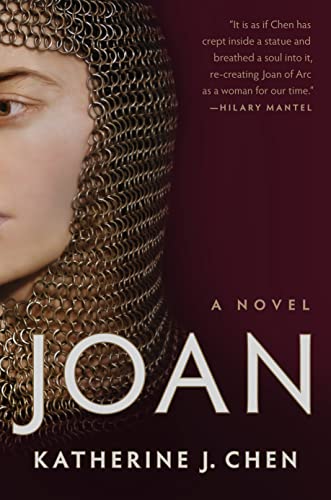
The illustration shows head of the title character in profile, wearing a coif of silver chainmail, against a maroon background.

By Sahana C.

From the very first moment of this book, I was entranced. Joan of Arc has always been a captivating figure, martyred as she was, but I didn’t know much of her other than what they taught me in Sunday School after church —  she was chosen by God to free France and end the Hundred Years’ War, and non-believers had her burned at the stake but she never let her faith waver. She was true, Joan la Pucelle, Joan the Maid, until the moment she died.  

Katherine Chen does not give us that Joan at all. In fact, the prophecies, the visions, the martyrdom that Joan is known for are machinations of the nobility in the Dauphin’s court; Joan is hale, hearty, and her spirit is unbreakable all on her own. Her relationship with her God is not that of a dedicated, unwavering believer, but that of a survivor, someone who will bargain, who will talk back, who will make wagers with her God and win. Joan is a fighter to her core, surviving an abusive father, then trauma and tragedy at the hands of the English. Then she not only survives the battlefield but navigates through French aristocracy and the world of men with no one and nothing on her side except her indomitable force of will.  

I’m reading another book right now about Chaucer’s Wife of Bath and thinking a lot about the ways that women made their own ways in the world, the ways women were forced to protect themselves and safeguard their own lives. I think we’re seeing a surge in popularity of feminist retellings of myth for that exact reason, to humanize the female characters we’ve heard about before but always from a man’s perspective – always fitting into a specific trope or box. What Katherine Chen has managed to do with Joan is just that — Joan, the saint, the martyr, is made human in this book. And no matter how close to God the rest of the world thinks she is, because of the work done to turn her into a mascot, Joan was a girl. Strong enough to best the British, brave enough to lead the French, and fierce enough to ensure she would be remembered.

Joan is available in print, e-book, and e-audiobook. If you’re looking for an inspiring, incredibly written read about a historical character that we’ve heard a lot about, but never necessarily in a way that makes her human, relatable, knowable – then Joan is for you. 

Sahana is an Instructor and Research Specialist at the Savage Branch. They enjoy adding books to their “want to read” list despite having a mountain of books waiting for them already.

Babel: An Arcane History

The book cover shows a tall round tower amid various domes and spires in a cityscape, against the dark background of a night sky; birds follow one another in a crooked line wrapped around the tower from bottom to top.

By Sahana C.

R.F. Kuang wrote her first novel at the age of 19, during a gap year from Georgetown. After graduating, she became a Marshall Scholar, studying at both Cambridge and Oxford University, graduating with a Master’s in Philosophy and a Master’s in Science, respectively. She’s currently in the midst of pursuing her PhD at Yale. R.F. Kuang knows a thing or two about what it means to be entrenched in higher education.  

Babel: An Arcane History is about a love affair with academia, and what that means as a person of color. For POC within institutions like Oxford, ones that have histories and wealth based in colonialism, pursuing higher education can feel like an act of betrayal, where the choice is between building a future and acknowledging the crimes and pain of the past. The novel juxtaposes this internal conflict with a parallel betrayal that ties together the rest of the book: the theory that every act of translation is an act of betrayal.  

It is the 1800s and Robin Swift, our protagonist, is taken from China by a professor, one who works in Oxford University’s prestigious Royal Institute of Translation, known colloquially as Babel. He’s thrilled to be invited to the Royal Institute, even more excited to be a Babbler, and intensely enamored of his cohort, his classes, and the campus. Despite all of the racism, discrimination, and academic pressure, Robin loves his work. He loves being a translator, and he loves the access to silver-working – where an act of translation inscribed on a silver bar produces magical effect. Robin and his cohort (Ramy, from Calcutta, Victoire, from Haiti but raised in France, and Letty, from England, but a woman in a time where her family could not accept that she wanted to study) work tirelessly to learn and advance in their skills of translation. They learn about the ways that translating fails: ciao means hello, yes, but hello doesn’t fully encapsulate the meaning ciao conveys, as it can also be a farewell. There is inherently an incongruence here – either a translator can be faithful to the text or to the intention of the text, but it can scarcely ever do both. Regardless, a choice must be made; regardless, a betrayal occurs. Robin is thrilled to be a part of the Royal Academy, but the idea of this betrayal lingers.  

But throughout his time, Robin has concerns that Babel might not be as utopian as it seems. The Royal Institute’s mission to study foreign languages empowers the British Empire and aids them in their quest to colonize the world. The more Robin and his friends learn, the more they wonder if all this betrayal is worth it, and if they can manage to ignore all the ways their work could be used against people like them, despite the Royal Institute’s claims that Babblers are all that they are.

I was not expecting to fall as madly in love with this book as I did, partially because the novel takes on the physical dimensions of a literal brick, and partially because it was recommended to me on Booktok, and I’ve learned to be wary. But I devoured this book, as complex as it is. The concepts of language, linguistics, and translation are woven so deftly, and the debate on how to push back against colonialism is nuanced and careful. R.F. Kuang never tells her reader what to think; she just introduces critical concepts through the lens of dark academia, and asks the reader to decide: can we disrupt systems of colonialism and colonial thought through work, collective action, and communication, or is violence necessary to dismantle the systems put in place? R.F. Kuang doesn’t claim to know, and she’s firmly entrenched in academia herself. But through Babel, she is asking the questions. Is there ever a “right” thing to betray?

Babel: An Arcane History is available in print, ebook, and eaudiobook.

Sahana is an Instructor and Research Specialist at the Savage Branch. They enjoy adding books to their “want to read” list despite having a mountain of books waiting for them already.

A Ballad of Booth 

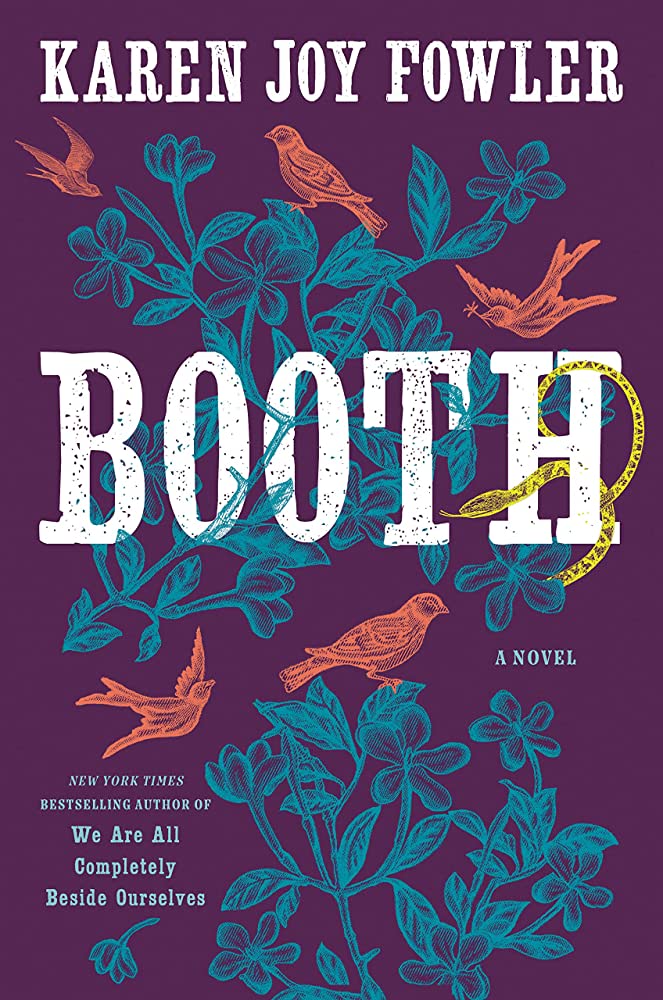
Against a deep indigo cover, naturalist sketches of teal flowers and orange swallows intertwine with the big block letters of the title. A yellow snake appears in the H.

by Cherise T.

Notorious. Home to many historical figures, Baltimore lays claim to one of the most reviled, John Wilkes Booth. Legendary. The pinnacle of theatrical performance, Shakespearean acting claims Junius, John’s father, and Edwin, John’s brother, as two of its finest. Radical. One of the highest acts of rebellion, the Underground Railroad claims Richard Booth, John’s grandfather, as one of its aides.  

Booth, by Karen Joy Fowler, explores these, and many other, aspects of an infamous family. The bestselling author of We Are All Completely Beside Ourselves, Fowler has written another dysfunctional family novel. Booth will engage readers interested in local Maryland history, the Lincoln assassination, and disturbing tales of family legacy.  

Enraged by the gun violence epidemic, yet not wanting to glorify an assassin, Fowler began researching the Booth family. With the goal of placing John Wilkes Booth in a broader sociological context, Fowler presents a detailed portrait of Booth’s first-degree relatives as well as his ancestry. I marveled at how the Booth family was at once isolated from and central to the politics surrounding the Civil War. We discover the abolitionist leanings of the majority of the Booth family and gain a limited glimpse into John’s radicalization. I learned a lot but was also left wanting to know more about John’s motivations and the repercussions for his family after the assassination. 

Fowler documents the timeline of Abraham Lincoln’s life alongside the lives of the Booths. We see the violent partisanship that has always been woven into the fabric of US history. At times I wondered why this book had not been written as narrative nonfiction instead. Similar to a solid history text, Booth documents significant quotes, historical events, and primary sources. We learn that Junius Booth frequented the Green Dragon Tavern, a Boston bar where you can still grab a drink. Fowler describes the construction of Tudor Hall, the Bel Air home of the Booths that remains open for tours.  

At the heart of the novel are the stage actors in the family, Junius, Edwin, John, and Junius, Jr. Both Junius and Edwin were internationally renowned for their stagecraft and self-destructive alcoholism. One of the joys of the novel is found in figuring out the sources of Shakespeare quotes the family members use as part of their daily communications. They are a theater family at their core. John was the ninth of ten children, four of whom died before reaching adulthood. Fowler traces these deaths to the lasting impact on the fates of family members. She depicts John as the light of his mother’s life, the golden child born to help ease the family’s pain. 

The novel is well researched, beautifully written, and provides a unique perspective on the Civil War in the context of one family’s experience. The reader connects with the men and the women in the family, as well as their associates, friends, and love interests. Booth would be an excellent choice for a book group discussion.  

Cherise Tasker is an Adult Instructor and Research Specialist at the Central Branch. When not immersed in literary fiction, Cherise can be found singing along to musical theater soundtracks. 

Am I Southern? Does It Matter? 

A Black woman with short hair looks pensively downward. Along the bottom, a black and white photo of slave quarters is superimposed, and the edges are faded like an old photograph.

by Eric L.

I recently read Kindred by Octavia Butler in my book discussion group. It was my first exposure to Butler, and I like both her style and the book overall quite a bit. We also read the graphic novel as a supplement. I recommend it, too, as the illustration and style were excellent.

Written in the 1970s, the plot concerns a Black woman from Los Angeles who is mysteriously transported back to the antebellum south, specifically to the eastern shore of Maryland. It continues to happen, and each time the protagonist remains a bit longer. The time she stays in the past is greater than the length of time she is missing from 1970s L.A. It goes without saying that the past is terrible for a Black woman. 

Hence my question about being southern. As someone from Baltimore, I tend to view myself as an “enlightened north-easter.” However, the racial history of this country is something that should be given some thought. It’s not just a southern plantation owner issue that ended in 1863.

Dana is a writer. Her husband is also a writer, and he is white. I’d rather not give too much away so you can read the book to determine why this is happening, but in a little bit of a spoiler, she has relatives on this plantation that she returns to again and again. One of them, who eventually becomes the plantation owner, is white; the other is a Black woman, technically a “free” woman. It’s not exactly the freest environment even if you’re not enslaved.

Her reminiscence about how she met her husband is sweetly romantic and interspersed throughout the book. The juxtaposition of the recent past, the present, and the distant past is an interesting story technique. At one point, her husband purposefully holds on to her during one of her time travels in an effort to accompany her. As a white man, he obviously has a much higher social standing than she does and hopes to provide some protection. He is successful, to some extent. She wonders if he will somehow be changed by spending time in this time period. Really, she’s wondering how anyone could not be changed, herself included.  

The discussions and disagreements between the two of them about common misunderstandings between men and women, Black people and white people, are telling. The whole book offers a compelling study in empathy. The protagonist’s own status as a free Black woman and a visitor to the plantation, along with her relations with both white people and enslaved persons, highlight ideas of jealousy and privilege. That said, Butler deftly deals with the concept of how we all think we’d comport ourselves in oppressive situations. When one’s actual survival is at stake, how outspoken could anyone be with a very real threat of state-sanctioned terror and beatings?  

To be clear: this is not a defense of race relations in the 1970s, or now for that matter. The protagonist experiences profound culture shock (e.g., I could beat you for speaking to me that way). For me, this story further acknowledges the history of those who resisted and fought back against nearly insurmountable odds. The protagonist is forced to reckon with her own privilege in the antebellum south and her relatively comfortable life in 1970s America. She leads you to this by thinking that, in just a few years, Harriet Tubman begins bringing enslaved people to freedom. As a reader you wonder, how? 

This book is the type of fiction that weaves a thought-provoking story with great social and moral commentary. It is my kind of read: messy, complicated, and realistic (except for the time travel). 

In sum, I think I am southern. Maybe many Americans are?

Kindred is available in print, e-book, and e-audiobook.

Eric is a DIY Instructor and Research Specialist at Elkridge Branch. He enjoys reading, films, music, doing nearly anything outside, and people.

The Kitchen Front by Jennifer Ryan

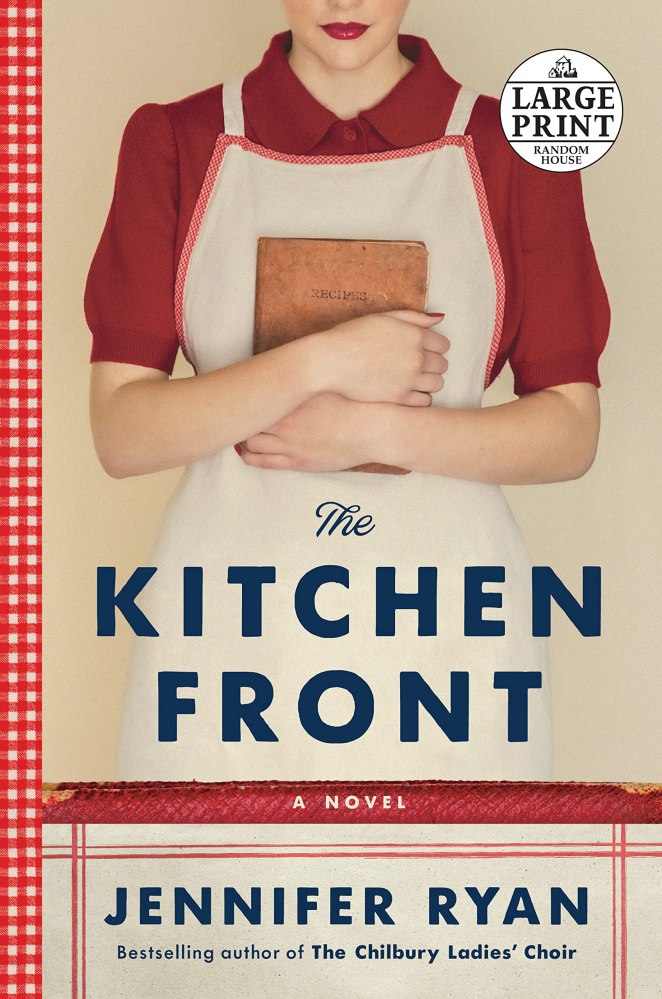
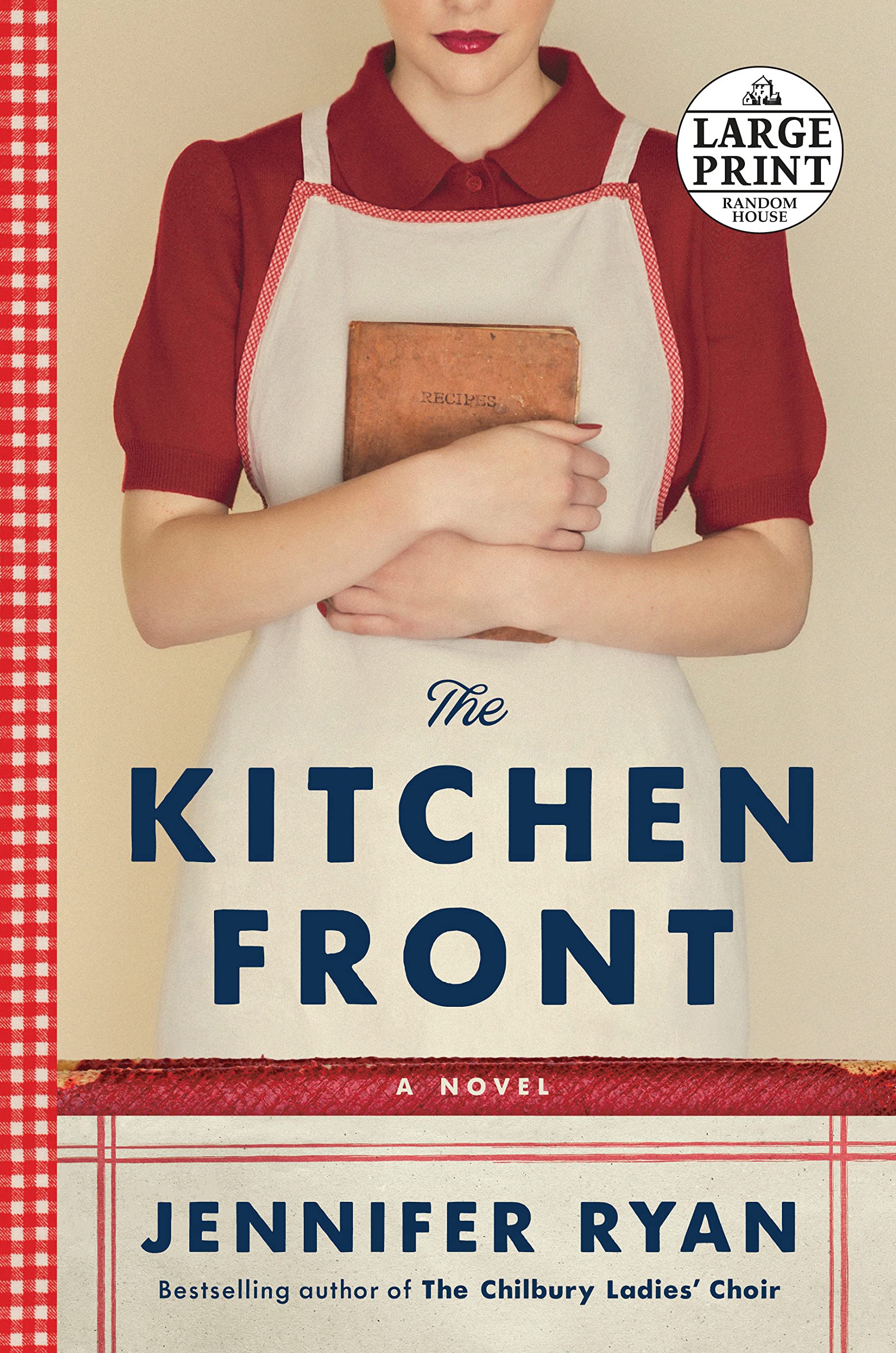
Image of a woman in a red shirt, red lipstick, and a white apron holding a cookbook across her chest. Red gingham boarder

by Kristen B.

The Kitchen Front by Jennifer Ryan could be easily categorized (and perhaps dismissed) as “women’s fiction” since it offers a solid look at four women’s lives in 1942 Britain. I rather despair of idea that novels about women and their daily travails are some how less weighty or less literary than more masculine options. This book is a highly readable reminder that not all the wartime effort took place on the continent and upon the seas, amid spies and battles. The first page provides a list of what a week’s worth of rations were for an adult – and let me tell you, it wasn’t much! Rationing continued in the UK for more than a decade after the end of the war, and I have wondered if we could have sustained that kind of national effort. We tend to look back at the 1950s of a time of growth and prosperity in the US (although not for all demographics), but it was a very different prospect for our allies.

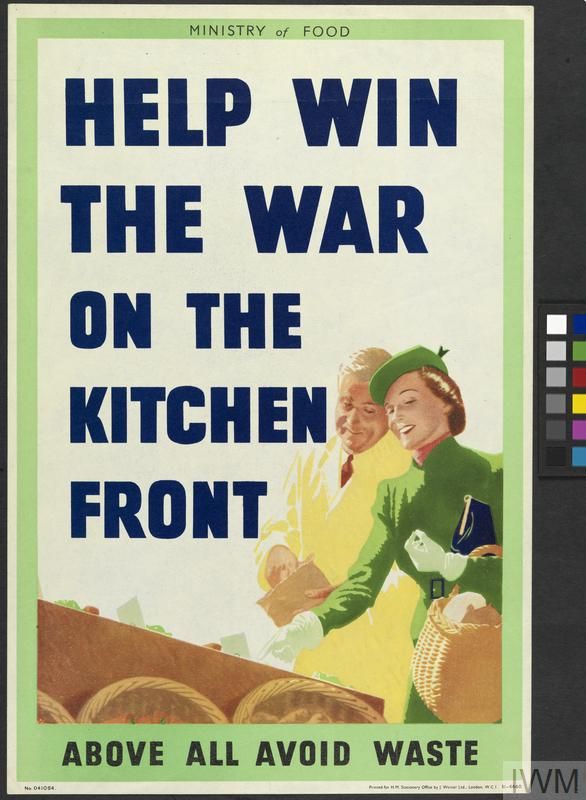
World War II poster featuring a woman in gloves and hat talking to a grocer that read: Help Win the War on the Kitchen Front.

It naturally fell to women to figure out how to make rations stretch to feed their families. In the days before packaged or frozen foods, everything was local and homemade, and the reality was that nobody got enough to eat by modern standards. Gardens (along with pigs, chickens, and bees) were a survival strategy, not just patriotic palaver. The BBC really did host a show called The Kitchen Front, which included ideas and recipes to make rations work and stretch – whether it was tinned sardines, Spam, or some other unfamiliar type of protein, like whale meat. This book starts with that show and adds a fictional local contest to find a relatable female host.

Of the four main characters and contestants in the book, Audrey spends her entire waking life working to feed her family and maintain their house. Her husband was an early RAF casualty, and she has three growing, hungry boys. Her husband was also an artist who mortgaged their home to the rafters, and she is left baking pies and cakes to try to make ends meet. Her home and garden become the center of the story in crucial ways.

The other three main characters each have their own private battles to fight. Gwendoline is Audrey’s sister, though she married up with the local fat-cat businessman and landowner. While a social success, the marriage and the man have proven to be unhappy decisions. The kitchen maid and apprentice cook at Gwendoline’s manor house, Nell, needs a little confidence in her own skills. She provides a young, hopeful perspective. The final woman, Zelda DuPont, worked as a French-trained chef in fancy London hotels before the war brought her to head the canteen at Gwendoline’s husband’s pie making factory. Zelda has fought tooth and nail to succeed in a man’s world before an unscrupulous, handsome cad leaves her heading to the country, an unmarried mother to be.

The convenient machinations of the contest and various plot lines bring all four women together, with Gwendoline having a connection to each of the women but Audrey operating as the beating heart of the story. The plot is mostly predictable, but I didn’t mind that at all. The characters are so wonderful, each in her own way, that I loved spending time with them. Not only did I need to know who wins the BBC contest, I enjoyed their unique points of view and individual struggles. Is it better to marry for love or money and position? Is it better to have a career or raise a family? It is better to be in service or more independent? There are no right answers, but women still struggle with these questions and the myth of “doing it all.” But when we support each other and do it together, everyone wins.

The Kitchen Front is available in print, large print, ebook, and eaudiobook.

Kristen B. is a devoted bookworm lucky enough to work as the graphic designer for HCLS. She likes to read, stitch, dance, and watch baseball (but not all at the same time).