
For adults. Registration required.
Thu, Sep 21 | 6 – 7 pm
Howard Community College
Monteabaro Recital Hall (free parking available)
10901 Little Patuxent Pkwy, Columbia
Join us for the annual Bauder Lecture at Howard Community College, featuring acclaimed author Nadia Owusu.
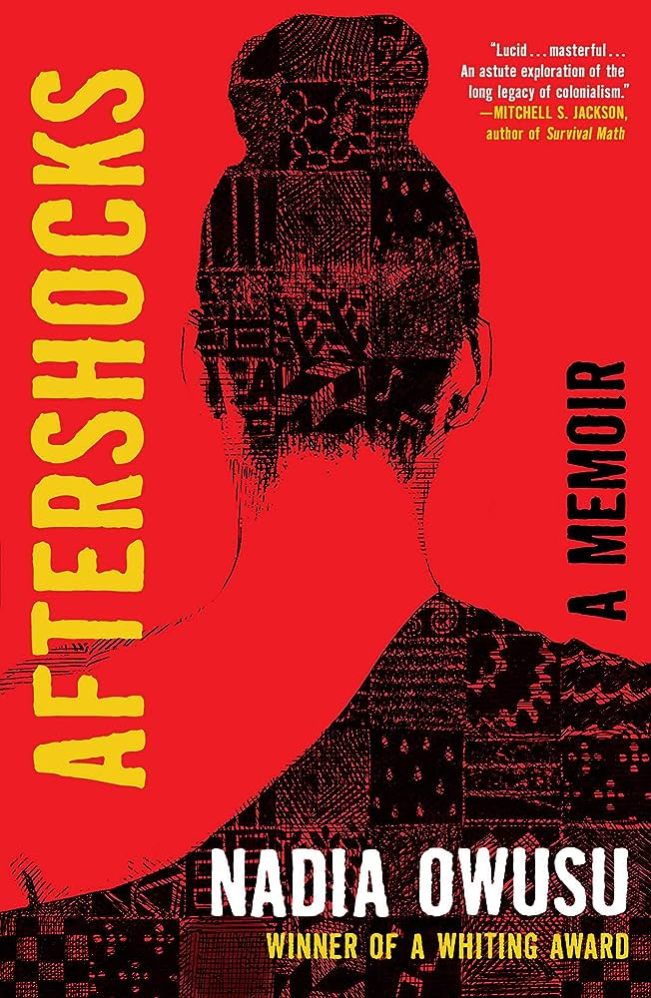
Nadia Owusu is a Brooklyn-based writer and urbanist. Her memoir, Aftershocks, was selected as a best book of 2021 by more than a dozen publications, including Time, Vogue, Esquire, and the BBC, and has been translated into five languages. It was a New York Times Editors’ Choice pick, named one of Barack Obama’s favorite books of the year, and selected by Nobel Peace Prize laureate Malala Yousafzai for her Literati book club.
From the Publishers Weekly review:
The biracial daughter of an Armenian mother and Ghanaian father, Owusu’s early life was fractured by her parents’ divorce and multiple moves necessitated by her father’s U.N. career. Living in Rome at age seven, she was visited by her long-absent mother on the day a catastrophic quake hit Armenia, seeding an obsession with earthquakes “and the ways we try to understand the size and scale of impending disaster.”
Nadia Owusu is the winner of a Whiting Award in nonfiction and has received fellowships from Yaddo and Art Omi. Her writing has appeared in The New York Times, Orion, Granta, The Paris Review Daily, The Guardian, The Wall Street Journal, Bon Appétit, and Travel + Leisure. She teaches creative writing at Columbia University and at the Mountainview MFA program at Southern New Hampshire University, and she is the Director of Storytelling at Frontline Solutions, a consulting firm supporting social-change organizations.
Tope Folarin, a Nigerian-American writer based in Washington, D.C., will be introducing Ms. Owusu and moderating the discussion. He serves as Director of the Institute for Policy Studies and the Lannan Visiting Lecturer in Creative Writing at Georgetown University. He is the recipient of the Caine Prize for African Writing, the Whiting Award for Fiction, and a fellowship from the National Endowment for the Arts, among other awards. He was educated at Morehouse College and the University of Oxford, where he earned two master’s degrees as a Rhodes Scholar. His debut novel, A Particular Kind of Black Man, was published by Simon & Schuster.
The Bauder Lecture by Howard Community College is made possible by a generous grant from Dr. Lillian Bauder, a community leader and Columbia resident. Howard Community College will present an annual endowed author lecture known as The Bauder Lecture, and the chosen book will be celebrated with two student awards. Known as the Don Bauder Awards, any Howard Community College student who has read the featured book is eligible to respond and reflect on the book in an essay or other creative format. The awards honor the memory of Don Bauder, late husband of Dr. Lillian Bauder and a champion of civil rights and social justice causes.
Aftershocks was selected by the Howard County Book Connection committee as its choice for the 2023–2024 academic year. The Howard County Book Connection is a partnership of Howard Community College and the Howard County Poetry and Literature Society (HoCoPoLitSo). Visit the Howard County Book Connection web page for additional information.
Aftershocks is available from HCLS in print, large print, e-book, and e-audiobook formats. HoCoPoLitSo will also have copies available for purchase at the event.
In partnership with Howard Community College and HoCoPoLitSo.


 CHAPTER CHATS