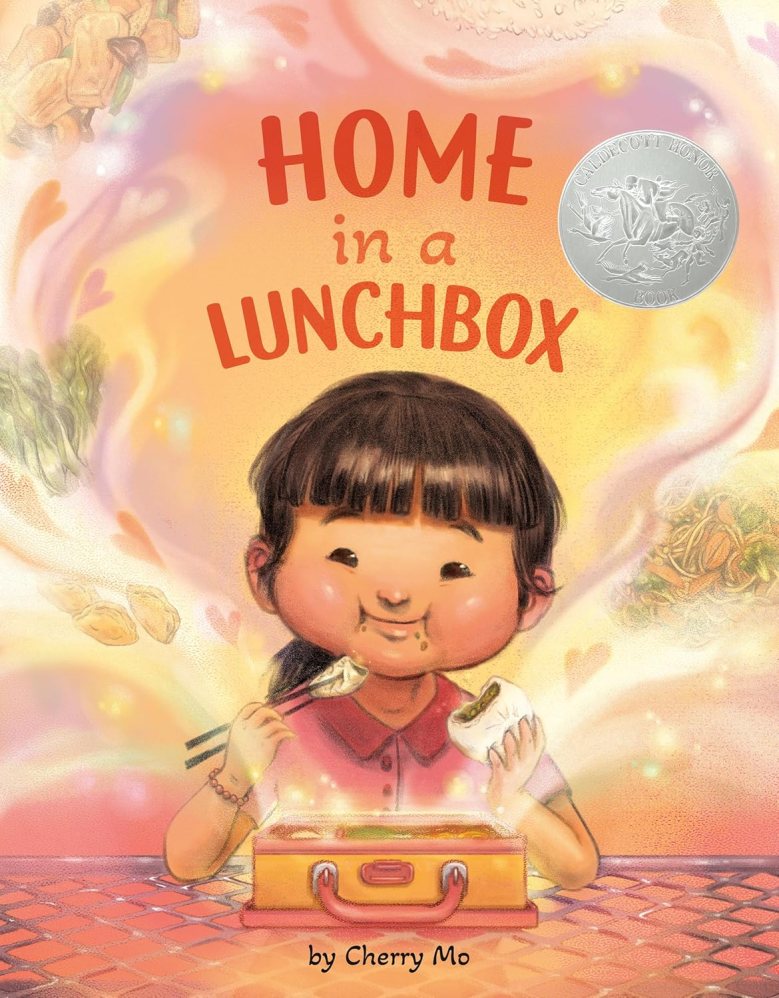
Intrigued by the front cover, I picked up Home in a Lunchbox by Cherry Mo from the children’s “new books” shelf not expecting to fall in love with this story, to be recommending it to colleagues, and to feel the need to write a book review for Chapter Chats! But, here we are…
Inspired by her own experience of moving from China to the United States as a child, Mo narrates the journey of Jun beginning school in a new country. Through expressive illustrations, bold uses of color, and just a handful of text you are taken on an emotional roller coaster as you witness her first week.
I truly felt Jun’s excitement at the bus stop on her first day, and her disappointment, confusion, and frustration as she tries to navigate the school and the English language. Then, I loved the profound comfort, joy, and love she finds in her delicious homemade lunches, and finally, the acceptance, friendship, and belonging as the story concludes.
With universal themes about belonging, embracing differences, friendship, and the power of food, Home in a Lunchbox is a feel-good, must read for people of all ages.
Home in a Lunchbox, a 2025 Caldecott Honor Winner, is available from HCLS in print and as an e-book on Libby.
Megan B. is a Children’s Instructor and Research Specialist at HCLS Miller Branch. She is constantly curious and loves to learn new things.
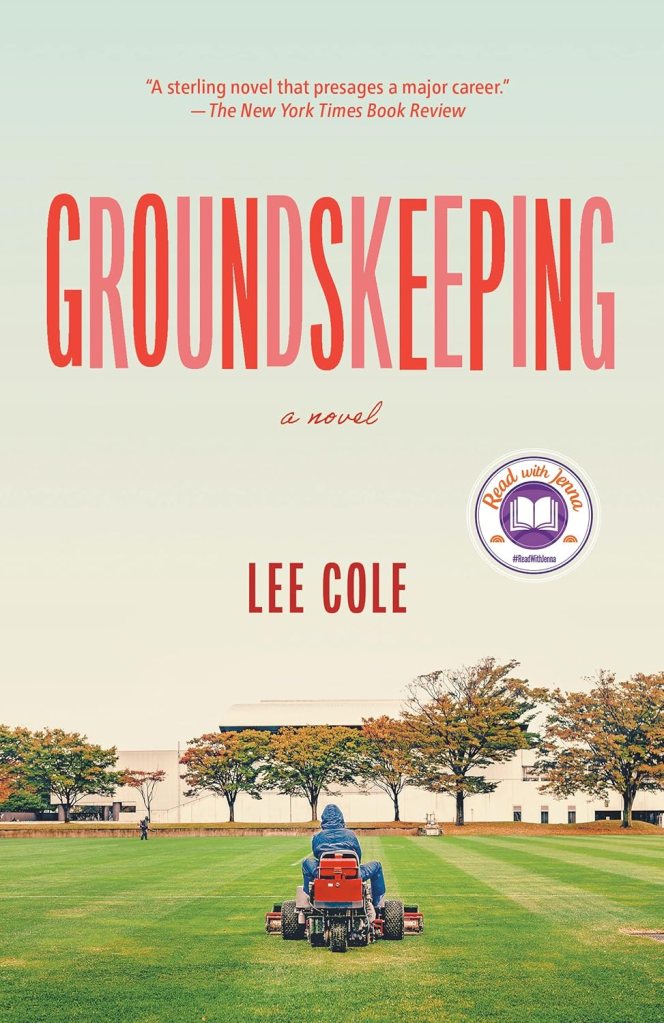
Books on Tap (an HCLS book discussion group) recently discussed Groundskeeping, seemingly an ideal title for book clubs: well written, timely, and with just enough spaces in the story to poke at. This debut novel by Lee Cole takes place at small liberal arts college in western Kentucky in 2016. The heart of the story revolves around a coming-of-age journey for Owen Callahan, a rather fatalistic young man with dreams of becoming a writer. After he graduated from a local state college, Owen ended up in Colorado, living out of his car, working odd jobs, and doing drugs. In the manner of a prodigal son, he swallowed his pride at age 28 and moved home into his grandfather’s basement. When we meet him, he has taken a job on the groundskeeping crew at the local college, which pays for creative writing classes.
As the book opens, Owen is lurking in the corner at a friend’s party as the new semester begins. He strikes up a conversation with an attractive young woman, who claims to come from a country that no longer exists. Alma provides the other half of the story’s equation, as the child of Bosnian Muslims who fled to the States when Yugoslavia fell apart. She grew up in northern Virginia, an Ivy League-educated over-achiever who became a published author fairly quickly. She has won a year-long fellowship at Ashby College, where she’s teaching workshops and polishing a volume of poetry.
The attraction that begins at the party blossoms into a true romance, with all the requisite drama and confusion. Owen and Alma are an “opposites attract” couple in almost every sense. He’s wholly from Kentucky and wants nothing more than to make his way out into the world, both physically and professionally. She has all the advantages-economic status, education, literary success, and a path forward, but her family’s history is rooted in trauma and tragedy. Given these fundamental differences, Owen and Alma have the capacity to both hurt and heal each other to staggering degrees.
A wide variety of supporting characters make the spaces and situations believable. Owen’s family sheds light on the disaffected rural Americans who became Trump supporters in the pivotal 2016 election. His uncle rages against opportunities lost while addicted to pain killers. His co-workers at the college provide another set of perspectives, and Alma’s family demonstrates how immigration (in something close to a refugee situation) can be a mixed blessing.
Cole’s language offers a constant recursive flow of Owen learning how to write and how to love, as he journals about the details of his days and discusses writing assignments. Combined with the richness of the characters, this is a more discuss-able book than is immediately apparent. In many ways, the setting is the third main character of the book. The hills, rivers, flea markets, bars, towns, and even the jargon and accents of western Kentucky give the novel a veritable grounding – a ground to keep, indeed.
Kristen B. is a devoted bookworm lucky enough to work as the graphic designer for HCLS. She likes to read, stitch, dance, and watch baseball (but not all at the same time).
As you celebrate, take the opportunity to include the library. The Fourth of July holiday commemorates the signing of the Declaration of Independence, in which the American colonies sought their freedom from England’s authority. The Equity Resource Center located at our Central Branch provides access to information on famous people like Ida B. Wells, Malcolm X, and Gandhi. In addition, you can borrow great films that celebrate freedom and equality such as, Guess Who’s Coming to Dinner, Schindler’s List, Philadelphia, and Freedom Writers.
As people traveled to America to embark on a new journey, they came from all races and cultures to find life, liberty, and the pursuit of happiness. Unfortunately, everyone’s journey to the United States was not a pleasant experience. InFrederick Douglass and the Fourth of July by James A. Colaiaco, he illustrates the extraordinary story of a slave turned distinguished gentleman.
Born in Maryland to a white father and black mother, Frederick Douglass was an abolitionist who taught himself how to read and write, which almost cost him his life. Through self-education and resilience, Douglass became one of the greatest orators and writers in American history. Frederick Douglass was invited to speak to the citizens of Rochester, New York on July 5, 1852 at the Corinthian Hall. In the speech that would be later entitled “What, to the Slave, is the Fourth of July,” Douglass explained how it was difficult to celebrate a holiday that symbolizes freedom and independence for Americans, even when many blacks were lynched, beaten, and sold as property. Douglass states in his speech, “What, to the American slave, is your 4th of July? I answer; a day that reveals to him, more than all other days in the year, the gross injustice and cruelty to which he is the constant victim.”
As you enjoy your great family barbecues, parades, concerts, and spectacular fireworks shows, consider what look the Fourth of July looks like from many points of view.
Brandon is a Customer Service Specialist at HCLS Central Branch who loves reading, football, and taking nice long walks around his neighborhood.
American Dirt’s story begins with Lydia’s family joyously gathering to celebrate her niece’s quinceanera. The day quickly becomes the beginning of a nightmare when the party is suddenly interrupted by a group of men with no regard for human life launching a violent attack. Lydia and her son, Luca, make it out only through luck. She realizes the attack was planned in vengeance against her journalist husband, who had recently exposed the identity of an infamous drug cartel’s leader. She realizes the leader was a frequent patron of her bookstore, one that she had considered a kindred spirit and even a friend because of his love of books. It is then that Lydia realizes the race is on to save both of their lives. Without time to bury her relatives or even cry, they leave their home in Acapulco. With this begins a story of cat and mouse as Lydia and her son set off on a dangerous mission to find refuge in the United States, following in the footsteps of many Central American immigrants before them.
When mention of American Dirt came up in conversation, several of my colleagues asked me, being Latina, of my opinion of it after it was received with controversial reviews. I was hesitant to pick it up only because of my familiarity with the tragic history of Central American immigrants to the United States, and I knew how emotionally taxing the subject could be. Looking back, I am glad I decided to read it, if only to be able to speak on its shortcomings. I have to say that I feel that, while detailed and evocative, the story came up short in its representations of immigrants and was especially off the mark when it came to cartels. The cartel leader is romanticized, being painted as a man of poetry and philosophy, with a deeply rich life. In reality, cartels are dysfunctional and dehumanizing organizations full of fear. They certainly have no mysterious allure to them.
In regards to our protagonist, Lydia, her background as a highly educated woman of the middle class does not align with the decisions that she made in the story. The danger that she put her and her son in was unnecessary and a poor decision. She leads them along one of the dangerous paths to the United States border, one usually only followed by the most desperate and poor immigrants as a final resort. Unlike so many of the people who would have taken that path, Lydia had options. She was comfortably middle class, with a college education, connections, and resources available to her. As such, I have to say that her story is not very realistic. Instead, I would have liked to read more about her companions on the journey, who truly represent the people who would have had to adopt such dangerous measures. These people holding on to hope, fleeing for the safety of themselves and for the survival of their loved ones, truly represent bravery. The end of Lydia’s story, though conclusive, left me frustrated. Her complacent satisfaction with her new job in the United States left a bitter taste in my mouth, speaking as a Central American immigrant myself.
If you choose to dive into American Dirt, I would take its legitimacy and credibility with a grain of salt. Let’s not forget it’s fiction. If you are interested in a nonfiction book that explores the topic with more nuance and depth, I highly recommend Enrique’s Journey by journalist Sonia Nazario, her account of a young Honduran boy’s perilous quest to reunite with his mother in the United States. Nazario based the book on her Los Angeles Times series of articles, also called Enrique’s Journey, which won the Pulitzer Prize for feature writing in 2003.






 CHAPTER CHATS