
Mixed Plate: Chronicles of an All-American Combo by Jo Koy

Jo Koy poses against a bright red backdrop, holding his suit jacket out between his pinched fingers and with his

by JP Landolt

My man Jo Koy bombed as the host of the Golden Globes. As I was reviewing some of the clips, my heart fell. This was NOT the Jo Koy I knew. I can’t help wondering where it went wrong, and I felt even worse about the kind of awful press he was getting. Comments like “Who even was this guy?” and “What a loser!” kept popping up in these online clips. I felt myself wanting to defend him and to prove to people that Jo Koy was truly funny. Unfortunately, hosting gigs like that are tough. They can sour (or sweeten) the masses to you, especially as a comic. And goodness me, even I know that a friendly roast of Taylor Swift is a “no-no” these days!  

If you get a chance to watch his numerous Netflix specials and pick up his book Mixed Plate, I believe you’ll gain more of an appreciation for Jo Koy. I am absolutely biased as I am also a “mixed plate” like he is – half Filipino and half white. 

You know, aside from my brother and me, the only Jewish-Filipino person I had ever heard of in the 90s was Rob Schneider, one of our most beloved comedians. I heard of Jo Koy through Filipino friends and family who alerted me to the fact there was a Filipino American comic who was crushing it (thanks for the heads up). He’d been grinding for years and made his way onto “Chelsea Lately” as a panelist. I saw one of his specials on Comedy Central in the early 2010s and would continue to look for Jo Koy material and find random snippets on YouTube. Finally, by 2017, Live from Seattle was on Netflix. I shared this with my husband and he, too, has become a Jo Koy fan.   

My family revels in comedians. We had cassettes of comedians that we’d listen to over and over. In fact, we had the same Richard Pryor cassette that Jo Koy references in this book. In the 90s I loved In Living Color, All That, and any comedy sketch show I could find. And SNL? SNL in the 90s was ripe with talent: Dana Carvey, Adam Sandler, Chris Farley, David Spade, and the rest of them. I remember Eddie Murphy in red leather, George Carlin and his bad words, and today I enjoy Jo Koy, Tiffany Haddish, Tom Segura, and others. When he finally “makes it,” he starts name-dropping his idols who soon become friends. Most surprising (and hilarious) is his friendship with Jon Lovitz!

Other revelations in this book proved to me just how incredible humor is. Some things make you laugh to keep from crying, and others make you laugh until your cheeks are wet with tears! The struggles in this book are so painfully real. There’s the struggle of not being enough, then there’s the struggle of not having enough. Growing up impoverished and mixed can amplify those feelings of not really belonging and simultaneously doing whatever you can to be seen. Jo Koy lived this reality, and I felt it in his words. Humor and shared experiences bring people together. There’s about seven pages of thank you’s at the end of this book, and it’s only a short testament to how much this book was created with love and gratitude. Jo Koy seems to have a happily ever after, and I’m here for it!

Mixed Plate is available from Howard County Library System in print and as an e-book.

JP has worked for HCLS since 2006. She enjoys gallivanting, Jollibee, and all the halo-halo she can eat.

Films for Change & Racial Equity Report

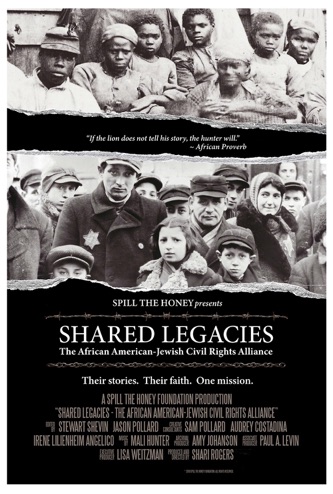
The Shared Legacy movie poster is all in grey scale, with a photo of a Black family shown on top and a Jewish family in the middle, with an African proverb separating them: If the lion does not tell his story, the hunter will.

Thursday, January 12
5 pm: film
7 pm: discussion
HCLS Miller Branch

Registration required.

Shared Legacies depicts inspirational African American and Jewish collaboration in the 60s Civil Rights era, shows that connection changing, and calls for it to be renewed in light of “divisive seeds of hate taking root anew in the American landscape.”

After viewing, participants and panelists from the African American and Jewish communities ask:

  • Can the legacy continue? How can our communities move forward with a shared agenda to promote racial equity in Howard County, as well as fight for an inclusive economy, education, and healthcare for all, and the equitable dispensation of justice?
  • Is there a joint role in the era of mass-incarceration and the post-January 6th America?
  • Can we move from friction (like that surrounding Ye and Kyrie Irving) to relationship and shared action?

The discussion will be informed by the local report recently released by HCLS: Inequity Within: Issues of Inequity Across Communities.

Films for Change is a series of documentaries about racial equity, each followed by panels featuring local leaders and organizations. Sponsored by the Horizon Foundation.  

In partnership with the African American Community Roundtable, the Jewish Community Relations Council of Howard County, The Martin Luther King Jr. Holiday Commission, and the Howard County NAACP.

Inequity Within Report

Over the last two years, Howard County Library System engaged more than 600 people in racial equity training. Using national data about disparities across education, health, housing, and legal systems, the trainers found that racial inequity looks the same across systems, socioeconomic difference does not explain racial inequity, and systems contribute significantly to disparities.
Howard County Library System’s new Inequities Within: Issue of Inequity Across Communities report examines the racial equity landscape in Howard County and across the state of Maryland. The data show disparities across education, healthcare, housing, economic, and legal systems for every racial group.

Page 10 of the Inequity Within report, showing bar graphs, titled "Jurisdictional Comparison of Socioeconomic Indicators".

In Howard County, for example:

  • Black residents are three times more likely to be denied a home loan than non-Hispanic white residents.
  • Hispanic students are 5.4 times more likely than white students to skip school because they felt unsafe.
  • Asian residents in the county are 1.8 times more likely to face poverty than non-Hispanic white residents.

As one of the wealthiest, healthiest, and most diverse communities in the state and the US, the belief that racial inequity does not exist here can be a hindrance to addressing those disparities.

We invite you to read the report, educate yourself, and join with us and others in this work.

For opportunities to learn more and discuss with community members, check here for classes and events.

Funded by a grant from the Institute of Museum and Library Services and administered by the Maryland State Library Agency