Hundreds of Beavers

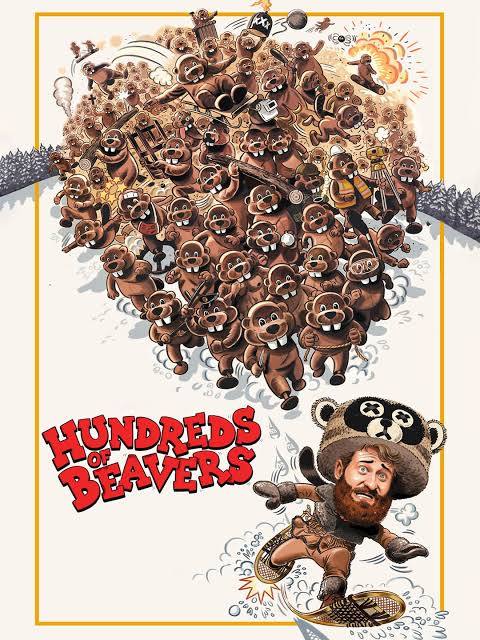
In a style reminiscent of National Lampoon or other madcap movies, the illustration shows a man dressed in a beaver costume fleeing a crowd of beavers. Text appears in red hand-drawn blocky letters.

by Alex P.

When Hundreds of Beavers got released to streaming services last year, it became one of the biggest success stories and most beloved films of the year, and for good reason. As a black-and-white slapstick comedy, awash in practical effects and Adobe After Effects 2D animation, completely devoid of dialogue and produced with only $150,000, it feels remarkably out of place in a cinema landscape dominated by CGI and character-driven dramas. But that very out-of-placeness is what makes its inventive qualities all the more precious. I feel that the poster, which IndieWire called one of the best of 2024, captures this perfectly. Its hand-drawn caricatures and bold red lettering are a direct throwback to the absurd comedies like It’s a Mad, Mad, Mad, Mad World and those by National Lampoon from the 60s and 70s, which make up just some of the film’s many influences. 

The influences are even wider than Hollywood comedies. The first act is a perfect translation of Looney Tunes cartoons to live-action film, before heavily incorporating video game logic in the second act. I particularly like how directly it translates the video game mechanics of survival games like Minecraft or Terraria into film action. We’ve seen a lot of video games adapted into films in the past decade, but they seem to flatten how the games work into standard Hollywood action. Seeing a movie that literally functions and presents itself like a video game as a framework for its action and plot is a bold innovation. Similarly fusing old and new influences, the slapstick feels equal parts Charlie Chaplin and early YouTube sketch comedy. 

Co-writer Ryland Tews stars as Jean Kayak, a 19th century applejack salesman turned fur trapper. The film’s action completely centers around his efforts to trap and kill cute critters (played by people in mascot suits) for sustenance and to trade their pelts for goods. The rigid logic about the tactics to trap each animal (beavers always fall for turds lacquered in castor oil, rabbits will go for anything that resembles a carrot) sets up most of the action as Jean discovers the logic of his world and his trade the hard way. The film’s best quality is the virtuosity with which it immerses you in recurring gags and wild internal logic that feel as well-scripted as a classical symphony. Again, thanks to the heavy use of video game logic, gags that would be throwaways in other movies recur again and again only to culminate in centerpieces where Jean uses everything he’s learned to set up giant, hilarious Rube Goldberg machines. 

In our age of digital proliferation, you’d think independent film would have flourished to a much greater extent than it has. Nearly everyone has a camera and powerful editing software sitting in their pockets. Instead, though, modern film has felt more suffocated than ever, as big studios insulate themselves from big risks by trying fewer crazy ideas and releasing fewer movies. In this era, then, it’s comforting and much needed to see a film made with no money whatsoever that looks amazing and oozes more creativity than most blockbusters and made more than six times its money back solely by word of mouth.  

You can watch Hundreds of Beavers on Kanopy with your library card and PIN. 

Alex Pyryt is a DIY Instructor & Research Specialist at HCLS Elkridge Branch.  
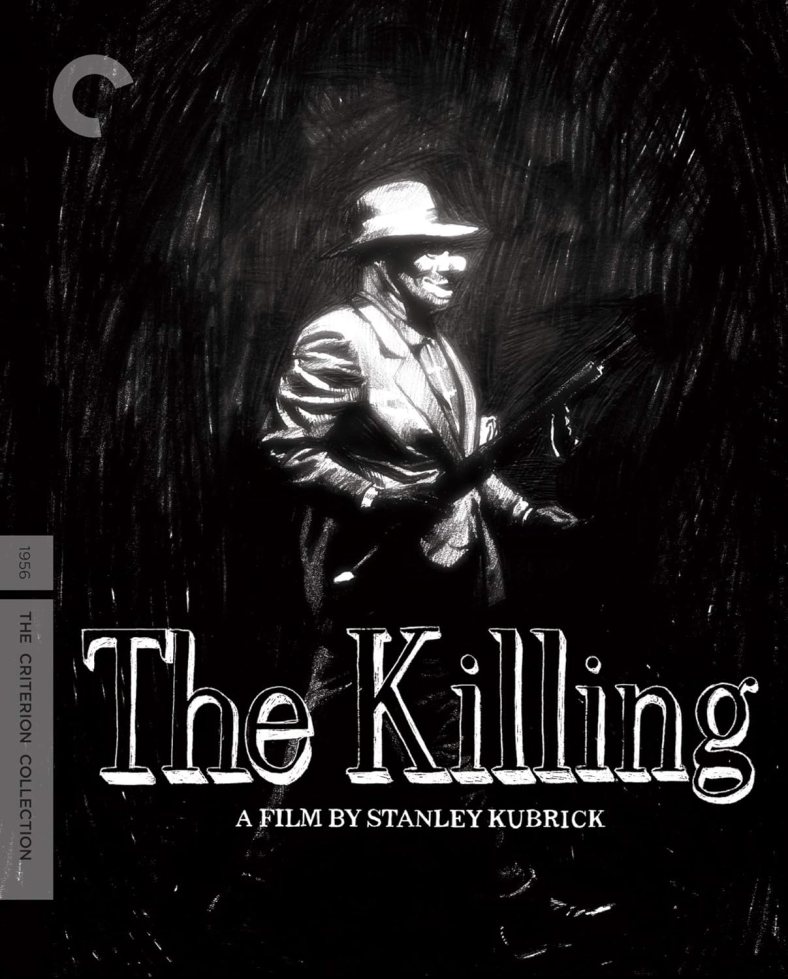
The Killing by Stanley Kubrick

The image depicts a man with a bulbous clown-like nose, wearing a hat and carrying a club. He is portrayed against a dark background.

by Alex P.

I’ve always been drawn to crime films, from Fritz Lang’s “M” to classic film noir to Martin Scorsese’s extensive gangster film output, with their allure of hidden underworlds of organized crime and the handsome rewards it brings at the risk of it all falling apart at any moment. Whether you identify with the criminal masterminds or with the police detectives hot on their trails, it’s a strain of cinema that’s had appeal since the inception of film itself and 1903’s The Great Train Robbery.  

One sub-genre of crime that’s stuck with me is the heist film. There’s something exquisitely thrilling about watching a heist carried out from the planning stage to the execution where it all goes so right or so wrong; think Baby Driver and The Bad Guys for popular recent examples. 

Director Stanley Kubrick’s shadow still looms large over the art of film, but some people may not know one of his earlier films, The Killing, a 1956 heist noir that gave Kubrick his first critical success. Many know the 1968 ensemble comedy Dr. Strangelove, his last black and white film before the monolithic 2001: A Space Odyssey. Fewer know of Lolita (yes, that Lolita), Spartacus, or Paths of Glory, but I suspect the most obscure are his first three films. Fear and Desire and Killer’s Kiss are independent, exploratory films where Kubrick was finding his footing; these were followed by The Killing, starring the elusive Sterling Hayden, which was a real home run.  

The Asphalt Jungle was a foundational heist films, and it seems clear that Kubrick wanted to emulate it a few years later with The Killing. Kubrick plucks Sterling Hayden from The Asphalt Jungle’s all-star cast to play Johnny Clay, the mastermind behind a heist at a horse-racing track. Clay remains a mysterious and dominating figure, and much of the story is dedicated to the setup of the heist and the ensemble of his hired co-conspirators. More of the tension comes from a psycho-sexual rift between George, the racetrack cashier, and his wife Sherry, who overhears the plot and schemes to take George’s money and run. This sub-plot strikes me as The Killing’s weakest aspect, as it is far too maudlin and the sets are cheap, complete with a fake parrot. The rest of the cast, though, comprise a thrilling ensemble of characters, each of whom plays a perfectly compartmentalized part.  

Johnny Clay, as played by Hayden, is a complete enigma. Just out of prison, he immediately starts moving on the heist. He conducts himself with an affect so cool and calculating that it strikes the viewer as sociopathic. My favorite participant in his heist is Maurice, played by Georgian wrestler Kola Kwariani. He’s a highly intelligent, thoughtful, soft-spoken man who works in a chess club, and it is tragic to watch Clay pay him to get drunk and start a fight, reducing a smart and sensitive man to hired muscle. Every participant is meticulously positioned to play a separate part in his scheme while remaining unable to implicate him if they fail. It’s so well-planned, and the execution is mesmerizing and unforgettable, but so are the inevitable snags along the way.  

When comparing The Killing to The Asphalt Jungle, I’ve found that the inherent moral ambiguity makes Kubrick’s heist film memorable, as the start of a theme that continued throughout his career. In The Asphalt Jungle, the charming and likeable criminals are served their just desserts, complete with a speech by the police to an eager press pool that feels straight out of a public service announcement. While in The Killing, the brief but poetic comeuppance that comes to the Clay at the film’s end comes instead from a cruel and simple twist of fate. Instead of seeking answers from the morals and standards and the laws of his era, Kubrick looked to bad luck and the randomness of the universe. 

Like many overlooked greats, The Killing can be found on Kanopy using your library card. Though I mostly use it for hidden gems that can’t seem to find their home in more commercial environments (take, for example, The Hudsucker Proxy), it still has recent blockbuster hits, as well as classic documentaries and more. 

Alex Pyryt is a DIY Instructor & Research Specialist at Howard County Library System Elkridge Branch. 

World Language Collection & Lunar New Year

The picture shows wooden tables and chairs, as if in a cafe, with a clock on the red brick interior wall surrounded by a variety of wooden rectangular clocks painted with the flag emblems of various countries.
Photo by Farzad Mohsenvanda at Unsplash.

by Mai-Leng O.

Welcome to Howard County Library System’s World Languages Collection! 

Howard County is a diverse and multi-ethnic community where the population comes from a myriad of countries across the globe. The vibrant, multiracial population makes our county an exciting place to be. With the growth of these demographics, HCLS began to enlarge its World Languages collection, consisting of print literature and DVDs, to support the reading and viewing needs of all residents. 

Presently, the print collection consists of many languages, including Arabic, Chinese, French, German, Japanese, Korean, Persian, Russian, Spanish, and several Indian languages such as Gujarati, Hindi, Malayalam, Tamil, and Urdu. The World Languages DVD collection consists of languages ranging from Albanian to Zulu. Many of the DVDs have English subtitles, so non-speakers of the language can appreciate and enjoy movies and documentaries from countries around the world. 

In addition to the physical World Languages DVD collection, we offer streaming video options through the Kanopy and Hoopla platforms. You just need a library card!

We invite you to visit our branches to borrow and enjoy our World Languages print and DVD collections, or visit us at hclibrary.org to access the streaming platforms. Happy reading and watching!

Celebrate the Lunar New Year with these upcoming events:

Lunar New Year: What Animal Are You?  
Mon, Jan 23
all day
HCLS Glenwood Branch
Family; all ages. Drop In. 
Celebrate Lunar New Year at the Glenwood Branch! Are you a lion? An ox? A rabbit? Find out what animal matches your birth year, then decorate a paper animal to join others in this self-directed community art project.
Visit our classes and events page here for more information.

Dim Sum of Crafts 
Mon, Jan 23
11 am – 12:30 pm & 2 – 3:30 pm 
HCLS Miller Branch
Ages 4 & up. Drop In. Allow 30 minutes.
Celebrate the Lunar New Year with a variety of crafts. For more information, visit our classes and events page here for the first sessions and here for the second session.

Mon, Jan 23
2 – 3 pm 
HCLS Savage Branch
Ages 3 & up. Ticketed. Allow 30 minutes.

Visit our classes and events page here for more information.

Mai-Leng Ong is the Senior Materials Specialist at Howard County Library System. She holds a Master of Science in Library and Information Science from the University of Illinois at Urbana Champaign.

Spooky Kanopy Picks

by Emily B.

Did you know you can use your library card to watch eight movies every month on Kanopy? Here are some spooky films to check out this October.

The image depicts a woman on pointe shoes in profile with her arms raised above her head and her head thrown back. The red of her dress runs down her legs and shoes and onto the ground, puddling as if it is blood.

Suspiria (1977) 

An American ballet student discovers that sinister things are afoot at a prestigious German dance academy. The film is regarded as one of the most influential horror films, with its striking visuals and haunting soundtrack.  

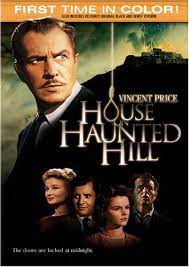
The image depicts a house on a distant hill against the backdrop of a cloudy sky. In the foreground are two men and two women and, superimposed above them, another man looking to the side with a slightly shocked expression and an eyebrow raised. The title of the film has a noose for the "o" in the word "House."

House on Haunted Hill (1959) 

An eccentric millionaire invites five strangers to a party at a haunted house, offering $10,000 to whomever survives the night. Partially inspired by Shirley Jackson’s The Haunting of Hill House, this film has solidified itself as a campy horror classic.  

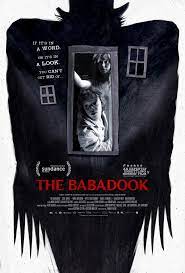
The movie poster depicts a silhouette of the Babadook surrounding an open door and two windows, as if the Babadook is the house containing them. Viewed through the open door are two children, one perched above the other, both looking out as if into the dark.

The Babadook (2014) 

A widow struggles to raise her young son, who is convinced that a character from a pop-up book is real and lurking around their home. 

The movie cover depicts a train in the background, with smoke and fire as if there has been an accident. In the foreground are several people fleeing the carnage, including a man carrying a young child whose face looks back a the train.

Train to Busan (2016) 

A man and his daughter attempt to survive a rapidly-spreading zombie infection that breaks out while they are on the train. This record-breaking Korean film will soon undergo an American remake. 

The movie cover depicts half of a woman's face from the neck up; she wears a coronet of flowers and greenery and appears frightened or distressed.

Midsommar (2019) 

A woman accompanies her boyfriend and his friends on a trip to Sweden for a midsummer festival and chaos ensues. Don’t let the beautiful setting and cheery color palate of the film deceive you – Midsommar is one of the most disturbing horror films I’ve ever seen.

The movie cover image depicts two children standing at the end of a hallway flooded with water. There are doors to their left and high windows to their right all along the sides of the hall. One child looks straight at the camera; the other is looking down and wears a facial-obscuring hoodie.

Dark Water (2002) 

A woman, in the midst of divorce negotiations, moves to a run-down apartment with her young daughter. A mysterious ceiling leak and ghostly appearances ensue. In 2005, an American remake of this Japanese film starring Jennifer Connelly was released.

You can borrow Midsommar, Dark Water, Train to Busan, The Babadook, and House on Haunted Hill on DVD, too.

Emily is an Instructor & Research Specialist at the Central Branch. She enjoys reading, listening to music, and re-watching old seasons of Survivor.

June is African American Music Appreciation Month

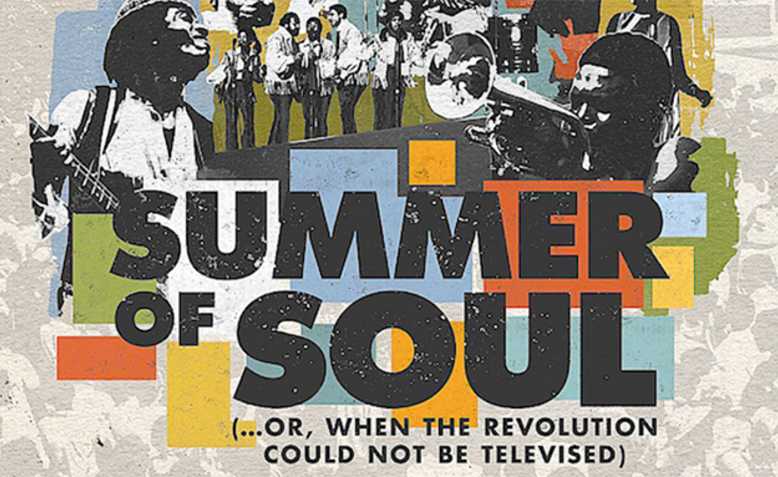
Collage of black and white photos of musicians and color blocks in red, green, blue, and yellow with "Summer of Soul" overlaid.

by Jean B.

Count Basie. Billie Holliday. Duke Ellington. I am an enthusiastic jazz fan, and I appreciate that sliver of African American music all year long, not just in June. But the musical expression of Black experience and artistry certainly isn’t limited to jazz or any other single genre. Gospel, rhythm and blues, soul, hip hop, rap, classical, rock and roll, techno, musicals – African American Music Appreciation Month provides a great opportunity to acknowledge and explore the tremendous breadth of African American musicians, composers, styles, and music entrepreneurs. Established in 1979 as National Black Music Month, it has been proclaimed by every U.S. President from Jimmy Carter to Joe Biden. So for this 43rd annual celebration, use HCLS as a portal to enjoy more of what you already like or discover something entirely new.

Expand Your Playlist
If you’re looking for new tunes, HCLS offers thousands of CDs across all genres to borrow. Using your library card and PIN, you also can stream music from Freegal. Not only can you search for favorite artists or songs, but you can find already curated Black Music Month playlists – like the one created by the Central Arkansas Library System with ten hours of music, ranging from Jimi Hendrix, to Sister Rosetta Tharpe; from Kendrick Lamar to Miles Davis. That’s a lot to appreciate!

Experience Live Concerts
Do you want to imagine you’re there, in concert? Documentary DVDs can bring the live concert experience right into your home. Check out Questlove’s Oscar-winning documentary, Summer of Soul, about the epic 1969 Harlem Cultural Festival that features performances by artists like Stevie Wonder, Nina Simone, B.B. King, and more. Or watch Eminem, Nas, and other hip-hop artists perform on Something From Nothing: the Art of Rap. From our Kanopy service, stream films like Rejoice and Shout: Gospel Music and African-American Christianity, which features legends of gospel like The Staple Singers and The Dixie Hummingbirds, to trace the 200-year evolution and contribution of gospel music in American pop culture.

The cover of I'm Possible: A Story of Survival, a Tuba, and the Small Miracle of a Big Dream features the outline illustration of a red figure playing a black tuba, framed by text.

Explore the Lives of African American Creators
If you’re curious about the life experiences that produced the music you hear, check out some great nonfiction. Be blown away by the memoir of Baltimore native Richard Antoine White, whose dream of classical tuba performance took him from a homeless childhood to a prestigious symphony orchestra career, an extraordinary story he tells in I’m Possible: A Story of Survival, A Tuba, and the Small Miracle of a Big Dream. Or be swept up in the incredible combination of poetry, art, biography, and music history in Jazz A-B-Z: An A to Z Collection of Jazz Portraits, where Wynton Marsalis writes wordplay jazz. I love his ode to Ellington, “a most elegant man” who sought “to educate, to elevate, to urge the earthbound ear and heart alike to soar,” just like the resources at HCLS!

Jean B. is a Children’s Instructor and Research Specialist at the Central Branch and loves reading books for all ages when she isn’t enjoying the outdoors.