The Teller of Small Fortunes by Julie Leong

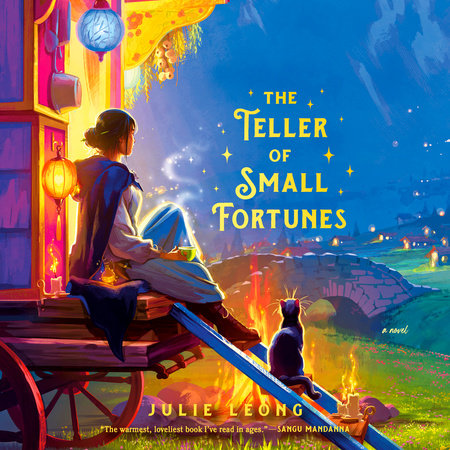
The colorful cover illustration shows a young woman sitting on the back of a caravan, with a cat at her feet, in front of a small campfire gazing out at a small town and a night sky.

by Kristen B.

Cozy fantasy is such a wonderful antidote to real life stress and chaos. The Teller of Small Fortunes brings all the good vibes. It’s a story full of found family and small stakes – but ones that become more important as the story progresses. Sometimes, one person making good decisions at the right inflection point can truly make a difference. I really need to believe that these days.

Tao travels in her custom-made wagon with her mule as her sole companion, setting up shop to tell regular people their small fortunes. Nothing too momentous, but important just the same. She brings a little happiness and diversion from mundane days. It’s a good life, if at times a little lonely. When she finds her road blocked by a tree, two new friends come into her life who also provide a little extra security – Mash and Silt, who used to campaign together and now are life-long friends. They are looking for Mash’s missing daughter and happen to be traveling in the same direction. Silt is a bit of a rogue, and Mash is one of the best friends anyone could wish for.

At their next stop, they meet Kina, the baker’s apprentice whose wares taste delicious but don’t always look particularly polished. She wants to see the world, or at least more than her seaside town that smells overwhelmingly of fish. Eventually, the group picks up a stray cat – who might be magical or might just be a cat. In one of my favorite episodes, Kina and Tao invent fortune cookies to sell in places where Tao’s magic might be less welcome.

As the travels continue, the small group forms tight friendships. It also becomes clear that there’s more to Tao than just small fortunes as their group is hounded by a representative from the kingdom’s official magicians. Tao doesn’t want to be involved in large scale politics, mostly because of bad childhood memories and her mother’s reaction to her magic. She just wants to be left alone to live her chosen life – but sometimes, friendship encourages us to overcome our fears and work for the greater good. For every problem introduced, a resolution comes along through a combination of good will, assuming the best, and being a good friend. If only it worked as well as that in real life.

The Teller of Small Fortunes by Julie Leong is available as a book, e-book, and e-audiobook.

Kristen B. is a devoted bookworm lucky enough to work as the graphic designer for HCLS. She likes to read, stitch, dance, and watch baseball (but not all at the same time).

Our next chapter starts soon when the blog moves to the newly redesigned hclibrary.org. All the same great reviews and news, plus more library information!

Bauder Book Talk: Meet two of the authors of Blackout

A black illustrated cover where two people standing holding hands, backs to the viewer, with a sketched city in front of them and lots of small windows lit up.

by Carmen J.

What do you get when you have six talented young adult authors, a pandemic, and a beautiful excuse to celebrate many versions of black love and romance? You get Blackout written by Dhonielle Clayton, Tiffany D. Jackson, Nic Stone, Angie Thomas, Ashley Woodfolk, and Nicola Yoon. Even better, you’ll get to see two of the featured authors (Clayton and Woodfolk) at the third annual Bauder Book Talk event on November 6 from 4:30-6:30 pm at HCLS’s East Columbia Branch.

Written and inspired during the 2020 pandemic and set in New York City during a blackout, each author contributes connecting narratives — which can stand alone — about Black teens in the midst of their unique, complicated, joyful, sometimes simple, often spontaneous, intense, surprising romantic journeys. Whether it’s two young men catching feelings on a stalled subway, a couple who must talk through their past relationship over a long walk across town, two girls whose chance encounter ignites a spark in a nursing home, each interwoven story shines to a satisfying conclusion at a Brooklyn block party. 

In particular, Woodfolk’s “Made to Fit,” Clayton’s “All the Great Love Stories … and Dust,” and the closing story titled “Seymour and Grace” (written by Yoon) are stand-outs. Bonus points for Blackout’s inclusion of queer love and the acceptance of the adults in their lives (Made to Fit). The warmth and feel-good feelings of Blackout remain long after the lights are back on.

EVENT HAPPENING ON NOVEMBER 6: Register now!

Celebrate the voices of young Black girls in literature at this year’s Bauder Book Talk. Dhonielle Clayton and Ashley Woodfolk share how their stories center joy, magic, and truth while creating space for Black teens to see themselves on the page. 

Clayton is a New York Times bestselling author and former middle school librarian whose work celebrates Black joy, magic, and possibility. She is the author of The Belles series and the Conjureverse series.

Woodfolk is the critically acclaimed author of The Beauty That Remains and When You Were Everything. Her work explores love, loss, friendship, and the complexities of finding one’s voice. A former publishing professional, Woodfolk is celebrated for her lyrical prose and heartfelt storytelling that resonates deeply with teens. 

Carmen J. is a teen instructor at HCLS East Columbia Branch. Among her favorite things are great books, all things 80s, shamelessly watching The Bachelor, gardening, and drinking anything that tastes like coffee.

Read Babel in 2025 (while waiting for Katabasis)

An illustration that looks like a highly detailed, black and white print shows a tall, classic tower set against a stormy sky. The title and author's name appear in gold copperplate lettering.

By Julia M.

If you’re a fiction reader, you have probably heard buzz about R.F. Kuang’s latest book, Katabasis. While you’re waiting for your hold on Katabasis to be delivered, I’ll make my case for you to pick up Kuang’s 2022 hit, Babel: or the necessity of violence: an arcane history of the Oxford Translators’ revolutionIf you’ve been yearning for the kind of book hangover that makes it impossible to pick up anything else because your mind is plagued with thoughts of the book you just finished — this is the book for you. (True story: I finished Babel over a month ago and haven’t stopped thinking about it since.) 

Babel is set in a historically re-imagined 1800s Oxford, England. We first meet the main character, Robin, as he’s dying of cholera in Canton, China. A professor from Oxford, Richard Lovell, comes to save his life with magic — but only after Robin’s mother passes away from the illness. From then on, Robin is raised as Professor Lovell’s ward, and spends the rest of his childhood being prepared for a higher education at Oxford University’s Royal Institute of Translation, also known as Babel. At Babel, Robin meets fellow year-mates Ramy, Victoire, and Letty, who become an inseparable band of friends throughout their education. He discovers a secret society that sparks the rumbles of revolution on campus — and whose connections run deeper than first meets the eye. 

If you’ve read The Poppy War or Yellowface, you’ve already become familiar with the pattern of R.F. Kuang’s books — she constructs a setup that is exciting, endearing, alluring, and which might be a book of its own in the hands of another writer. After she makes you fall in love with her characters, she does something that sets her apart: she swings the pendulum of reality in your face. You’re made to face brutalities that exist in our real-world society and shatter any delusions of a happily-ever-after for the characters you’ve grown to love.

R.F. Kuang writes with candor about colonialism, racism, language, academia, and power. To weave in elements of fantasy is an added bonus that makes the world rich and makes you wish you could stay in its happy places longer. For better or for worse, you’ll fall in love with the group of four hopeful students we meet at the onset of the story; I can’t say more about them without spoiling the story, so go ahead and read for yourself.

Babel by R. F. Kuang is available in print, e-book, and e-audiobook formats.

Julia is a Teen Instructor & Research Specialist at the Central Branch. They love reading YA books, playing the cello, practicing martial arts, trying new cookie recipes, and generally squeezing as many hobbies into a day as possible. 

The Spellshop by Sarah Beth Durst

A warm painting shows a cozy cottage in dappled sunshine at the top of steps, on which a winged cat lounges.

by Kristen B.

Some books have it all: A courageous librarian, an ambulatory talking spider plant, winged cats, cloud bears, and a romantic interest who rides sea horses. The Spellshop by Sarah Beth Durst gives you a warm hug in the form of a book. That’s not to say it’s only cozy vibes and no plot – there’s plenty of story to keep you reading.

Kiela and her assistant Caz (the sentient plant) flee political unrest that sets fire to the Great Library of Alyssium. Kiela, who has been preparing for this unfortunate reality, packs as many books as she can, herself, and Caz into a boat and sets sail for the island where her family originally came from. She makes it across open waters to Caltrey, where the cottage she remembers from childhood still stands.

It turns out that the political upheaval in the capital city has also had consequences on this faraway island. Imperial sorcerers no longer travel, and magic has become unbalanced, causing huge storms and other troubles. However, the books Kiela rescued are mostly magical spellbooks. The chapters where she and Caz test spells through pure trial and error are delightful. The drawback is that unlicensed magic is illegal, so Kiela ends up opening a jam shop and providing “remedies” on the side (fooling no one).

As she settles in, Kiela makes all sorts of wonderful friends. She also reconnects with Larran, a childhood friend who now happens to be a helpful, handy, and handsome neighbor. Although a natural introvert, Kiela soon discovers the importance of connections and trust within a small community. The found family at the center of the book comes together to see everyone through a series of mishaps and misfortunes, including a suspiciously behaved Imperial citizen who washes up during a big storm. Sorting out the unexpected visitor drives the second half of this gentle book.

The joy of this sort of cozy fantasy is that even though stakes are high, and certainly Kiela feels as though her world is ending, people help each other and make it through. Cozy fantasy is the counterweight to all the dread-full, grim-dark fantasy that has been dominating the genre in recent years. The Spellshop might be as far from A Song of Ice and Fire as a reader can get and still be reading in the same fantasy genre. And that’s okay. It’s good to have a wide variety of books to suit all different readers and moods. Honestly, while it might not make sense if you use strict logic, The Spellshop makes perfect sense to your heart with its hopeful outlook on a world in turmoil.

I am looking forward to reading the second book, The Enchanted Greenhouse, about the magician who created Caz and the second chances she is given.

The Spellshop by Sarah Beth Durst is available in print, e-book, and e-audiobook.

Kristen B. is a devoted bookworm lucky enough to work as the graphic designer for HCLS. She likes to read, stitch, dance, and watch baseball (but not all at the same time).

Fantasy Reads on the High School Summer Reading List

by Julia M.

There’s no time like the summertime to dig into a long, immersive fantasy book. The 2025 High School Summer Reading list features several titles that fit the bill—here are five recommendations to keep you engrossed for hundreds of pages! 

Deep is the Fen by Lili Wilkinson is a suspenseful fairy tale centered on a cast of lifelike characters on their quest to find the heart of the nefarious secret society known as the Order of Toadmen. The main character, Merry, grapples with her magical ability as she fights against society to save her father. I loved this book’s sweet friendships, the rivals-to-teammates dynamic between Merry and her counterpart, and the way the mystery unfolds as we follow the main characters deeper and deeper into the murky magic.    

Blood at the Root by LaDarrion Williams explores a world of magic incorporated through Black American history, folklore, and myth. When Malik Baron reunites with his estranged grandmother, he’s drawn into a world of magic and mystery that may just give him the tools he needs to control his magical powers and protect his foster brother on his journey to find his missing mother. This book transforms the magic school trope into something defiant and heartfelt.  

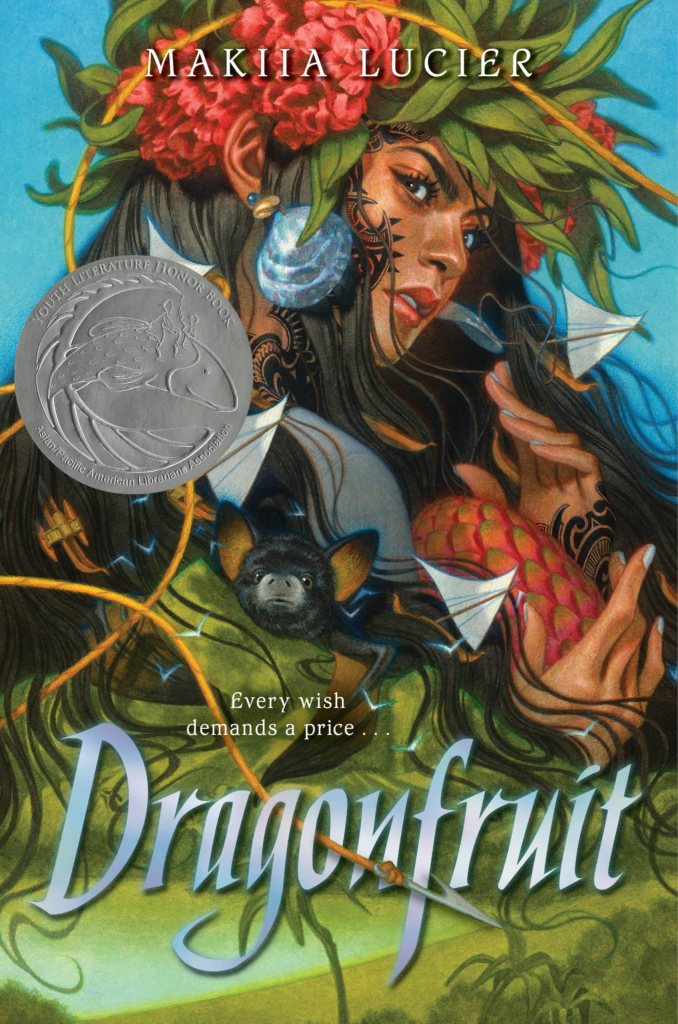
Dragonfruit by Makiia Lucier is a fantasy adventure based on mythology from Guam and other Pacific Islands. We meet our main character, Hanalei, in her days of exile after her father steals a sea dragon egg. She spends her days studying and sketching the majestic sea dragons in the surrounding waters, and when an encounter with a dragon offers her a chance to return home, Hanalei is launched into a quest that could save her family—and the entire kingdom of Tamarind. The book delivers a beautifully woven, mythology-rich expansion on the teen dragon rider trope and leaves readers asking, “When will there be another one?” 

Wrath Becomes Her by Aden Polydoros is a historical fantasy set in 1940s Lithuania. The book follows Vera, a golem created from an ancient magic, called kishuf, by a father grieving for his murdered daughter. Driven with a violent purpose, Vera is sworn to avenge herself against the Nazis. Throughout her quest, she finds that she’s not the only one with access to kishuf—and it’s going to take everything Vera has within her to come out triumphant. This dark fantasy draws from Jewish folklore to spin a tale full of strength and vengeance.  

Heir by Sabaa Tahir picks up almost two decades after A Sky Beyond the Storm, the final installment in Tahir’s previous series. Sabaa Tahir excels at balancing a full cast of characters and creating interesting and distinct points-of-view, and Heir is no exception. We get to watch the story unfold from behind the eyes of Aiz, Sirsha, and Quil—the orphan, the outcast, and the prince. Like the Ember in the Ashes quartet, Heir tells a war story in a fantasy setting that delves into issues of genocide, human rights, family bonds, and betrayal, and underscores it with characters that forge fierce bonds of friendship and love.  

Happy reading!  

Julia is a Teen Instructor & Research Specialist at the Central Branch. They love to read YA books, play the cello, practice martial arts, try new cookie recipes, and generally squeeze as many hobbies into a day as possible.

Meet the Author: Neon Yang

Meet Author Neon Yang
Wed, May 7 | 12:30 – 1:30 pm
Online. Register at bit.ly/Author-Yang to receive the link for the event.
For adults.

Neon Yang is a queer non-binary author based in the UK. They have been nominated for the Hugo, Nebula, World Fantasy, Lambda Literary, Ignyte, and Locus Awards, and their Tensorate series of novellas (The Black Tides of Heaven, The Red Threads of Fortune, The Descent of Monsters, and The Ascent to Godhood) was an Otherwise Award Honoree. In previous incarnations, Neon was a molecular biologist, a science communicator, a writer for animation, games and comic studios, and a journalist for one of Singapore’s major papers.

The Black Tides of Heaven & The Red Threads of Fortune

Review by Kristen B.

A person with long black hair and a determined scowl, dressed in black robes, sits cross-legged upon a cloud. The art is ornate and swirling like classic Asian paintings.

How do fate and free will coexist? Can they? Is a person’s fate preordained no matter their actions, or can they swim upstream against the current? The Black Tides of Heaven by Neon Yang examines this conundrum through a set of turning points in Sanao Akeha’s life. Born an unexpected twin, Akeha lives their life always in the shadow of their more famous sibling, Mokoya the prophet, who has visions of future events. This novella considers Akeha’s opposition to the roles and responsibilities of being a member of the ruling dynasty. In a series of vignettes from childhood through early adulthood, Akeha makes choices that affect himself and his relationships, his twin, his mother, and maybe the entire nation.

In these books, the magic system is based on elemental powers, such as air, water, and earth, that weave through the Slack. Magic users “tense” to employ the energies available. I really like the idea of tense/slack as a way of projecting power. In another interesting piece of world-building, children are genderless. Each person confirms their chosen gender as they approach adulthood. The twins’ mother, the Protector, rules as a complete authoritarian, with an iron fist in the form of Tensorate pugilists who train at the Great Monastery. Akeha discovers a rebellion of Machinists, who employ physics and chemistry to rival the Tensors. Yang does an excellent job building a rich world that seems both familiar and foreign.

The Red Threads of Fortune follows Mokoya, after the devastating and tragic events of the first book. She has moved on from her role as prophet and now hunts magical beasts in the desert. She’s following rumors of a particularly large and dangerous naga, a dragonish serpent from the Quarterlands where gravity is lighter so the monsters can fly. Rider, who comes from the Quarterlands astride a tamed naga, hunts the same creature, and they team up with Akeha and the Machinists rebellion after the naga attacks a small city. Moyoka eventually finds an answer to the unwanted prophecies that seem to ruin her life. I look forward to reading the next two installments in this complicated world.

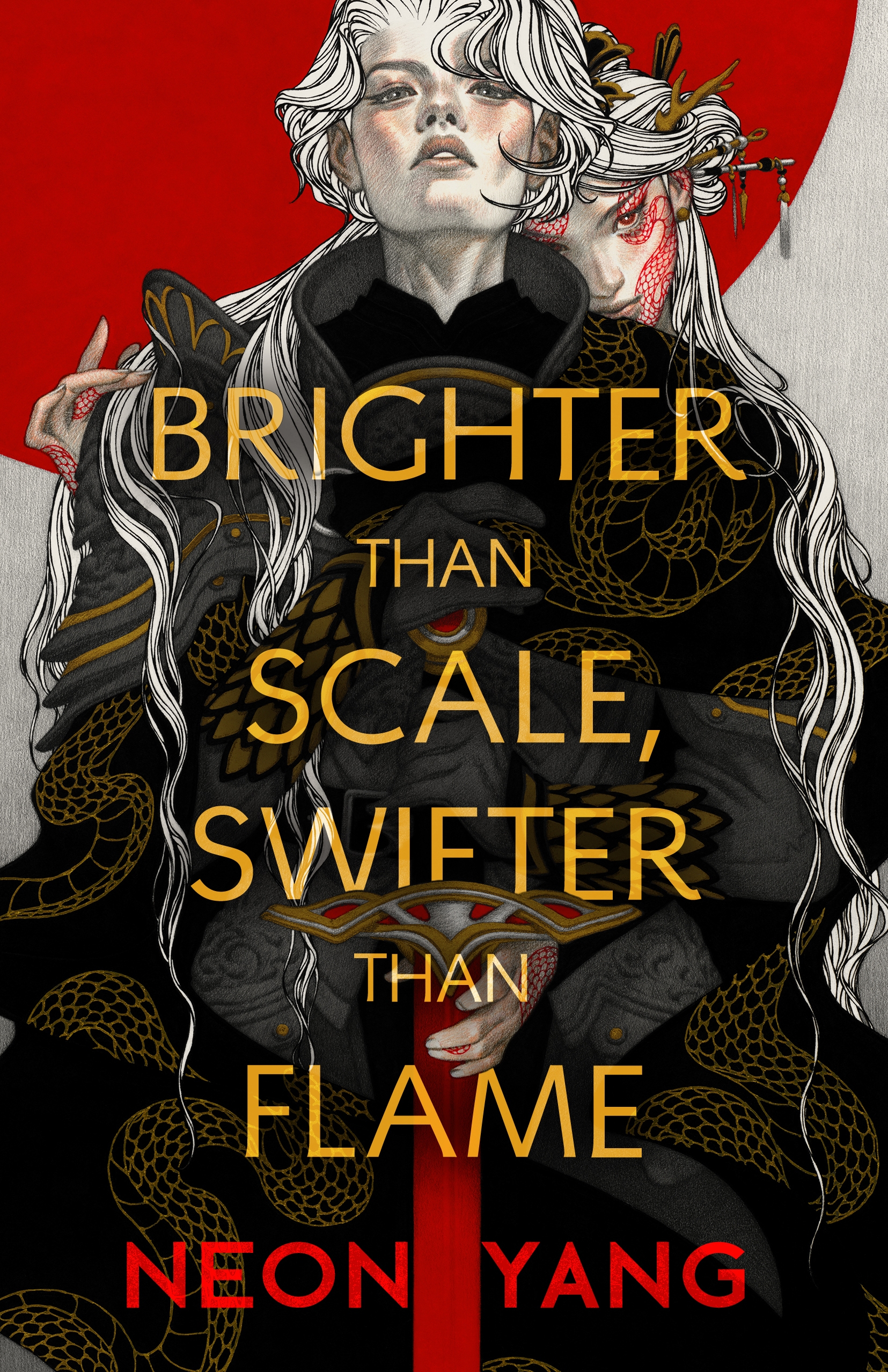
Their latest book, Brighter Than Scale, Swifter Than Flame, is a stunning queer novella about a dragon hunter finding home with a dragon queen. New York Times bestselling author Olivie Blake calls it, “A lovely, intricate gem of a fairy tale about finding yourself in another person and traveling distant lands to finally come home. I loved it.”

Kristen B. is a devoted bookworm lucky enough to work as the graphic designer for HCLS. She likes to read, stitch, dance, and watch baseball (but not all at the same time).

Silk Road Reads

by Tony B. 

I admit this is a fairly niche set of titles, especially given my past with archaeology, but it is interesting to see how Central and Western Asia can fascinate far Eastern writers as much as it does the Western reader. These manga series all share a common thread of being set in real or fantasy versions of places like Turkmenistan or the various Persian dynasties. The stories may be different, but they all have a cultural or at least aesthetic backdrop of a mythical Silk Road-esque past. 

Manga cover shows a high desert landscape in the background, with a young woman striding off the cover. She's dressed in traditional steppe garp in red and black, with a creamy while underskirt and embroidered boots.

The Bride’s Story by Kaoru Mori
No, not the cult classic movie, but rather a brilliant manga series set in mid 19th century central Asia (think modern day –Stans). The detail that Mori puts into her work is staggering, and she placed specific emphasis on the rich textile traditions of the area. Bold patterns and intricate needlework serve not only as part of the plot revolving around a nontraditional marriage, but as a luxurious backdrop for rather complex characters. Colonialism and foreign power threaten to upend traditional life constantly, and Mori places her characters firmly between the Russian and British factions, during the time period of The Great Game of shadow diplomacy and proxy wars during the 1850s. This series does not stick to one genre, with elements of slice-of-life, coming of age tales, romance, history, and ethnography. No matter the topic or conflict, The Bride’s Story is gorgeously illustrated and historically sound. 

A light bright manga cover in creams, greys, and pale purples shows a figure in a cloak looking to the left, with a hawk on their shoulder.

Heroic Legend of Arslan by Hiromu Arakawa
From the mangaka of Fullmetal Alchemist, this series takes place in a mythical and magical version of ancient Persia. This series utilizes a lot of place names and proper names that are real aspects of several eras of the Persian Empire. Places like Ecbatana and Fars, and people named Daryun and Andragoras, transport the reader into a different, ancient world. Following a young prince who is navigating the trials and tribulations of sudden leadership, the reader watches his coming of age as a compassionate leader in a land accustomed to war. FMA readers will find this series visually familiar, but with enough change to keep it interesting. 

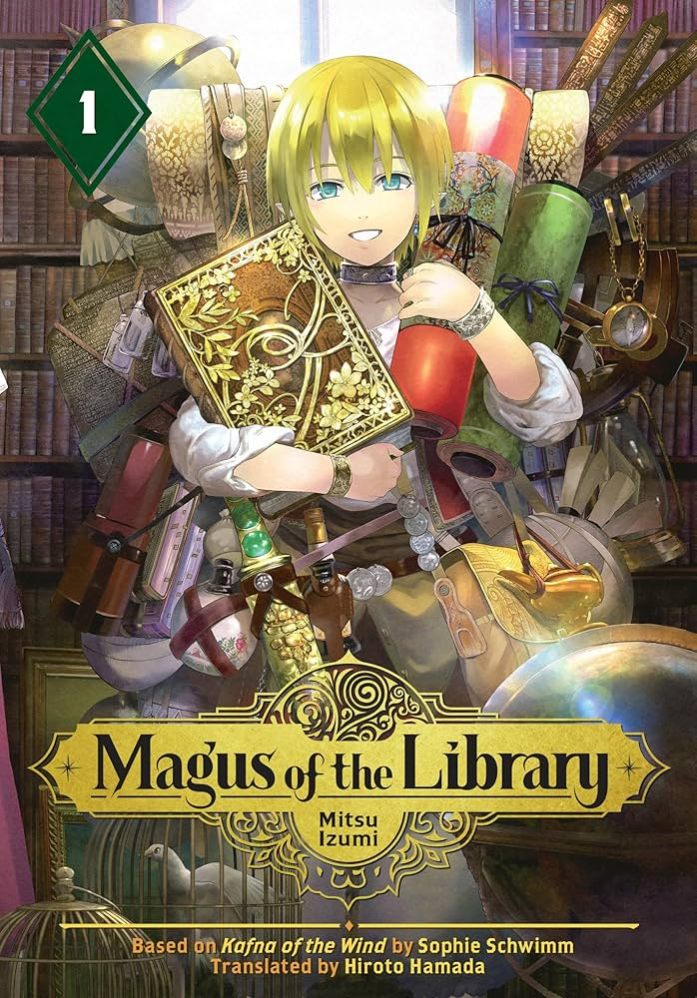
A bright and busy manga cover shows a young person in a wing chair with a library behind, clutching a wide assort of items including a bottle and a book.

Magus of the Library by Mitsu Izumi
Another story rich in detail and set in an alternative Western Asia, this manga leans less on history and more on magic. This was a bit of an indulgent read as a librarian, as most of the characters simply gush about their love of books and passions for various aspects of librarianship and reading. It also does not hurt that the fantasy society in question treats their magical librarians like super-humans. The series revels in diversity of characters, both real and fantasy, drawing from multiple historic inspirations for the factions complete with rivalry and culture shock. 

Tony is an Instructor and Research Specialist at HCLS Miller Branch. He has a degree in history and a renewed interest in science fiction and fantasy.

Ink Blood Sister Scribe by Emma Torzs

A deep purple background shows a plant and fountain pen, with the four words of the title interlaced in light yellow.

by Kristen B.

There seems to be a trend these days that recognizes the inherent magic of books. I mean, what’s more magical than a book? A bound set of white paper pages, set with solid black type that absolutely transports you via your imagination. Maybe you’re sleuthing for clues to solve a crime? Maybe you’ve stepped through the back of a wardrobe into a snowy woods? (still waiting for this to happen, honestly) Maybe you’re falling in love with your worst enemy from high school? So many books, so little time!

Ink Blood Sister Scribe by Emma Torzs takes the magic of books one step further, giving us spell books and the scribes who write them. It’s an entirely enthralling concept in a debut novel that reads as part family saga and part thriller, with a bit of romance thrown in to keep things fun. The three alternating POV main characters are desperately trying to figure out what’s going on in their world, and I enjoyed putting together the pieces with them.

The book opens with Esther loving her life and falling in love at the scientific station in Antarctica. She moves every year, trying to stay hidden from the people who killed her mother. Only this time, she likes the work and she has a girlfriend, and she’s literally at the far end of the earth. What could go wrong? Then, a new batch of researchers arrives and bad things start to happen, like people disappearing on the ice fields. She notices that mirror magic seems to have found its way into the dormitories. Esther knows about magic but is immune to it. She flees, terrified by an attempt on her life and anonymous notes that reach her through a mirror at the station.

Joanna, Ester’s half sister, lives a completely home-bound life in New England, as compared to Esther’s constant movement. She has an obsessive routine that protects the books her father collected throughout his life, books that led to her parents’ divorce and an almost complete estrangement with her mother. Joanna can perform the spells in their family’s magical library to maintain the protective wards on the estate. Before events get underway, Joanna found her father dead in the front yard, bleeding from one finger into one of the spell books. Her personality and life seem as opposite from Esther’s as possible, but the sisters miss each other terribly.

Nicholas is the poor, little, rich kid that no one feels terribly sorry for – until you do. He seemingly has an enchanted life of parties, limos, bodyguards, and a huge family estate in the English countryside. Nick is one of the last known living Scribes, a person who can write spells. There’s a catch, though – a scribe has to use their own blood as the ink. It turns out that Nick’s guardian and mentor is not (surprise surprise) an entirely ethical person, despite family ties. Uncle Richard has some fairly classic failings. When Nick runs away with his grumpy bodyguard Collins, they meet Esther on her way out from Antarctica. This coincidence has been carefully engineered – but I don’t want to give away more than that. Also, Collins is one of the best side characters ever, along with Nicholas’ dog Sir Kiwi.

From there on, it’s a flat out race to save the three protagonists, foil nefarious plans, and make magic accessible again. I don’t want to spoil any of many plot twists and turns, some of which are well telegraphed and others are more surprising. The interlocking story lines take a while to resolve, but I loved every word of discovering hidden libraries, teasing out the meaning of long-lost spells, and unraveling family secrets. The conclusion is satisfying, if a little rushed after the prolonged setup. I would love to read more about these characters in the future.

Ink Blood Sister Scribe by Emma Torzs is available in print, e-book, and e-audiobook.

Kristen B. is a devoted bookworm lucky enough to work as the graphic designer for HCLS. She likes to read, stitch, dance, and watch baseball (but not all at the same time).

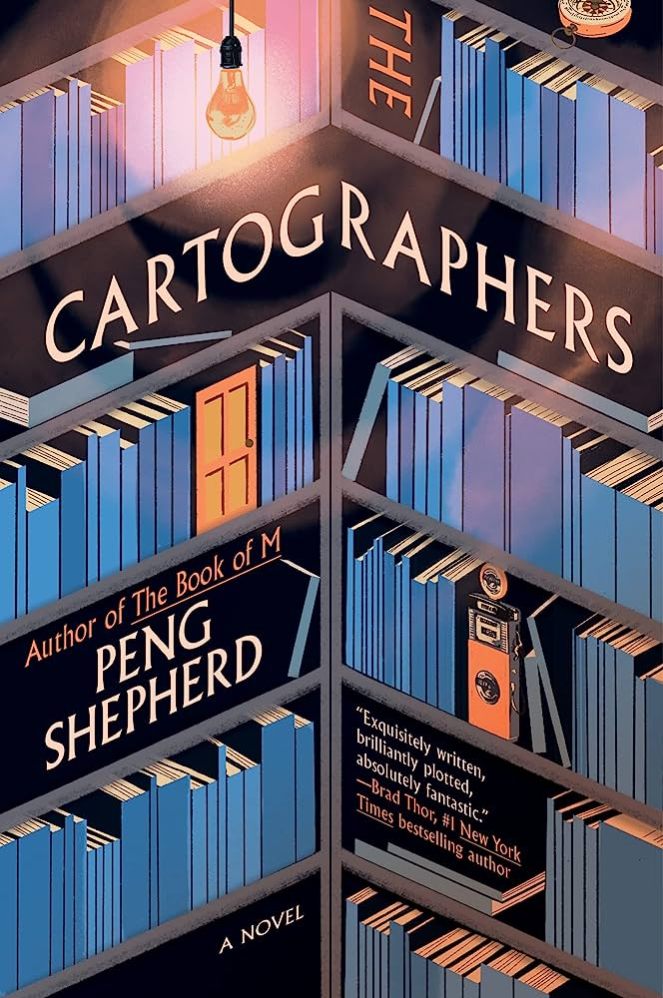
The Cartographers by Peng Shepherd

Image looks like a corner of two book cases. Shelves are lines with book books, an old fashioned camera, and a door. A bare lightbulb illuminated the title, which bends into the corner.

by Kristen B.

Maps fascinate me. I can lose time tracing routes and looking at where places are in relation to other places. Sometimes, it’s part of planning a vacation or maybe thinking through historical events. Other times, it’s just daydreaming. The Cartographers by Peng Shepherd hit me right in all of my map-loving feels. At heart, this novel is written directly for anyone who has ever pored over a map with a little wonder and wanderlust.

The book begins as Nell Young receives distressing news that her estranged father was found dead in his office at the New York Public Library’s maps division, in the main building on Fifth Avenue. The fast-moving plot intertwines current-day murders with Nell’s parents’ halcyon college days spent at the University of Wisconsin’s renowned cartography program, living the dream with a group of incredibly close friends. When Nell arrives at the library where she spent her childhood and always planned on working, she checks the secret compartment in her father’s desk. She finds an old gas station map of the state of New York, the very object that caused their years-long rift.

The combined mysteries of the cheap, old map and her father’s death propel Nell into a running, breathless search to figure out what happened to her dad, and, in turn, to her mom. As Nell researches the surprisingly valuable 1950s road map, her life becomes complicated by an old boyfriend, old family friends, and the need to stop anyone else from dying. In a related entanglement, the old boyfriend works for a cutting-edge tech company looking to create the “perfect map.”

About the time the gas station map was manufactured, various small cartography companies began adding copyright traps to their intellectual property to stop bigger corporations from stealing their work. It’s a fascinating bit of trivia that becomes pivotal to all the knotty problems, but I don’t want to spoil the fun of discovery. I’m not sure the author fully delivers on the set-up, but it’s a great premise. In the end, though, Shepherd wraps it all up and puts a bow on this story.

I really enjoyed how this book mapped the plot from past to present, where certain roads ran true and others were always traps for the unwary. On one level, it’s a cautionary tale about obsession and secrecy. As always, the solution is trust and transparency. Nell knows it, and she is strong enough to solve her own life.

Available as a print book , e-book, and an e-audiobook.

Kristen B. is a devoted bookworm lucky enough to work as the graphic designer for HCLS. She likes to read, stitch, dance, and watch baseball in season (but not all at the same time).

The Kingston Cycle by C. L. Polk

Covers of the three books in the series: Witchmark in blue, Stormsong in deep purple, and Soulstar in reds and pink. Each features figures in black silhouette against colorful backgrounds.

by Kristen B.

Ursula LeGuin wrote a famous short story, “The Ones Who Walk Away from Omelas,” about a utopian city with a catch. The peaceful and joyous life of the city’s citizens is made possible only through the absolute suffering of a single child. Everyone is made aware of the bargain as they reach adulthood, and those who can’t sanction it become those who walk away. In Witchmark (also available as an e-audiobook), author C. L. Polk answers LeGuin’s moral question more firmly: Those who can’t sanction a bad bargain are destined to unmake it.

Meet Miles, a war veteran who works as a psych doctor in a veterans hospital. The book begins with a dying man dumped, almost literally, into Miles’ arms. Our brave doctor has been tracking some worrisome patterns at the hospital, with traumatized veterans reporting a mysterious malaise, one that actively promotes domestic violence and mayhem. Miles sees the connection but can’t figure out why it’s happening or how to stop it. Side note: the role of newspapers in this series delights me!

Miles has turned his back on a wealthy but constrained life to use his healing talents. In Kingston, capital city of Aeland, the uppermost class possesses magic to control the weather, particularly the huge storms that threaten every winter. Other witches are considered dangerous to themselves and others, and they are institutionalized around the country. The author provides an antidote to all these troubles with a lovely romance blossoming between Miles and Tristan Hunter. Tristan has a rather unusual background that plays into solving both the initial murder and the other issues.

Polk continues to weave a Gordian knot of interrelated troubles, because the problems aren’t limited to a single world. There’s also the Solace, which exists parallel to Aeland, where souls go to reside after death. The Amaranthines rule there, an immortal race that serves as a sort of overarching moral conscience to the regular world, though one with real teeth. It turns out that they have noticed strange happenings during and after the recent war, and they are concerned because no Aelander souls have come into the Solace in decades. Therein hangs the rest of the story, but I don’t want to spoil it for you.

Witchmark sets the stage for the next two books, which are substantially more political in nature. Miles’ sister, heir to the family’s fortune and magic, becomes the main point of view for the second book, Stormsong (also in e-audiobook format). Grace has to balance the country’s needs against her own as her one true love also happens to be a star newspaper reporter. She must further balance her magical duties to protect Aeland from increasingly violent storms with her political position as Chancellor to a queen who has no desire to make necessary changes. A locked door political assassination only adds to her difficulties.

The third book, Soulstar, moves to yet another character, Robin, who has been part of the proceedings all along as a nurse and friend at Miles’ hospital and a key player in Grace’s political striving. She belongs to a minority and operates as a secret witch, whose talent lies in seeing and communicating with the dead. As the books progress, we see Aeland’s highly inequitable, stratified, royalist society change drastically. Revolution is the name of the game in this final book. Modern parallels are clear, but it’s still fun to root for the underdogs who want a seat at the table and their fair share of pie. Maybe what we need is a magical, immortal race to encourage us to live with compassion and sympathy for others.

All three books take place in Kingston, in which Polk gives us a deeply imagined, tangible city that seems as real as the wonderful, persistent people who live there. In each installment, you get a rousing story, a queer romance, and a hero who is trying to make the world a better place. Because if you can’t condone living in a society that excels only by requiring the suffering of some people, what does that require of you?

Kristen B. is a devoted bookworm lucky enough to work as the graphic designer for HCLS. She likes to read, stitch, dance, and watch baseball (but not all at the same time).