Now That’s Chutzpah 

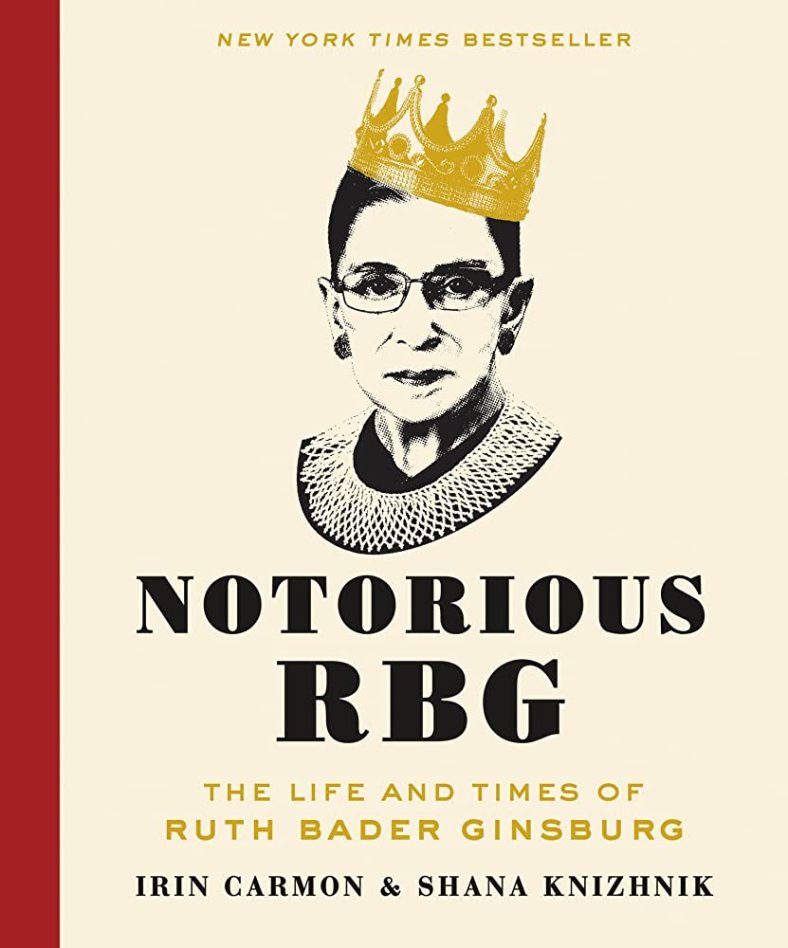
A black and white portrait of Supreme Court Justice Ruth Bader Ginsburg, wearing her dissent color and sporting a golden crown.

Truly walking a mile in another person’s shoes is rarely possible, but when you want to take a stroll, biography and memoir are right here inside the doors of everyone’s favorite library. Aspiring to understand the Jewish experience, readers can check out materials with unique perspectives on Jewish heritage. Consider exploring the lives of three Jews raised in Brooklyn, New York. 

In June 2013, Ruth Bader Ginsburg seized the rare opportunity to read a dissent from the bench of the Supreme Court. Wearing her “dissent collar,” she stated that the court’s majority opinion was a “demolition” of the Voting Rights Act. A slight 80-year-old woman with a soft voice, Justice Ginsburg was already legendary for her groundbreaking work on gender equality as well as her rigorous workout regimen, but her words were her superpower. She may have been the physical opposite of the deceased rapper Notorious B.I.G., but they both used language to pack a punch, and so the Notorious R.B.G. Tumblr (a multimedia blog site) was born. Fact-checked by RBG herself, Notorious RBG: The Life and Times of Ruth Bader Ginsburg, by Irin Carmon and Shana Knizhnik, presents one of the most fun and inspiring biographies available. Packed with tribute art, photographs of folks in RBG costumes, judicial wisdom, and primary sources, tweens and adults alike can embrace this book. There is also a young readers’ edition

Speaking of art, who does not love Where the Wild Things Are and New Yorker cartoons? Wild Visionary: Maurice Sendak in Queer Jewish Context, by Golan Y. Moskowitz, makes an in-depth journey into Sendak’s legacy. His upbringing and life as a Jewish gay man informed the futuristic outlook he brought to his books. Because they lost so much family in the Holocaust, Sendak’s parents were overly protective, and home felt as if it were filled with “dead Jews.” Considered a literary and artistic disrupter, Sendak believed that books were a way for children to safely explore their natural fears. Throughout his life, Sendak used his art to confront injustice, challenge prejudice, and engage readers in the gravity of children’s emotional lives. 
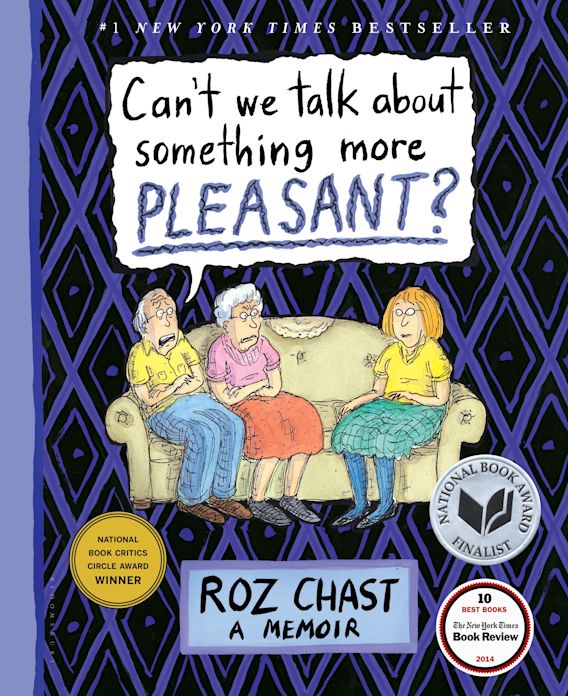
Against a backdrop of a black and puple diamond pattern, an illustration shows three people sitting on an sofa. Two elderly people next to a younger person. The text bubble reads, "Can't we talk about something more PLEASANT?"

Can’t We Talk About Something More Pleasant is New Yorker magazine cartoonist Roz Chast’s graphic memoir. The art is poignant and funny, provocative and familiar. Doesn’t every family have at least one closet so deep that we never know what was really in it until the person dies and the time comes to clean out its contents? Chast mines the contents of her life, including drawings, possessions, photos, letters, and family anecdotes to create an unforgettable portrait of her upbringing and a piercing view of death. Her relationship with her parents was fraught, making this an uncomfortable read at times. Chast’s dark humor in addressing challenging end-of-life issues resonated deeply with me. Her parents lived into their 90s, and she draws and writes about falls, elder law, dementia, nursing aides, financial fears, incontinence, bed sores, hospice. Filled with universal family truths, the book is one I’ve read and reread, rare for me. It’s a head-on confrontation with the circle of life. 

Cherise Tasker is an Adult Instructor and Research Specialist at the Central Branch. When not immersed in literary fiction, Cherise can be found singing along to musical theater soundtracks. 

What I Read on My Summer Vacation 

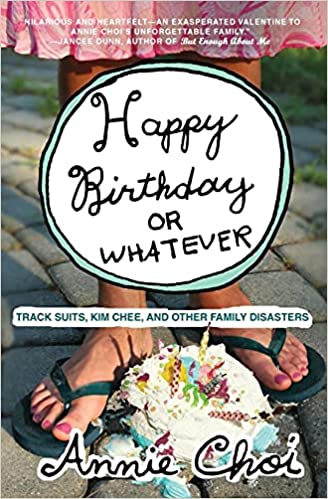
You see feet in flip flops (with pink toenails) under a dress hem. Between the feet is a smashed small birthday cake with

by Christie L.

I’m a speed reader. When I told my family that I read four books on a recent getaway, they teased me about whether I remembered any details. One was an advanced reader copy and not widely available for a couple of months. While I may not have encyclopedic recall, I can tell you enough about the other three to entice you to check them out for yourself. 

The first was by one of my favorite authors, David Sedaris. His latest book, Happy-Go-Lucky, (also as an e-book and an e-audiobook) chronicles his adventures in London, New York, North Carolina, and other locations. He begins with a story about going with his sister Lisa to a shooting range in North Carolina where he learns how to shoot a gun while pondering what types of people own them. From there, he jumps to a story about his father. Sedaris spends a considerable amount of the book talking about his father’s declining health and their complicated relationship. He shares deeply personal stories about his father and his sisters – the funny, awkward, and sometimes uncomfortable interactions, including painful questions about whether their dad sexually assaulted their sister Tina. Sprinkled throughout these recollections are other unrelated stories about a speech he thinks about giving to college graduates, the falling-apart house he and his partner Hugh purchase and fix up in France, travels to Eastern Europe, and life in NYC during the pandemic and protests following George Floyd’s murder. As with all of his previous works, one never knows what the next page holds – it may be laugh-out-loud funny, awkward, or thought-provoking. But it will never be boring. 

Next was Happy Birthday or Whatever: Track Suits, Kim Chee, and Other Family Disasters by Annie Choi. She often made me laugh while also giving me some insight into life as the child of Korean immigrants. Choi relates stories about her mother’s obsession with her daughter’s grades so she can go to an Ivy League school, her mother’s collection of knick-knacks, trips to Korea to see extended family, dating non-Koreans, going to Korean school, saving her stuffed animal collection, and defending her vegetarian diet. When she wrote about her mother’s cancer diagnosis and treatment, I could relate. It doesn’t matter who you are – it’s incredibly hard to live across the country from your parents when they struggle with health issues. Choi’s witty and touching memoir transcends cultures and gives us a glimpse into her world – and ours.

A wide horizon of a rural setting at sunset with a viviid red sky. Two figures are walking on the grass.

Finally, I finished the week with God Spare the Girls by Kelsey McKinney, a book I discovered from a Texas fiction list curated by Texas Monthly. As a native Texan who’s also a pastor’s daughter, I was interested in this story that follows two sisters whose father is a pastor and who are expected to be above reproach at all times. But that’s where the similarity ends. Before he retired, my dad served Lutheran congregations in rural Texas, living in parsonages (houses provided by the church) and ministering to folks in our small community. In this story, Luke Nolan is the pastor of an evangelical megachurch who has a secret that could end his career. (Side note: career vs. calling is a philosophical discussion for another time.)

When his daughters find out, they question not only their father but also their faith. Without giving anything away, the book explores double-standards, patriarchy, relationships between sisters and between children and parents, and how faith guides and impacts lives. It’s a fascinating coming-of-age story about two sisters who come to terms with what they really believe and how they will decide to live their lives.

Christie is the Director of Communication and Partnerships for Howard County Library System. She loves walking through the network of pathways in Columbia, sitting on the beach, and cheering for the Baltimore Orioles and Texas Aggies football team.