
Mossa and Pleiti series by Malka Older

by Kristen B.

The first two books in a series by Malka Older take place about 500 years in the future. Humanity no longer lives on Earth, a planet we have rendered uninhabitable. Instead, we colonized Jupiter – known as Giant – and some of its moons. A series of platforms and railways encircle the big gas planet, on which farms, businesses, and Valdegeld University exist (or in some cases, subsist). There are three major schools at the university: Classics, Modern, and Speculative. Classics studies literature, history, biology, and more from our planet of origin, trying to figure out how the pieces of well-balanced biospheres (ones not continually in crisis) operate. Modern looks at the issues facing the populace where they are now. Speculative also looks to return to Earth, among other goals, but not (necessarily) to restore it to its former glory. University-level research appears to be the biggest enterprise and employer, upon which the survival of the species relies. It’s rather a pointed observation, given the modern American penchant to argue with experts and deny scientific advancement.

I pieced together most of this synopsis from the information around the edges of Older’s first two short novels in a mystery series that is planned to run for at least five books. Pleiti is tenured faculty at Valdegeld, with a specialty in classic literature. Mostly, she researches how the various elements of biospheres worked together by reading books published when those animals lived on Earth. Mossa is an Investigator, the equivalent of a police detective, who spends most of her time searching for lost people. The two were lovers in their past, who, as the series begins, perhaps look to rekindle their romance.

The two installments to date are a lovely combination of science fiction, college politics, and detective mystery. Pleiti and Mossa are enigmatic people, but you find yourself wanting to know more about them as individuals and a couple.

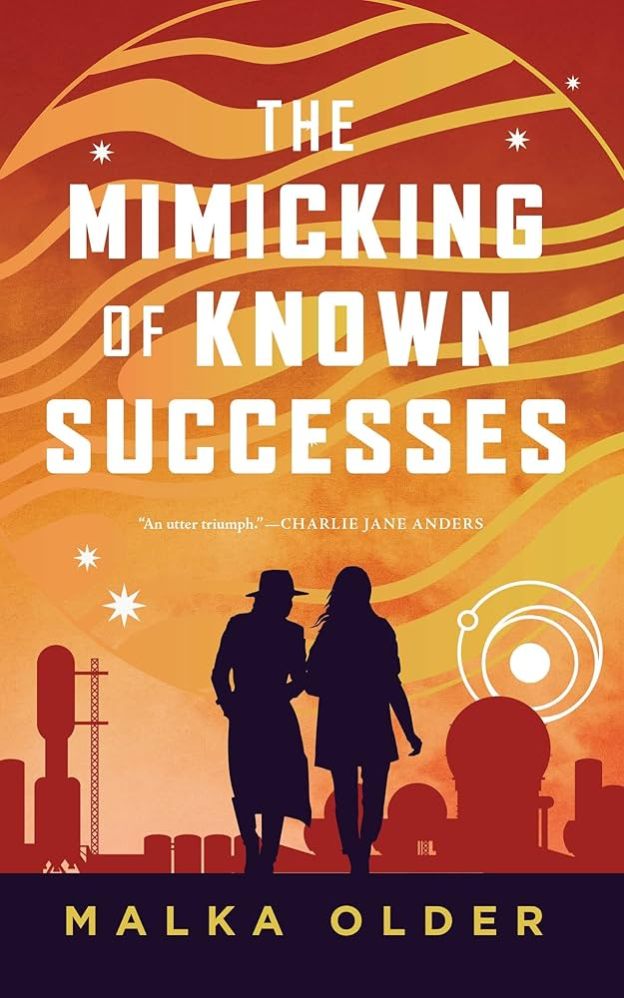
The Mimicking of Known Successes: A man from the university takes a railcar to a remote platform, then promptly disappears. Mossa is pretty sure that he didn’t jump to his death into the planet, and she ends up at Pleiti’s campus asking questions and looking for help. University politics and personalities mix badly with personal ambitions to see Earth restored. Favorite pieces include atmoscarves, the sheer quantity of scones and tea consumed, and the existence of the mauzooleum where “ancient” breeds of animals are carefully bred and studied. I had to make an effort to keep reading through a fairly slow set-up and was rewarded with an exciting, and rather unexpected, conclusion.

The Imposition of Unnecessary Obstacles: I enjoyed this one more, when I could enjoy the mystery without working to understand the world-building. Mossa and Pleiti once again join forces to solve a case involving missing persons – and a subsequent murder – that requires them to do a fair amount of traveling, including to the moon Io and the far side of Giant. Gourmet snacks once again play a not-inconsiderable role as our valiant pair completes some quality sleuthing. There’s also the mention of an opera named Murderbot, which was a high-quality tidbit. I gobbled up this book over a weekend and appreciated the slightly faster pacing and tighter timeline.

A third installment is scheduled to be published in June, The Potency of Ungovernable Impulses, and I’m already looking forward to it.

Kristen B. is a devoted bookworm lucky enough to work as the graphic designer for HCLS. She likes to read, stitch, dance, and watch baseball (but not all at the same time).

The Cold Vanish

The book cover is an aerial photograph of a mountainous area covered in conifers, with a cloudy gray-white mist settled over the dark green of the treetops.

“Searching for a missing person, after that first week, is a believer’s game” (219).

The Cold Vanish: Seeking the Missing in North America’s Wildlands is a gem of a book, written by Jon Billman, a fiction and journalism professor at Northern Michigan University. He also writes for Outside magazine, where I found the article that was the germ of the idea for The Cold Vanish. Billman tells the stories of a myriad of the disappeared, people who seemingly stepped off a trail at Mesa Verde or Yellowstone or Olympic and were never seen again. He intertwines their (shorter) stories with the book-length account of Randy Gray, father of Jacob Gray, a young man who parked his bike on the side of the road in Olympic and vanished into the woods of northern Washington. Although the disappearance is Jacob’s, the story really belongs to Randy, as we see the lengths he goes to in order to keep hope alive and continue the search for his son. Randy is a character – a Christian hippie surfer and building contractor, full of boundless energy and humor, enthusiastic, and generous. He is also willing to explore (if not exactly embrace with open arms) any theory that might locate Jacob and give him and his family some closure. My favorite anecdote about Randy: “Randy Gray cannot tell a lie, and so declares the two avocados rolling around somewhere in the back of the Arctic Fox when the customs agent asks if we have any produce. The agent pretends she doesn’t hear him, hands our passports back, and welcomes us to Canada” (274).

One of the stories really struck a chord with me. I’ve been to Mesa Verde, and walked the trail Billman mentions from the interpretive center to Spruce Tree House – “more of a sidewalk – it’s wheelchair accessible for less than a quarter mile, where visitors can view the [Anasazi cliff] dwellings from the shade of the overhanging cliff” (119-120). Yet 51-year-old Mitchell Dale Stehling disappeared while walking that trail and was not found until last year (his remains were located after the book was published, in August 2020). No other park visitor has stayed missing from Mesa Verde since the park was founded, and the area encompasses just over 50,000 acres. How could someone disappear off of a trail adjacent to the park’s gift shop?

The accounts of the disappeared have many explanations, some plausible, some completely off-the-charts crazy. I love a book like this that takes a journalistic viewpoint and presents the theories without passing comment; a book about conspiracy theories *not* written by a conspiracy theorist. In that respect, The Cold Vanish resembles another of my favorites in this genre, Where Bigfoot Walks: Crossing the Dark Divide by Robert Michael Pyle. In that book, acclaimed naturalist Pyle explains why the flora and fauna of the Pacific Northwest would be conducive to the existence of the Sasquatch – should such a creature exist. Like Pyle’s book, Billman’s presentation is open-minded and even-handed, and he makes valid observations and connections about why someone like Randy Gray might entertain the wild ideas of psychics and Bigfoot hunters. “Randy is the ultimate optimist. He’s wildly curious. The seeker from the Who song. ‘What else do I got?’ he says. ‘What else can I do?'”(217). Billman makes the reader understand Randy’s quiet desperation for any tenuous thread to follow.

He also explores other stories and disappearances: people who choose to go missing, the hunt for the Utah survivalist “Mountain Man” Knapp (who evaded authorities for seven years by breaking into remote cabins and stealing food and guns), and the serial killers in the Great Basin and in the Yosemite area who sought victims in remote wilderness areas. One of the best anecdotes is about Alan Duffy, a bloodhound trainer and handler who teaches his dogs, Mindy Amber and R.C., to search for the missing with a single verbal cue – either “Gizmo!” for cadavers, or “Find!” for a living person.

The book will leave you full of wonder at the majesty and hidden depths in what might seem like a benign, unspoiled setting, but which really harbors dangers that amateurs and enthusiasts ignore to their peril. You will also ponder the number of missing persons cases still unsolved: where are the (still) disappeared in our national parks and wild places, and will they ever be found?

The Cold Vanish is also available from HCLS as an eaudiobook from Libby/OverDrive.

Julie is an instructor and research specialist at HCLS Miller Branch. She loves gardening, birds, books, all kinds of music, and the great outdoors.