Lights Out by Navessa Allen

A blue skull and type appear ghostly against a black background. An X and a heart appear in the eye sockets.

by JP Landolt

“Mmm-kay?! Make it work!” I said in my best Tim Gunn voice, cackling and carrying on with my girlfriends. Missy and Rachel are crumpled against me on either side. We’re squished together on the bottom mattress of their dorm room’s bunkbed. Thelma’s hair spills over the top of the bunk framing her face in a dizzying array of red and black. She’s upside down and laughing hysterically. Jen is folded in half, bracing her side after falling on the floor. She’s silently laughing, red-faced, and breathless. Everyone was thoroughly amused by my overly dramatic storytelling, especially when describing a particularly racy scene in one of Jen’s romance paperbacks. Unfortunately, the dean lived directly below this room, and soon the stern knocking from below forced us to freeze. “Oh dear!” I remarked, as a sultry Tim Gunn, and another boisterous round of laughter ensued.  
 
That was me. A naive eighteen-year-old exploring the genre we shall refer to as “super spicy romance.” Embarrassing, exciting, and 100% for adult readers only.  

Now that my prefrontal cortex has fully matured (LIES) and I have more than 20 years of distance from blushing on the bottom of that bunkbed (OMG), I’ve explored nearly every genre of spicy, adult romance: Fae, gangsters, dragons, hockey players, fractured fairy tales, hackers, Hollywood, vampires, wolves, rockstars, gargoyles, cowboys, billionaires, and psychos. If you’re not familiar with this genre, let me assure you that the list is immense and overwhelming – and constantly growing. Seriously, romance can be anything from wholesome and cozy to downright sadistic. I literally just put down a book whose jacket described it as a cozy racoon-shifter polyamorous romance.  

Today, I submit Lights Out for your dark romance reading pleasure. Lights Out is spicy, with morally gray characters, and packed with trigger warnings. In fact, after reading these trigger warnings, some readers may consider another title. Not me! There was one trigger that hit squarely in the center of my morbid curiosity. Which one? Not telling. Let’s just say if you enjoy true crime or serial killer docuseries, this book could be a good fit. 

I opted to listen to this book because it’s written in duet and I’m a huge fan of Jacob Morgan (aka Zachary Webber). His voice just makes my heart purr. He voices our main male character, Josh, who has a complicated family history which makes his social media and masked proclivities even more telling. He had me giggling on the bottom bunk all over again thanks to a fast-paced story with a well-written sense of humor set against the silliness of those feelings that come from having crushes…and maybe stalking? I wouldn’t know.  

While our heroine, Aly, is a pragmatic yet bratty trauma nurse who should be more concerned about the unfolding events than she is. She’s got her own questionable tendencies. Not to mention, her suspicious familial relations that definitely slide from morally gray to jet-black. Finally, Josh and Aly’s chemistry is – chef’s kiss! 

Lights Out is the first book of the Into Darkness trilogy by Navessa Allen and book two, Caught Up, should be available in June. I simply cannot wait to find out where this relationship is going and what other crazy situations Josh and Aly get into with his high-tech hackery and her sheer audacity.   

Lights Out by Navessa Allen is available in print, e-book, and e-audiobook.

JP Landolt has worked for HCLS since 2006. You may find her gallivanting through Maryland’s parks on beautiful, breezy days.  

The Big Sleep by Raymond Chandler

A bright yellow cover features a red cutout image of a revolver.

by Jean B.

I took an uncharacteristic turn this summer by watching a movie before reading the book. Heresy! When my book club decided to read the Raymond Chandler classic, The Big Sleep, I felt unenthusiastic and decided to first check out the famous film adaptation, starring Humphrey Bogart and Lauren Bacall. 

I discovered an atmospheric masterpiece that is like a train wreck: you can’t look away, even as the bodies are piling up and the unanswered questions are mounting faster. Seamy and steamy, the film’s careless violence and social dysfunction surprised me in a 1940s-era production. Of course, that’s why they call it film noir, right?  Bogart, as the hard boiled private detective Philip Marlowe, dives into the sordid world of the spoiled, rich Sternwood sisters (Bacall and Martha Vickers) to catch a blackmailer and through a meandering investigation, ignites all kinds of sparks – romantic and otherwise.   

I appreciated the film for its classic style and mesmerizing performances, but I also felt perplexed by the story. It turns out, I’m not alone: as one critic wrote, “The Big Sleep is the best scripted, best directed, best acted, and least comprehensible film noir ever made.” Interestingly, the screenplay was written by William Faulkner, known for his own complex literature. I wondered, did Faulkner make the plot incomprehensible or was that Chandler’s work? 

Clearly, it was time to read the book and find out for myself. Told in first person by Marlowe, the story unfolds through sharp dialogue and terse descriptions of people and urban landscapes. Having seen the movie first, I heard Humphrey Bogart’s voice as I read, a definite bonus! While I usually prefer to form my own image of a character from the author’s writing, Bogart and Bacall seemed perfectly suited to Chandler’s style and words, so I didn’t mind having them in my head. 

The book provided a wealth of detail and allowed me to add more depth to my understanding of the characters and their predicaments. Still, this is not the kind of mystery you try to solve on your own. As a detective, Marlowe makes no effort to be especially clever or careful; he doesn’t store up observations and deductions a la Sherlock Holmes. 

Instead, he confronts a suspicious character, spills whatever information he has, then stands back to see what happens. Although the plot feels more comprehensible in the book than the movie, it’s still like a many-layered onion: each time Marlowe deciphers one crime and its culprit, another one emerges and more motives, corruption, romantic relationships, and villainy appear. Still, Chandler’s language and pungent metaphors make the effort to untangle these webs worthwhile. When a writer can make even a dreary office evocative (“His office had the musty smell of years of routine”), you can’t help but turn the page to keep reading.  

So which was better:  the book or the movie? I’m glad to have experienced both. The Big Sleep is all about atmosphere – when you soak it up both through the author’s words and the performances of great actors on the screen, you get the full picture, even if you’re still a little fuzzy on whodunnit! 

Borrow either or both at HCLS: in print and on DVD.

Jean is a Children’s Instructor and Research Specialist at HCLS Central Branch. She loves talking about books with people of all ages, but especially enjoys leading the Heavy Medals book club for fourth and fifth graders, exploring award-winning books of all genres.  

Killers of the Flower Moon by David Grann

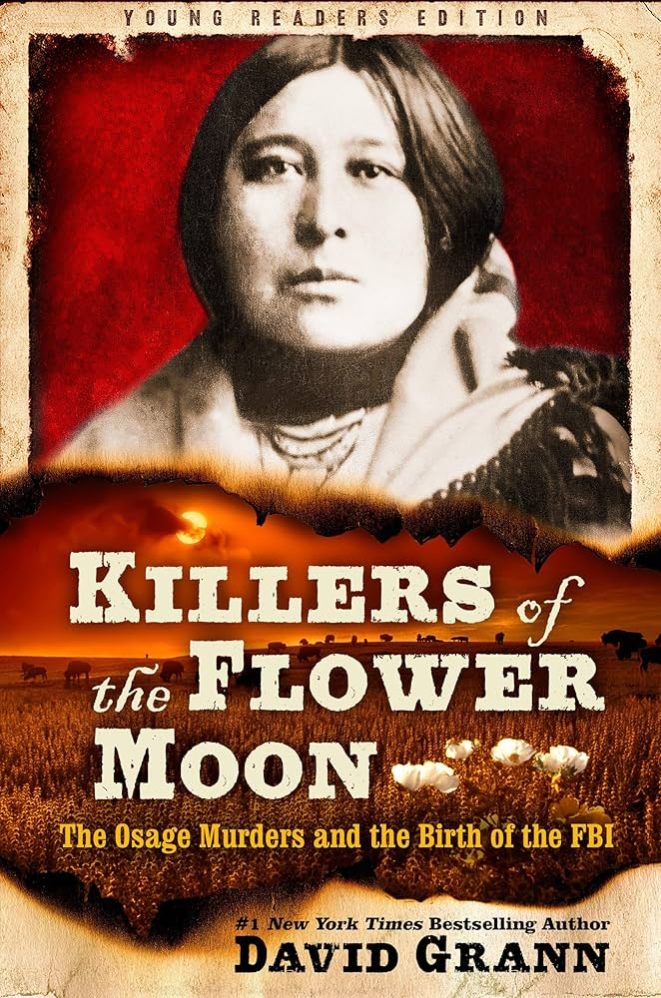
Black and white photo of a Native woman in her traditional blanket sits above a landscape of prarie grasses with white flowers, all with red

by Eric L.

Although a graduate of a mostly white private high school, I was lucky to attend a good public college that furthered my historical education. Like many pieces of history, the “Osage Reign of Terror,” which took place roughly from the 1910s to the 1930s, was not addressed in my education. Someone suggested that the term is a misnomer because it sounds as though Osage caused the reign of terror; however, the opposite is true.

Killers of the Flower Moon is an entertaining and provocative read. Published in 2017, the book is on bestseller lists again because of the critically-acclaimed Martin Scorsese film, starring Lily Gladstone, Leonardo DiCaprio, and Robert DeNiro. Author David Grann is a thorough researcher, and he recounts the history of the Osage people and how they ended up in Oklahoma. They, like so many other Native tribes, were continually pushed West out of desirable land until they arrived on the least desirable part. A chief at the time suggested that they take the hilly land in Oklahoma because the white man would not want it, and perhaps would leave them be. He was wrong. Another chief decided that they would have to parcel it out like real estate – but the Osage owners retained all the mineral rights. A shrewd stratagem, as they realized oil had been discovered.

The reserved mineral rights could not be sold to a non-Osage person, but only inherited in a practice that became known as “head rights.” This seemed a genius move, but unfortunately, the chief was battling with a far more powerful entity. As more oil was found on Osage land, the income generated from the rights to drill became very valuable. All the major oil companies wanted to drill on this land, and were spending large amounts of money to do so. For a short time, the Osage had the most wealth per capita in the United States.

This situation was untenable to some white Americans. The Osage were prohibited from accessing their bank accounts and assigned guardians (through the Bureau of Indian Affairs) who controlled their money; in the movie, you hear Mollie Burkhart refer to herself as “incompetent” when talking to her banker. The need for a guardian was determined by how much native blood a particular Osage person had and thus the extent of their head rights. All this sets the backdrop to the Reign of Terror, when more than an average number of wealthy Osage folks died untimely deaths and others (mostly white men) inherited their wealth.

After a number of botched, failed, and bogus investigations, the nascent FBI, under the direction of a young J. Edgar Hoover, decided to get involved. After all, the murders occurred on federally managed land, which was technically the FBI’s jurisdiction. Grann’s book follows a particularly tragic example, where a WWI veteran, Ernest Burkhart, came to live with his uncle “King” Hale, a cattle rancher in the Osage country. Ernest marries Mollie, whose family died around her from natural and unnatural causes. It is Mollie who ventures to Washington, DC to ask the Bureau of Investigation to provide answers.

I won’t spoil the mystery and subsequent court case, but Grann successfully interweaves a story of the early FBI with the tragedy of Mollie’s family and the plot to inherit their rights. It’s terribly sad, but with an interesting cast of characters and a well-written murder mystery. The story is told largely from the FBI agent’s perspective, but Grann is very thorough in his research and interviews, and he uncovers more than the FBI found (or at least documented). The movie shifts the narrative from the FBI to Ernest Burkhart and King Hale, and to a lesser extent, Mollie.

I’m certain the film will attract some backlash for bringing up the ghosts of our past. It always seems strange to me that we don’t want to better appreciate our collective history. I loved that one wise Osage person wondered whether any of it was worth it, since they lost so much. I can’t pretend to have an answer for that, but it’s a sad and instructive story about American greed and racism. What I’ll take from it, which is well-developed in the book, is that there were some dedicated FBI agents and citizens who spent time investigating and solving some of these crimes despite nearly insurmountable odds. Read the book and see this film; it’s a story worth repeating and knowing.

Killers of the Flower Moon: The Osage Murders and the Birth of the FBI by David Grann is available in many formats:
print, large print, e-book via Libby/Overdrive, e-book via CloudLibrary,
audiobook on CD, e-audiobook via Libby/Overdrive, e-audiobook via CloudLibrary

You can also get on the waiting list for the DVD of the movie, which is set to be released at the end of February, 2024.

Kristen B. contributed to this review.

Eric is a DIY Instructor and Research Specialist at Elkridge Branch. He enjoys reading, films, music, doing nearly anything outside, and people.

Killers of a Certain Age by Deanna Raybourn

The book cover depicts a red hand holding a long, sharp black kitchen knife, with a strand of white pearls around the wrist.

By Sahana C.

Almost-retired lady assassins taking on a shady secret organization with good intentions but a crooked bent – that’s all the introduction I needed to be intensely, rapturously interested in Killers of a Certain Age by Deanna Raybourn.  

The four main characters are set to celebrate their retirement from the Museum, an organization founded to assassinate Nazis who fled justice, and are reuniting on a cruise. It’s fun! Celebratory even! Until one of them notices a mid-level smug assassin who seems to be tailing them, and that can only mean one thing – someone has ordered a hit on them, and they’ve got to figure out who it is and why. After all, they’ve spent the last forty years killing only the bad guys – what could be so wrong about that? 

One strength of this book is that the pacing is rapid and the plot moves along, yet we still discover so much personality, so much verve, and so much life in each of the characters. Each of the four main lady assassins – Billie, Natalie, Mary Alice, and Helen – are given backstories. Each fits into a trope: Billie as the stolid leader with a rebellious streak, Mary Alice as Billie’s counterbalance and de facto second in command, Natalie as flirtatious and almost ditzy but handy with a lock pick, and Helen, the one the others worry about, but well-bred, well-pedigreed, and almost certainly more capable than she seems.  

Each character is so vivid, but at no point does the plot suffer for this focus on characterization. In fact, as many of my personal favorite books do, the characterization that is introduced instantly propels us forward into a new plot point. It’s brilliantly written when you learn something new about a character, and then immediately realize, “OH, that’s how they’re going to solve that seemingly-insurmountable obstacle! That’s why no one seemed concerned about that plot hole! I can’t believe they didn’t have to deus-ex-machina this, it’s not even plot contrivance, and it makes perfect sense in context!”  

Suffice it to say that I was entertained. I had fun with this book. It’s not deep, but it’s definitely about murder. This is a fun mystery-suspense book along the lines of The Thursday Murder Club, and I liked it just as much or (dare I say it?) a bit more.  

It’s an HCLS Adult Summer Reading Book this year too, and you can find it in print, e-book, and e-audiobook.  Be part of HCLS’ Summer Reading Adventures.

Sahana is an Instructor and Research Specialist at the Savage Branch. They enjoy adding books to their “want to read” list despite having a mountain of books waiting for them already.

Author Works: Sarah Gailey

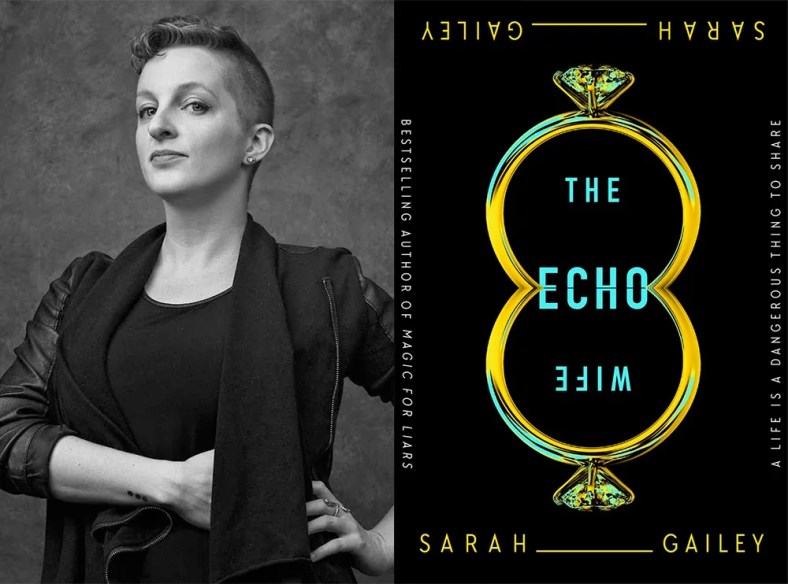
Black and white photo of the author, with short hair and one hand tucked inside her jacket, sits next to a cover of The Echo Wife. The cover shows an engagement ring and its reflection in gold with blue highlights, the title appears in blue inside the rings.

Tue, May 17 at 7 pm online
Register at bit.ly/echowife.

by Kristen B.

Author Sarah Gailey discusses their acclaimed novel The Echo Wife (also eBook and eAudiobook) in conversation with Maggie Tokuda-Hall, author of Also an Octopus (reviewed here). Gailey’s most recent novel, The Echo Wife, and first original comic book series with BOOM! Studios, Eat the Rich, are available now. Other shorter works and essays have been published in Mashable, The Boston Globe, Vice, Tor.com, and The Atlantic, and their work has been translated into seven languages and published around the world.

Publisher’s Weekly review of The Echo Wife:

This creepy, exhilarating science fiction outing from Gailey (Magic for Liars) dissects an unconventional affair that violates both a couple’s marriage vows and scientific integrity. Dr. Evelyn Caldwell is startled to discover that her husband, Nathan, has been seeing another woman—and even more shocked to learn that the other woman is a clone of Evelyn herself. Nathan created Martine to be everything Evelyn isn’t: attentive, submissive, and family-oriented. Adding insult to injury, Nathan used Evelyn’s own research to do so. An explosive confrontation among the three ends in Nathan’s murder, leaving Evelyn and Martine forced to work together to cover up the crime. It’s a situation that is not entirely unfamiliar for Evelyn, whose troubled past is teased out bit by bit. The women slowly discover that Nathan was hiding more secrets than either of them knew, forcing Martine and Evelyn to think on their feet in order to save themselves and the odd little family they create along the way. Gailey’s story unspools as a series of dark reveals that leave both the characters and the audience reeling. Readers won’t want to put this one down. (Feb.)

Gailey is a Hugo Award winning and bestselling author of speculative fiction, short stories, and essays. They have been a finalist for the Hugo, Nebula, and Locus awards for multiple years, and their bestselling adult novel debut, Magic for Liars, was published by Tor Books in 2019.

A bright pink cover shows a black hand upside down with its fingers crossed and a mystical eye on the wrist. the title of the book frames it in large yellow layers.

My book club (Books on Tap) read Magic for Liars for our May meeting. As with many other of Gailey’s books, it doesn’t fit neatly into one category. Yes, it’s a murder mystery complete with clues, red herrings, multiple suspects, and gory details. The book also tackles grief, illness, and how families deal with both. These weightier topics rather sneak around the edges of the crime scene. Our protagonist and Private Investigator, Ivy Gamble, is hired to solve the death of a teacher at the school for magical students where her sister teaches. She tells us up-front that she’s a liar, that she resents the living daylights out of her magical sister, and that she’s not proud of how the situation resolved. To say they are estranged doesn’t begin to cover the levels of distrust and bitterness that separate these twin sisters – one magical, one not. Do you trust that sort of narrator? It’s a terrifically entertaining read that nonetheless leaves you thinking about what you might do in a similar situation.

Magic for Liars is available in print, as an eBook and an eAudiobook.

The Thursday Murder Club by Richard Osman

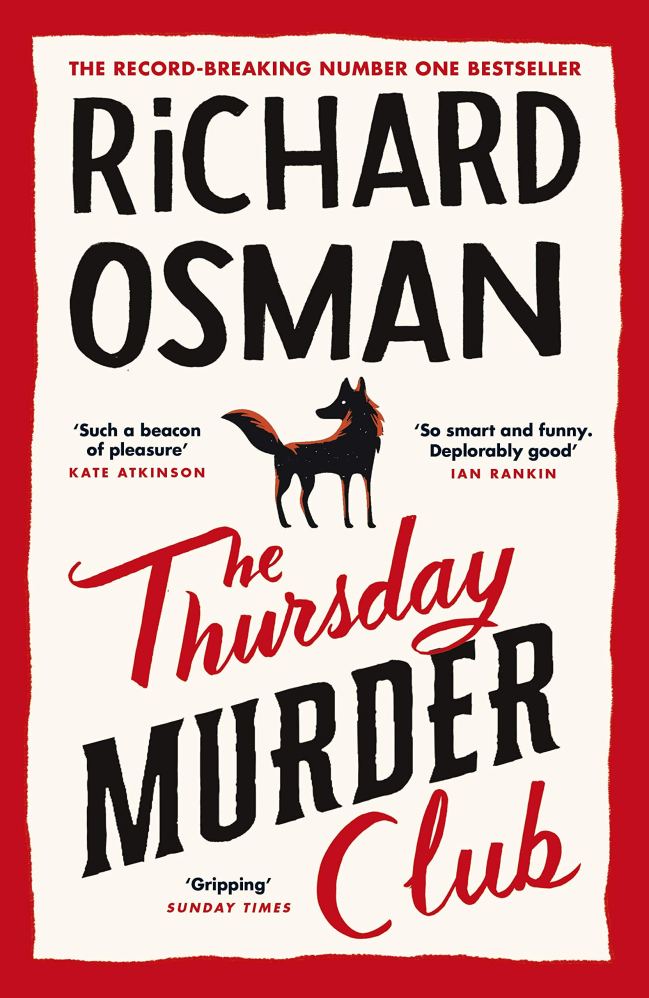
A fairly plain cover with a red edge and the title in script and the author's name hand lettered. A small wolf stands between author and title lines.

by Sahana C.

I read the introduction on Goodreads: “Four septuagenarians with a few tricks up their sleeves, a female cop with her first big case, a brutal murder. Welcome to…The Thursday Murder Club” and immediately placed a request for this book. Then I waited for a few weeks and was thrilled when I finally got the notification that the novel was ready for me. I finished it the day I started, because, first things first, the book is hilarious. I paged through, intent on the mystery and trying to pick up the clues scattered through the pages and thinking about the details of the case, then suddenly remembered that the characters are using and abusing the privileges of their old age. One of the main characters pretends to have her handbag stolen to talk to a police officer, while another pretends that his memory is going in order to get a detective to give him what he needs. All of them are ever-so-charming when they’re trying to get their way, and you suddenly remember that the point-of-view character is a seventy-something year old who is casually discussing (and excited about investigating!) murder.  

The novel happens in a retirement village, Cooper’s Chase, and centers on four friends who genuinely seem to have absolutely nothing in common and no real reason to like each other. (Except Joyce: “I think we all like Joyce,” says Ibrahim. Ron and Elizabeth nod their agreement again. “Thank you, I’m sure,” says Joyce, chasing peas around her plate. “Don’t you think someone should invent flat peas?” (p 13)). The four meet weekly (on Thursdays, to no one’s surprise) in the Jigsaw Room to solve cold cases, especially murders. There’s Ron, a loudmouthed, passionate rabblerouser whose biggest role in the group comes from his unwavering suspicion of any sort of authority. Ibrahim, a retired psychiatrist, serves as the group’s resident tech expert, who is wildly proud of his technological prowess while also organizing and keeping the data on all of the crimes the club discusses. Joyce, the first point of view readers are introduced to, is a former nurse and the newest member of the group, who is steadfast and practical, keeps her head down, and bakes a mean cake in almost every other scene. Finally, rounding out the four and one of the founding members of the Thursday Murder Club is Elizabeth, who remains infinitely mysterious, with a checkered past, who always manages, somehow, to get her way.  

Through trickery and subtle coercion, they involve themselves in the investigation of a murder that occurs adjacent to their retirement village, bringing two detectives into the fold: Donna, a young woman looking to prove herself, and Chris, a detective who feels a bit past his prime. The detectives quickly realize the importance of our Murder Club, never take them for granted, and come to realize that the Thursday Murder Club’s influence and investigative effort is absolutely necessary to solving the crime. Through it all, we get an actual well-constructed mystery, one that leaves bread crumbs and truly utilizes each of the ensemble cast of characters to the full extent of their humor and intelligence. It keeps the plot moving from beat to beat.  

No real moral judgements are made in the story. The retirement village is full of rich and accomplished people who are ready for some time out of the spotlight, but who have their own secrets and problems, which in turn allows them to confront the criminals without any real superiority. The only judgements are for the truly obnoxious characters (one in particular, who simply has no manners), and even comes across as more of a grandparent’s headshake of disapproval than any real condemnation. 

The Thursday Murder Club is a cozy mystery full of humor, vitality, and life, more than I anticipated for a book about murder and retirement villages. It is available in print, eBook, and eAudiobook

Sahana is an Instructor and Research Specialist at the Savage Branch. She enjoys adding books to her “want to read” list despite having a mountain of books waiting for her already.

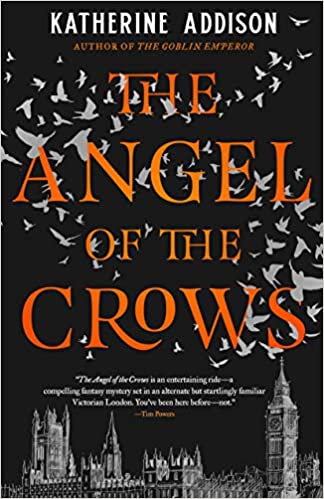
The Angel of the Crows by Katherine Addison

Black background with grey bird silhouettes above the image of British Houses of Parliament. Title appears in red.

By Kristen B.

Sherlock Holmes is a perennial favorite. So many movies and TV shows have delved into Sir Arthur Conan Doyle’s series of short stories and novellas, from House M.D. to Benedict Cumberbatch on the BBC to Robert Downey, Jr’s movies, that the character has entered the common sphere. You really don’t have to explain him and his particular attention to detail.

Katherine Addison’s new novel, The Angel of the Crows, combines Victorian England, the Sherlock Holmes stories, and Jack the Ripper with a supernatural, steampunk milieu that includes angels, Fallen angels, vampires, werewolves, and hellhounds. Angels operate a little differently here: they are only thinking, rational beings with names when they have a habitation. Without a location (usually a public building) to guard, an angel is Nameless and belongs to the collective hive-mind. In the worst case, when an angel loses its habitation, the trauma can cause it to Fall (capital letter necessary) … which can have an impact like a bomb.

You need to know this to understand our intrepid detectives, Crow and Dr. J. H. Doyle. Crow names itself Angel of London but is really managing to hold onto a name and an identity by sheer force of will. The angel is a maniac for helping the local police solve murders and other crimes (and obsesses over the daily papers to this end). Dr. Doyle has returned home from the war in Afghanistan, where an unexpected attack by Fallen angels left behind an interesting assortment of wounds and complications. The two social misfits become unexpected, but oddly compatible, flatmates.

These two get themselves into – and out of – all sorts of predicaments. The structure of the book is fantastic, with the overarching story of solving the Jack the Ripper/Whitechapel murders carrying throughout. The novel, however, divides into several, shorter parts which work as discrete, individual detective stories about missing persons, foreign treasure, and other mundane mysteries – most of which are direct pastiches of Sir Arthur Conan Doyle’s originals. The smaller adventures allow the individual characters to come to life and steal into your heart a little bit at a time. Both Crow and Doyle are wrestling the world for their right to live as they choose – and you root for them as well as their superior sleuthing.

While by no means a strict Sherlock equivalency, the book recognizes and honors its source material. I hope you enjoy it as much as I have. It may, indeed, spur you to reacquaint yourself with the originals, too.

Kristen B. has worked for HCLS for more than 15 years, and currently hosts the Books on Tap discussion group at Hysteria Brewing Company. She loves reading, Orioles baseball, and baking.