Agatha Christie in the English Countryside

by Sahana C.

Like any self-respecting book nerd, I can only go on vacation if I have at least five books ready and on hand at any time. This was trouble when I was younger, before e-books and e-audiobooks, with backpacks and suitcases full to the brim with tomes. My worst-case scenario was always that I would run out of things to read.  

I went on vacation around Britain recently, and, as is my wont, brought eight different novels with me in various formats. Sure, I brought a few too many physical books, and yes, maybe I bought a book or two on the trip to weigh down my backpack. I felt adequately prepared, as I was taking train rides through the English countryside and knew that I would want to embody the aesthetic of reading whatever I had in hand, only to look up at rolling fields dotted with sheep, old worn walls of stacked rocks dividing the endless green into pastures.  

As always happens on vacation, though… I felt a craving. I was on a train. In England. Arguably there was only one author who could scratch the itch. I had read Murder on the Orient Express too recently and watched the movie even more recently, so I went onto Libby to see if anything was “Available Now” and found one of my all-time favorite Agatha Christie mysteries: And Then There Were None.  

I had read the book before, but not for years, and I was immediately immersed in the atmospheric gloom hanging over the description of the story’s central island. I arrived in Oxford, and while the day was gloriously sunny, the evening became overcast. As I curled into bed, I fell into the world of the ten main characters, each with something devious and criminal to hide, from Vera Claythorne to Phillip Lombard to Justice Wargrave. It took me two and a half hours to tear through the thriller, which gets the ball rolling early and never allows the momentum to stop.  

The original title of the book and the changes made to it have a history that has to be acknowledged as racist and problematic. There was no reason to include racism in the novel, especially such casual racism. The nursery rhyme that is the basis for the novel is a disappointing reflection of our history. But this book, plot-wise, is an impressive example of Christie’s talent, ability, and intellect. This is the locked room mystery to end all locked room mysteries, one that is nigh impossible for the reader to solve all the way through because of the masterclass in subjective narrators.  

It was a delight to read Christie as an American in England for the first time, to sit on a train as it trundled by coastlines that Christie took care to describe herself. I’d suggest, for others interested in what books to read as they travel: let the trip inform you. Give your surroundings a chance to suggest a good book or two. There’s nothing better than recognizing the view in front of you in the book you’re holding.  

And Then There Were None by Agatha Christie is available to borrow in print, e-book, e-audiobook and audio on CD. There are also two ways to watch adaptations, a recent TV series and a classic movie.

Sahana is the Communications Strategist at HCLS. They enjoy adding books to their “want to read” list despite having a mountain of books waiting for them already.
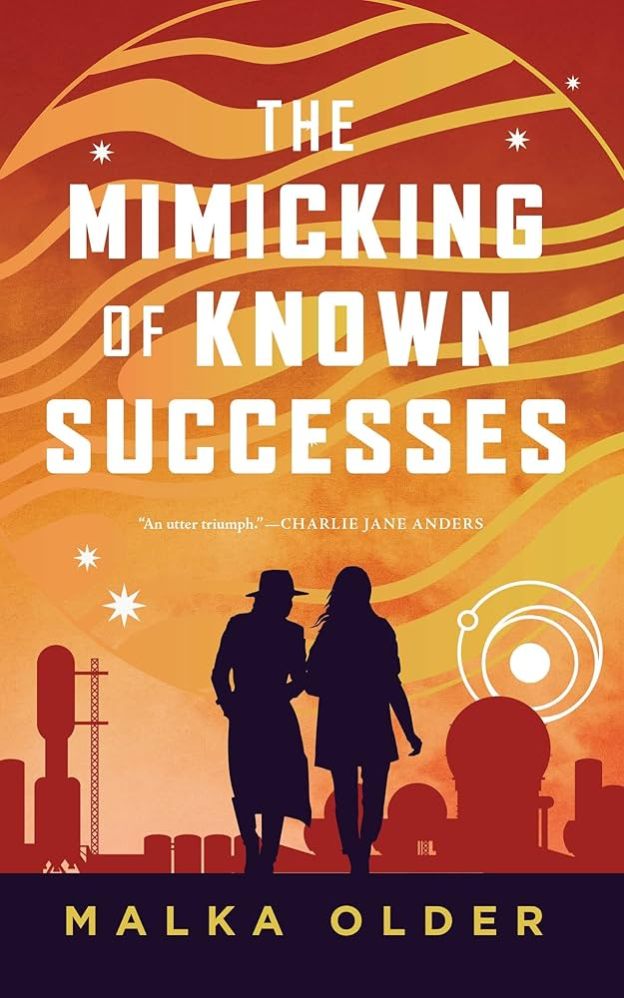
Mossa and Pleiti series by Malka Older

by Kristen B.

The first two books in a series by Malka Older take place about 500 years in the future. Humanity no longer lives on Earth, a planet we have rendered uninhabitable. Instead, we colonized Jupiter – known as Giant – and some of its moons. A series of platforms and railways encircle the big gas planet, on which farms, businesses, and Valdegeld University exist (or in some cases, subsist). There are three major schools at the university: Classics, Modern, and Speculative. Classics studies literature, history, biology, and more from our planet of origin, trying to figure out how the pieces of well-balanced biospheres (ones not continually in crisis) operate. Modern looks at the issues facing the populace where they are now. Speculative also looks to return to Earth, among other goals, but not (necessarily) to restore it to its former glory. University-level research appears to be the biggest enterprise and employer, upon which the survival of the species relies. It’s rather a pointed observation, given the modern American penchant to argue with experts and deny scientific advancement.

I pieced together most of this synopsis from the information around the edges of Older’s first two short novels in a mystery series that is planned to run for at least five books. Pleiti is tenured faculty at Valdegeld, with a specialty in classic literature. Mostly, she researches how the various elements of biospheres worked together by reading books published when those animals lived on Earth. Mossa is an Investigator, the equivalent of a police detective, who spends most of her time searching for lost people. The two were lovers in their past, who, as the series begins, perhaps look to rekindle their romance.

The two installments to date are a lovely combination of science fiction, college politics, and detective mystery. Pleiti and Mossa are enigmatic people, but you find yourself wanting to know more about them as individuals and a couple.

The Mimicking of Known Successes: A man from the university takes a railcar to a remote platform, then promptly disappears. Mossa is pretty sure that he didn’t jump to his death into the planet, and she ends up at Pleiti’s campus asking questions and looking for help. University politics and personalities mix badly with personal ambitions to see Earth restored. Favorite pieces include atmoscarves, the sheer quantity of scones and tea consumed, and the existence of the mauzooleum where “ancient” breeds of animals are carefully bred and studied. I had to make an effort to keep reading through a fairly slow set-up and was rewarded with an exciting, and rather unexpected, conclusion.

The Imposition of Unnecessary Obstacles: I enjoyed this one more, when I could enjoy the mystery without working to understand the world-building. Mossa and Pleiti once again join forces to solve a case involving missing persons – and a subsequent murder – that requires them to do a fair amount of traveling, including to the moon Io and the far side of Giant. Gourmet snacks once again play a not-inconsiderable role as our valiant pair completes some quality sleuthing. There’s also the mention of an opera named Murderbot, which was a high-quality tidbit. I gobbled up this book over a weekend and appreciated the slightly faster pacing and tighter timeline.

A third installment is scheduled to be published in June, The Potency of Ungovernable Impulses, and I’m already looking forward to it.

Kristen B. is a devoted bookworm lucky enough to work as the graphic designer for HCLS. She likes to read, stitch, dance, and watch baseball (but not all at the same time).

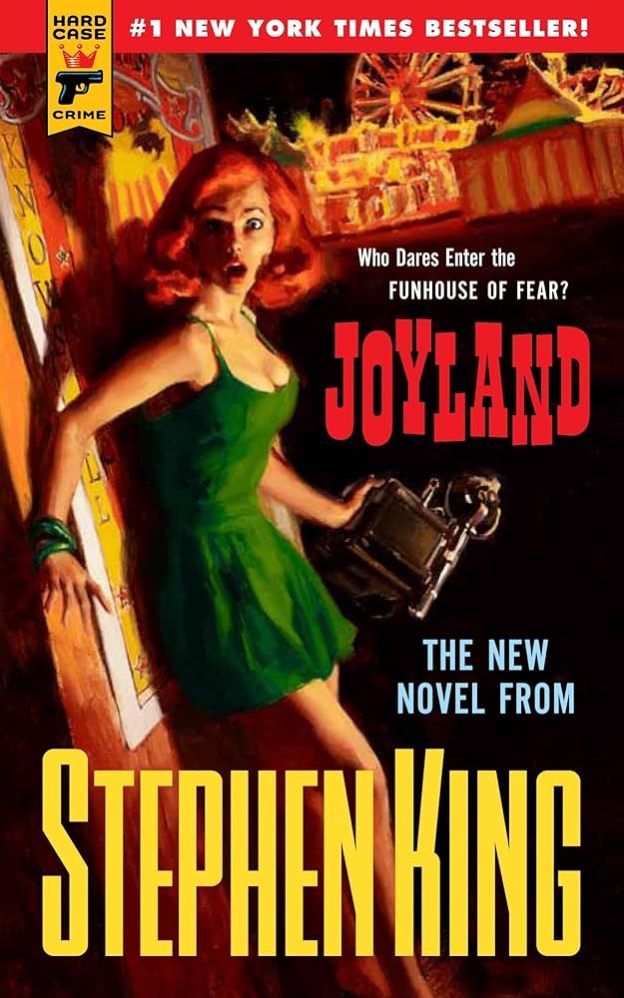
Joyland by Stephen King

In the vein of old pulp covers, a red-haired woman (maybe a doll?) in a short green dress holds an old-fashioned square camera. She looks startled, and there's a carnival above and behind her.

Stephen King is an author whose work, while distinctive in style and subjects, spans many genres. This is proven, in some ways, by the breadth of Stephen King movie adaptations. Many know his work through classic Hollywood horror films like The Shining and Misery, but fewer know that non-horror classics like The Green Mile and The Shawshank Redemption have their origins in his work. Even fewer know of his forays into fantasy (The Dark Tower, The Eyes of the Dragon) or science fiction (The Tommyknockers, Running Man).  

One particular stylistic foray of King’s was his trilogy for Hard Case Crime, a publishing label that focuses on a style of detective novels known as hard-boiled fiction. This extends to the cover art for their releases, which all pay homage to pulpy paperbacks of the 1940s and 50s. King has written three books for the imprint: The Colorado Kid (2005), Joyland (2013), and Later (2021).  

The middle of these, Joyland, less resembles the detective noir fiction of the 40s by Raymond Chandler and Mickey Spillane than it is more akin to King’s classic coming of age story The Body (later adapted into the Hollywood hit Stand by Me). The book’s adult narrator, Devin Jones, recalls his summer job at Joyland carnival in North Carolina from his high school years. He describes it as a popular, dingy, and dubious little fairground that’s ideal for students who want to make a little money on their summer break. Devin, though, seems to be a natural at carny work, rising to the top of the ranks and becoming buddy-buddy with the management. After becoming somewhat of a local hero with a particularly good performance in a blistering hot mascot suit, he elects to take a break from school to work full-time at the carnival, much to the dismay of his parents. 

Again, the tone is far less Maltese Falcon and more sentimental and sweet, a nostalgic ode to the growing pains and new experiences that are expected from a carnival summer job in a beach town. Much of the book provides a nuts-and-bolts look at how carnys work, down to their slang and the way they work the rides, games, booths, and stands. Eventually, an murder mystery emerges (and a connection to one of King’s other novels, as introduced by a fortune teller), but it’s overwhelmingly clear that King’s heart lies elsewhere; It’s one of his sweeter novels, aching with nostalgia and an overwhelming amount of heart. I found it best experienced through its audiobook, a great performance by actor Michael Kelly, best known for his work in the show House of Cards.  

Joyland by Stephen King is available in print and e-book, e-audiobook and book on CD.

Alex Pyryt works in the Customer Service department in the Savage Branch of the Howard County Library System. 

The Big Sleep by Raymond Chandler

A bright yellow cover features a red cutout image of a revolver.

by Jean B.

I took an uncharacteristic turn this summer by watching a movie before reading the book. Heresy! When my book club decided to read the Raymond Chandler classic, The Big Sleep, I felt unenthusiastic and decided to first check out the famous film adaptation, starring Humphrey Bogart and Lauren Bacall. 

I discovered an atmospheric masterpiece that is like a train wreck: you can’t look away, even as the bodies are piling up and the unanswered questions are mounting faster. Seamy and steamy, the film’s careless violence and social dysfunction surprised me in a 1940s-era production. Of course, that’s why they call it film noir, right?  Bogart, as the hard boiled private detective Philip Marlowe, dives into the sordid world of the spoiled, rich Sternwood sisters (Bacall and Martha Vickers) to catch a blackmailer and through a meandering investigation, ignites all kinds of sparks – romantic and otherwise.   

I appreciated the film for its classic style and mesmerizing performances, but I also felt perplexed by the story. It turns out, I’m not alone: as one critic wrote, “The Big Sleep is the best scripted, best directed, best acted, and least comprehensible film noir ever made.” Interestingly, the screenplay was written by William Faulkner, known for his own complex literature. I wondered, did Faulkner make the plot incomprehensible or was that Chandler’s work? 

Clearly, it was time to read the book and find out for myself. Told in first person by Marlowe, the story unfolds through sharp dialogue and terse descriptions of people and urban landscapes. Having seen the movie first, I heard Humphrey Bogart’s voice as I read, a definite bonus! While I usually prefer to form my own image of a character from the author’s writing, Bogart and Bacall seemed perfectly suited to Chandler’s style and words, so I didn’t mind having them in my head. 

The book provided a wealth of detail and allowed me to add more depth to my understanding of the characters and their predicaments. Still, this is not the kind of mystery you try to solve on your own. As a detective, Marlowe makes no effort to be especially clever or careful; he doesn’t store up observations and deductions a la Sherlock Holmes. 

Instead, he confronts a suspicious character, spills whatever information he has, then stands back to see what happens. Although the plot feels more comprehensible in the book than the movie, it’s still like a many-layered onion: each time Marlowe deciphers one crime and its culprit, another one emerges and more motives, corruption, romantic relationships, and villainy appear. Still, Chandler’s language and pungent metaphors make the effort to untangle these webs worthwhile. When a writer can make even a dreary office evocative (“His office had the musty smell of years of routine”), you can’t help but turn the page to keep reading.  

So which was better:  the book or the movie? I’m glad to have experienced both. The Big Sleep is all about atmosphere – when you soak it up both through the author’s words and the performances of great actors on the screen, you get the full picture, even if you’re still a little fuzzy on whodunnit! 

Borrow either or both at HCLS: in print and on DVD.

Jean is a Children’s Instructor and Research Specialist at HCLS Central Branch. She loves talking about books with people of all ages, but especially enjoys leading the Heavy Medals book club for fourth and fifth graders, exploring award-winning books of all genres.  

The Frozen River by Ariel Lawhon

The book cover depicts a woman in a red coat from an overhead view, walking down a frozen path with icy trees on either side of the path.

By Piyali C.

Set in a small town called Hallowell in Maine, the year is 1789. Maine is in the throes of winter and the mighty Kennebec River has frozen, entombing a man in the ice. The midwife and healer of Hallowell, Martha Ballard, is called to examine the body and determine the cause of death. Several months ago, the wife of Hallowell’s pastor, Rebecca Foster, was allegedly raped by two prominent citizens of Hallowell; one of them, Joseph Burgess, is the man found dead, stuck in the ice. There are horrific bruises on the body of the dead man to indicate that he may have been murdered before being thrown into the river. This incident pushes the sleepy town of Hallowell into an intricate legal battle, full of conspiracy, power plays, and intrigue. The punishment for rape is death, but proving rape is almost impossible.  

Martha Ballard finds herself deeply entrenched in all of this, as she was the one who determined that Rebecca Foster had been raped after examining her bruised body. By doing so, Martha makes some powerful enemies, and they try to intimidate Martha by targeting her husband and children. But Martha, who has learned to read and write at a time when women were discouraged from doing either, kept records of the weather and her activities in midwifery every day of her life. She is called to be a prominent witness and her journal plays a pivotal role. Having read The Sewing Girl’s Tale by John Wood Sweet not too long ago, I knew that this trial to prove rape and hold the perpetrators accountable in the late 1800s would likely be an exercise in futility. 

This book, unlike Lawhon’s other ones, is inspired by true events but not based on them. She admits that she took real-life characters and while relying heavily on historical facts, she fictionalized certain aspects of the story to make modern readers completely immersed in the plot and the characters. Martha Ballard indeed kept detailed accounts of her daily life, profession, and weather throughout her life. She was called regularly to court to give her professional opinion on cases relating to rape, children born out of wedlock, murder, and female promiscuity at a time when women were not allowed to enter courthouses without the presence of their husbands or fathers. She was respected for her midwifery, and it has been recorded that she made no distinctions between White or Black mothers at the time. There were 12 free Black families living in Hallowell according to the census, and Martha delivered babies of every color. Martha Ballard is the great aunt of Clara Barton, founder of the American Red Cross. And according to the author’s note, “She is also the great-great-great grandmother of Mary Hobart, one of the first female physicians in the United States. She left a medical legacy in this country that is unmatched. And it is thanks to the diary she kept.” 

I had a difficult time putting this book down, not simply because of the mystery surrounding the death of Joseph Burgess or the rape case, but because of the courageous protagonist and her determination to tell the story of women at a time when they were subjugated. The characters are superbly etched. They came alive in my mind as I read the book and so did the frigid winter of Maine. The writing is beautiful, lucid, and atmospheric. I lived in Hallowell in the deep, dark winter, witnessing the events alongside the Ballard family as Ariel Lawhon navigated through the lives of the characters in this book, documenting their joys, sorrows, triumphs, and losses. 

The Frozen River by Ariel Lawhon is available in print and large print, as well as e-book and e-audiobook formats.

Piyali is an instructor and research specialist at HCLS Miller Branch, where she facilitates Light But Not Fluffy and co-facilitates Global Reads. She keeps the hope alive that someday she will reach the bottom of her to-read list.

Meet the Author: Ira Marcks

A group of kids are posed in a movie poster group with a large shark behind them and a lighthouse below. It's a colorful cover with sunset colors above a clear

Wednesday, Apr 3
5 – 6 pm
HCLS Central Branch
Ages 10-17.

Mystery, Adventure, and Friendship in Ira Marcks’ Graphic Novels: Shark Summer and Spirit Week

by Ahmad Ndir

Ira Marcks’ graphic novels Shark Summer and Spirit Week combine mystery, adventure, and friendship in different settings. Both books feature young protagonists who are drawn into solving a local legend or curse with the help of unlikely allies. The stories are fast-paced, engaging, and full of twists and turns that keep readers on the edge of their seats.

Shark Summer is set on Martha’s Vineyard, where a Hollywood film crew arrives with a mechanical shark and a youth film contest. Gayle, a disgraced pitcher, sees a chance to turn her bad season into the best summer ever by making a movie about the island’s phantom shark. Along the way, she teams up with Elijah, an aspiring cinematographer, and Maddie, a moody director. Together, they uncover the truth behind the shark and the history of the island. The book has a vivid sense of place and a nostalgic vibe that pays homage to classic movies like Jaws and The Goonies.

Spirit Week takes place in the Underlook Hotel in Estes Park, Colorado, a famous landmark that belongs to the reclusive horror writer Jack Axworth. Suzy, an aspiring engineer, is invited to tutor Jack’s son, Danny, but instead she finds herself investigating a local curse that threatens the hotel. With the help of Elijah, an amateur filmmaker, and Rena, the hotel’s caretaker, Suzy tries to save the hotel and the town from the shadows of the past. The book has a creepy and dark tone that draws inspiration from horror stories like The Shining and The Haunting of Hill House.

Both books are well-written and illustrated, with expressive characters and colorful scenes. The themes of acceptance, belonging, and finding your family intertwine throughout the stories, as the characters overcome their personal challenges and grow closer to each other. The books are suitable for middle grade and young adult readers who enjoy graphic novels, mystery, and horror. I would recommend them to anyone who likes a good scare along with a good laugh.

Author is posed in front of a book case and he is adjusting the collar of his sweater.

Award-winning graphic novelist Ira Marcks visits HCLS on April 3 at 5 pm at Central Branch. He discusses how he plans, writes, and draws a long form comic story by engaging hands-on using the three essential elements of storytelling – characters, setting, and theme. Followed by book sales and signing.

Ahmad Ndir is a Teens’ Instructor & Research Specialist at the Central Branch at HCLS. Along with helping young learners discover new books, he is an avid reader of teen fiction and nonfiction titles on different aspects of psychology. He strives for positivity for himself and those around him, in both his personal and work life.


A Master of Djinn by P. Djeli Clark

A lone figure is seen walking up a backlit staircase, with an elaborate clockwork structure above the title.

by Kristen B.

It’s an alternative history, magical, buddy cop, police procedural romp of a story, complete with a little romance. If you’re looking for fun, A Master of Djinn has it!

Set in 1912 in an alternative Cairo, Egypt, the story begins with the horrific mass murder of the Hermetic Brotherhood of Al-Jahiz, a group of British men dedicated to the return of al-Jahiz, an almost mythological mystic. Only almost, though, because al-Jahiz did exist, and he upended the world order when he brought djinn and all sorts of magical creatures back into the world. He’s regarded equally as hero, genius, and dangerous iconoclast. It would appear that al-Jahiz has returned, and he’s working to upset the balance of powers yet again. Or has he?

Fatma el-Sha’arawi is an agent of the Ministry of Alchemy, Enchantments, and Supernatural Entities, and she’s called immediately to the Brotherhood’s mansion, home of the Worthington family. Fatma wears beautiful, flashy Western-style suits and a bowler hat, and she carries a sword in her cane. She is met at the crime scene by her unexpected, new partner Hadia, a recent addition to the Ministry. The interplay between the seasoned professional and the newbie who can “handle herself” provides terrific exchanges and some genuinely funny moments. Hadia has a cousin for every circumstance and wears modern, colorful hijabs. The third amazingly competent woman who contributes to solving the crime is Fatma’s mysterious lover, Siti, who worships Sekhmet of the old Egyptian pantheon. These three women of color make a formidable team with their intelligence, various connections, and genuine affection for one another.

The Worthingtons, on the other hand, seem rather hapless and ineffectual. The patriarch, whose murder launched the investigation, had an attachment to all things Egyptian that bordered on obsession. None of his offspring share his interests, and his heir starts to disentangle the family fortunes in order to return to England’s greener shores. The friends and flunkies around them serve to reinforce the suggestion of incompetent colonialists trading on wealth and social standing, but the investigation keeps leading back to the estate.

The unraveling of the whodunnit involves lady thieves, a worldwide peace summit being hosted by the Egyptian king, old gods, and new technology. It’s a fantastic mix – in all senses of the word. Layered among all the action and adventure, author Clark sneaks in commentary on colonialism, sexism, classism, colorism, and all manner of other social constructs. However, he never throws these strong women a challenge they can’t overcome in this highly cinematic, fast-moving novel.

A Master of Djinn by P. Djeli Clark is available in print, e-book, and e-audiobook.

Kristen B. is a devoted bookworm lucky enough to work as the graphic designer for HCLS. She likes to read, stitch, dance, and watch baseball in season (but not all at the same time).

Night Film by Marisha Pessl

A red toned cover with a fine circular pattern overlaid on a woman's profile, with the collar of her jacket turned up to frame a square jaw.

by Emily B.

I first read Night Film earlier this year over the course of a long weekend. Though the temperature was hot and the humidity almost unbearable, author Marisha Pessl transported me to a chilly October night in New York City with ease. Night Film is a perfect November book and is best enjoyed as the temperatures cool and the nights grow longer.  

The book opens with the mysterious death of Ashley Cordova, piano prodigy and daughter of infamous horror director Stanislas Cordova. Stanislas, who has a huge cult following, hasn’t been seen outside of his huge upstate New York estate in 30 years. 

Investigative journalist Scott McGrath has long been obsessed with Cordova and the mystique surrounding him and his films. He teams up with two unlikely sidekicks – a drifter and a wannabe actress – to uncover the truth behind Ashley’s death. Along the way, the three encounter a fair share of kooky and offbeat characters who offer insight into the case. 

Pessl peppers newspaper clippings, online forum posts, and other documents throughout the book, making you feel immersed in the investigation. This immersion is taken a step further with the bonus content available on Pessl’s Night Film Decoder website, which includes even more mixed media sources, like video and audio recordings.  

On top of all this, it’s clear that Pessl took her time devising Stanislas Cordova’s filmography. The details included about some of the fictional films are so illustrative and specific – down to the blocking or costumes in his most iconic movies’ scenes. All the descriptiveness surrounding the fictional films culminates in a jaw-dropping sequence about two-thirds through the novel. A sequence that I still find myself thinking about, nearly five months after reading the book.

Night Film is an engrossing, unputdownable read perfect for fans of horror and mystery. It’s a book whose atmosphere and characters stay with you for a long time. 

You can request a physical copy here or check out the e-book and e-audiobook versions on Libby/Overdrive.  

Emily is an Instructor & Research Specialist at the Central Branch. She enjoys puzzling, reading, listening to music, and re-watching old seasons of Survivor. 

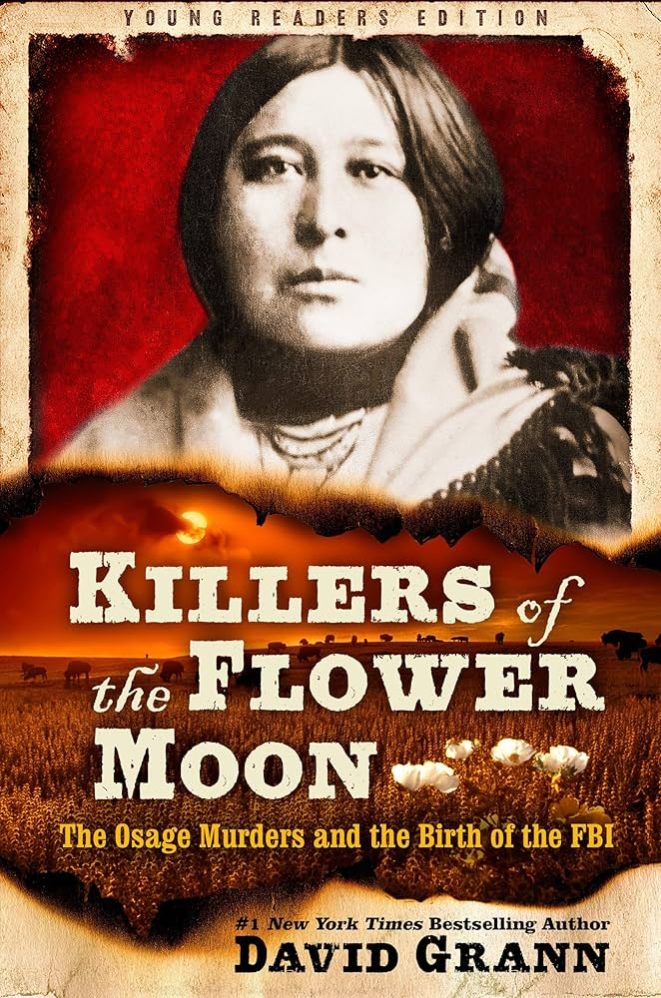
Killers of the Flower Moon by David Grann

Black and white photo of a Native woman in her traditional blanket sits above a landscape of prarie grasses with white flowers, all with red

by Eric L.

Although a graduate of a mostly white private high school, I was lucky to attend a good public college that furthered my historical education. Like many pieces of history, the “Osage Reign of Terror,” which took place roughly from the 1910s to the 1930s, was not addressed in my education. Someone suggested that the term is a misnomer because it sounds as though Osage caused the reign of terror; however, the opposite is true.

Killers of the Flower Moon is an entertaining and provocative read. Published in 2017, the book is on bestseller lists again because of the critically-acclaimed Martin Scorsese film, starring Lily Gladstone, Leonardo DiCaprio, and Robert DeNiro. Author David Grann is a thorough researcher, and he recounts the history of the Osage people and how they ended up in Oklahoma. They, like so many other Native tribes, were continually pushed West out of desirable land until they arrived on the least desirable part. A chief at the time suggested that they take the hilly land in Oklahoma because the white man would not want it, and perhaps would leave them be. He was wrong. Another chief decided that they would have to parcel it out like real estate – but the Osage owners retained all the mineral rights. A shrewd stratagem, as they realized oil had been discovered.

The reserved mineral rights could not be sold to a non-Osage person, but only inherited in a practice that became known as “head rights.” This seemed a genius move, but unfortunately, the chief was battling with a far more powerful entity. As more oil was found on Osage land, the income generated from the rights to drill became very valuable. All the major oil companies wanted to drill on this land, and were spending large amounts of money to do so. For a short time, the Osage had the most wealth per capita in the United States.

This situation was untenable to some white Americans. The Osage were prohibited from accessing their bank accounts and assigned guardians (through the Bureau of Indian Affairs) who controlled their money; in the movie, you hear Mollie Burkhart refer to herself as “incompetent” when talking to her banker. The need for a guardian was determined by how much native blood a particular Osage person had and thus the extent of their head rights. All this sets the backdrop to the Reign of Terror, when more than an average number of wealthy Osage folks died untimely deaths and others (mostly white men) inherited their wealth.

After a number of botched, failed, and bogus investigations, the nascent FBI, under the direction of a young J. Edgar Hoover, decided to get involved. After all, the murders occurred on federally managed land, which was technically the FBI’s jurisdiction. Grann’s book follows a particularly tragic example, where a WWI veteran, Ernest Burkhart, came to live with his uncle “King” Hale, a cattle rancher in the Osage country. Ernest marries Mollie, whose family died around her from natural and unnatural causes. It is Mollie who ventures to Washington, DC to ask the Bureau of Investigation to provide answers.

I won’t spoil the mystery and subsequent court case, but Grann successfully interweaves a story of the early FBI with the tragedy of Mollie’s family and the plot to inherit their rights. It’s terribly sad, but with an interesting cast of characters and a well-written murder mystery. The story is told largely from the FBI agent’s perspective, but Grann is very thorough in his research and interviews, and he uncovers more than the FBI found (or at least documented). The movie shifts the narrative from the FBI to Ernest Burkhart and King Hale, and to a lesser extent, Mollie.

I’m certain the film will attract some backlash for bringing up the ghosts of our past. It always seems strange to me that we don’t want to better appreciate our collective history. I loved that one wise Osage person wondered whether any of it was worth it, since they lost so much. I can’t pretend to have an answer for that, but it’s a sad and instructive story about American greed and racism. What I’ll take from it, which is well-developed in the book, is that there were some dedicated FBI agents and citizens who spent time investigating and solving some of these crimes despite nearly insurmountable odds. Read the book and see this film; it’s a story worth repeating and knowing.

Killers of the Flower Moon: The Osage Murders and the Birth of the FBI by David Grann is available in many formats:
print, large print, e-book via Libby/Overdrive, e-book via CloudLibrary,
audiobook on CD, e-audiobook via Libby/Overdrive, e-audiobook via CloudLibrary

You can also get on the waiting list for the DVD of the movie, which is set to be released at the end of February, 2024.

Kristen B. contributed to this review.

Eric is a DIY Instructor and Research Specialist at Elkridge Branch. He enjoys reading, films, music, doing nearly anything outside, and people.

Killers of a Certain Age by Deanna Raybourn

The book cover depicts a red hand holding a long, sharp black kitchen knife, with a strand of white pearls around the wrist.

By Sahana C.

Almost-retired lady assassins taking on a shady secret organization with good intentions but a crooked bent – that’s all the introduction I needed to be intensely, rapturously interested in Killers of a Certain Age by Deanna Raybourn.  

The four main characters are set to celebrate their retirement from the Museum, an organization founded to assassinate Nazis who fled justice, and are reuniting on a cruise. It’s fun! Celebratory even! Until one of them notices a mid-level smug assassin who seems to be tailing them, and that can only mean one thing – someone has ordered a hit on them, and they’ve got to figure out who it is and why. After all, they’ve spent the last forty years killing only the bad guys – what could be so wrong about that? 

One strength of this book is that the pacing is rapid and the plot moves along, yet we still discover so much personality, so much verve, and so much life in each of the characters. Each of the four main lady assassins – Billie, Natalie, Mary Alice, and Helen – are given backstories. Each fits into a trope: Billie as the stolid leader with a rebellious streak, Mary Alice as Billie’s counterbalance and de facto second in command, Natalie as flirtatious and almost ditzy but handy with a lock pick, and Helen, the one the others worry about, but well-bred, well-pedigreed, and almost certainly more capable than she seems.  

Each character is so vivid, but at no point does the plot suffer for this focus on characterization. In fact, as many of my personal favorite books do, the characterization that is introduced instantly propels us forward into a new plot point. It’s brilliantly written when you learn something new about a character, and then immediately realize, “OH, that’s how they’re going to solve that seemingly-insurmountable obstacle! That’s why no one seemed concerned about that plot hole! I can’t believe they didn’t have to deus-ex-machina this, it’s not even plot contrivance, and it makes perfect sense in context!”  

Suffice it to say that I was entertained. I had fun with this book. It’s not deep, but it’s definitely about murder. This is a fun mystery-suspense book along the lines of The Thursday Murder Club, and I liked it just as much or (dare I say it?) a bit more.  

It’s an HCLS Adult Summer Reading Book this year too, and you can find it in print, e-book, and e-audiobook.  Be part of HCLS’ Summer Reading Adventures.

Sahana is an Instructor and Research Specialist at the Savage Branch. They enjoy adding books to their “want to read” list despite having a mountain of books waiting for them already.