Black Woods Blue Sky by Eowyn Ivey

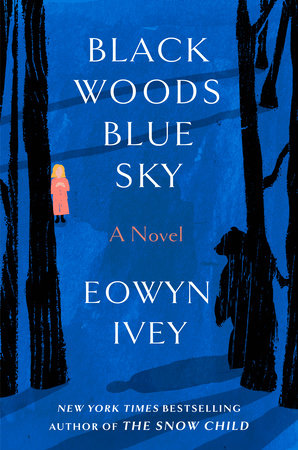
The book cover depicts a girl with blonde hair and a peach-colored dress or cloak and dark boots, in the blue of a darkened woods with black trees casting shadows on the ground. One tree conceals a bear, who is looking at the girl and whose shadow more closely resembles that of a human.

By Piyali C.

Riveting, dark, and deeply atmospheric, Black Woods Blue Sky by Eowyn Ivey took me straight into the untamed wilderness of Alaska. I walked the difficult yet vibrant terrains of several mountains, trails, and streams with strong and resilient Birdie, delightful little Emaleen, and quiet, enigmatic Arthur Neilsen.

Birdie is a single mother as a 26-year-old, who is trying her best to give her six-year-old daughter, Emaleen, a good life. Birdie works at a roadside bar in a small town in Alaska and lives in a little cabin given to her by the bar owner, Della. She tries her best to toe the line that is expected of her as a mother and an adult. But this life feels constrained; Birdie wants something bigger and better for herself and Emaleen. She aspires to live the life that she knew as a young girl – happy and free in the wilds of nature. 

Birdie had heard about the mysterious Arthur Neilsen, who lives a quiet and solitary life in the black woods. She gets to know him better when Arthur brings little Emaleen back to safety after she gets lost in the woods looking for Birdie. Arthur is somewhat of a legend in the small hamlet where Birdie lives. He grew up in the village but left his parents to live as a recluse deep in the forest, far from human civilization. He visits the village very rarely. His quiet presence, his knowledge of the local flora and fauna, the mysterious scar on his face, and his inscrutability pique Birdie’s interest in him. She feels a certain reticence in Arthur which she cannot seem to breach when she tries to get close to him. Arthur does not stay away from her either, as he keeps coming back from the woods to sit in silence next to Birdie.

Arthur’s quiet life in the great unknown appeals to our young protagonist and she decides to move into Arthur’s shack, along with Emaleen. The shack is nestled deep in the forest and only accessible via flight. At the beginning, there is immense joy in discovering each other and making a good life amid expansive natural beauty. Gradually, however, Arthur disappears for days on end without an explanation, and an inexplicable darkness creeps in along with the approaching winter. Birdie is afraid for her safety and the safety of her daughter, but she finds the freedom of this new life irresistible. Birdie is caught between her desire to live her life on the edge and her instinct to bring her daughter back to safety and lead a predictable life. The choice that Birdie makes will have life-changing consequences. 

The masterful blend of fairy tale with stark reality makes this book unpredictable, enigmatic, and unputdownable. The characters come alive on the pages and the voice of each character sounds authentic. Emaleen talks to us in the voice of a six-year-old. Birdie’s voice reveals the conflict within her, trying to be a responsible mother but also yearning for freedom and fulfillment as a young woman. Arthur doesn’t say much, but the dark secret that he carries within him becomes clear in the paucity of his soft-spoken words.  

Some reviews mention that this story is inspired by the popular fairy tale Beauty and the Beast. Personally, I did not find many similarities except the fact that a pretty young woman falls in love with a physically unattractive, quiet man. This story is a powerhouse in its own right, one that I believe would be a good choice for a book club. The flawed characters, the formidable and beautiful wilderness of Alaska, the gorgeous prose, the plot, the relationship between man and nature, the whiff of fairy tale infused within the story, Birdie’s choices and the consequences of those – all of these would spark a great discussion. 

Black Woods Blue Sky by Eowyn Ivey is available in print and as an e-book and e-audiobook from Libby.

Piyali is an instructor and research specialist at HCLS Miller Branch, where she facilitates two book discussion groups: Light But Not Fluffy and Global Reads. She keeps the hope alive that someday she will reach the bottom of her to-read list.
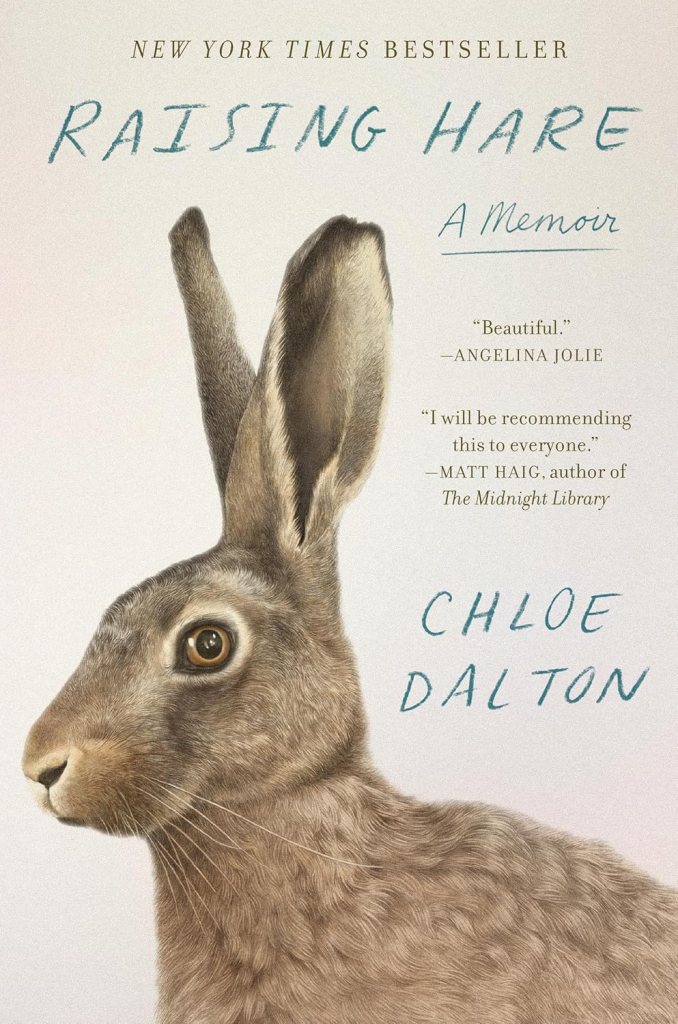
Raising Hare: A Memoir

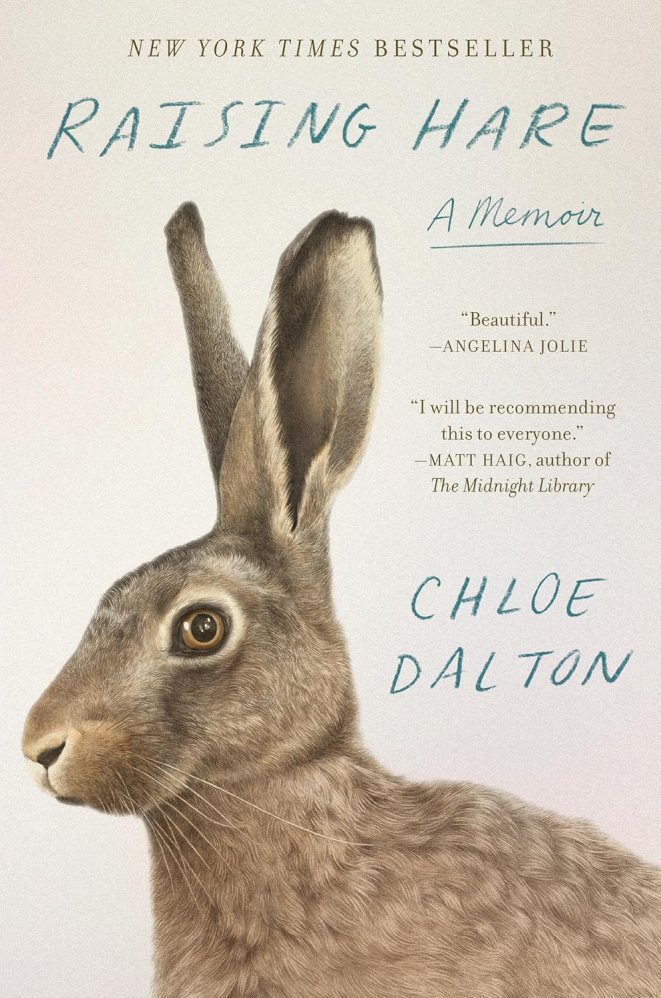
The book cover is a colored illustration of a hare in profile, with its ears alert and its whiskers extended. The viewer sees one golden-brown eye staring back at them.

By Julie F.

Chloe Dalton, the author of Raising Hare: A Memoir, is a writer, political adviser, and foreign policy specialist who decided to escape London during the pandemic. In February 2021, while still getting used to the lay of the land and the run-down home she purchased in the dead winter landscape, she discovers a leveret (a baby hare) in her garden. Not knowing anything about the species, but determining that the mother is not close and may not return, she brings it in and sets about trying to keep it alive.

There is a lovely, intimate prologue from the perspective of the mother hare that offers one explanation for how the leveret, which she has carefully hidden from predators, might have come to be separated from her. Dalton is clearly the kind of person who listens to the landscape and tries to discern what it wants to communicate. She tries very hard to ensure that the leveret stays wild. She bottle-feeds it and then offers it porridge oats, but then she plans to release it into the wild. Although the leveret ventures into her garden, and then eventually over the garden wall, it never becomes fully wild (nor fully tame), and it returns again and again–delivering the next litters of baby leverets in the garden, and even later in the house, where she feels safe and they grow up feeling even safer, having been born on the floorboards.

The memoir is a lovely meditation on what is tame and what is wild, the tenuous but loving connection between humanity and nature, and how slow, deliberate observation can teach us so much about a species. Dalton knew next to nothing about hares when she began and is surprised to learn that there’s not that much information out there; most of what she learns is gleaned from the poet William Cowper, whose period of depression in 1774 was relieved when he was gifted a three-month-old hare and later acquired two more, all of whom he adored. She says, “I doubt that Cowper imagined his poems might be used as a guide to raising a leveret nearly 250 years later, but his words were in many ways the most useful of any I found” (53). This is particularly true in relation to feeding and shelter; though Cowper kept his leverets in pens at night, she didn’t keep the leveret locked in, “never want[ing] it to feel trapped inside, nor barred from coming in” (53).

This is a tour-de-force–beautifully written, resonant, humorous, and charming at times, but full of emotional and philosophical heft. I can’t say enough good things about it, and it’s such an accomplished first book from a thoughtful, skilled, and talented author. If you enjoy audio, the narration by Louise Brealey is also accomplished and is a beautiful accompaniment to the text (if you like to listen as you read along as I did). The illustrations by Dublin-based artist Denise Nestor are also full of wonder and beauty. Near the end of the book, she talks about the impact of the hare on her life, and her description is a wonderful summation of the emotions you feel while reading her story. I’ll conclude with her words, because my own are inadequate in comparison:

“She has taught me patience. And as someone who has made their living through words, she has made me consider the dignity and persuasiveness of silence. She showed me a different life, and the richness of it. She made me perceive animals in a new light, in relation to her and to each other. She made me re-evaluate my life, and the question of what constitutes a good one. I have learnt to savour beautiful experiences while they last–however small and domestic they may be in scope–to find the peace to live in a particular state of feeling, and to try to find a simplicity of self. The sensation of wonder she ignited in me continues to burn, showing me that aspects of my life I thought were set in stone are in fact as malleable as wax, and may be shaped or reshaped. She did not change, I did. I have not tamed the hare, but in many ways the hare has stilled me” (275).

Raising Hare: A Memoir is available in print and as an e-book and e-audiobook from Libby.

Julie is an instructor and research specialist at HCLS Miller Branch who finds her work as co-editor of Chapter Chats very rewarding. She loves gardening, birds, crime and espionage fiction, all kinds of music, and the great outdoors.

Animal Fun on the Summer Reading Lists

The photograph shows a tiger bathing in a pool of water.
Photo by Jakob Owens on Unsplash.

By Eliana H.

Happy Summer! I’m hoping that you are enjoying lots of fun activities so far this summer, including some of our classes and events. When you’re ready for some quieter fun, of course we always encourage you to dive into a good book. Our Summer Reading Adventures last all summer long, so here are a few suggestions to check out and regain your momentum if the first burst of reading excitement has passed for your student. In particular, these are titles that many an animal lover will be excited to explore. 

K-1: 

Wutaryoo by Nilah Magruder 

The illustration shows the title creature, Wutaryoo, facing a group of animals in what looks like a conversation, against a green-blue sky. The animals include an elephant, a giraffe, a fox, a rabbit, a bird, a buffalo, and a wolf.

In this book, Wutaryoo is a mysterious creature. She doesn’t know her name, so when other animals come up and say “Wutaryoo?” it sticks. Since she can’t answer their question, Wutaryoo asks it back. And each animal tells her their story, of what kind of creature they are and how that type of creature came to be. More than anything, Wutaryoo wants to know her own story, who her people are, and where she came from. So, Wutaryoo sets off on a long journey to try to find out. She walks and swims and climbs and digs. She encounters even more different kinds of creatures and seeks answers for herself. Where does she go, and what does she learn? You’ll have to read the book to find out! 

2-3: 

Horace and Bunwinkle by PJ Gardner 

The illustration shows a dog and a pig, back-to-back, in front of a barn and a fence against a blue sky with fluffy white clouds. A female mallard is perched on one of the fenceposts.

Horace is a very proper Boston terrier who hates dirt and the outdoors. So when his person, Eleanor, moves to a farm called the Homestead, he is NOT excited. Just as he starts to come to terms with this new home, Eleanor adopts a piglet as Horace’s little sister and calls her Bunwinkle. The two couldn’t be more different, and they can’t understand each other at all. Eventually they begin to bond, especially when they start to watch a pet detective show together. Soon they discover a real mystery in their neighborhood when animals start to disappear! Can Horace and Bunwinkle, along with their friends, solve the mystery before it’s too late and one of them disappears?! Read along as Horace, Bunwinkle, and the whole cast of furry and feathered friends – each of whom has LOTS of personality – work together to figure it out. 

4-5: 

Rewilding: Bringing Wildlife Back Where It Belongs by David A. Steen, illustrated by Chiara Fedele 

The picture shows a beige tree with green leaves against a pale pink background, surrounded by animals, including a wolf, a tortoise, a buffalo, and a beaver.

Anyone with much interest in animals will know that, unfortunately, many are endangered. Whether due to habitat loss, over-hunting, or other human activities, people have made it impossible – or nearly so – for some animals and plants to thrive in the places they used to live. This book shares efforts that have been made around the world to help various wildlife make a comeback in the areas where they previously flourished. From toads to lynxes to carnivorous plants, learn about how people have worked to change the circumstances they face and support their success. Beautiful, realistic illustrations help readers envision the flora and fauna being described, and a “What Can You Do?” section at the end inspires action to accompany the learning. 

Eliana is a Children’s Research Specialist and Instructor at HCLS Elkridge Branch. She loves reading, even if she’s slow at it, and especially enjoys helping people find books that make them light up. She also loves being outside and spending time with friends and family (when it’s safe).

The Hawk’s Way by Sy Montgomery

The book cover depicts a Harris hawk perched on a branch and leaning forward as if about to take flight.

By Julie F.

I’m always thrilled to find a slim work of nonfiction that nonetheless packs a big punch. New Hampshire author and naturalist Sy Montgomery provides just that in her 79-page volume, The Hawk’s Way: Encounters with Fierce Beauty, a concise but wondrous celebration of raptors and their impact on her life. Accompanied by the stunning photography of artist Tianne Strombeck (see her wildlife photography galleries here), Montgomery’s story of her journey from hunting skeptic to passionate advocate for birds of prey will thrill any nature lover, or for that matter, any casual nonfiction reader.

It all begins with a visit to master falconer Nancy Cowan and a four-year-old Harris’s hawk named Jazz. Nancy warns Sy about Jazz – her unwillingness to cooperate, her feisty nature, and of course the fact that this easily provoked species can tear skin and pierce to the bones with their fierce talons – and yet, Sy is smitten: “I know I don’t matter to her at all. Yet, to me, she is everything” (16). As we see the progression of Sy’s work with Jazz and Cowan’s other raptors, we learn tidbits about the language, history, and specialized gear of falconry, all of which fascinates and contributes to our understanding of their bond. Yet, as interesting as these facts are, Montgomery confesses that, “From falconry I want only one thing: to get closer to birds of prey. Majestic, graceful, strong, big, brave, and smart: Who would not hunger for such company” (24)?

As Montgomery learns more about bird anatomy and vision, methods of catching a wild hawk to train, and even what it means for a hunting dog to “get birdy,” the reader is pulled along on her intellectual, ethical, and emotional journey. She questions whether she is really cut out to be a falconer; after all, she is told time and again by experts that the hawks will kill her precious domesticated chickens – no holds barred, no quarter given. The book is a compassionate, compelling, but stark look at the lives of these fierce creatures – sometimes bloody and violent, sometimes full of soaring elevation and elation, always and forever wild.

Sy Montgomery is the author of thirty-three books of nonfiction for both children and adults, including The Good Good Pig, How To Be a Good Creature: A Memoir in Thirteen Animals, and The Soul of an Octopus, which was a finalist for the National Book Award. Described as “equal parts poet and scientist” by The New York Times, she also scripted and narrated the National Geographic documentary based on her book Spell of the Tiger. The Hawk’s Way is also available as an e-audiobook from Libby/OverDrive. I listened to Montgomery’s narration as I read along, and the enthusiasm for her subject conveyed in her voice made this a wonderful listen.

Julie is an instructor and research specialist at HCLS Miller Branch who finds her work as co-editor of Chapter Chats very rewarding. She loves gardening, birds, crime fiction, all kinds of music, and the great outdoors.

Author Works with Robin Wall Kimmerer

The book cover shows a single braid of yellow sweetgrass stretching horizontally below the title.

Wed, Sep 14, 7 – 8:30 pm
online
Register at bit.ly/braidingsweetgrasshcls

Acclaimed author and scholar Robin Wall Kimmerer explores the dominant themes of her book Braiding Sweetgrass: Indigenous Wisdom, Scientific Knowledge, and the Teachings of Plants, which include cultivation of a reciprocal relationship with the living world. Consider what we might learn if we understood plants as our teachers, from both a scientific and an indigenous perspective.

Robin Wall Kimmerer is a mother, scientist, decorated professor, and enrolled member of the Citizen Potawatomi Nation. Her first book, Gathering Moss: A Natural and Cultural History of Mosses, was awarded the John Burroughs Medal for outstanding nature writing, and her other work has appeared in Orion, Whole Terrain, and numerous scientific journals. She tours widely and has been featured on NPR’s On Being with Krista Tippett and in 2015 addressed the general assembly of the United Nations on the topic of “Healing Our Relationship with Nature.” Kimmerer is a SUNY Distinguished Teaching Professor of Environmental Biology, and the founder and director of the Center for Native Peoples and the Environment, whose mission is to create programs which draw on the wisdom of both indigenous and scientific knowledge for our shared goals of sustainability.

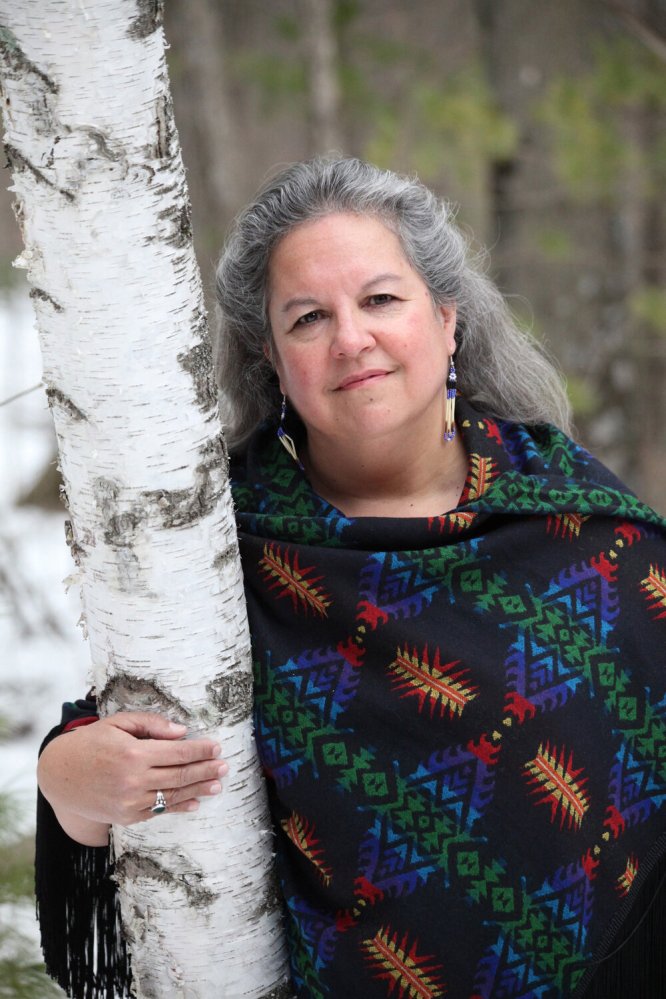
The author, with long grey hair pulled away from her face, leans against a white birch tree. She is wearing a richly colored and patterned poncho and dangling beaded earrings.

As a writer and a scientist, her interests in restoration include not only restoration of ecological communities, but restoration of our relationships to land. She holds a B.S. in Botany from SUNY ESF, an M.S. and Ph.D. in Botany from the University of Wisconsin and is the author of numerous scientific papers on plant ecology, bryophyte ecology, traditional knowledge and restoration ecology. She lives on an old farm in upstate New York, tending gardens both cultivated and wild.

Braiding Sweetgrass is available to borrow in print, e-book, and e-audiobook, or you can purchase online from The Last Word Bookstore.

The event is part of the “Guide to Indigenous Maryland” project. This program is supported in part by the Institute of Museum and Library Services, through the Library Services and Technology Act, administered by the Maryland State Library, as well as by the Prince George’s County Memorial Library System. Maryland Libraries Together is a collaboration of Maryland libraries to engage communities in enriching educational experiences that advance an understanding of the issues of our time. Learn more at bit.ly/indigenousmd

Losing Eden by Lucy Jones

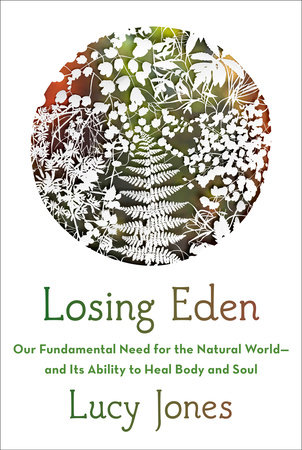
A circle filled with the white "negative" space of different sorts of ferms and plants against a green and red background sits above the title and author.

by Ben H.

What can a casual reader take away from Lucy Jones’s 2020 book Losing Eden: Our Fundamental Need for the Natural World and its Ability to Heal Body and Soul? I’d like to say I’m not just a casual reader, but I am. Losing Eden isn’t as entertaining as Rhythm of War, as helpful as The Korean Vegan (I can’t stop making the spicy and crunchy garlic tofu!), or as cathartic as rewatching The Return of the King. But, it’s totally worth your while!

Losing Eden is informative, thought-provoking, and well researched. I found inspiration in its pages. I found it comforting and distressing. Sometimes it’s comforting to read a whole book about how the world is hurtling toward disaster instead of dozens of headlines, short articles, op-eds, and social media posts. Reading Losing Eden made me feel like Ethan Hawke in First Reformed, except I have a daughter and I don’t pour Pepto-Bismol in my whiskey.

Losing Eden is glued together with memoir paste, but it’s mostly an academic, research-based treatise on the importance of time spent outdoors, the immense value of plants and animals, and the urgent need to protect the natural world. Jones uses climate change, mental health, socio-economics, and racial equity as reasons to care about this green world. She also references dozens, if not hundreds, of studies, books, and research projects running the gamut from the social effects of green space in Chicago to the importance of the Białowieża Forest, a primeval area in Poland and Belarus. 

She cites Robert Pyle’s theory of the extinction of experience. Pyle’s general idea is that the less we interact with nature, the less we will care about it. Extinction leads to extinction of experience and then to more extinction. Jones writes, “Over the past fifty years the populations of mammals, birds, reptiles, and fish have fallen by 60 percent worldwide.” Passages like that are distressing.  

Jones explores the possible emotional impact of spending time outdoors. The answer might be in the dirt. A bacteria found in dirt, mycobacterium vaccae, has been linked to increased happiness. In 2004, oncologist Mary O’Brien created, “a serum that contained M. vaccae, a species of bacteria found in soil.” It did not have the desired effect, a cure for cancer, “but, strangely, those who received the immunization reported feeling happier.” Dr. Christopher Lowry was separately working on a similar research project and found that ,“mice injected with the bacterium exhibited fewer anxiety- or fear-like behaviour and were 50 percent less likely to have stress-induced colitis.” It’s dangerous to label nature as a panacea for mental health issues, but I think Jones makes a compelling argument, while being careful not to stray into an irresponsible reliance on nature as a magical cure.  

Jones also mentions chronic inflammation and its connection with mental health. She writes, “people with depression, anxiety, schizophrenia, and other neuropsychiatric disorders have been found to have higher levels of inflammation biomarkers.” Cytokines are a biomarker for inflammation, and “studies show that just two hours In a forest can significantly lower cytokine levels in the blood, soothing inflammation. This could partly be caused by exposure to important microorganisms.” If you’ve never heard of shinrin-yoku, this book is for you.

She also approaches the topic from a socioeconomic angle. She writes that “people in lower socio-economic groups or from racial and ethnic minorities usually have less access to green space and parks than those who are white and affluent.” She traces this issue back to the 17th century and the enclosure acts in England: “the practice of enclosing land from the British people began in earnest with the passing of over 5,200 Enclosure Acts between 1604 and 1914, which fenced off 6.8 million acres of previously common land.” I particularly loved this part of her book because the enclosure acts were an integral part of my thesis on pastoral poetry. If you’re ever in the UMBC library, check out: “Borrowed Weeds: Courtiers in Disguise in Renaissance Pastoral.” I guarantee you’ll be the first person to ever check it out.  

Jones saved one of her most compelling arguments for last. She cites the research of Professor Rich Mitchell from the University of Glasgow. His idea of “equigenesis” is full of real-world applications. The basic idea is that “If an environment is equigenic, it may reduce the gap between the rich and the poor by weakening the link between socio-economic inequality and health inequality.” Prof. Mitchell realized that the massive changes needed to address inequity weren’t going to happen, so he searched for other solutions. A 2015 study looking at more than 20,000 people in 34 European countries showed that, “access to nature was the one characteristic that reduced socio-economic inequality in mental well-being (by 40 percent).” 

Her evidence is compelling. Jones accumulated loads of research and attacked the question from many angles. I had a lot of takeaways from her book. I should definitely encourage my daughter to play in the dirt. I should garden. I should spend time outdoors. Should I buy a chicken to diversify my microbiota like Jones did? Maybe? 

I’ll definitely encourage my daughter to continue to watch squirrels, look for the moon during the day, and watch for chubby hawks in the trees.  

Ben Hamilton works at Project Literacy, Howard County Library’s adult basic education initiative, based at HCLS Central Branch. He loves reading, writing, walking, and talking (all the basics).

Explore Nature with April #ELKReads

Spring is here! Temperatures are warming, plants are budding and blooming, and animals are reemerging – including creepy crawlies that we might be less than enthusiastic to greet. As you welcome the change of seasons, here are some reads that celebrate the natural world. Take a look below to find titles for all ages, and keep an eye on our social media to see additional suggestions for each age group.

A colorful collage of "Nature PIcks for Little Kids" with purple mountains in the background. Titles include: 
Plant the Tiny Seed by Christie Matheson whose cover features bright flowers and red type.
Call Me Tree/Llámame árbol by Maya Christina Gonzalez, which shows a boy in a green shirt and blue pants standing with arms outstretched in front of a tree.
Over and Under the Pond by Kate Messner and illustrated by Christopher Silas Neal shows a mother and child paddling along water and the rocks, reeds and fish under them.
The Invisible Garden by Valérie Picard and Marianne Ferrer has lush greenery enclosing a small girl in a blue dress.
What Does Bunny See? by Linda Sue Park and illustrated by Maggie Smith features a a small brown bunny in a colorful field.
Gator, Gator, Gator! by Daniel Bernstrom and illustrated by Frann Preston-Gannon has clear crisp painting of a girl with binoculars in a boat in a bayou.
:

For Little Kids:

What Does Bunny See? A Book of Colors and Flowers by Linda Sue Park, pictures by Maggie Smith

A rabbit explores a garden and finds flowers of every color, before hopping home for a nap and dreams of rainbows. Rhyming clues invite the reader to answer the question: What does bunny see? 

Over and Under the Pond by Kate Messner, illustrated by Christopher Silas Neal. Also available as an eBook.

Join your little one in discovering all the amazing creatures that live in the unique ecosystem of a mountain pond. As a boy and his mother paddle across the pond, they discover the interconnected nature of the creatures that call the pond home. Turn the pages to the end of the story to read facts about all the animals you see.

Call Me Tree = Llámame árbol by Maya Christina Gonzalez

Come balance, sway, sing, and stretch along with children imagining what it’s like to be a tree. Bright, colorful pictures show children of different backgrounds learning to embrace nature, each other, and themselves. The fun, singsong text is full of sweet affirmations written in both Spanish and English.

A colorful collage of "Nature PIcks for Big Kids" with purple mountains in the background. Titles include:
Wild in the Streets by Marilyn Singer and illustrated by Gordy Wright, which features a monkey with a juvenile on her back with a city in the background.
Love, the Tiger by Frédéric Brrémaud art by Federico Bertolucci shows a leaping, snarling tiger in full color.
Pilu of the Woods by Mai K. Nguyen has the title encircled by leaves and a child centered at the bottom holding a white flower.
Seedfolks by Paul Fleischman features a grid of six squares with pictures of a Black man, a pticher, and a young white woman in the top row; and an eggplant, an older white woman, and a jumprope in the bottom row.
One Well by Rochelle Strauss's cover features a coastline next to a rich blue sea.
Extinct by Lucas Riera has a collage of extinct and endangered animals on a pale yellow cover.

For Big Kids:

Extinct: An Illustrated Exploration of Animals That Have Disappeared by Lucas Riera

Explore the gorgeous illustrations in this volume filled with information about the species that have vanished over the last century. Along with the tragic stories of how many of these species have been lost to the world, this book also shares inspiring tales of species that were rediscovered and some that were successfully reintroduced into the wild.

Seedfolks by Paul Fleischman. Also available in eBook and eAudiobook format.

A vacant lot in inner-city Cleveland, Ohio brings together a community in unexpected ways in this classic tale. Follow the stories of 13 diverse residents as they discover the power of gardening and working together to heal and make change.

Wild in the Streets by Marilyn Singer

This richly illustrated book combines poems with the fascinating backstories of 20 animals who’ve figured out how to thrive in cities. From reticulated pythons in Singapore’s sewer system to coyotes in Chicago, discover why these animals came to be such close neighbors with humans. At the end of the book, enjoy bonus pages on poetry forms and resources to learn more about these clever creatures.

A colorful collage of "Nature PIcks for Teens" with purple mountains in the background. Titles include:
Zen and Gone by Emily France's cover is deep blue with orange, yellow, and aqua stylized trees.
I Am Still Alive by Kate Alice Marshall has a stark black and white cover with a pen/ink drawing of pine trees.
Feral Youth by various authors (Shaun David Hutchinson + 9 others) shows legs walking beside a puddle, reflected in the water, in watery blues and black.
Consider the Platypus by Maggie Ryan Sandford has a deep teal cover with a white circle from which a platypus emerges.
Up to this Pointe by Jennifer Longo shows a girl in a parka and a pointe shoes, with glaciers in the background, on a medium blue background.
Unicorn Power! by Mariko Tamaki features the manga illustration of a red-haired girl in rappelling harness.

For Teens:

Consider the Platypus: Evolution through Biology’s Most Baffling Beasts by Maggie Ryan Sandford, illustrated by Rodica Prato 

This beautiful nonfiction volume explores some of the quirkiest creatures you can find, along with more common animal companions and friends. Beginning with Darwin’s theory of evolution, the author also explains how advances in scientific knowledge, especially genetics, have expanded our understanding of how animals became their current selves.

Feral Youth

This multi-authored novel tells the story of ten teens left alone in the wilderness for a three-day survival test. The diverse group of troubled teens have to overcome their vast differences to survive in the wild with no readily available food or water, just the packs on their backs.

Zen and Gone by Emily France. Also available as an eAudiobook.

When Oliver takes a summer trip from the bustling city of Chicago to Boulder, Colorado, he experiences a bit of a culture shock. There he meets Essa, a nature-loving girl who plays wilderness survival games with her friends. The two begin to explore Buddhism and meditation at the local Zendo. When one of their survival games goes wrong, the two have to rely on their newfound spiritual strength if they are to save Essa’s sister, Puck, and survive the trip themselves.

A colorful collage of "Nature Picks for Adults" with purple mountains in the background. Titles include:
Down from the Mountain by Bryce Andrews has a rim-lit sihouette of a grizzly bear against a black ground.
The Overstory by Richard Powers shows a painting of a stand of trees, with an inset circle of the same picture smaller.
A Walk in the Woods by Bill Bryson has a the snout and ears of a brown bear peeking up from the bottom of the cover with green woods behind it.
The Drunken Botanist by Amy Stewart
has an old-fashioned typographical cover in greens and golds.
Gardenista by Michelle Slatalla shows the photo of a lush green garden on a misty morning.
Garden Renovation by Bobbie Schwartz features the photo of someone in an apron and gloves standing about potted decorative trees.

For Adults: 

Down from the Mountain: The Life and Death of a Grizzly Bear by Bryce Andrews. Also available in eBook and eAudiobook format.

In Montana’s Mission mountains, conservationist and rancher Bryce Andrews watches a young grizzly bear be tagged with a GPS collar. As the seasons pass, he tracks her through forests, cornfields, and cattle ranches as she struggles to feed herself (and later her two cubs) from a wilderness increasingly fractured by human use, while he works with farmers, hunters, and Native organizations to protect the bears. Tensions rise as bear encounters with humans and their property become more frequent and destructive, and, as a series of tragic events unfolds, Andrews eloquently wonders what can be done to find balance between these two species. While deeply personal and rooted firmly in the landscapes and culture of the American West, this story is also emblematic of global struggles where habitat loss is pushing wildlife into ever closer proximity with human settlements.

Garden Renovation: Transform Your Yard into the Garden of your Dreams by Bobbie Schwartz

Spring is upon us, and maybe you want to venture into the yard and get ready for outdoor living! In Garden Renovation, you’ll find practical do-it-yourself plans to build or re-build your garden environment. Like many gardening and outdoor project books, the beautiful pictures are just as much fun to look at and dream over as they are instructive. If you decide to take on a project, don’t forget the DIY Education Center can help!

A Walk in the Woods by Bill Bryson. Also available as an eBook, eAudiobooks on OverDrive or CloudLibraryaudiobook on CD, and as a Playaway.

If you’re not familiar with this humorous author, you are in luck, because we own many of his fantastic books. In A Walk in the Woods, Bill Bryson recounts his discovery of and attempts to hike the Appalachian Trail. In this book, you are not inspired by the story of a very fit hiker doing the entire trail from Maine to Georgia in record time, but rather laugh along with the story of an average middle-aged person and his old friend hiking and discovering together. While very funny, Bryson also weaves interesting trail history and social commentary into his tale. I always recall his comments on how few people walk in the woods, and how, after days in the woods, the modern world seems harsh, especially for those on foot. Robert Redford produced and starred as Bryson in the film adaptation, available on DVD

The Elkridge Branch + DIY Education Center opened the doors of its new building in March 2018. Our staff are always happy to help you with your questions about books, tools, technology, and more!

The Nature Fix: Why Nature Makes Us Happier, Healthier, and More Creative

The book cover depicts the profile of a human covered in maple leaves, with some of the leaves trailing off into the air as if windblown. The colors range from shades of green to yellow. orange, and red.

By Nina L.

Finding ways to increase our well-being during the pandemic has taken on greater significance than ever. Spending time outdoors, one of the few pastimes still available to us, may actually have greater benefits than we realize, according to The Nature Fix: Why Nature Makes Us Happier, Healthier, and More Creative. Author Florence Wiliams, a contributing editor to Outside magazine and transplant to Washington, DC from Boulder, CO, felt depressed, irritable, and unable to focus after the move. Realizing that she missed the mountains and easy access to nature, Williams began asking, “…how much nature do we need to fix ourselves?” and, “What is it about nature that people seem to need?” Williams embarked on a two-year research project to learn the answers from scientists around the world.

Williams buoys up the factual and data-heavy text with sprinkles of humor evident in chapters titled, “How Many Neuro-Specialists Does It Take to Find the Stinking Milk Vetch?” and, “Squat Down and Touch the Plant.”  She subjected herself to wearing an EEG device strapped around her head while viewing the San Juan River, went on a kayaking trip with veterans suffering from PTSD, and visited countries including Japan, South Korea, Scotland, and Finland to understand what we can learn from other nations.

Many countries make access to and immersion in nature a national priority. In Japan, the practice of forest-bathing, or shinrin yoku, has been found to have quantifiable effects on health. The practice involves slowing down in order to open up to the sights, scents, textures, sounds, and even tastes of nature. Williams’ initiation into forest-bathing started with a warm cup of “mountain-grown, wasabi-root and bark flavored tea.” Later in the day she inhaled the scent of sugi pines, stretched out on a mossy boulder, and listened to the quacking of ducks. Afterwards, not surprisingly, her blood pressure measured several points lower.

Subsequent chapters fully explore the individual senses of smell, hearing, and sight. The hinoki cypress forests found in South Korea are full of beneficial phytoncides, a chemical released by plants. Beyond just smelling good, phytoncides boost the immune system, reduce blood pressure, lower cortisol, and improve concentration. The Korean Forest Agency offers guided trips through the forests to help cancer patients, children with allergies, and prenatal women, among others.

Similarly, just listening to a trickling stream can have a positive impact on our brain. Even as we tune them out, industrial sounds affect us negatively — traffic, planes, electric saws, and leaf blowers can all raise stress levels and deter alpha waves, while the opposite holds true of the sounds of nature. Enjoying beautiful scenery also activates “happy molecules.” Visual artist and physicist, Richard Taylor, studies fractal patterns found in nature such as in clouds, coastlines, and plant leaves. Exposure to fractal patterns activates brain regions that regulate emotions and reduces stress up to 60 percent by increasing alpha waves.

The Finns have found that a mere five hours a month spent in nature improves physical and emotional health. Recommendations for time outdoors can be compared to the food pyramid: short walks during the week, a weekend away once a month, and every year or two aspiring to spend a few weeks in a natural setting. Beyond benefits on an individual level, the increasing scientific evidence of how nature improves health can shape public policy decisions, such as how educators approach school recess, city planners provide urban green space, and architects design hospitals.

The wealth of evidence in The Nature Fix supports what many of us already know, that nature is good for us. Yet taking a deep dive into understanding the scientific research helped me override the temptation to stay on the couch and choose instead to find time in my day, even if just a little, to enjoy the rich and renewing effects of nature.

The Nature Fix is also available from HCLS as an ebook and an eaudiobook via Libby/OverDrive.

Nina L. is a Customer Service Specialist at the Miller Branch of HCLS. She loves art, yoga, dogs, cats, and reading horizontally.