Lawrence Lanahan and The Lines Between Us

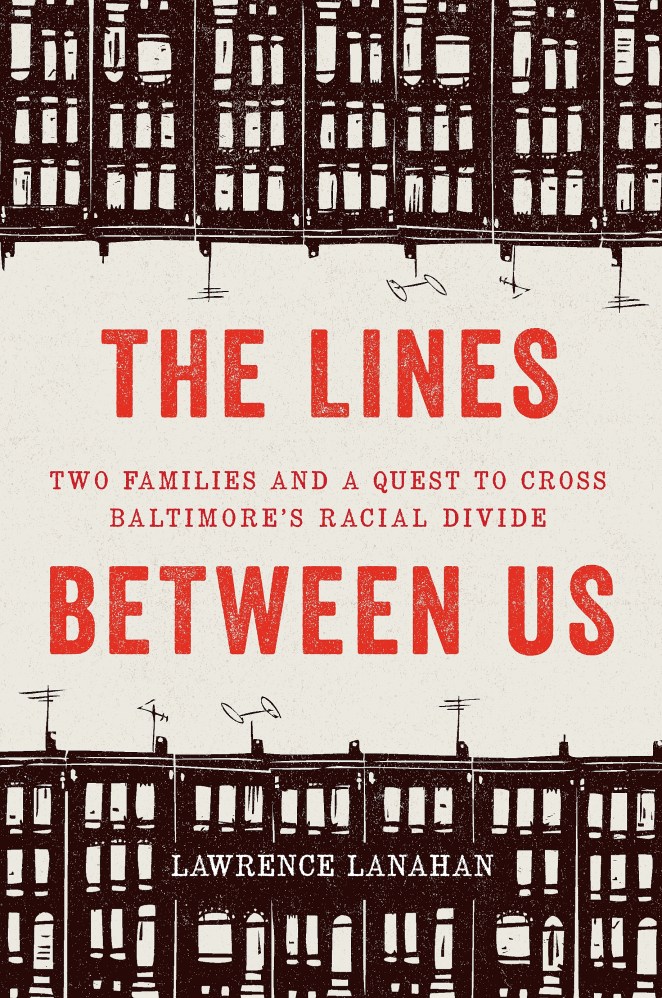
Stylized black and white drawing of typical Baltimore rowhouses frame the title.

By Holly L.

Journalist Lawrence Lanahan’s 2019 book The Lines Between Us: Two Families and a Quest to Cross Baltimore’s Racial Divide opens with two epigraphs:

It’s in the way their curtains open and close.

“Respectable Street,” XTC

I don’t even have to do nothing to you.

“Big Brother,” Stevie Wonder

The first line comes from English post-punk band XTC’s 1981 song about what songwriter and frontman Andy Partridge considered “the hypocrisy of living in a so-called respectable neighborhood. It’s all talk behind twitching curtains.” The second lyric is from a track from Stevie Wonder’s 1972 album Talking Book. In the song, Wonder takes the white establishment (Big Brother) to task for only coming to the ghetto “to visit me ‘round election time.” He continues his indictment – “I don’t even have to do nothin’ to you” because, from offenses ranging from criminal neglect of its black citizens to having “killed all our leaders…you’ll cause your own country to fall.”

It is fitting that Lanahan chose these words and these voices to begin this story, as his narrative weaves together multiple perspectives but most closely follows the criss-crossing threads of two individuals, one black and one white.

Nicole Smith is a young black woman living with her family in a West Baltimore rowhome owned by her mother, Melinda. When we meet Nicole, she is twenty-five and is contemplating the crossing of a line—leaving her neighborhood (and family and community) behind in search of security and opportunity for herself and her six-year-old son, Joe. Though she is enrolled in Baltimore City Community College and is on a waitlist for affordable housing in the city, Nicole seems to be on an existential treadmill, running but getting nowhere fast. She’s heard of a place called Columbia, a planned community in Howard County, with a reputation for good schools, plenty of jobs, and safe streets. Could she make it there?

Mark Lange is a white man raised in the Baltimore suburbs who, after a spiritual reckoning in his late teens, embarks on a path of service informed by the teachings of Mississippi civil rights activist and Christian minister John M. Perkins, who argued that those who wanted to help communities in need must live among them. As Mark’s story begins to be told, he feels a gravitational pull from his comfortable suburban life in Bel Air toward Sandtown, a West Baltimore neighborhood where his best friend Alan Tibbels, a like-minded white Christian with a mission of racial reconciliation, relocated with his family. If he moves, would Mark prove to be just another “white savior” looking to appease his own guilt? Or would be able to form meaningful relationships and help foster change in an impoverished community?

In this meticulously researched book, Lanahan alternates the fascinating tales of Nicole and Joe with the complicated history of Baltimore’s segregation and the resulting devastating impact on its black communities. Having its genesis as a year-long multi-media series on inequality in the Baltimore area broadcast from September 28, 2012 to October 4, 2013 on WYPR, Maryland Public Radio, the depth and breadth of Lanahan’s reporting is detailed to an almost dizzying degree. But just when a reader’s brain might start to get overwhelmed by the minutiae of historical detail (as mine sometimes did), my attention would come swiftly back into focus as the humanity of Nicole and Mark’s stories propelled me through the book. The Lines Between Us should be required reading for anyone who wishes to understand the institutional forces that shape inequality in our region and for those whose understanding of their neighbor might require them to cross a line. And isn’t that most of us?

Join us: Author Works with Lawrence Lanahan
Wednesday, January 12 from 7 – 8:30 pm
In person, HCLS Central Branch
Register at bit.ly/3pFTq3y

To learn more about the historical policies of redlining, visit the interactive exhibit currently at Central Branch. Undesign the Redline explores the history of structural racism and inequality, how these designs compounded each other from 1938 Redlining maps until today, and the national and local impacts. Join a guided tour on Wednesdays at 11 am and Saturdays at 2 pm.

Holly L. is an Instructor and Research Specialist at the Miller Branch. She enjoys knitting and appreciates an audiobook with a good narrator.

Thank you for reading in 2021

A blue background with "snow" above a white block at the bottom, on which rests 2022. Happy New Year appears below the year.

Thanks for reading Chapter Chats through another year of pandemic and uncertainty. We now have more than 180 followers, who have viewed posts almost 40,000 times (maybe we’ll be influencers soon?). The library went through some big changes, from contactless pickup to having all six branches fully open again. We talked about all sorts of things on the blog, from democracy to Paddington Bear, from National Library Week to National Geographic. Hopefully, you found something to suit you.

These blog posts were some of the most popular during the past year; make sure you didn’t miss out:

The Other Black Girl reviewed the hit title and invited you to an author event.

Celebrating Women’s History Month with #ELKReads promoted titles for all ages.

Learn about taking free music lessons with ArtistWorks

Pandemic Reads took a look at Station Eleven and The Plague.

Everyone Has a Flavor reviewed the graphic novel series, Space Boy.

All Things LEGO! talked to folks who love to build with blocks.

The Nature Fix reminded us of the importance of being outdoors.

The Daughters of Erietown reviewed Connie Schultz’s novel of small town, blue collar America.

But maybe you missed some of these other excellent reviews:

Mistborn takes a look at best-selling author Brandon Sanderson’s first series.

Definitely Hispanic offers a light-hearted reflection on owning an identity.

Cooking Up Some Comics introduces some manga titles that feature food.

Happy New Year! We hope to see you often in 2022 – on the blog and in person!

Listening List: Six Nonfiction Titles with Great Audiobooks

by Rebecca W.

A plain blue-green background shows golden cracks, which frame the text "Know My Name: A memoir. Chanel Miller. Read by Author"

Know My Name by Chanel Miller
Read by the author
Available through: Overdrive/Libby

In 2018, a victim impact statement, written by “Emily Doe”, was posted on Buzzfeed where it instantly went viral. Chanel Miller wrote the statement during the sexual assault case against Brock Turner. Turner, found guilty of sexually assaulting Miller on Stanford’s campus, was sentenced to only six-months in county prison. In her book, Know My Name, Miller claims authorship of the impact statement and expands on the experience of sexual assault and navigating our justice system.

Why choose the audiobook?

In a review of the book in The Atlantic, Megan Garber wrote a statement that resonates with my experience reading this book; “Know My Name is difficult to read in part because it is beautiful to read.” Miller uses her talent as a writer to show the reader her feelings, her reactions, and her experiences during the aftermath of the assault. From the title the reader is introduced to a major theme of this book, authorship and identity. For me, listening to Miller read this book added to the meaning of that theme.

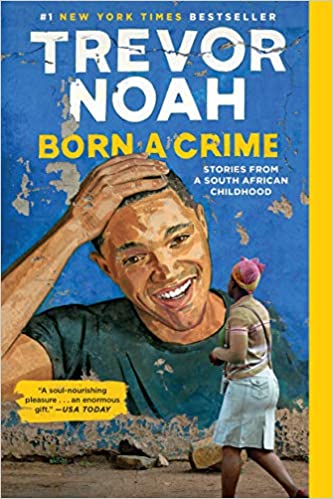
A woamn walks past a wall painted with an image of the author against a blue background.

Born a Crime by Trevor Noah
Read by the author
Available through: Audiobook on CD

Daily Show host Trevor Noah recounts his childhood growing up in South Africa during apartheid, then post-apartheid. Born in 1984 to a black Xhosa mother and a white Swiss-German father, Noah’s conception was in violation of a number of laws at the time, giving name to his memoir’s title Born a Crime. While this book is wholly focused on Noah’s experience growing up in South Africa, it is also largely about the close relationship between him and his mother, Patricia Nombuyiselo.

Why choose the audiobook?

If you’re like me and have fully embraced the internet age, you may have seen “CD only” and already moved onto the next item on the list. But I’m telling you, it’s worth it. Simply put, Noah made a name for himself as a comedian. He not only brought this background into the writing of this book, but the narration. If you could even call it narration. I would say it’s more of an all-out performance. So, see if you can find that CD player in your car and check this one out, it’s a must-listen.

You see a large sharp wooden paencil, where the colors also create an image of a figure silhouetted in mountains.

Educated by Tara Westover
Read by the author
Available through: Overdrive/Libby, Cloud Library, Audiobook on CD

In her memoir, Tara Westover recounts her journey from childhood, the youngest of seven children raised by survivalist parents, to a Ph.D. candidate at Cambridge University. Growing up in southeastern Idaho, Tara’s world was built around extreme political views, religious ideology, and physical violence. Lacking any formal education, Westover was seventeen the first time she stepped into a classroom. While attending college, Westover studied history where she learned, for the first time, of events such as the Holocaust and the Civil Rights movement. Throughout her book, Westover examines the relationships between her upbringing and family, and her growing perspective achieved through education.

Why choose the audiobook?

I am sure there are a good chunk of you who have already read Educated. But if you are one of the lucky few who haven’t, you should absolutely pick up the audiobook. Simply put, Westover is not only a remarkable writer, but a talented speaker. While the story she tells is full of extremist ideology and paranoia-fueled thought patterns, Westover reads her memoir with a calmness and clarity that highlights the themes of learning and perspective found throughout her book.

A small figure pushes a large peach up a steep black slope. The background is a pale peach and the river and hillsides are in grey

Eat a Peach by David Chang
Read by the author
Available through: OverDrive/Libby

David Chang, professional/celebrity chef and owner of the popular restaurant Momufuku (among many more), set out to write a book about the business of cooking, and maybe throw in a recipe or two. Well, this is not that book. Though he may have fought it, this is a memoir; covering Chang’s rise to fame, his Asian-American identity, and his experience with bi-polar disorder. Chang shares his triumphs as a chef in a way that entangles all three of these areas, telling the good, the not-so-good, and the regrettable. But don’t worry, you still get to hear all about some delicious food.

Why choose the audiobook?

Okay, you’ve probably caught on to my formula by now: memoir + read by the author = going on the list. What can I say. When you have an author that can read their own work (and that is not always the case) it just works so well! Chang’s reading of this book is so conversational, full of honesty, humor, and not-so-occasional swearing.

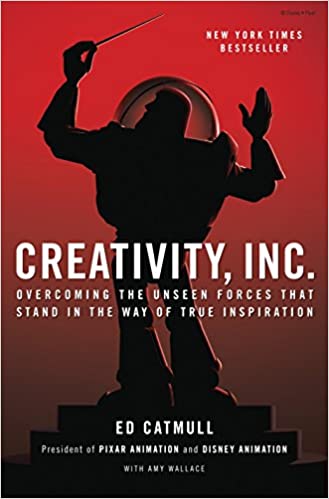
The silhouette of Buzz Lightyear is rim lighted against a red background. He has a conducting baton in his right hand.

Creativity, Inc.: Overcoming the Unseen Forces that Stand in the Way of True Inspiration by Ed Catmull with Amy Wallace
Read by: Peter Altschuler
Available through: Overdrive/Libby, Audiobook on CD

If you’re thinking the only reason this book made the list is because I am a huge fan of Pixar… well you’re not totally wrong. But the main reason I recommend this book is how well author Ed Catmull, co-founder of Pixar Animation Studios, communicates his core message of how to balance creativity and business. In the book, Catmull chronicles his journey from a computer science student to creating the first computer-animated feature film, and the success that followed. In each stage of Pixar’s journey Catmull explains how he was able to manage a team effectively, and sometimes not effectively, while fueling their creativity. Now I know what you’re thinking, how hard can it be to spark creativity in an animation studio? But when you really look at the process of animation, there is a lot of repetitive, monotonous work… seeing any similarities to other jobs out there? I really enjoyed hearing how Catmull identifies creative drain and the steps he takes to work through it.

Why choose the audiobook?

With this story being largely a Pixar story, I was expecting a tone fitting to the brand. Altschuler delivered. The narration of this book hit the same notes of inspiration and excitement that are characteristic of Pixar’s animations, making Altschuler’s narration one of the most enjoyable aspects of the book.

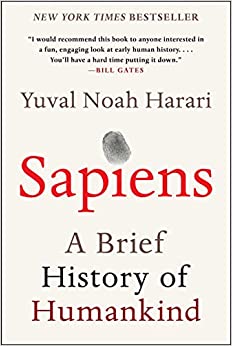
A beige cover features a smudged fingerprint dotting the "i" in Sapiens.

Sapiens: A Brief History of Humankind by Yuval Noah Harari
Read by: Derek Perkins
Available through: Overdrive/Libby, Audiobook on CD

Can you fit the entirety of human history into 15 hours? Well, no. But Yuval Noah Harari does a pretty good job at summarizing it in his book, Sapiens: A Brief History of Humankind. Breaking his book into three main revolutions (cognitive, agricultural, and scientific), Harari spans the entirety of homo sapiens’ existence, looking at it through a historical, biological, and, at times, philosophical lens. Harari begins his book about 70,000 years ago and ends in modern day – predicting what will become of the last human species. While I really enjoyed Harari’s take on this subject, I will preface this suggestion with the fact that the author does make some large generalizations in this book. If a particular subject in this book sparks your interest, I highly suggest looking deeper into it. Again, the entirety of human history in one book is a tall order, but Sapiens is a fantastic jumping-off point.

Why choose the audiobook?

If you haven’t already noticed, the majority of this list is made up of biographical works. I tend to lean this way when choosing nonfiction books to listen to because their storytelling structure usually translates to great audio. However, I really wanted to get my hands on this book and the hold list for the audiobook was shorter (who else has been there?). Though it wasn’t my first choice, I really enjoyed the audio version. When I first started it, I found myself missing the ability to re-read that traditional book format allows. However, once I accepted the fact that I wouldn’t be turning back any pages, I found the book really enjoyable. The writing does an excellent job at allowing the reader to absorb a lot of information, while still maintaining an easy-to-follow structure. So, if you are looking for an audiobook, but are more interested in the give-the-facts-and-figures type of book, Sapiens would be a great one to try.

Becky is an Adult Instructor and Research Specialist at the HCLS East Columbia Branch who enjoys art and everything science.

Twilight of Democracy (I hope not)

The book cover shows the title, "Twilight of Democracy: The Seductive Lure of Authoritarianism," and the author's name, "Anne Applebaum," accompanied by "Winner of the Pulitzer Prize." The words are in white except for "Authoritarianism," which is in red. The background of the cover is in gradating shades of blue.

By Eric L.

Twilight of Democracy: The Seductive Lure of Authoritarianism is a great read for the current moment. The title of the book should give you a fairly good idea of what the book is about. Anne Applebaum’s area of analysis and expertise seems particularly relevant right now. Sadly, she and I agree that hate and the belief in authoritarians has increased in recent times in America. Applebaum discusses how this is also the case in Britain, Hungary, and Poland (countries with which she has experience). Applebaum’s husband is involved in politics in Poland, which provides her an interesting vantage point into the “power elite” (my term). 

If you’re not familiar with Anne Applebaum, I would encourage you to read some of her articles in The Atlantic. I am mainly familiar with her work through this magazine. She is a journalist, but I would also describe her as a historian who has authored several highly regarded books on Russian history. She is also currently a senior fellow at Johns Hopkins University’s School of Advanced International Studies. I would describe Anne Applebaum’s politics as different than mine, where she is “center right” and I’m not. We may differ on specific policy prescriptions and perhaps views on liberalism and markets, but we agree that hate and authoritarians are both inimical to democracy. 

The book grabs you from the onset by describing a New Year’s Eve party they hosted as the 20th century ended. She details the somewhat raucous party, the guests, and the optimism many attendees shared for liberal democracies in the 21st century. I am younger than Applebaum, but I recall a similar optimism (and perhaps a little worry about Y2K). She then goes on to describe how in the 20 years since this party many of the guests would no longer speak to each other, and how’d she’d cross the street to avoid some of these folks. In our highly polarized and political society we can all share this sentiment to some extent. Perhaps we don’t know Boris Johnson personally, as she does, but we can relate, and her brief biographical sketch of Johnson is indeed indicative of western politics at this moment. 

The book is written by a good journalist, and thus it is engaging and thoughtful. It is very Western-focused, but it does concern more than the United States. The similarities of the things happening in these countries are a bit frightening. Personally, I’m remembering the era during the last century when fascism began to spread in the West. 

She goes into detail through character sketches of some of the people and the trajectory of their political beliefs. Many were former anti-communists and are now hard-right and authoritarian in nature. She points out that these are not poor, rural people, but actually quite elite, wealthy, and well-educated. She subsequently proffers her theories as to why this is the case, including that of a behavioral economist who suggests about one third of the population, irrespective of political beliefs, has an authoritarian “disposition.” This actually does not surprise me. Applebaum also puts words to the belief of many of these folks that things were better in previous times. The section where she delves into the different types of nostalgia is very interesting. 

I don’t agree with everything Applebaum posits, however I’d like to think she’d appreciate that fact. Specifically, I think she discounts corporate power and race issues in America. They’re addressed, but not to my satisfaction. Where I agree with Applebaum is that democracy is messy, it’s problematic, and not everyone is happy. In sum, it’s tough! It’s certainly much easier to be in complete control and get your way all the time. However, I don’t think I have an authoritarian “disposition” and I think getting my way all the time is not good for me psychologically. That said, I hope we’re not in the twilight of democracy.

Twilight of Democracy: The Seductive Lure of Authoritarianism is also available in large print and as an eBook and an eAudiobook from Libby/OverDrive.

Eric is a DIY Instructor and Research Specialist at the Elkridge branch. He enjoys reading, films, music, doing nearly anything outside, and people.

Explore the Ghoulish side of the Globe with the Atlas of Monsters and Ghosts!

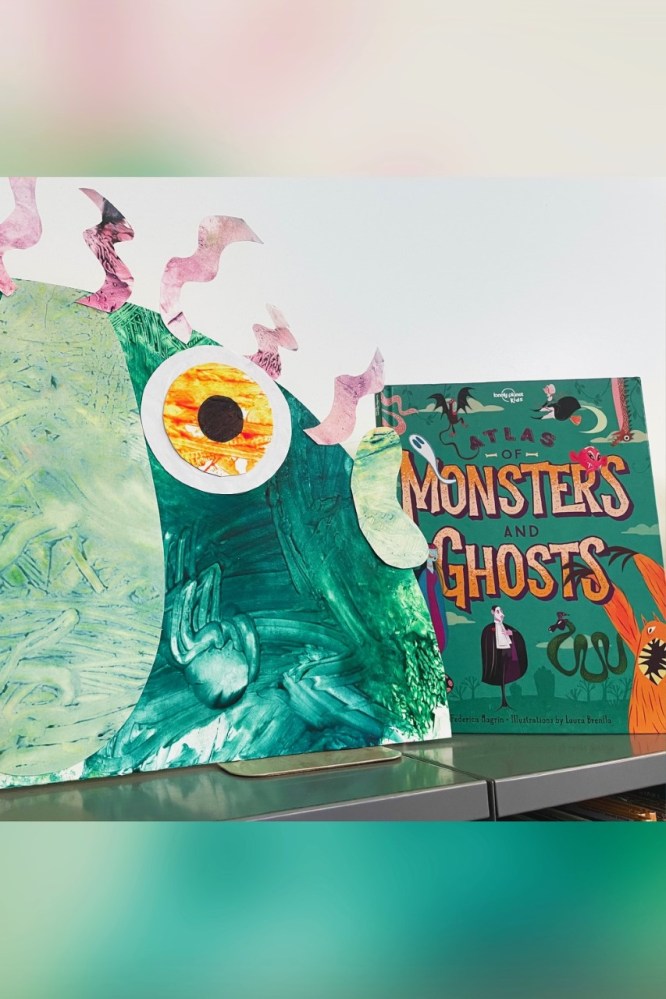
The picture depicts a teal-colored fish-like monster with a yellow eye next to the book, which has a teal color and depicts a variety of monsters, including dragons, snakes, and Dracula.

By Claudia J.

Ok, I’ll admit it: I love Halloween but I’m not the biggest fan of scary things. You won’t catch me at a movie theater watching the latest film from the Halloween franchise or reading IT by Stephen King. I tend to focus on the lighter side of the season. Yet, when I was browsing through some of the oversized books that live upstairs at the Miller Branch, I stopped at a bright teal atlas filled to the brim with whimsical illustrations and trips around our world. However, instead of historic sites and tourist destinations, this atlas is filled with MONSTERS and GHOSTS!

Atlas of Monsters and Ghosts by Federica Magrin, with immensely detailed illustrations by Larua Brenlla, takes readers on a ghastly trip to hunt down the most fearsome creatures known to humanity. Each continent is covered throughout the pages, highlighting monsters and ghosts with cultural significance. I’m sure most of us already know of Bigfoot, King Kong, and the Boogeyman through classic stories and tales. But have you heard of the Smok Wawelski from Poland, a fearsome dragon from the cave at the foot of Wawel Hill? Or Krasue, the spirit from Thailand with the floating head who feeds on anything in her sights? These monsters and spirits are not only highlighted, but their stories are tied in with learning about each country’s tales and fables. One particular feature of the atlas that I enjoyed was that it gave special sections to the monsters and spirits of Greek Mythology and the ones from Japanese folktales, both of which have been spotlighted in various other stories, movies, and video games.

One fair warning for all my budding Monster Hunters: some of these stories, no matter your age, are not for the faint of heart despite its art style and its publisher, Lonely Planet Kids. Nevertheless, it was an interesting, spooktacular read, one that may send a chill up your spine, but which will definitely teach you something new along the way. What I learned is to not visit the places where these creatures have been spotted! I think I’ll opt for a warm beach instead.

You can borrow or request Atlas of Monsters and Ghosts at all HCLS locations for your horrific, spooky enjoyment.

Claudia J. is an Instructor and Research Specialist for Howard County Library System. She enjoys stories in all forms, from books to graphic novels, movies to video games: you name it!

Eat Your Veggies! Cookbooks and a Class.

A pile of bell peppers from the Farmers Market, in greens, yellows, and purples.
Produce from weekly farmers market at HCLS Miller Branch.

By Holly L.

Low-Fat. Mediterranean. Atkins. Whole 30. Keto. Paleo. Vegan. Pegan. Pegan? (That’s paleo meets vegan.) While there is little consensus as to which diet is the best, there is near universal agreement that a healthy diet includes abundant produce – fruits and, especially, vegetables. But most of us still aren’t getting enough. According to the USDA’s most recent Dietary Guidelines for Americans, 90 percent of the US population does not get its daily recommendation of vegetables.

Whether you are already getting your five servings a day, we have a cornucopia of titles in our cookbook collection to help you incorporate more plant-based foods into your diet.

Meera Sodha’s East: 120 Vegan and Vegetarian Recipes from Bangalore to Beijing is an inspired collection of vibrant recipes, many originally published in her Guardian food column,”The New Vegan.” In her introduction, Sodha recalls when she first agreed to write the column that not only was she not vegan, she was in the middle of a major life change, having recently given birth to her first child. Excited by the writing challenge when she was seeing the world anew through her daughter’s eyes, she embarked on a journey to discover vegan recipes that would satisfy not just vegans but meat-eaters like herself. With a culinary background (and two prior cookbooks) rooted in her Indian heritage, Sodha broadens her horizons in East, with vegetarian and vegan recipes inspired by her travels in East and South Asia. The book is divided into chapters such as Snacks & Small Things, Curries, Flour and Eggs, Legumes, and Sweets. A few pages of “alternative contents” are also helpful, with categories such as Quick Dinners and From the Pantry, in addition to seasonal categories for those who like to cook by the calendar. This fall, I am tempted by Autumn Pilau with squash, lacinato kale, and smoked garlic, perhaps followed by some Pineapple Love Cake or Salted miso brownies.

The title Mostly Plants echoes a line from author-journalist Michael Pollan’s 2008 book In Defense of Food: “Eat food, not too much, mostly plants.” While recognizing the nutritional and cultural value of meat, he champions a diet of moderation composed mostly of whole foods, with meat being demoted from star to supporting player. In Mostly Plants: 101 Delicious Flexitarian Recipes from the Pollan Family, Michael Pollan’s mother, Corky, and sisters Tracy, Dana, and Lori have created a cookbook full of healthy, flavorful recipes designed to be on the table in 35 minutes or less. Each Pollan has her own dietary preference, some eating meat and others not. Their goal with the book is not to promote one particular diet but rather to shift “the ratio from animals to plants.” Each recipe features easy-to-read icons indicating if it is vegetarian, vegan, dairy-free, gluten-free, and/or fast, as well as helpful hints for adaptations (to make a vegetarian recipe vegan, for example). Beautiful photos fill the pages, highlighting such recipes as Mesclun greens with persimmons and Manchego cheese and Udon Noodle Soup with miso-glazed vegetables and chicken. The book finishes with a chapter devoted to sweets, the Apple Galette Rustique with apricot glaze sounding to me like a perfect fall dessert.

Fans of chef-activist Bryant Terry may know him as the author of the celebrated 2014 cookbook Afro-Vegan: Farm-fresh African, Caribbean and Southern Flavors Remixed. In his more recent book Vegetable Kingdom: The Abundant World of Vegan Recipes, Terry explores the realm of vegetables in all their glorious parts, from seeds to roots. In his introduction, subtitled “Fennel for Zenzi,” Terry credits his two daughters as his inspiration. “I wrote this book to make a diversity of foods from the plant kingdom irresistible to them, to inspire their curiosity.” Even the structure of the book, with recipes sorted into chapters based on which part of the plant is used (flower, bulb, etc.) came from his older daughter Mila’s gardening class assignment. The recipes exhibit a further geographical reach than his previous books, with influences from East and Southeast Asia, reflective of his wife’s heritage. The book offers a feast for the senses, not just for the eyes and the palate, but for the ears, too. Terry includes a song pairing for each recipe. Before I prepare Dirty Cauliflower with tempeh, mushrooms, scallions, and parsley, I will be sure to queue up the suggested track, “Flat of the Blade” by Massive Attack. Terry does not include a chapter on sweets, but I imagine that he would approve of my default easy dessert—a few squares of dark chocolate which is, of course, vegan.

If you are interesting in healthy plant-based cooking, consider joining HCLS Elkridge Branch for Plant-Based Nutrition: Everything You Want to Know and More! on Thursday, October 7 at 6:30 pm. University of Maryland Extension teaches participants about plant-based nutrition, the benefits of a plant-based diet, and how to shop and plan meals using plant-based foods.

Holly L. is an Instructor and Research Specialist at the Miller Branch. She enjoys knitting and appreciates an audiobook with a good narrator.
Brat: An ’80s story

Black and white photo of Andrew McCarthy in a tweed jacket, loosening a skinny tie.

by Eric B.

I’d completely agree with the author Jay McInerney’s (Bright Lights, Big City) assessment on the back jacket cover of Brat: An ’80s Story

“My only quibble with this absorbing, thoughtful, and sometimes painfully honest memoir is with the title; McCarthy is anything but a brat. He is certainly an unlikely movie star, and the story of how this diffident and insecure young man found himself at the center of the culture in the 1980s—and then decided to walk away from it all—makes for a fascinating read.”

Perhaps you’ve seen Andrew McCarthy on the talk show circuit, or just remember him from his 80s films. I am a fan of his work in Less than ZeroPretty in Pink, and St Elmo’s Fire. Moreover, and you may scoff, but I do realize the genius that is found in Weekend at Bernie’s. I’m a fan of McCarthy’s acting, and perhaps his general on-screen demeanor in these “period pieces.” He played thoughtful, “emo” characters before it was nearly a trope in myriad indie films (to be sure, I still love the sensitive emo characters). For example, I’d contend that Timothy Chalamet is successful in a way I’m not sure was possible in the recent past with more rigid gender roles.

Several years ago, I read some of McCarthy’s travel writing and liked his style. The piece was about Los Angeles and was personal for him, and he spiced it up with personal anecdotes about his memories. For fans of 80’s films and McCarthy, Brat is like a greatest hits collection.  

The book opens with him abruptly leaving the Pretty in Pink Hollywood premiere to slam drinks at the bar across the street. McCarthy briefly gets into his middle-class upbringing, childhood, his time at NYU studying acting, before landing his first role and dropping out to pursue Hollywood acting full time. The remainder of the book is about the roles and the experience of his meteoric rise in Hollywood during the decade. McCarthy lived in New York for the duration of his Hollywood fame, which I found surprising, but makes sense now. He laments the fact that he didn’t pursue the theater, instead of accepting some of the roles he was offered. 

He includes some interesting stories about his experiences in Hollywood and some of the characters he encountered. I would not describe this as a tell-all book, but rather a memoir of a person experiencing and observing the strange world of American film and celebrity but never really feeling terribly comfortable in it. John Hughes described him as a “wimp,” which seems like a nasty thing to say. His experience at a Paramount anniversary party with Hollywood legends and young up and comers, where he realizes he could not and had no desire to be Tom Cruise, is hilarious because we all know how their respective careers progressed. McCarthy includes many pictures, and this one of the entire group at the Paramount party is telling. 

Artists who have a tough time with the nature of celebrity interest me generally. I appreciate what it’s like to want to be noticed, appreciated, and recognized, but then not wanting all that attention. I’m terrified of someone trying to take my picture as I try to live my daily life. McCarthy has accepted his status as an 80s star and a member of the “brat pack,” even though this was a media term. He’s not seen some of these people since the respective films were completed.  

If you’re a fan of so-called “brat pack” films, or 80s movies, John Hughes films, or just looking for a book not concerning current affairs, it’s a pretty good read. I acknowledge my bias on this subject, but I enjoy McCarthy’s writing style and his reflective and analytical nature. Perhaps this comes through in his acting?  Andrew McCarthy does seem like someone I’d know, or someone I’d like, but perhaps this is how celebrity works. Briefly reflecting on his days at NYU, McCarthy said that after class he’d hang out in the “post-bohemian cross culture” of Washington Square Park, observe all the interesting people, buy two joints off a Rastafarian for a buck apiece, then go home and watch the Rockford Files. This sounds like a nice afternoon to me, or perhaps a celebrity dream date.  

Also available as an eBook and eAudiobook via OverDrive/Libby.

Eric is a DIY Instructor and Research Specialist at the Elkridge branch. He enjoys reading, films, music, doing nearly anything outside, and people.

Crying in H Mart

Against a red background, two sets of chopsticks hold noodles in long swoop that looks like an H.

by Ben H.

I’d be remiss to write about Michelle Zauner’s Crying in H Mart without mentioning Psychpomp, the 2016 Japanese Breakfast album that served as a preview for the memoir that debuted at No. 2 on The New York Times‘ best sellers List. Passages describing the creation of the album are brief, but lyrics are scattered throughout the memoir like Easter eggs.  

Zauner recorded the album in Eugene in the months after her mother died. Zauner’s mother is on the album cover, reaching toward the camera. It’s a rad shoegaze album full of great lyrics, and it’s my 2-year-old daughter’s favorite album. Kiki’s been listening to it since she was born. She points to this album cover when she wants to bop: 

Two Asian woman look down into the camera, one reaching out. They are under a blue sky and wind is blowing their hair.

Zauner, who was born in Seoul; raised in Eugene, Oregon; went to school in Philadelphia; and now lives in Brooklyn has a real Maryland vibe (whatever that means). Maybe it’s just me, but I felt close to Zauner after reading her book. It’s honest and intimate (I know that’s a book cover cliché and I still can’t help myself). 

The memoir is incredible. Her mom was only 56 when she died, and Zauner had a complicated relationship with her. She illustrates their relationship by detailing a series of events from childhood conversations to her mom’s final word. The book is only around 250 pages, but Zauner uses anecdotes and conversations like a pointillist uses points to create a full portrait. Her mother is down-to-earth, glamorous, pragmatic, whimsical, frustrating, mysterious, and lovely.  

Zauner writes about eating food, making food, storing food, watching videos of other people make food (Maangchi gets her own chapter), and it’s all great. The passage where she makes her first real batch of kimchi is one of my favorites. Food is the constant in her relationship with her parents: “What they lacked in high culture, they made up for by spending their hard-earned money on the finest of delicacies. My childhood was rich with flavor – blood sausage, fish intestines, caviar. They loved good food, to make it, to seek it, to share it, and I was an honorary guest at their table.” 

After her mother’s cancer diagnosis, her mental fantasies to cure her mom are heartbreaking. We’ve all tried to barter with the universe or with God to get something, and in that vein, Zauner writes, “I spent an hour on the treadmill. In my head I played a game with the numbers. I thought to myself, if I run at eight for another minute, the chemo will work. If I hit five miles in half an hour she’ll be cured.”  

The details of Zauner’s childhood in Eugene and her visits with family in Seoul are highlights, but I found myself returning to the intimate moments between Zauner and her mother. Crying in H Mart is officially going to be a movie; I can’t wait for the screen adaptation, but I think it’s going to be a tearjerker. 

You can place the book on hold, as many other folks want to read it right now, but it’s worth the wait. Also available as an eBook and eAudiobook.

Ben Hamilton works at Project Literacy, Howard County Library’s adult basic education initiative, based at HCLS Central Branch. He loves reading, writing, walking, and talking (all the basics).

Cool off in Patapsco Valley State Park

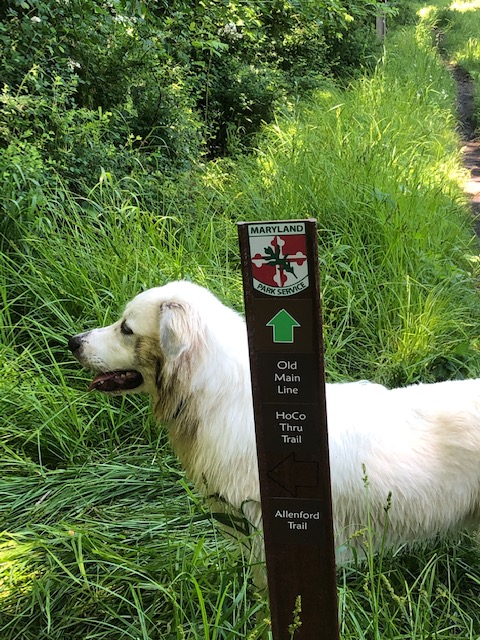
The writer's dog stands in thick grass near a trail marker in Pataspco Valley State Park.

by Eric L.

You may be hot and it may be humid, but this doesn’t mean you should stay indoors. To the contrary, you should get outside. If you’re reading this, it’s probable that you live close to Patapsco Valley State Park. The Park was founded prior to the National Park Service and encompasses approximately 16,000 acres. It offers some very fine East Coast nature, in my opinion. 

I’m from Baltimore, I have spent a lot of hours hanging around it, the recreation areas and even camping right off Route 40. My significant other finds this hilarious. I’m assuming because of the proximity to suburbia and the bustling thoroughfare right next to the camping area.

I’ve ridden my bike in it and hiked so many miles. I’d be curious to know the total – maybe thousands! I moved to Ellicott City to be in the Patapsco Valley. My neighborhood is on it, and I consider myself very lucky. There are not as many cicadas back there now, and it’s cooler than the blacktop world. Some of the views are just spectacular (perform an internet search for some of the scenery). 

All three of the dogs I’ve owned as an adult have logged thousands of miles with me. To be sure, I’m not a dog training expert, but I’ve been lucky, patient, diligent and have walked my dogs all over it, sometimes even off-leash. It’s a great place to take your kids to play, outside! My kids have also enjoyed many great afternoons in the Patapsco Valley. 

If you feel as though you need some motivation, borrow some of the great materials we have.  

Also, a great nonfiction read A Walk in the Woods by Bill Bryson (also as a book on CD, as well as an eBook and eAudiobook from Libby/OverDrive)Bryson tells the humorous account of his discovery, and attempts to hike the Appalachian trail. To be sure, this is not the story of an experienced hiker doing the entire trail from Maine to Georgia in record time, but rather the story of an average middle-aged person and his old friend hiking and discovering together. He interweaves interesting history and social commentary. Or try the film, starring Robert Redford.

There are so many different terrains one can hike, from flat, paved trails to some rocky terrain. That said, you need not be exceptionally fit, after all, it’s just a walk. You will need some comfortable shoes, running, or trail running. Hiking boots, or shoes, are certainly nice for some of the more rocky, advanced terrain. Please keep in mind that Maryland has a large deer population, and thus deer ticks. That said, dress accordingly, and use bug spray as needed. Do some research (Consumer Reports) about the most effective ones, it is very important! 

At any rate, don’t miss out. Get back there! It’s thought by many a lay person, psychologist, scientist that a walk in nature will make you feel better. View the Park’s website to find the right trail and place for you. Stop by the Elkridge Branch + DIY Center, where you can borrow trekking poles, a compass, binoculars in case you spy something you’d like to view up-close, and metal detectors for treasure hunting.  

Eric is a DIY Instructor and Research Specialist at the Elkridge branch. He enjoys reading, films, music, doing nearly anything outside, and people.

Talk Therapy

By Holly L.

When faced with a personal problem, some people will talk about it. Find a shoulder to cry on, a sympathetic ear to fill. Others of us have a tendency to downplay it, to deny it, to avoid talking about it. This isn’t the healthiest coping method, bottling it all up inside and burying that bottle in the backyard behind the garden that really needs watering and….what was that? A problem? There’s no problem. It’s all….just…. FINE. 

(smiles sheepishly) 

Even though I sometimes — okay, often — have trouble talking about my problems, when I do let down my guard and confide to someone, I almost always feel miraculously better. The truth is that talking helps, and I find the same sort of comfort reading about the personal struggles of others and learning about how they’ve navigated their own difficult moments. Two recent nonfiction books recall this power of a good talk to bring peace to a troubled mind.

The cover shows a square, yellow tissue box with a white tissue coming out of the top of it, against a turquoise background with the title overlaid in black lettering.


Maybe You Should Talk to Someone: A Therapist, Her Therapist, and Our Lives Revealed is a fascinating and highly readable memoir by psychotherapist Lori Gottlieb. In this 2019 book, she shares her experience as a therapist going to therapy following a devastating personal crisis. We are introduced to the character of Wendell, her quirky therapist with a shabby office and a straightforward but compassionate demeanor. During the author’s sessions with Wendell, we are allowed glimpses of the kinds of thoughts that run through a therapist’s mind when she herself is in therapy: Does he think my problems are trivial? Will he ever replace this old couch? Does he like me? Weaving the story of her own journey with those of her patients, Gottlieb offers up a humor-laced but empathetic glimpse into her own and her patients’ sessions, giving the reader a behind-the-scenes look at therapy from both sides of the therapist’s couch. As I followed Gottlieb and her patients’ struggles and successes, I saw parts of myself reflected in the characters and was prompted to examine my own relationship to therapy and the benefits of talking through problems. Also available as an eBook.

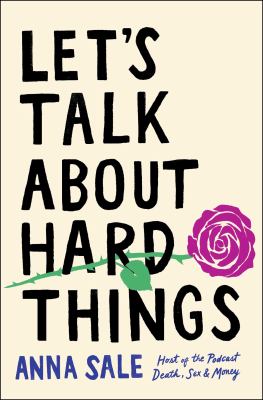
The book cover shows a pink rose with a thorny green stem, winding through the black lettering of the title against a cream-colored background. The author's name, Anna Sale, and "Host of the Podcast Death, Sex & Money" are written in cornflower blue.

I have been a fan of Anna Sale’s podcast Death, Sex, and Money for a few years and had been eagerly anticipating the release of Let’s Talk About Hard Things when it landed on our library shelves in May (also available as an eBook). This moving book continues the kinds of discussions that make her podcast so compelling, focusing on, “the things we think about a lot and need to talk about more.” Subjects ranging from, yes, death, sex, and money, but also family and identity. Sale opens the book by sharing some hard things from her own past, specifically the unraveling of her first marriage. Feeling utterly lost after her divorce, she began to find strength and clarity by talking to others about their own dark times and hearing how they found, or didn’t find, peace. Realizing how therapeutic these hard conversations can be, she was inspired to launch her podcast in 2014 on WNYC, New York City’s public radio station. Let’s Talk About Hard Things serves as a companion piece to Death, Sex, and Money, and it contains some of the most crucial conversations and valuable lessons from Sale’s life. Fans of the podcast will be reassured to know that, although the book may include a few references to the podcast, the majority of the material comes from fresh interviews conducted for this project. Sale’s written tone is as warm and personal as the voice she brings to her podcast (for this reason, I highly recommend the eAudiobook). After finishing this book, I was left with a feeling of comfort, as if I had just had a conversation with a close friend. The kind of conversation that doesn’t always find answers but that deepens connections and speaks to the power of just talking. And being heard. 

If you need someone to talk to, please visit this HCLS page for local mental health resources.

Holly L. is an Instructor and Research Specialist at the Miller Branch. She enjoys knitting and appreciates an audiobook with a good narrator.