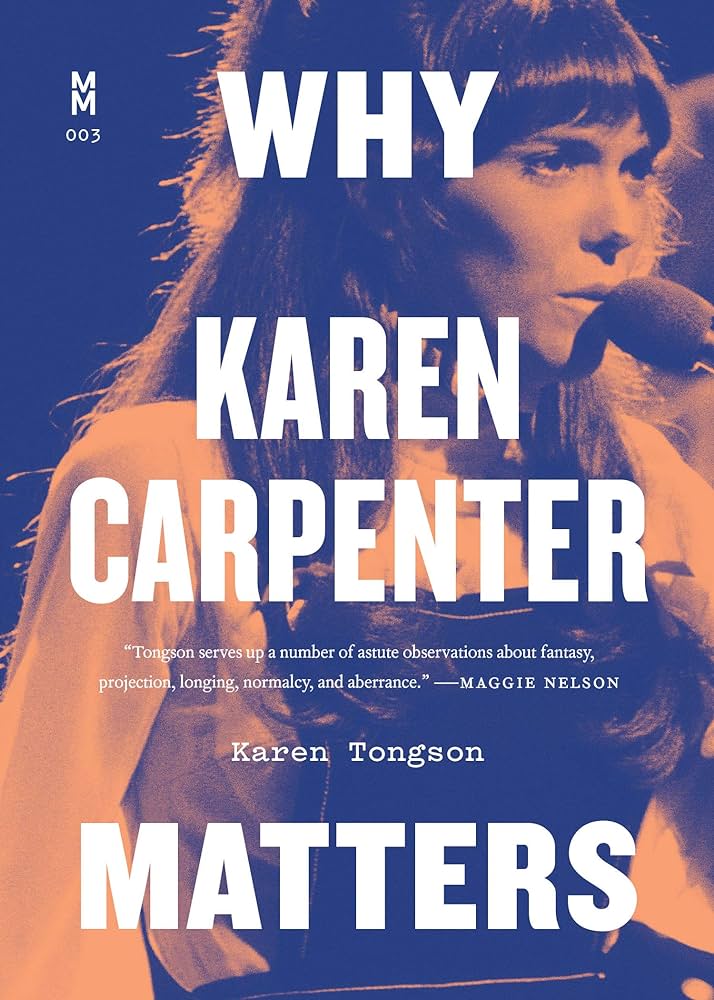
Why Karen Carpenter Matters by Karen Tongson

A blue and beige duotone image of Karen Carpenter singing into a microphone, with text in white block letters "Why Karen Carpenter Matters".

by Angie E.

In Why Karen Carpenter Matters, the author writes about something she calls “the Karen effect,” being “the capacity to make you feel something, to make you believe in a spiritual undoing and trembling beneath the polished arpeggios and vacuum-sealed harmonies.” She speaks for many fans, I am sure, in describing the distinct sound of one of the most gifted vocalists of all time.

Author Karen Tongson (named after the singer) is a Filipino-American cultural critic, writer, and queer studies scholar. In this moving and often riveting half memoir/half biography she intertwines cultural analysis and personal anecdotes, creating a rich mix of insight and emotion into the life of Karen Carpenter.

The Carpenters’ music was immensely popular in the Philippines and other parts of Asia during the 1970s and beyond. Their songs had a significant impact on Filipino culture, and Tongson grew up with a deep appreciation for their music.“To be corny is to be mawkishly old-fashioned; tiresomely simple and sentimental,” Tongson writes, explaining part of the reason of her love for Karen Carpenter, who ultimately became the tether to the Philippines.

Tongson also navigates the sensitive topic of Karen’s eating disorder with grace, shedding light on the societal pressures that contributed to Karen’s tragic struggle. She emphasizes that Karen’s story is not just one of personal struggle, but a reflection of the larger issues women faced during that era, and still to this day, a powerful reminder of the need for compassion and understanding.

One of the most striking aspects of Why Karen Carpenter Matters is its examination of the intersection of race, gender, and music. Tongson studies the ways in which Karen Carpenter’s voice transcended cultural boundaries and challenged stereotypes, making her an unexpected icon in the LGBTQ+ community. Karen’s voice, as the writer beautifully describes, became a “sonic balm” for those who found solace and identity in her music.

I have loved the Carpenters since I was a kid and find Why Karen Carpenter Matters to be one of the most authentic and soulful nonfiction reads ever, not just on Karen Carpenter, but on any person or subject. I can still feel sad when I hear a song of hers on the radio or my music streaming, but that doesn’t take away the power or comfort or loveliness of one of the most sincere voices I have ever heard in music. From all accounts written about her, from everything friends of hers have said, Karen was a fun and funny woman, sweet and a genuine person.

For more about the Carpenters:
Carpenters: The Musical Legacy is an enchanting journey through the timeless melodies of Karen and Richard Carpenter. There are lots of fascinating tidbits about recording sessions and songs chosen for albums and what Karen and Richard thought about their music and about music in general.

Lead Sister: the Story of Karen Carpenter is not owned by HCLS, but is well-worth tracking down through Marina. A 2023 release, it takes a more artistic look at her life and how much more there was to her in her musical life than that magical voice. Karen herself once said that she thought of herself as a drummer who sang, not a singer who played the drums. I think she would like this book a lot.

Angie is an Instructor & Research Specialist at Central Branch and is a co-facilitator for Reads of Acceptance, HCLS’ first LGBTQ-focused book club. Her ideal day is reading in her cozy armchair, with her cat Henry next to her.

All the Beauty in the World: The Metropolitan Museum of Art and Me by Patrick Bringley

At the top of a grand staircase, surrounded by columns and arches, a man in blue suite stands in front of a large, classical painting.

by Kristen B.

As a native to central Maryland, I grew up regularly visiting some of the best museums in the country. My parents would herd us onto the Metro, and we would spend long days at the various Smithsonian Institution buildings – American History, Natural History, the Zoo – along with the National Gallery of Art. Everything was free and fascinating. To this day, I love to spend time in a museum. So, when I heard about All the Beauty in the World: The Metropolitan Museum of Art and Me, read by the author, it seemed like a good choice for an audiobook for my commute. I was right about that!

Patrick Bringley turned a similar childhood love of museums into a job during a particularly stressful period of his life. When, as a young man just out of college and working for The New Yorker, Patrick got the news that his beloved older brother was diagnosed with an aggressive form of cancer, he re-evaluated many of his choices. To be able to spend as much time as possible taking care of Tom, Patrick found a less demanding job as a security guard at The Metropolitan Museum of Art.

This memoir illustrates ten years of Patrick’s life, in which he grieves his brother, falls in love, works in close proximity to some of the world’s most famous fine art, and moves from being a novice to a veteran at the museum. It’s a loving look at family, and a fascinating, up close view of what it’s like to spend 8-10 hours of every working day on your feet among both ancient and contemporary art. He details some of his favorite pieces, including Fra Angelico’s Crucifixion and Peter Bruegel’s The Harvesters, and he spends the better part of one chapter mesmerized by quilts and their makers. Bringley recounts camaraderie with his cohort along with amusing interactions with visitors, including the tourist parents who are looking for the dinosaurs (oops, wrong museum … will mummies do?).

This slim, beautifully written volume presents an interesting cross-section of Bringley’s life, one that reminded me of why great works of art exist – to help people of all generations and historical eras express faith, love, grief, and the human condition. The most lovely part of this book seems to be the author himself, who embodies a sort of Midwestern niceness and willingness to take the world at face value. He approaches and interacts with the art surrounding him from a genuine humility of spirit, looking for the author’s intent and the common human truths to be found. I don’t read a lot of nonfiction, but I do enjoy the occasional memoir. This was one of the best, told in a self-deprecating style that focused on the wonders (personal and creative) around the author as much as on the author himself.

The title is available in print, e-book, e-audiobook, and audiobook on CD.

Kristen B. is a devoted bookworm lucky enough to work as the graphic designer for HCLS. She likes to read, stitch, dance, and watch baseball in season (but not all at the same time).

Bauder Lecture Series: Nadia Owusu

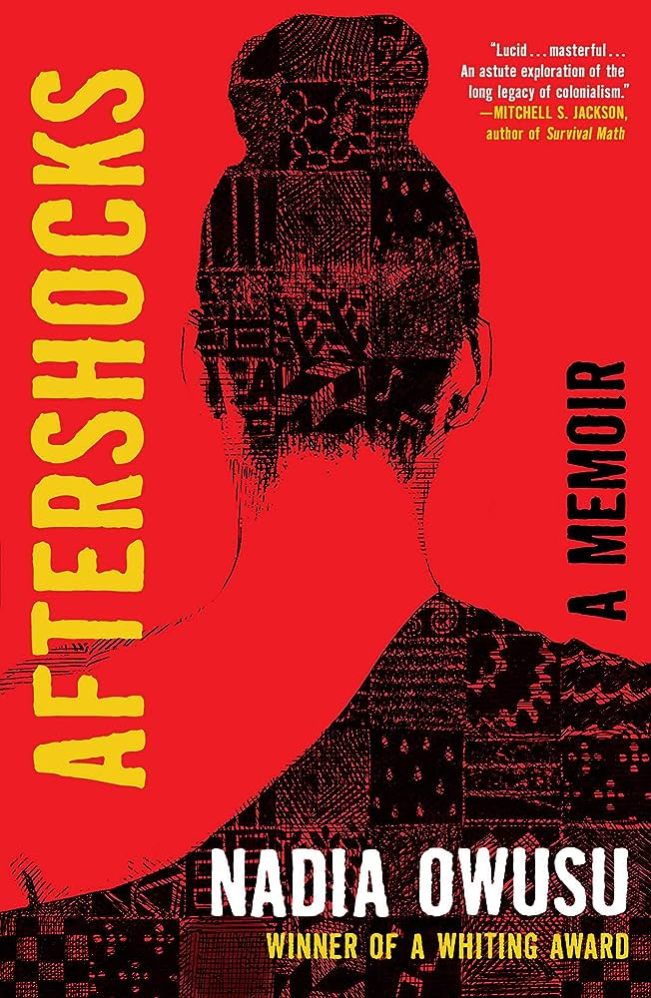
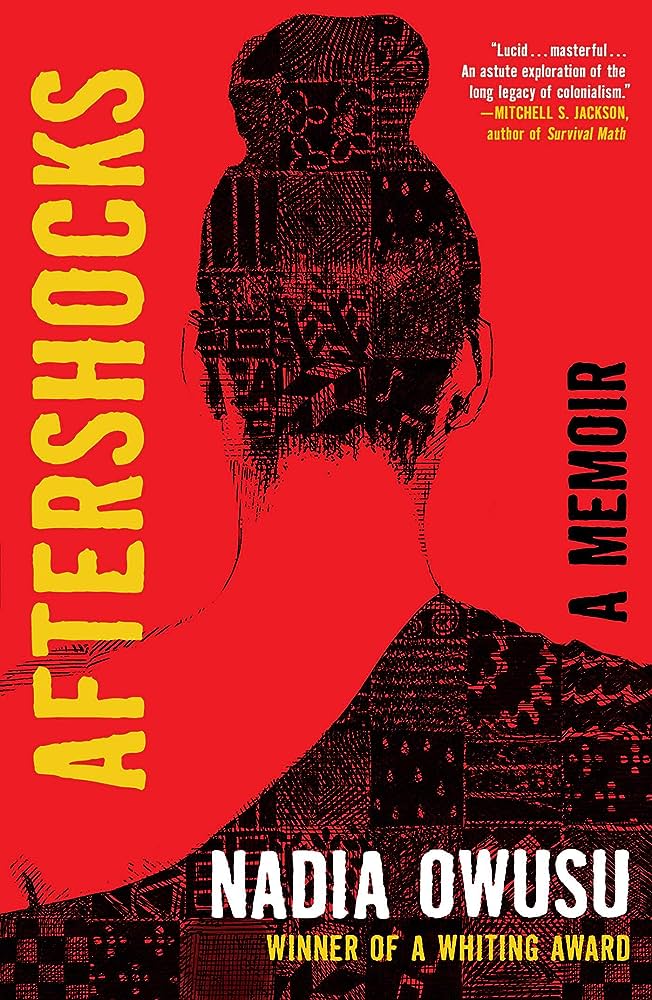
Red cover shows the silhouetted back of a woman with her hair up, her shirt and hair are covered in squares of textures and patterns.

For adults. Registration required.

Thu, Sep 21 | 6 – 7 pm
Howard Community College
Monteabaro Recital Hall (free parking available)
10901 Little Patuxent Pkwy, Columbia

Join us for the annual Bauder Lecture at Howard Community College, featuring acclaimed author Nadia Owusu.

Nadia Owusu is a Brooklyn-based writer and urbanist. Her memoir, Aftershocks, was selected as a best book of 2021 by more than a dozen publications, including Time, Vogue, Esquire, and the BBC, and has been translated into five languages. It was a New York Times Editors’ Choice pick, named one of Barack Obama’s favorite books of the year, and selected by Nobel Peace Prize laureate Malala Yousafzai for her Literati book club.

From the Publishers Weekly review:
The biracial daughter of an Armenian mother and Ghanaian father, Owusu’s early life was fractured by her parents’ divorce and multiple moves necessitated by her father’s U.N. career. Living in Rome at age seven, she was visited by her long-absent mother on the day a catastrophic quake hit Armenia, seeding an obsession with earthquakes “and the ways we try to understand the size and scale of impending disaster.”

Nadia Owusu is the winner of a Whiting Award in nonfiction and has received fellowships from Yaddo and Art Omi. Her writing has appeared in The New York Times, Orion, Granta, The Paris Review Daily, The Guardian, The Wall Street Journal, Bon Appétit, and Travel + Leisure. She teaches creative writing at Columbia University and at the Mountainview MFA program at Southern New Hampshire University, and she is the Director of Storytelling at Frontline Solutions, a consulting firm supporting social-change organizations.

Tope Folarin, a Nigerian-American writer based in Washington, D.C., will be introducing Ms. Owusu and moderating the discussion. He serves as Director of the Institute for Policy Studies and the Lannan Visiting Lecturer in Creative Writing at Georgetown University. He is the recipient of the Caine Prize for African Writing, the Whiting Award for Fiction, and a fellowship from the National Endowment for the Arts, among other awards. He was educated at Morehouse College and the University of Oxford, where he earned two master’s degrees as a Rhodes Scholar. His debut novel, A Particular Kind of Black Man, was published by Simon & Schuster.


The Bauder Lecture by Howard Community College is made possible by a generous grant from Dr. Lillian Bauder, a community leader and Columbia resident. Howard Community College will present an annual endowed author lecture known as The Bauder Lecture, and the chosen book will be celebrated with two student awards. Known as the Don Bauder Awards, any Howard Community College student who has read the featured book is eligible to respond and reflect on the book in an essay or other creative format. The awards honor the memory of Don Bauder, late husband of Dr. Lillian Bauder and a champion of civil rights and social justice causes.  

Aftershocks was selected by the Howard County Book Connection committee as its choice for the 2023–2024 academic year. The Howard County Book Connection is a partnership of Howard Community College and the Howard County Poetry and Literature Society (HoCoPoLitSo). Visit the Howard County Book Connection web page for additional information.

Aftershocks is available from HCLS in print, large print, e-book, and e-audiobook formats. HoCoPoLitSo will also have copies available for purchase at the event.

In partnership with Howard Community College and HoCoPoLitSo.

How to Keep House While Drowning by KC Davis

by Eliana H.

I read – actually, listened toHow to Keep House While Drowning after a good friend shared repeatedly and enthusiastically how valuable it was to her. It’s pretty short, and I figured it was worth a look at least. Let me now tell YOU that it is certainly worth picking up. There is a line on page 6 that says, “If you are crying (or wincing internally) right now, this book is for you.” I will freely admit here that I was crying at that point, and this book was for me. 

If you have ever found yourself having a hard time keeping up with everything you feel like you should be doing, this book is for you, too. Everyone struggles sometimes. Our society puts ever-increasing demands on all of us, but it doesn’t necessarily provide the support needed to meet those expectations. For many of us, there are times where even basic tasks can feel overwhelming, especially if we struggle with ADHD, depression, or other challenges to executive functioning. 

Author KC Davis is a licensed professional therapist, and she is so gentle with readers of this book. Chapters are short, main points are highlighted, and a shortcut journey through the book is offered for those who do not have the capacity to go through the whole thing. But most of all, judgment is completely removed. Every situation Davis describes is explained as a legitimate challenge or obstacle, and she explicitly tells us early on that she does not think laziness exists. What a novel, generous concept! It should not be such an amazing thing to offer everyone grace and compassion when they are struggling, but Davis does so ably and authentically. 

The primary tenet guiding this book is this: “You don’t exist to serve your space; your space exists to serve you.” It’s that simple and that groundbreaking. When we can reframe our perspective on the relative value of our time and having a picture-perfect home, we can find space to prioritize what truly needs to get done, in what timeframe, and to what level. Concrete steps are offered to guide you through the process of managing care tasks – the term Davis uses to encompass the everyday business of caring for oneself and one’s belongings. Nothing is set in stone, and throughout the book, readers are encouraged to figure out what works for them. Everyone’s capacities and priorities are different, so no strategy works for all. But helpful suggestions and guidelines can give us a place to start, even when we are struggling. 

Even if you’re telling yourself “I’m not drowning,” it’s worth taking a look at How to Keep House While Drowning. Just a glance at the short appendices may give you some ideas for improving the functionality of your space, and you may find yourself wanting to see more of what the author has to say. You can borrow it in print, audiobook on CD, e-book, or e-audiobook

Eliana is a Children’s Research Specialist and Instructor at HCLS Elkridge Branch. She loves reading, even if she’s slow at it, and especially enjoys helping people find books that make them light up. She also loves being outside and spending time with friends and family (when it’s safe).

Rough Sleepers by Tracy Kidder 

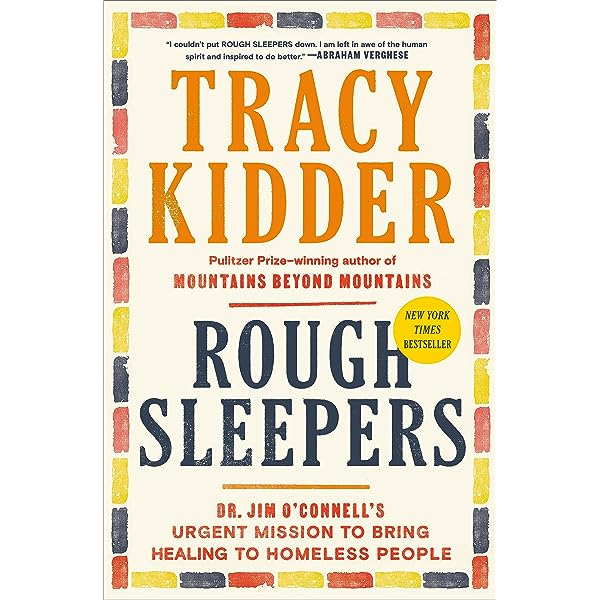
A colorful border of blue, red, and yellow bricks surrounds the author and title.

by Piyali C.

After graduating from Harvard Medical school and towards the end of his residency, Dr. Jim O’Connell, a brilliant and gifted man, was approached by the Chief of Medicine of Massachusetts General Hospital to help in an organization to provide health care for the homeless population of Boston. “Rough sleepers” is a British term for someone who is homeless and sleeps without adequate shelter or protection. Dr. O’Connell decided to defer a prestigious fellowship at Memorial Sloan Kettering hospital for a year to devote his time to developing the Boston Health Care For The Homeless Program, which, at the time, was primarily run by nurses. He was not convinced this was his life’s calling but he could not refuse his superior’s plea for help.

The first day he walked into the clinic at Pine Street Inn Shelter, he had his stethoscope around his neck. A nurse at the shelter, Barbara McInnis, asked him to put his stethoscope away and instructed him to soak the feet of the patients. While Dr. O’Connell did not understand the significance of the instruction at the time, he did what he was told. As he soaked each individual’s feet for several days, they gradually started opening up to him. The homeless population had an ingrained mistrust of physicians because they had been treated disrespectfully for so long. Once he put away his stethoscope, people slowly started telling him about their other ailments. Dr. O’Connell listened and treated but only if they were willing to be treated. He respected their choice about their own health.  

Thus began Dr. Jim O’Connell’s lifelong journey of providing not only medical care but friendship and respect for the human dignity of the homeless people of Boston, whom he encountered in his long tenure of providing medical care. Pulitzer Prize winning author Tracy Kidder followed Dr. Jim for five years as he rode his Street Team van to seek out individuals who needed medical attention on the streets. If not medical help, he handed out blankets, warm socks, a sandwich, Dunkin Donut gift cards, or hot chocolate. He offered treatment or shelter for a chilly night but always left the choice to the individual whom he was trying to help. He emphasized a style of medicine where the patients came first. The providers and the patients created a ‘circle of friends’. Throughout his career Dr. O’Connell viewed his patients in their totality. He heard their stories. He came to know they were incredibly brave, they were difficult, they were charming, they could be obnoxious under the influence of alcohol or substance abuse, and when the effect wore off, they were kind, clever and funny.  

This is one of those books that changed the way I thought about the homeless population. Each person I see living on the streets has a story. I had stopped seeing them in the true sense of the word. I was desensitized to their presence, often getting annoyed by their panhandling. After reading the book, I was aware of my part in perpetuating the process of robbing a person of dignity by not “seeing” them. 

Rough Sleepers is inspiring, thought provoking, and a beautifully written documentation of the lives of some individuals who have truly hit the rock bottom in life and those who are trying their best to help them and give them the human dignity that everyone deserves. 

Rough Sleepers by Tracy Kidder is available in print, e-book and e-audiobook formats. 

Piyali is an instructor and research specialist at HCLS Miller Branch, where she facilitates Light But Not Fluffy and co-facilitates Global Reads. She keeps the hope alive that someday she will reach the bottom of her to-read list.

Trail Dogs and Wildfires by Bob Roller

The cover photograph depicts a mountain wildfire burning trees in a forest, with smoke filling the sky but a patch of blue in the far distance.

Thu, Jul 13
7 – 8 pm
Miller Branch
Learn more and register here.

Trail Dogs and Firefighters: A Memoir from the Burning West is an enthralling story about Robert J. (Bob) Roller’s unexpected plunge into the intense world of trail “dogging” and wildland firefighting. The story brings to life the beauty of the American West, the community of interesting people who seek the danger of this lifestyle, and the bonds forged in this environment, in a way that only someone who lived through these experiences can describe.

Trail Dogs and Firefighters captures the dangerous early season efforts to clear isolated routes high in the Wyoming mountains, and it climaxes with a series of intense wildfires fought across the intermountain west.

This is the perfect book for anyone interested in the real lives of wildland firefighters or anyone who simply enjoys reading about people who rise to meet impossibly challenging situations by relying on their training, luck, and faith in each other.

Roller has deployed to wildfires, mass migrations, hurricanes, and pandemics. He is a Certified Emergency Manager, a Nationally Registered Paramedic, and a civilian graduate of the US Army’s Command and General Staff College. Roller was the vice president of Cabin John Park Volunteer Fire Department, where he has served as a firefighter, paramedic, and special operations swiftwater rescue technician, and he has also served on three mid-Atlantic mountain-rescue teams.

Brand New Book Club Alert!

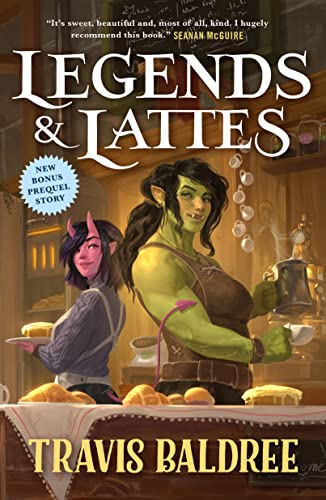
An illustration shows two female fantasy creatures making coffee, with a counter full of pastries in front.

Between the Lines
Third Fridays; 5 – 6 pm
Brewing Good at Savage Mill
Register for emails and updates.

by Sahana C.

Let me know if you can relate, but my attention span has been pretty garbage lately, to be frank. It makes reading harder, and it makes some of my old favorite genres, tropes, and go-tos feel tedious. It makes it hard to motivate myself, when there’s so much on streaming, and my phone is just barely out of reach.  

So recently, the best way I’ve found to get out of my reading slumps is to switch it up. And in the wake of world events over the past few years, I’ve been trying to intentionally read more diversely and to see as many different perspectives as I can through the books I choose. I’ve managed to read some really interesting things, venturing outside of my comfort zone (and it makes giving recommendations, a whole lot easier!). 

Something I love to do when I’m reading something I’m not familiar with, whether my lack of familiarity be related to genre or to the topics and themes in the book, is to try to figure out what in my life can relate. I always ask myself what exists in my life that mirrors this, or if there’s nothing that’s familiar, I try to learn as much as I can about the subject.  

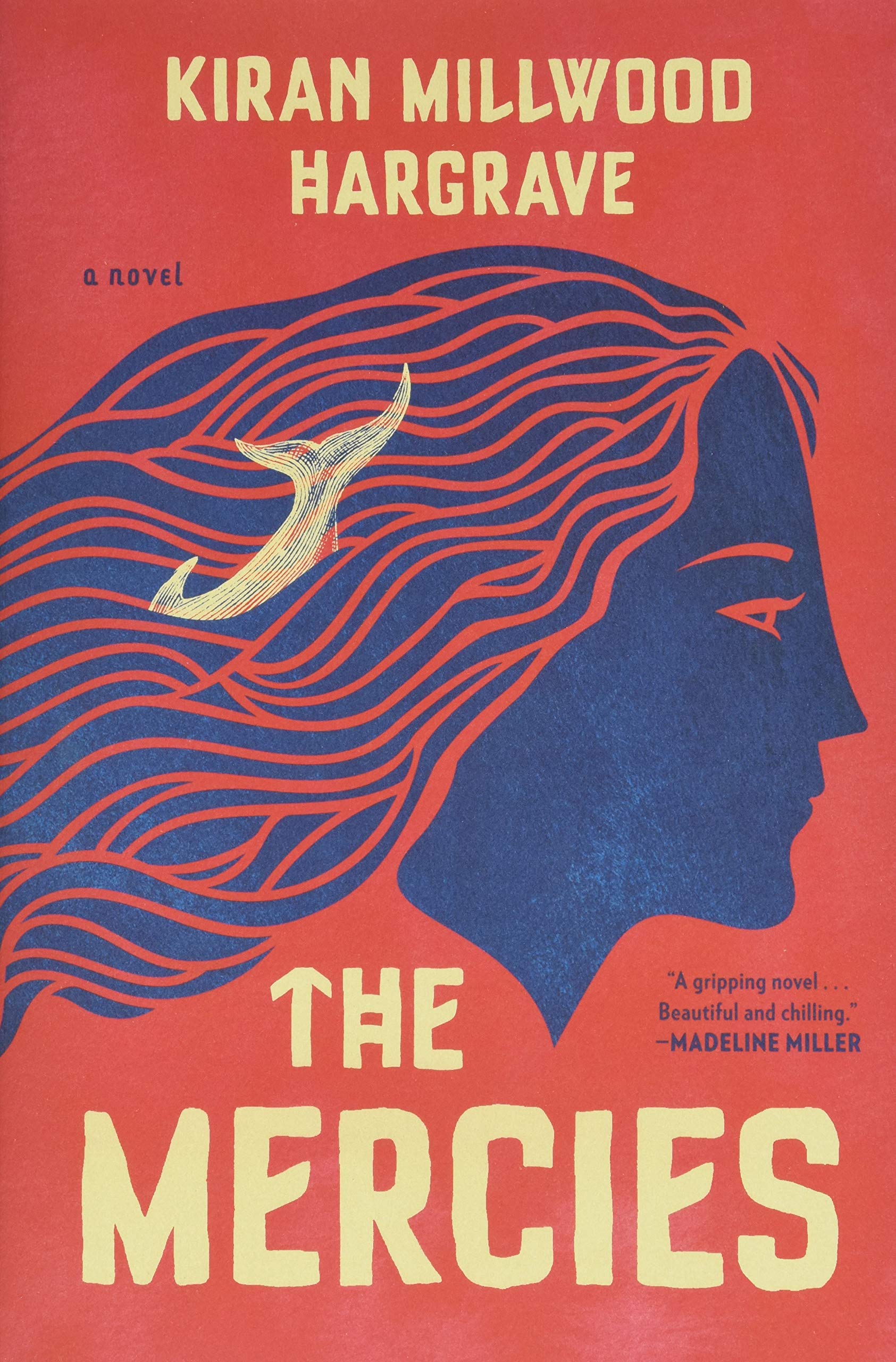
Against a red background, a blue block print of a woman's profile showls long har, with a fish tail embedded.

My favorite book of 2022, for example, was about sapphic Norwegian “witches” from 1621. The Mercies by Killan Millwood Hargrave gave me a lot of context to a witch trial I didn’t even know existed, as well as introduced me to the Sámi people, an indigenous group that spans Scandinavia. Shortly after, I read a cheesy friends-to-lovers novel that had me thinking about the romance in The Mercies all over again. I love doing stuff like that, and I know a lot of people who do, too. Here at the branch, we discuss it among ourselves, as staff, but we kept talking about how fun it would be to do as a book club.

Which is why we’re all here now! In this brand new book club, I’m really hoping that we can make connections. We’ll read books of all sorts, from sci-fi, poetry, historical fiction and romances, to nonfiction, biographies, then more fiction. I really want to discuss the similarities and differences, the intersections and identities, the ways that genre and form show up and make each work.  

Between the Lines is going to be hosted at Brewing Good, at the Savage Mill, and we’re incredibly excited for this partnership. It’s a fantastic setting for a book club, with the cutest café and sitting area. We’ll discuss our book of the month on the third Friday of the month, from 5-6, but come by a bit earlier to grab something to eat or drink, and we’ll settle in slowly.  

We’re kicking off with a fun one this summer: Legends & Lattes by Travis Baldree is about an orc who is done with all of the violence of her life and is ready to start a new life, opening up a coffee shop (are you seeing why we picked this book?) while trying to stay on her new path, regardless of distractions.  

Pick up a copy at the Savage Branch, read the e-book through Libby, or peruse the copies that are already at Brewing Good – either way, we hope to see you on July 21.  

Register for emails and updates.

Sahana is an Instructor and Research Specialist at the Savage Branch. They enjoy adding books to their “want to read” list despite having a mountain of books waiting for them already.

The Bright Ages

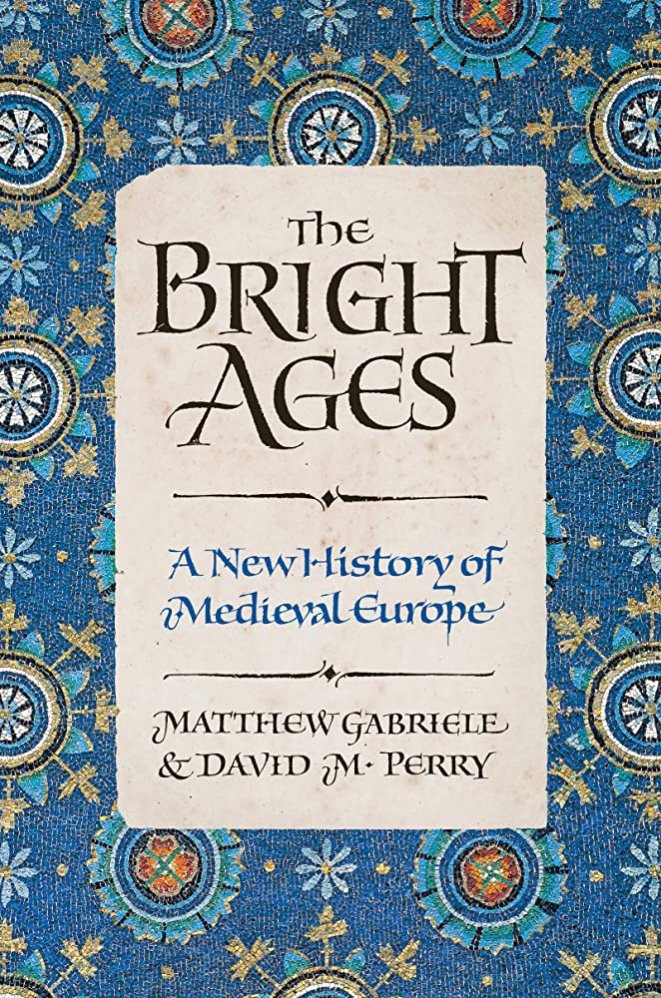
A blue brocade fabric surrounds a parchment-looking rectangle that has title and author in a calligraphic typeface.

by Tony B.

The Bright Ages by Matthew Gabriele and David M. Perry tries to shed some metaphorical light into the historical era many have been taught to call “The Dark Ages.” Characterizing early medieval Europe as “Dark” is mostly a reference to the fall of Rome and the end of Pax Romana. The authors challenge that notion, as the Eastern Roman empire in Constantinople was still, at least to its inhabitants, Roman. This particular argument of The Bright Ages is its most well delivered, but from there, things get iffy.

So why Bright over Dark? It is really easy to consign the messier parts of European history – between Enlightenment highs and the idealized Classical – to a lesser status. Instead, by delving more intimately into Medieval lives, you can find the light of stained glass cathedrals, golden relics, and deep acts of charity, but also the hotter fires of politics, rebellion, and warfare. The goal should aim to examine both for a more nuanced, holistic view of an era.

However, The Bright Ages tends to be a bit cherry-picked for the particularly bright or positive aspects of Medieval society. While it is wonderful that examples delineate traditionally marginalized people showing agency and influence, they tend to be the exceptions that prove the rule and not indicative of a broader norm. The author’s favorite example, the remarkable life of Galla Placidia, was just that, remarkable, and not indicative of all medieval women’s sense of agency. This tendency for forced historiography pervades The Bright Ages, though the overall idea of challenging “The Dark Ages” is valid.

One of the book’s main positive points is that it challenges readers to rethink some of the knowledge we take for granted about Europe’s Medieval period. For instance, the early Medieval world was a lot more connected than many assume. As the authors point out, an elephant from the Congo Basin made its way to the court of Charlemagne in Aachen, Germany, as a gift from the Abbasid Caliph in Baghdad to the newly crowned Emperor of the Holy Roman Empire. However, the authors tend to skip over the bad that comes with the good, like the taking of war slaves or the horrors of the Crusades.

While it toes the line between academic and popular historical writing, the book did itself no favors by omitting notes and sources. Overall, The Bright Ages posits an interesting idea and is one of many voices challenging “The Dark Ages,” but it can be a bit incongruous and sparse on evidence.

Tony is a Customer Service Specialist at Elkridge Branch. He has a degree in history and a perpetual interest in Medieval Europe.

Between Two Kingdoms: A Memoir of a Life Interrupted by Suleika Jaouad 

by Piyali C.

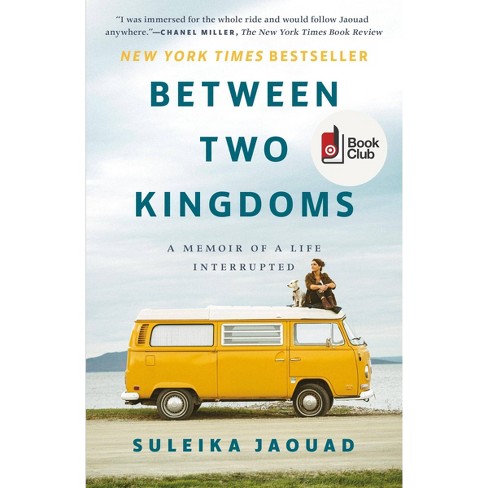
A woman and her small white dog sit atop a VW camper/bus

“I used to think healing meant ridding the body and heart of anything that hurt. It meant putting your pain behind you, leaving it in the past. But I’m learning that’s not how it works. Healing is figuring out how to coexist with the pain that will always live inside of you, without pretending it isn’t there or allowing it to hijack your day. It is learning to confront ghosts and to carry what lingers. It is learning to embrace the people I love now instead of protecting against a future gutted by their loss.” (P.312) This passage from Suleika Jaouad’s inspiring memoir, Between Two Kingdoms: A Memoir of a Life Interrupted, resonated so much with me that I had to write it down. 

At the tender age of twenty-two, when Suleika’s peers were looking forward to their futures, she was diagnosed with leukemia with a 35 percent chance of survival. It started with an intolerable itch all over her body, followed by mouth sores and extreme fatigue. When the diagnosis came down like a heavy anvil, she was, understandably, shattered. Thus began a tremendously painful journey of chemotherapy, clinical trials, a bone marrow transplant, waiting for biopsy results, and interminably long stays at the cancer ward in hospitals. During those stays, Suleika felt she had limited time left on this earth so she decided to do something meaningful while she still could. After her anger at the unfairness of her fate dissipated some, she took up writing blogs geared towards young adults suffering from cancer. The New York Times published her blogs under the column Life, Interrupted. She got an outpouring of letters and emails of support from people from various parts of the country.  

After three years of painful struggle, her cancer finally went into remission. However, Suleika discovered that she did not know how to come back to a life without cancer – the kingdom of healthy people. She found herself at a junction where she needed to relearn how to integrate into regular life again. Such a close brush with her mortality made her aware that life is much more than what she had envisioned at twenty-two, before she got sick. Like any young adult, Suleika had hoped for a successful career and love. After her remission, her definition of success changed. She adopted a puppy, Oscar, borrowed a friend’s car, learned to drive, and embarked upon a 100 day, 15,000 mile road trip across the country to meet with some people who had sent her letters of love and support when she was sick. 

Between Two Kingdoms: A Memoir of a Life Interrupted is about Suleika’s fight against cancer, and so much more. It explores what living truly means and how to emerge to the other side of pain stronger with a clearer vision of the meaning of life. This book is about new beginnings. 

We read books for many reasons. Personally, I love reading because books teach me empathy. They allow me to understand that everyone is fighting their own battle and I need to extend grace. In this particular book, Jaouad’s struggle against cancer was painful to read, however, I drew inspiration from her resilience, her fierce determination to win, her understanding and respect for other people’s pain, and by the love and support that held her up. The love came not only from her immediate family – her parents, brother, boyfriend, friends but also from complete strangers who never met her. The innate goodness of humanity shone brightly in this memoir, and it gave me hope. 

Between Two Kingdoms: A Memoir of a Life interrupted by Suleika Jaouad is available in book, e-book, and e-audiobook formats.

Piyali is an instructor and research specialist at HCLS Miller Branch, where she facilitates Light But Not Fluffy and co-facilitates Global Reads. She keeps the hope alive that someday she will reach the bottom of her to-read list.

Orwell’s Roses by Rebecca Solnit

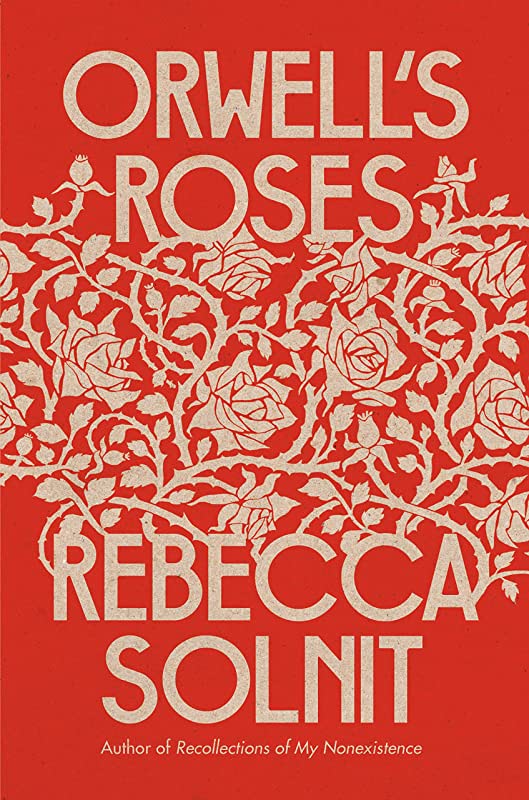
A deep red cover is illustrated in beige with twining roses, full of blooms and thorns. The title works into the top and the author's name at the bottom.

One of the pleasures of reading Orwell’s Roses is its unexpected turns from one subject to the next. – NPR

by Kristen B.

Do you enjoy tangential conversations? Where you’re not sure how you discussed so many things in one sitting? Have I got a book for you! Orwell’s Roses by Rebecca Solnit contains loosely connected essays that meander through several subjects. She recounts her global travels and wide-ranging interests, examining them all through the lens of George Orwell and his love of green and growing things. Every section starts with a variation of the sentence, “In 1936, a writer planted roses.”

Of course, the writer in question is Orwell himself, who planted a garden that contained roses at the rural cottage where he and his wife were living. The biographical bits about him include his family’s privileged background, its more recent impoverished status, his early life in India and Burma, and his latter life retreat to the remote, Scottish island of Jura. His dedication to socialist causes led him to volunteer in the Spanish Civil War, fighting against Franco. He was seriously injured, and the entire experience informed much of his early writing. Orwell suffered his entire life from weak lungs, complicated by his time in both sub-tropical countries and a period spent destitute in Spain. He eventually died of tuberculosis at the age of 46. He left a legacy of prescient writing, decrying the evils of totalitarianism, but he considered his gardens and roses equally important, as revealed in some of his journalism.

Solnit’s chapters move among these facts, linking them with socialism, coal mining, art in Mexico, Soviet politics, and the rose-growing industry in modern Colombia. She actually travels to Bogota and finagles a rare tour of a flower factory. Another chapter discusses British portraitist Joshua Reynolds and Orwell’s family pedigree, which connects to anti-colonial discourse about the Empire’s reliance on Caribbean sugar and its slave economy. Which, in turn, returns her to the notion of “genteel nature,” where the wealthy and titled classes had their fashions evolve from structured, manicured gardens to more relaxed, wild cottage gardens. At the same time, she considers how the ancient custom of holding land in common disappeared with the advent of enclosure laws and how that affected lower classes. This, in turn, returns her thoughts to Orwell and his roses.

The entire book reads in this sort of overlapping, interleaved, circular fashion: much, I suppose, in the manner of rose petals. It’s all interesting, and I enjoyed the interwoven ideas. But it does seem a little disjointed at times. While Orwell and roses act as the connective threads, the book serves more as a social and historical review of certain strains of thought. I am not a regular reader of nonfiction. The ever-changing discussion worked in my favor, as there was always something new just a few pages away. It also inspired me to put both Orwell and Solnit on my future reading lists.

Orwell’s Roses is available from HCLS in book format and also as an e-book and e-audiobook from Libby/OverDrive.

Kristen B. is a devoted bookworm lucky enough to work as the graphic designer for HCLS. She likes to read, stitch, dance, and watch baseball in season (but not all at the same time).