My Friends by Fredrik Backman

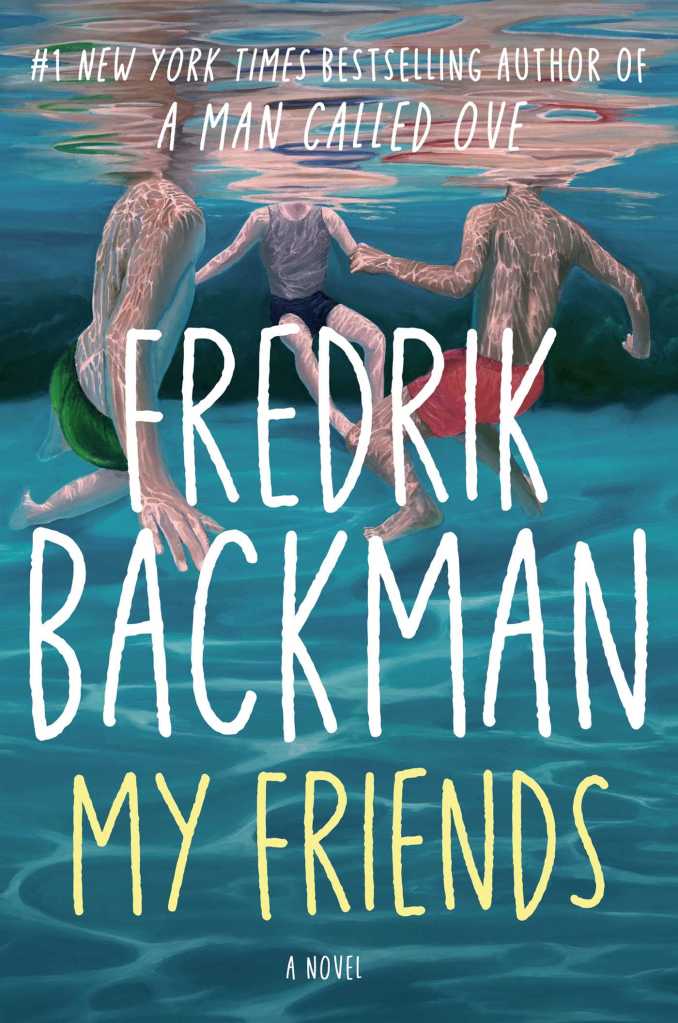
A sort of underwater shot, but illustrated, of three people in a swimming pool - three men in standard bathing trunks. Type treatment of title and author in the usual skinny handwriting style of Backman's books.

Our next chapter starts soon when the blog moves to the newly redesigned hclibrary.org. All the same great reviews and news, plus more library information!

by Kim J.

Once I read my first Fredrik Backman book, I couldn’t stop. I devoured each of his titles in quick succession and recommended them to anyone who would listen. Each of Backman’s books is a snapshot of humanity: character-driven stories that weave together timelines and perspectives with honesty and emotional depth. While reading his novels, I laugh, I cry, and sometimes I laugh until I cry. His characters feel so real that I become genuinely invested in their lives, making it bittersweet when their stories end. One of my favorite parts of reading Backman is his gift for language. His turns of phrase are fresh, ringing true and making me marvel at the mind that created them. 

Some favorites: 

  • “A lack of self-confidence is a devastating virus. There’s no cure.” – My Friends
  • “Boats that stay in the harbor are safe, sweetheart, but that’s not what boats were built for.”   – Anxious People
  • “Having a grandmother is like having an army. This is a grandchild’s ultimate privilege: knowing that someone is on your side, always, whatever the details.” – My Grandmother Asked Me to Tell You She’s Sorry

When I heard Backman had a new book out this year, I immediately added myself to the holds list. My Friends is the newest addition to Backman’s repertoire, and it did not disappoint. One of the main characters, Luisa, is a 17-year-old who has run away from her latest foster home. She loves art, and her favorite painting is about to go up for auction. She’s determined to see it in person at least once in her life. While she’s excellent at making plans, life has a way of surprising her. Her story is interlaced with the backstory of how her favorite painting came to be. What follows is an adventure filled with creativity, love, grief, friendship, found family, inside jokes, and storytelling. I highly recommend My Friends if you like humor, heartfelt depth, and a warm, bittersweet ending. However, it does need some content warnings: the story touches on several heavy topics including domestic violence, sexual assault, physical abuse, and bullying. In the end, it’s a story that stays with you long after you turn the last page. 

While you may have to wait for My Friends (available in print, large print, e-book, e-audiobook), you can explore other equally wonderful titles by Fredrik Backman: 

Anxious People 

Beartown Trilogy: Beartown, Us Against You, The Winners 

A Man Called Ove 

My Grandmother Asked Me to Tell You She’s Sorry 

Britt-Marie Was Here 

Kimberly J is an Instructor and Research Specialist at the HCLS Glenwood Branch. She enjoys reading, photography, creating, crafting, and baking.

Get Crafty at the Library

Students at a library painting class sharing smiles.
Students practice painting from observation during a class at HCLS Savage Branch.

by Emily B.

Searching for a cool and creative way to beat the heat this summer? Look no further than your local library, because summer fun at the library isn’t limited to kids and teens! At most of our branches, we offer art- and craft-related series classes. These classes are an opportunity to practice different crafty techniques and create something that you can take home, all in a supportive and welcoming environment. Each branch offers a unique spin.

At HCLS Miller Branch, Mindful Making emphasizes the meditative aspects of creativity. Adult Instructor Holly creates a relaxing and low-pressure class environment with cozy lighting and relaxing instrumental music. She purposefully selects activities that incorporate simple steps and repetition, to allow you to de-compress while engaging in creative practice.

At HCLS Glenwood Branch, Adult Instructor Kimberly makes use of the branch’s makerspace and its tools. Her classes offer a hands-on opportunity to learn about and use different DIY and crafting tools, like the laser cutter/engraver or the Cricut, and are a great introduction to the makerspace’s offerings. Kimberly remarks that attendees often return to the makerspace after her classes, ready to put their newfound knowledge to work.

At HCLS Central Branch, my colleagues, Roslyn and Mikki, and I offer Craft Works twice a month. Each month, we feature a different project. Our strive to create a welcoming environment for adults to express their creativity. One of my favorite features is how supportive and encouraging everyone is. Oftentimes, as the class winds down, our attendees take time to admire each other’s projects made during the class.

Visit howardcounty.librarycalendar.com for more details and to register for the classes on this page and the next, as well as many others.

RANDOM CRAFTS OF KINDNESS
For adults. Register at bit.ly/rcok
Learn to create something new, spend some relaxing time making art and crafting with your neighbors, and share your creations with other community members in random acts of kindness. All supplies provided.
Water Color Bookmarks: Create watercolor bookmarks for National Watercolor Month.
Sat, Jul 13 at 3 – 4 pm | Savage Branch
Cyanotypes: Take advantage of the harsh sun of August by making Cyanotype art and applying them to office supplies.
Sat, Aug 10 at 3 – 4 pm | Savage Branch

CRAFT WORKS
For adults. Register at bit.ly/craftworks_central
Let your creativity shine in a relaxed and welcoming environment. Each month, learn about different art media and explore new techniques.
July: Pressed Flower Sun-catcher
Tue, Jul 23 at 7 – 8:30 pm | Central Branch
Thu, Jul 25 at 2 – 3:30 pm | Central Branch
August: Resin Bookmarks
Tue, Aug 20 at 7 – 8:30 pm | Central Branch
Thu, Aug 22 at 2 – 3:30 pm | Central Branch

ART IN THE AFTERNOON & EVENING
Explore new artistic themes or media in a relaxed, welcoming environment. Create art inspired by the wildlife and scenery of the Chesapeake Bay. Choose from a variety of projects.
Chesapeake Bay Art Workshop
Tue, Aug 20 at 7 – 8:30 pm | Elkridge Branch

MINDFUL MAKING
Cyanotype Prints
Slow down with us at Mindful Making, where we focus on process over product and discover the meditative benefits of simple acts of creation. In August, we create cyanotype sun prints. All materials provided.
Thu, Aug 1 at 7 – 8 pm | Miller Branch

SEWING SKILLS
How to Repair Clothing
For adults. Register at bit.ly/diy_repair
Learn the basics of clothing repair to extend the lifetime of your clothing, including how to restitch a seam, repair hems, and patch tears. Some prior experience with using a sewing machine recommended.
Wed, Aug 14 at 7 – 8:30 pm | Elkridge Branch

Veterans Creating Art

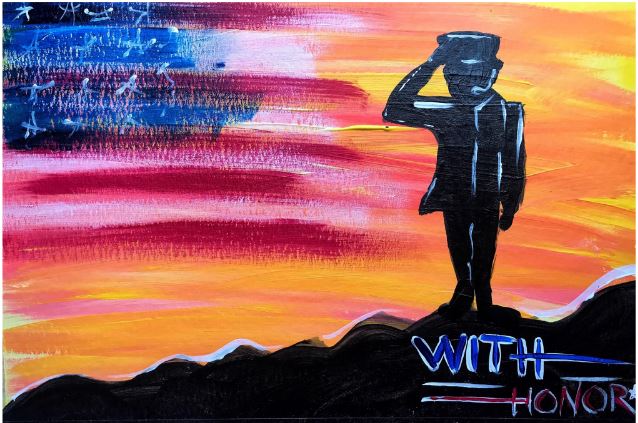
A painted illustration with a saluting soldier in silhouette against a sunset, with the suggestion of the American flag blending into the colors of the sky.

Colors of Courage: A Guided Painting Class for Veterans (with ArtJamz)
For veterans. Register.
Looking for a unique way to express yourself and connect with fellow veterans? Consider this veteran-focused guided painting class that offers a chance to connect with other veterans in a supportive and nurturing environment. Enjoy the opportunity to socialize and bond with other veterans, fostering a sense of camaraderie and support.
Wed    Nov 8  6:30 – 8:30 pm   Elkridge

Romare Bearden: Artist, Activist, Veteran
by Emily B.

Artist Romare Bearden was born in North Carolina in 1911 and moved to Harlem a few years later as part of the Great Migration, which saw approximately 6 million African Americans leave the southern United States for industrialized areas with less hostility and prejudice. Bearden’s mother Bessye was a prominent civic activist, and their Harlem home hosted notable cultural figures like Duke Ellington and Langston Hughes. This intersection of activism and artistry would prove influential to Bearden and his life’s work, but not before a quick detour into America’s favorite pastime.

While attending college in Boston, Bearden became a baseball star. He pitched for his school’s team and the Boston Tigers, part of the all-black Negro Baseball League. He was offered a spot on Philadelphia Athletics, a Major League team, on the condition that he passed for white. Bearden rejected the offer and returned to New York, uncomfortable with hiding his identity. After graduating college, Bearden became a case worker for the New York Department of Social Services. He would continue in this line of work on and off to support his artistic passions, which he pursued most nights and weekends. He also spent a few years as a political cartoonist for the Baltimore Afro-American, a weekly newspaper (available at hclibrary.org > research).

During this time he joined the Harlem Artists Guild, a collective of Black artists that aimed to encourage young artists and foster an appreciation for art, while creating awareness of the issues faced by the community. Most of Bearden’s art during this period consisted of abstract paintings.
Between 1942 and 1945 Bearden was in Europe, serving in the all-Black 372nd Infantry Regiment of the US Army. Bearden returned to Europe in 1950, utilizing the GI Bill to study literature and philosophy and tour museums.

After returning from his studies Europe, painting felt stale to Bearden. He found inspiration in the Civil Rights Movement and mass media. He began creating collages, utilizing magazine clippings to create socially-conscious works of art. This artistic shift was well received, with his collages becoming his most iconic works. Prior to his death in 1988, Bearden created approximately 2,000 works of art across many mediums. While he is most remembered for his collages, his impact extends far beyond the art world.

Framed reproductions of his works “Carolina Blues” and “Jamming at the Savoy” are available to borrow from the Art Education Collection.

Emily is an Instructor & Research Specialist at the Central Branch. She enjoys puzzling, reading, listening to music, and re-watching old seasons of Survivor.

At the Intersection of Art and History

he Old Oak, Jules Dupré (French, 1811-1889) (Artist), 1845-1850, oil on fabric, Acquired by William T. Walters, 1883

by Rohini G.
With the objective of making art more accessible and engaging to every person in our community, we have built an extensive network with national art museums to bring art education and appreciation into our homes through the virtual Art Museum Series. If you are interested in bringing actual art into your home, you can borrow framed painting and photography prints from the Art Education Collection, available at Central and Glenwood Branches.

Renaissance and Baroque Portraits
For adults. Register for link to class.
Wed, Sep 20 | 1 – 2 pm
online

Art and history are often intertwined, as paintings can reflect the cultural, social, and political contexts of their time. Two examples of such paintings are the Portrait of Maria Salviati de’ Medici and Giulia de’ Medici by Pontormo and Balthazar by Rigaud.

The de’Medici portrait, painted around 1539, depicts Maria Salviati, the widow of Giovanni delle Bande Nere de’ Medici and the mother of Cosimo I, the grand duke of Tuscany, and Giulia de’ Medici, a relative of Maria who was left in her care after the murder of her father, Duke Alessandro de’ Medici. Alessandro was the child of a Medici cardinal and an enslaved African servant, making Giulia one of the first people of African ancestry in European art.

Next, we examine Balthazar, painted around 1700, who is identified as the youngest of the three kings who followed a new star to Bethlehem in Judea to pay homage to the divine child born under it. The kings are usually depicted as very grave but this Balthazar looks right at us with an open, friendly demeanor. This is most likely not simply one of three paintings of the kings as semi-historical figures but rather a portrait of a specific man who wished to be depicted as the magnificent figure of Balthazar.

Both these paintings are currently hang at The Walters Art Museum in Baltimore and demonstrate how art can capture not only the appearance but also the identity and history of its subjects. They also show how art can communicate across time and space, revealing stories and perspectives that might otherwise be forgotten or overlooked.

19th Century Landscapes
For adult. Register for link to class.
Wed, Oct 25 | 1 – 2 pm
online
Moving to the 19th century, we study landscapes and look at how artists used landscape painting to both reflect and shape environmental understanding. The Old Oak by Jules Dupré(1845-1850, and The Terrace at Saint-Germain, Spring (1875) by Alfred Sisley belong to the Barbizon school of landscape painting in France. Members came from different backgrounds and worked in a range of styles but they were drawn together by their passion for painting en plein air and their desire to elevate landscape painting.

image credits:

The Old Oak, Jules Dupré (French, 1811-1889) (Artist), 1845-1850, oil on fabric, Acquired by William T. Walters, 1883

Rohini is the Adult Curriculum Specialist with HCLS. She loves literature and rainy days.

Ernie Barnes: From Athlete to Artist

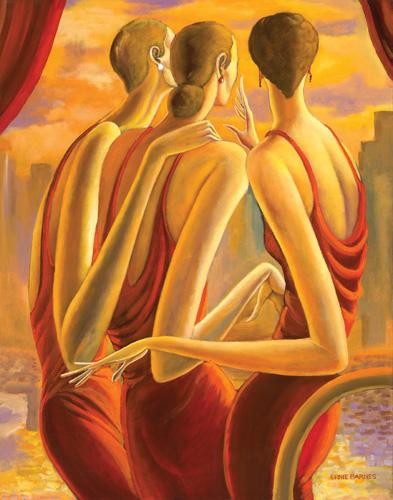
A painting by Ernie Barnes, The View, which showcases three African American women dressed in drapey formal dresses looking out at water and an urban skyline. The viewer only sees the women's elegant forms from behind as they are framed by red curtains. The palette is all golds and reds.
The View by Ernie Barnes

by Emily B.
Ernie Barnes was born in Durham, North Carolina in 1938, amidst harsh Jim Crow segregation laws. His love and appreciation for art was sparked at an early age. Young Barnes often accompanied his mother at work, where she oversaw the household of a prominent attorney. This early exposure to art proved to leave a lasting impact on Barnes.

Though art remained an important outlet throughout his early years, Barnes discovered a talent for football in high school. He attended college on an athletic scholarship (studying art, of course) and went on to play football professionally for five seasons. Much of his early work focused on his teammates. His athleticism had a marked influence on his art style, which was characterized by figures with closed eyes and elongated bodies. In an interview, Barnes recounted how a mentor told him “to pay attention to what my body felt like in movement. Within that elongation, there’s a feeling, an attitude and expression. I hate to think had I not played sports what my work would look like.”

After moving on from professional football, Barnes’ art became less sports-focused. He was often influenced and inspired by the communities and the people he interacted with most – ranging from depictions of Black Southern life (seen in pieces like Uptown Downtown and Each One, Teach One) to the Jewish community of Fairfax, California (seen in Sam & Sidney). Sugar Shack, far and away one of Barnes’ most popular paintings, has a storied history. The famous work, which depicts a jazz club packed with dancers, was painted in 1971 but reworked twice for famous clientele. First for use in the opening credits of Norman Lear’s Good Times and a second time to create a cover for Marvin Gaye’s album I Want You.

Though he passed in 2009, Barnes’ cultural impact lives on. His journey from a childhood in the Jim Crow-era south to becoming one of the first athletes with a celebrated career in art is impressive and inspiring. Several of Barnes’ paintings are available to borrow through the Art Education Collection at the Central and Glenwood Branches. Young readers may enjoy Between the Lines: How Ernie Barnes Went from the Football Field to the Art Gallery by Sandra Neil Wallace.

Emily is a Customer Service Specialist at the Central Branch. She enjoys reading, listening to music, and re-watching old seasons of Survivor.

The Walters Art Series 

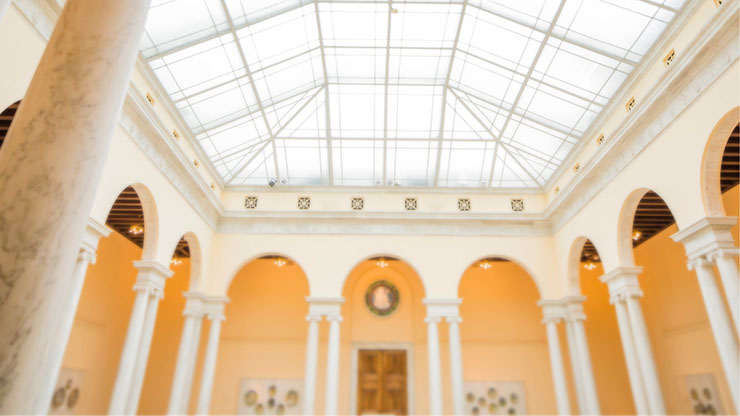
View of the atrium at the Walters Art Museum, filled with bright light, white columns, and creamy golden walls.
View of the atrium at the Walters Art Museum

by Rohini G.

This fall, and continuing into winter, Howard County Library System partners with The Walters Art Museum to bring an educational approach to art as we discuss specific works of art and the themes behind them. This series of four classes launches with The Art of Looking on October 13. Asking us to slow down and take the time to see the details, Docents Jill Reynolds and Bonnie Kind examine, analyze, and interpret artworks. Expertise gained through this session can be applied to the subsequent session on Symbolism in Renaissance & Baroque Art. The winter sessions will have an exciting and other-worldly feel as we explore Fantastical Creatures in sculpture and paintings. This will segue seamlessly into the fourth session on Chinese Ceramics, just in time to celebrate the Lunar New Year.  

Sign up for the series or individual classes that interest you. REGISTER  

The Art of Looking brings forth the concept of Artful Thinking. Developed by Project Zero, Harvard Graduate School of Education, this routine encourages students to make careful observations and develop their own ideas and interpretations based on what they see. By separating the two questions, What do you see? and What do you think about what you see?, the routine helps distinguish between observations and interpretations.

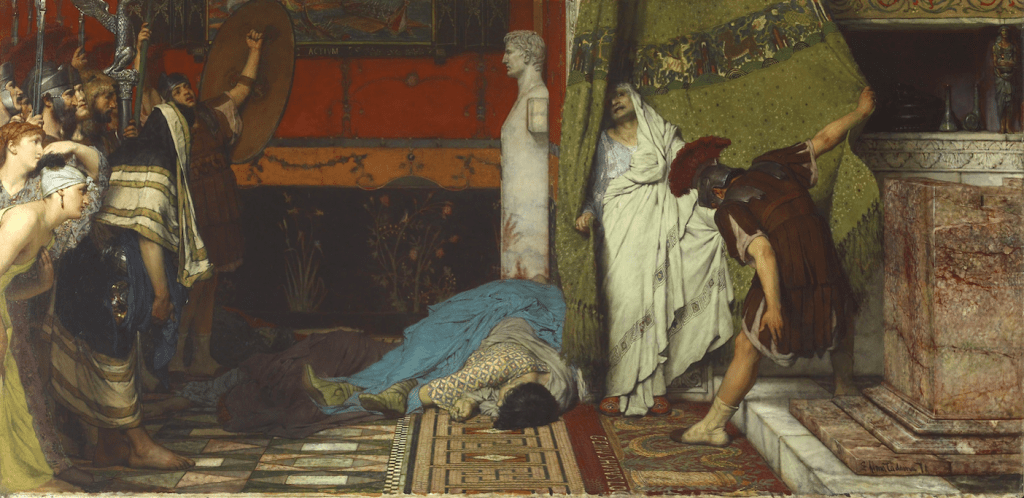
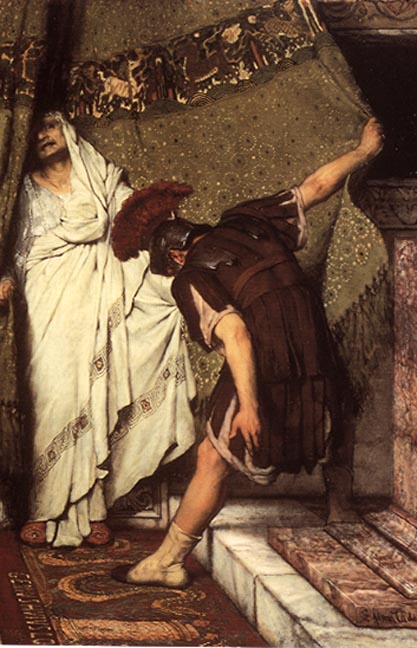
The painting depicts the aftermath of the murder of the emperor Claudius.  Gratus, a member of the Praetorian Guard, draws a curtain aside to reveal the terrified Claudius who is hailed as emperor on the spot.  Beneath the bloodtstained herm in the background lie the bodies of Caligula, his wife Caesonia, their young daughter, and a bystander.  Roman men and women are depicted at the left, overlooking the scene.
Image credit: Sir Lawrence Alma-Tadema, A Roman Emperor: 41 AD, 1871, oil on canvas. Bequest of Henry Walters, 1931, acc. no. 37.165. Courtesy of the Walters Art Museum. 

In this painting titled A Roman Emperor (Claudius), Sir Laurence Alma-Tadema OM RA (1836-1912), depicts the aftermath of a violent historical event. In AD 41, the debauched Roman emperor Caligula was murdered. Gratus, a member of the Praetorian Guard, draws a curtain aside to reveal the terrified Claudius who is hailed as emperor on the spot.  Beneath the herm in the background, lie the bodies of Caligula, his wife Caesonia, their young daughter and of a bystander. The blood stains on the herm* denote the struggle that has transpired as well as the setting, the Hermaeum, an apartment in the Palace where Claudius had sought refuge.

This detail from the painting depicts Gratus, dressed in the brown uniform of the Praetorian Guard, pulling back a green curtain with brown fringe and a white and brown circular pattern, to reveal the emperor Claudius behind the curtain.  Claudius is robed in white and his frightened face is half-hidden behind the curtain.  Gratus is bowing to him.
Image credit: Sir Lawrence Alma-Tadema, detail from A Roman Emperor: 41 AD, 1871, oil on canvas. Bequest of Henry Walters, 1931, acc. no. 37.165. Courtesy of the Walters Art Museum.

In the detail of the painting, we see Gratus pulling back the curtain that has hidden Claudius while bowing and the half hidden, scared face of the new emperor.

What a story!

Sir Laurence Alma-Tadema, the creator of this magnificent artwork, was one of the most renowned painters of late nineteenth century Britain.

Born in Dronrijp, the Netherlands, and trained at the Academy of Antwerp, Belgium, he settled in England in 1870 and spent the rest of his life there. A classical-subject painter, he became famous for his depictions of the luxury and decadence of the Roman Empire, with languorous figures set in fabulous marbled interiors or against a backdrop of dazzling blue Mediterranean sea and sky. One may add that this painting, A Roman Emperor (Claudius), differs from most in the artist’s œuvre.

Analyzing paintings and sculptures, their form, symbolism, ideas, and meaning creates a space to understand and interact with history at a deeper level. Bring your curiosity and questions to the experienced and knowledgeable docents Jill and Bonnie as we embark on this journey intersecting Culture and History.  

The Walters Art series:   

Wednesday, Oct 13 at 1 pm – The Art of Looking REGISTER.  

Wednesday, Nov 10 at 1 pm- Symbolism in Renaissance & Baroque Art  REGISTER. 

Wednesday, Jan 26 at 1 pm – Fantastical Creatures REGISTER. 

Wednesday, Feb 23 at 1 pm – Chinese Porcelain REGISTER. 

Rohini is the Adult Curriculum Specialist with HCLS. She loves literature and rainy days.

*Herm: a squared stone pillar with a carved head on top (typically of Hermes), used in ancient Greece as a boundary marker or a signpost

The Yellow House: Van Gogh, Gauguin, and Nine Turbulent Weeks In Arles

By Nina L.

We know them today as giants of art history, but in 1888 French artist Paul Gauguin had an estranged family, a background in financial trading, and limited artistic success. Vincent Van Gogh, a 35-year-old Dutchman, had failed miserably at several vocations before turning to art with the encouragement and financial support of his brother Theo.

The Yellow House, Van Gogh, Gauguin, and Nine Turbulent Weeks in Arles, by Martin Gayford, is an intimate and revelatory look at a time when Van Gogh and Gauguin lived together in a self-styled artist’s colony of two. They were an odd pair, full of contrasts – Gauguin cerebral, Van Gogh emotional, but both drawn to the idea of inventing a new art of the future. The book follows the events as they unfold day-to-day with granular detail.  Drawing on the copious letters of both artists, Gayford makes it easy to imagine being in the house looking on as the two men worked in the small, cramped, ten-foot wide studio filled with the heavy atmosphere of tobacco and turpentine.  

While living in Paris, Van Gogh dreamed of starting an artist’s colony in the south of France. He settled on Arles, a provincial town on the way to the Mediterranean coast. Both he and Theo admired Gauguin, enticing him to Arles with the offer of free room and board in exchange for his paintings.  Van Gogh, who later became the greater artist of the two, regarded Gauguin as a mentor and had high expectations of living and working together. In anxious anticipation of Gauguin’s arrival, he set about transforming the little yellow house, carefully choosing furnishings, brightening the exterior and interior with paint, and hanging his art work throughout the house, including his newly created Sunflowers. The first few weeks went well, with exchanges of ideas and daily painting trips to the surrounding countryside, but when the weather turned cold and rainy, spending all day in the small, cramped space didn’t bode well for the two large personalities.

By late December of 1888 the relationship was fraying and Gauguin considered returning to Paris. On December 23rd, while feverishly working on a painting, Van Gogh suffered a mental attack and cut off part of his ear with a razor. He then wrapped the ear in newspaper and took it to a local brothel with instructions to give it to one of the women. Gauguin, alarmed at Van Gogh’s deteriorating state, had spent the night in a hotel. Returning to the house the next day he discovered a trail of blood and Van Gogh deep asleep in bed with no memory of the previous night. The traumatic events ended the dream of living and working together. Gauguin left for Paris, later moving to Tahiti, never to see Van Gogh again. For the rest of his short life Van Gogh struggled with mental illness, which Gayford attributes to bipolar disorder, gaining fame only after his death.

After reading the book, I found myself looking at the world differently, imagining how Van Gogh or Gauguin would see it. One of Van Gogh’s breakthroughs was in placing contrasting colors side by side. Placing colors together which are opposites on the color wheel creates a visual frisson, or what Van Gogh called electricity. He even had a box of yarn to test out color combinations before using his paints.

Interested in creating art work in the style of Van Gogh? Here is a project suitable for any age. Take some time to look at one of Van Gogh’s paintings, such as A Starry Night. Use a blue or gray colored pastel or construction paper along with chalk pastels in white, yellows, oranges, blues, and purples. Black can be added as an accent. Lightly sketch in your own version of A Starry Night. Look at how Van Gogh painted the wind, winding around the canvas, or the stars radiating out as if glowing. Working from dark to light, use thick, short broken strokes and follow the contour of shapes, repeating the pattern over and over until filling the composition. You may find yourself seeing the world just a little bit differently.

Did you know? You can even borrow a framed print of a Van Gogh painting or one from Gauguin via the HCLS Art Collection.

Nina L. is a Customer Service Specialist at the Miller Branch of HCLS. She loves art, yoga, dogs, cats, and reading horizontally.