Joan is OK

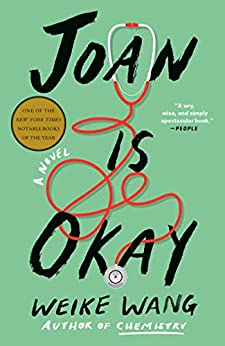
The book cover shows the title in black lettering against a pale green background, with a doctor's stethoscope in silver and salmon tones coiled through the letters of the title.

By Gabriela P.

When we meet Joan, the titular heroine of Wang’s novel, the first assessment might be that her story starts where others potentially end. She has everything: she’s in her mid-thirties, living in Manhattan, and a brilliant attending I.C.U. physician. She is ticking off her American Dream checklist, seemingly without a hitch. Having grown up in California with poor immigrant parents, Joan views professional success as a great equalizer. “The joy of having been standardized,” she says, “was that you didn’t need to think beyond a certain area. Like a death handled well, a box had been put around you, and within it you could feel safe.”

But is Joan, or Jiu-an, OK? Of course she says she is. After all, doesn’t she tell her coworkers so everyday, during their brief and polite interactions? Yet they never feel connected with her and would be the first to doubt her response as genuine. While there is concern from some, as when Human Resources reaches out over her excessive shifts, there are also those who delight in her seemingly irreplaceable work ethic. The hospital director calls Joan, “a gunner and a new breed of doctor, brilliant and potent, but with no interests outside work and sleep.” In the first few pages we spend with her, upon receiving news of her father’s death, she flies to Shanghai for the funeral and back in only 48 hours.

Joan’s wealthy older brother, Fang, thinks she needs to give up the Upper West Side for the safety of the suburbs and start a private practice. His wife, Tami, thinks it’s high time Joan gets married and starts a family, because, “a woman isn’t a real woman until she’s had a child.” Her mother fails to connect with her through shopping, and even her neighbor is a habitual overstepper. To everyone in her orbit, Joan is someone who has to be taught how to live.

But as the story progresses, Joan ends up having to reflect on her obsession with productivity as she takes a hard look at her relationships to family and society. “Was it harder to be a woman? Or an immigrant? Or a Chinese person outside of China?,” she asks herself. “And why did being any good at any of the above require you to edit yourself down so you could become someone else?”

The developing Covid pandemic looms over the few months we spend with Joan, which impacts her personally as well as professionally. Wang details the news coming out of Wuhan and elsewhere matter-of-factly — increasing case counts and deaths, border and business closings — sparking a sense of dread in readers who know all too well what’s coming. Joan deadpans: “Some government officials also believed that it was important to keep the American people informed and reminded of where the virus really came from. So, the China virus, the Chinese virus, the kung flu.” Online she starts to see, “clips of Asian people being attacked in the street and on the subways. Being kicked, pushed and spat on for wearing masks and being accused of having brought nothing else into the country except disease.”

Joan is angry. If there is one thing that Wang knows is important for her character, it’s to keep her emotions unmuted to the reader. While cool on the surface, Joan bubbles underneath. Her deeper self only seeps through via dry comebacks that leave others chuckling uneasily.

So Joan probably isn’t OK. She’s a bit awkward, tense, and has complicated relationships with family as well as an affinity for work that others can’t seem to wrap their heads around. But Wang gives us a character so unapologetically true to herself that you can’t help wanting to get to know her, even when it’s pretty clear that she wants nothing more than to be left alone.

Wang’s narrative poses subtle questions about belonging and the definition of “home.” There are moments of unexpected tenderness and reminders of the devastating toll the pandemic had on communities and the individuals within them. And of course, the reader has to ask themselves at the end whether anyone is really OK, and if it’s such a bad thing to be.

Gabriela is a customer service specialist at the Miller Branch. She loves long walks, reading with her dog, and a good cup of coffee.
Pandemic Reads

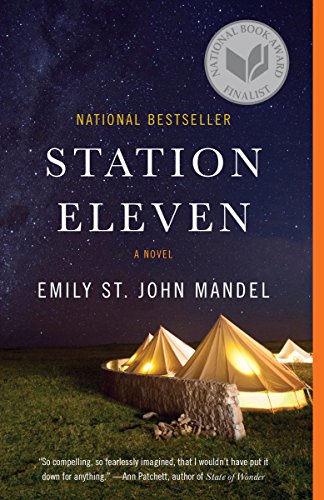
Against a deep blue night sky, light glows within canvas tents set against a stone wall.

By Eric L.

If you’re reading this, you probably like books. And you may, like me, find and pick stories to read that you can relate to irrespective of time and place. That said, thanks to the fantastic members of my HCLS book discussion group (Read. Think. Talk. First Monday of the month at 7 pm) for suggesting Station Eleven by Emily St John Mandel (also an ebook, eAudiobook, and an audiobook on CD) and The Plague by Albert Camus (also an eAudiobook). We discussed the former title as a group and it made for a good conversation.

I tend to want to know about the human experience, although some things are just too sad right now. To be sure, both of these books are sad, but I’ve definitely read more melancholy stories. What’s more, I’d contend these reads put the global pandemic in perspective. So, if you feel as though you’re up to it, I recommend these titles (I can completely understand if you’d prefer not to read about plagues and pandemic.).

Station Eleven was a good book, a suspenseful page turner with many likeable characters and some interesting commentary on the modern world and celebrity. It is scheduled to be an HBO miniseries, but unfortunately the filming was stopped due to the pandemic. Emily St John Mandel’s latest book (The Glass Hotel) made President Obama’s Best of 2020 list.

A nonlinear story, the book recounts a much deadlier and contagious flu from the outbreak to the post-apocalyptic world that remains after much of the population and civilization are wiped out. The story revolves around an aging actor and his tangential relationships. The characters include his two ex-wives (one of whom is a shipping executive/comic book artist and writer), a self-declared prophet, his business consultant best friend, a paramedic, a child actor, and a Shakespearean acting troupe and symphony traveling around the Great Lakes region of North America. The individual daily experiences told from the perspectives of these characters, pre, during, and post the pandemic, are compelling. Moreover, their individual stories intersect in creative ways. 

As mentioned before, I will concede that Station Eleven has some disturbing parts. For me, and probably for most American readers existing in relative comfort, the transition from the modern world to a more primitive existence is frightening. In some ways the inability of society to stop the unraveling seems improbable, but not impossible. I do think a cursory analysis of what holds society together can be a bit horrifying. 

After completing Station Eleven, I really wanted to read The Plague by Albert Camus. Camus is known as a philosopher of sorts, although he denied being an “existentialist,” he is perhaps an “absurdist.” Put simply, Camus’ books examine the random aspects of human existence but not in as overly academic way. Instead, I’d contend he uses fiction to spin a thoughtful tale. I’ve read The Stranger and The Myth of Sisyphus, and I recommend both, but The Plague is particularly apropos right now. 

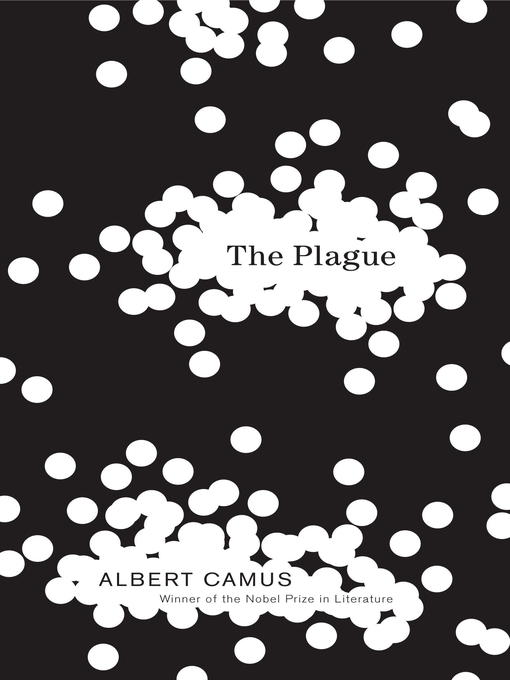
A stark black background is covered with scattered white dots, some of which merge to form larger spaces where the title and author's name appear.

The Plague describes the beginning of an outbreak of a plague in a small coastal town that is too busy to be bothered with such things. The story gets much deeper into the actual outbreak and day-to-day management of the plague from the perspective of a narrator whose identity is only revealed in the end (I found this interesting). 

The reactions of the characters to the plague vary and are indicative of human feelings throughout time. For example, one character is determined to break the law and escape the quarantined town to be with a loved one. Camus adroitly addresses the feelings we all share to some extent, immortality, and that need to believe that it won’t happen here, happen to me, etc. These sentiments shape our collective response to situations like a pandemic. This is in no way an indictment, but rather a recognition of human nature. I certainly recalled my similar reaction to other epidemics, and I assumed the Coronavirus would unfold for me in a similar way. That is, abstract, contained, and impacting other people, but not my daily life. 

Camus’ idea is that terrible things, such as plagues, are inevitable. Moreover, we are all susceptible to some random demise. My favorite character in Station Eleven, Clark, recognizes this fact and angrily points it out to religious zealots who believe they’re in some way chosen because they survived. I don’t think it’s healthy for us to ruminate about the fact we could cease to exist at any minute. (It is odd that Albert Camus met what he would’ve described as an “absurd” end in a car crash at age 46.)  Perhaps living through these things, will enable us to remember and collectively take it more seriously, sooner. Some contend that Camus’ recognition of the fragility of humans and society is to engender a kinder world. 

So as not to end this post on a very depressing note, I believe both authors are optimistic about humanity. Camus and Mandel both highlight the joy that comes from being with each other and the many pleasures of life. They describe the simple pleasures of swimming, dancing, art, friendship, dogs (I certainly love all these things). These are the things that keep the characters from giving up despite grave circumstances. Conversely, both authors astutely highlight the things that perhaps we deem important, but really are not. 

Here’s hoping I’m reading and writing about books concerning rainbows next year! 

Eric is a DIY Instructor and Research Specialist at HCLS Elkridge Branch. He enjoys reading, films, music, doing nearly anything outside, and people.

Intimations by Zadie Smith

The book cover shows a gray hallway with slotted windows and light coming through them to land on the floor and the opposite wall, which curves away from the viewer toward a dark entryway.

By Eric L.

I recall the first time I read something in the New Yorker by Zadie Smith nearly a decade ago. It was a nonfiction story about Joni Mitchell entitled “Some Notes on Attunement: A Voyage Around Joni Mitchell.” It was a nonfiction personal reflection about how she, a woman of color, had no interest in the music of a white folk singer, who on the surface would have nothing at all in common with her despite her friends’ incredulous responses concerning her cluelessness.

Smith describes how she realized her youthful stubbornness and closed-minded self as the culprit. The essay was about her own change and growth and the change of Joni Mitchell as an artist (she is pretty great by the way). Probably much like all people that love books, artists, writers, and the like, I felt a connection to Zadie Smith. I liked her style, her attitude, and her contemplative nature. And I can certainly relate to the glib rejection of things I didn’t think were for me. I subsequently realized we’re the same age, although other than that, we are very different on the surface I may not have guessed her writing was the sort of thing I’d love, but I do.

At any rate, her new essay collection, Intimations, is a book of very short essays written just prior to and during the beginning of the Coronavirus pandemic. The essays include the commonplace and ordinary events of everyday life, set into a broader, more abstract context. Obviously, I have a bias in this matter, but her essays and style are perfect for this moment. Smith’s ability to relate everyday individual experiences into a much more abstract concept is nonpareil. I found the essays particularly poignant now that I miss, and have ample time to ruminate about, the quotidian things of my pre-socially distant life.

There is an essay about our desire, or our need, to fill up time with things to do. One entitled “Suffering Like Mel Gibson,” (I’m a sucker for a strange title) that is hardly at all about the actor. Instead, it’s a piece about suffering and privilege, and how we ought to consider these separately, and not discount the feelings of others. Smith even describes the moment when she recognized her own class privilege. She has a series of very short character sketches about the people in her neighborhood and their respective reactions to the looming pandemic in America. “Peonies” is a very entertaining piece about flowers, control, aging, being a woman, and the coronavirus. The penultimate essay, “Postscript: Contempt as a Virus,” is arguably the best: it begins with a description of the global pandemic, her experience in England (where she has gone after leaving New York), and “herd immunity,” then gets into the murder of George Floyd and racism as a virus we all spread and suffer. It’s a masterfully done and moving piece. All the essays are excellent, but this one alone is worth picking up the book.

Since that first essay, I’ve read almost all of her essays. However, I must admit that I liked, but did not love, her most famous fictional work, White Teeth. No matter; for me, she excels in the essay genre. I’d highly recommend Grand Union and Feel Free (which includes a great story about a library), as well.

Smith’s ability to display so much humility and not only admit, but describe in detail, her foibles and ignorance is something I really respect. Perhaps this is the very opposite of the cultural atmosphere in the United States.

Intimations is available at HCLS in print, in large print, and in eBook and eAudiobook format through OverDrive/Libby.

All royalties Smith earns from this book are donated to The Equal Justice Initiative and The COVID-19 Emergency Relief Fund for New York.

Eric is a DIY Instructor and Research Specialist at HCLS Elkridge Branch. He enjoys reading, films, music, doing nearly anything outside, and people.

A Community Memorial for the Covid-19 Pandemic

A black silhouette of a bare tree sits on a blue background, with red letter that read "Remembrance Trees" and a white ribbon with a message on it.

HCLS and InLACE, the Initiative for Latin American Community Engagement, are partnering to offer Remembrance Trees, a community memorial for the Covid-19 pandemic from Dec 9 – 21, and Remembering Together, a virtual event on Monday, Dec 21, 6 – 7 pm. These efforts look to honor those loved ones who have passed and those who are struggling near and far due to the Covid-19 pandemic — and to help us remember that while we might be distanced, we’re deeply connected and can support each other.

Patricia Silva of InLACE approached the library and asked if HCLS wanted to collaborate on this important, meaningful idea during what will be a challenging holiday season for many.  HCLS’s Katie DiSalvo-Thronson spoke with her about the inspiration and hopes for these projects. For more information about Remembrance Trees and Remembering Together, visit hclibrary.org/remembrance.

How did you get the idea for this effort?

I first was thinking about this because so many people were dying and how much despair they must have felt and how lonely people have been. When you hear that the families couldn’t say their goodbyes, that bonds were lost… We need to honor them.

I haven’t lost anyone, but when I hear people talking about their friends, sons and daughters being sick or dying that makes me sad and makes me want to reach out with information or emotional support and it makes me want to honor those lives. 

Our losses are not reflected only in death, but people losing their jobs, not being able to have food in the house, or facing mental health difficulties. This pandemic affects your hope. What I want to honor also encompasses people who are living with those struggles and uncertainty.

What do you want to remember during this memorial and event?

I think that every life counts and no one should endure this alone. Solidarity.

For you, what does “community” mean in this moment?

Well, it’s a tricky one, because community is something that is immediate around you – but when you become a citizen of the world the notion of community just gets bigger, broader. I live in Howard County, but what happens in my native country of Brazil also affects me.

The other day I was walking through my neighborhood and I saw a lawn sign that said “together and apart.” I think that the same time that social distance makes us physically distant from each other, it could give us a sense of connectivity. We can support each other in ways that are less physical and concrete because what we do and don’t do impacts other people’s lives. If we do social distance, that will impact the curve and fewer people will get sick. The beauty of it in my view is that applies to everything. If we reach out to family and friends to support them, that can save lives, that can help someone. We are in this together. That’s true!

Who should participate in this memorial and event?

Oh my gosh! This is open to everyone who wants to express their solidarity, and in any sense grieve and mourn and remember.

Patricia Silva is InLACE’s Co-Founder and President and a community advocate.