
Silk Road Reads

by Tony B. 

I admit this is a fairly niche set of titles, especially given my past with archaeology, but it is interesting to see how Central and Western Asia can fascinate far Eastern writers as much as it does the Western reader. These manga series all share a common thread of being set in real or fantasy versions of places like Turkmenistan or the various Persian dynasties. The stories may be different, but they all have a cultural or at least aesthetic backdrop of a mythical Silk Road-esque past. 

Manga cover shows a high desert landscape in the background, with a young woman striding off the cover. She's dressed in traditional steppe garp in red and black, with a creamy while underskirt and embroidered boots.

The Bride’s Story by Kaoru Mori
No, not the cult classic movie, but rather a brilliant manga series set in mid 19th century central Asia (think modern day –Stans). The detail that Mori puts into her work is staggering, and she placed specific emphasis on the rich textile traditions of the area. Bold patterns and intricate needlework serve not only as part of the plot revolving around a nontraditional marriage, but as a luxurious backdrop for rather complex characters. Colonialism and foreign power threaten to upend traditional life constantly, and Mori places her characters firmly between the Russian and British factions, during the time period of The Great Game of shadow diplomacy and proxy wars during the 1850s. This series does not stick to one genre, with elements of slice-of-life, coming of age tales, romance, history, and ethnography. No matter the topic or conflict, The Bride’s Story is gorgeously illustrated and historically sound. 

A light bright manga cover in creams, greys, and pale purples shows a figure in a cloak looking to the left, with a hawk on their shoulder.

Heroic Legend of Arslan by Hiromu Arakawa
From the mangaka of Fullmetal Alchemist, this series takes place in a mythical and magical version of ancient Persia. This series utilizes a lot of place names and proper names that are real aspects of several eras of the Persian Empire. Places like Ecbatana and Fars, and people named Daryun and Andragoras, transport the reader into a different, ancient world. Following a young prince who is navigating the trials and tribulations of sudden leadership, the reader watches his coming of age as a compassionate leader in a land accustomed to war. FMA readers will find this series visually familiar, but with enough change to keep it interesting. 

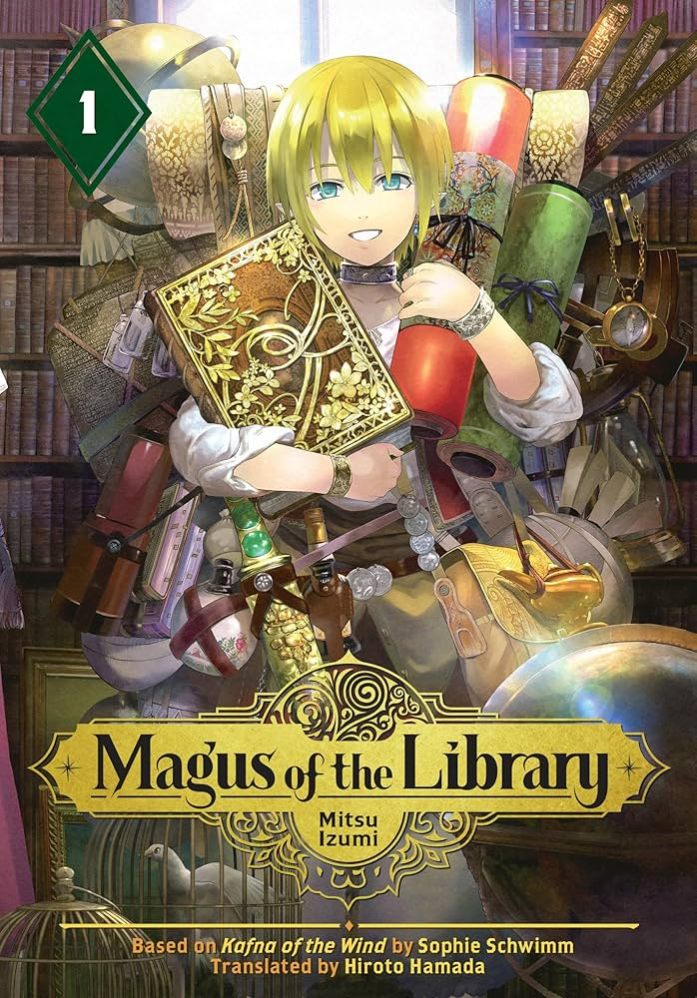
A bright and busy manga cover shows a young person in a wing chair with a library behind, clutching a wide assort of items including a bottle and a book.

Magus of the Library by Mitsu Izumi
Another story rich in detail and set in an alternative Western Asia, this manga leans less on history and more on magic. This was a bit of an indulgent read as a librarian, as most of the characters simply gush about their love of books and passions for various aspects of librarianship and reading. It also does not hurt that the fantasy society in question treats their magical librarians like super-humans. The series revels in diversity of characters, both real and fantasy, drawing from multiple historic inspirations for the factions complete with rivalry and culture shock. 

Tony is an Instructor and Research Specialist at HCLS Miller Branch. He has a degree in history and a renewed interest in science fiction and fantasy.

Ancient History: The Silk Road

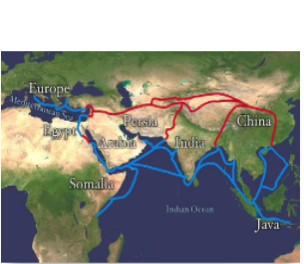
The public domain map in green, blue, and tan shades depicts the Silk Road Route that ran from China through India and Persia and into Europe,, as well as a more southerly route that encompassed modern-day Malaysia and Singapore, the coast along the Indian Ocean, and eastern Africa up to Europe via the Red Sea.
Map of the Silk Road Routes (Public Domain)

Formally established during the Han Dynasty of China, the Silk Road was a vast network of trade routes that was the lifeline of commerce from 130 BCE – 1453 CE. Many different branches comprised this road connecting China, India, and Persia, with Persia being a gateway further into Europe. The main route of the Silk Road was established much before the Han dynasty; known as the Persian Royal Road during the Achaemenid Empire, it connected north Persia (modern-day Iran) to Asia Minor (modern-day Turkey). The Persian Road was maintained with a system of postal stations and gradually expanded into the Indian sub-continent across Mesopotamia and into Egypt.  

Howard County Library System and the Walters Art Museum present a fascinating class that looks at works from the Walters Art Museum that illuminate the expansive story of the Silk Road. 

May 17 from 12 – 1 pm. Register here.  

A manuscript page with Arabic script at the top, featuring a shade tree, bamboo, and a man in a turban studying with writing tools surrounding him. A smaller figure kneels in the bottom right hand cornder.

The term “Silk Road” wasn’t coined until 1877, when German geographer and historian Ferdinand von Richthofen first used it to describe the trade routes. Historians now prefer the term “Silk Routes,” which more accurately reflects the fact that there was more than one thoroughfare. 

Many different goods including gunpowder, precious stones, and ivory were traded along this route; however, it was the exotic silk that gave its name to this road. Many of the goods traded across this route had a great impact on the cultural development of the world. Paper and gunpowder, both developed in China, and the rich spices from India contributed to both European culture and warfare. Similarly, techniques for making glass migrated eastward to China from the Islamic world. However, silk continued to be the most sought-after and expensive commodity, especially in Rome. The Byzantine emperor Justinian (327-565 CE) sent emissaries to steal the closely guarded secret of silk and bring it back to initiate the Byzantine silk industry. In 1453 CE, the Byzantine Empire fell to the Ottoman Empire which closed the Silk Road and cut ties with the west.  

The legacy of the Silk Road is the impact on art, religion, technology, science, and language that fostered a growth and enrichment of world civilization. Unfortunately, disease also traveled along and the bubonic plague of 542 CE was thought to have spread to Constantinople via the Silk Road. Famous Italian explorer Marco Polo traveled overland on the Silk Road to the Mongol Empire ruled by Kublai Khan in 1275 and wrote the epic The Travels of Marco Polo (also available as an eBook from Libby/OverDrive). 

The closing of the Silk Road in 1453 forced traders to explore sea routes and discover new ports. This was the beginning of the Age of Discovery which led to a new era with the rise of seafaring nations. Join us for the class with a docent from The Walters Art Museum to learn more.