Times are hard for many, if not all, of us. As we struggle to navigate a landscape that is changing socially, physically, and economically, finding guides that feel true to our inner selves can be enormously helpful.
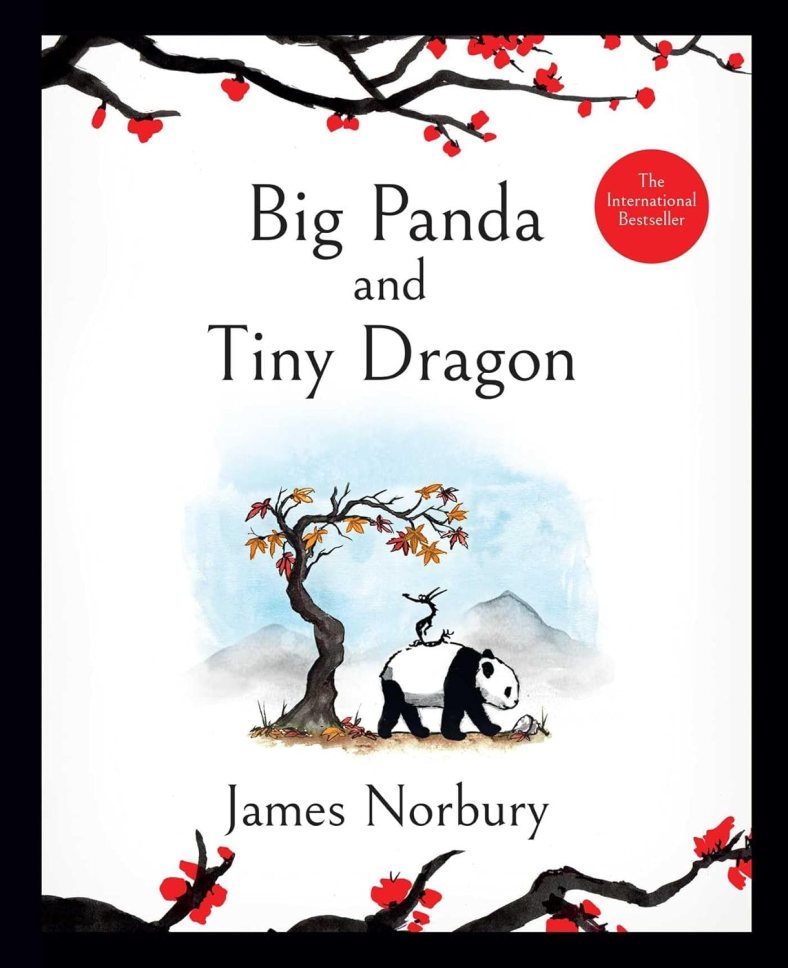
When I saw a coworker return a book called Big Panda and Tiny Dragon, I was drawn to the cover and asked if I should read it. She gave an enthusiastic, unequivocal yes. Apparently another coworker had recommended it to her. I recently passed along the recommendation to a group text full of people I was confident would appreciate it as well. And now, I am recommending it to all of you.
Big Panda and Tiny Dragon is a simple, beautiful book. Only a few words or sentences fill each page, accompanied by lovely watercolor illustrations. As they move through the seasons, companions Big Panda and Tiny Dragon share tidbits of wisdom inspired by Buddhism. While there is often a literal interpretation indicated by the illustration, each one clearly has a deeper meaning when applied to life more broadly. The comfort and wisdom shared in the pages of this book are a warm hug that is welcome during many stages of life. I expect this is a volume I will return to again and again – when things feel challenging or I find myself too caught up juggling modern-day stressors.
An afterword from the author shares some of his journey from mental health struggles to helping others, and what led to him creating this book. As readers from around the world have shared with him, people from all different backgrounds and experiences have found connection with and meaning in this unassuming little volume. I venture to guess that you will, too.
May is Mental Health Awareness Month. If you need immediate support, call or text 988 to reach the National Suicide & Crisis Lifeline. Explore more mental health services in Howard County.
Big Panda and Tiny Dragon is available in print and as an e-book.
Eliana is a Children’s Instructor and Research Specialist at the Elkridge Branch and co-chair of the HCLS Equity Committee.She loves reading, even if she’s slow at it, and especially enjoys helping people find books that make them light up. She also loves being outside and spending time with friends and family (when it’s safe).
Jenny Odell is an interesting person and quite a writer. Let me give the caveat that we have a similar worldview, so perhaps I’m biased. In How to Do Nothing: Resisting the Attention Economy, she cites numerous writers with whom I also seem to share beliefs and an ethos, including Rebecca Solnit and Jia Tolentino. (Check out their books and articles; both are worth your time.) I am now reading Odell’s latest work Saving Time: Discovering a Life Beyond the Clock.
The title of How to Do Nothing is a bit of a misnomer. (The book cover is beautiful, by the way.) It’s not about doing nothing, but about a sort of resisting in place and trying to distance yourself a bit, not completely, from technology and productivity as the subtitle suggests. Two things that have come to dominate American culture, as well as are inextricably linked in many cases.
Odell likes labor, a lot, both as a movement and a concept. Her brief anecdotes about the history of the labor movement in the United States alone make the book worth reading. Odell also mentions interesting art and literature throughout the text. These are things that interest me a great deal, and Odell made me think that I don’t know nearly enough about them. It’s a feeling I like, and one of the many reasons I read books.
Odell suggests that instead of dropping out, we should rather “resist in place.” She devotes a section of the book to the various movements to start a new “society” outside of mainstream society and the reasons for their failures. Starting a new society is something I’ve considered, intellectually at least, as it is a common trope in both books and films. Unfortunately, problems of equality and politics tend to persist in any sort of human organization, as is the case in Odell’s examples. This reality is also often borne out in the history of any political revolution. Animal Farm, although appearing to be about the Russian revolution, is really a satirical allegory of this concept.
The actual world and humans are much easier to avoid than ever as we work remotely, stare at screens, and seemingly try to avoid one another. Odell offers us a simple solution; observe the world around us, the local, the quotidian moments of each day as a form of resistance. Take a longer look at your real surroundings and your fellow humans. For example, she recommends that you go to the park and just sit or be. Truth be told, I’m already pretty good at this sort of thing, however I could probably observe the world around me better. (I plan to work on this.)
It may sound cliched at this point, but Odell implores us to get back to nature and each other. I do believe these things could drastically change society for the better. She does concede, and I agree, this is a privilege and requires time. In other words, many of us are squeezed for time and the specter of economic precariousness looms large for far too many. That said, this is a sort of a circular reinforcement to her argument, and it’s certainly easier said than done. However, she successfully bolsters her argument with historical examples of how the US labor movement took back their time. In short, people working in solidarity improved not only conditions and pay, but their amount of free time. I have no doubt we’re all the better for that. But let me be clear, this doesn’t happen easily or quickly, and there are very powerful forces that will push back.
Some folks in my book discussion group (Read. Think. Talk.) didn’t care for the book’s style. They found it disjointed and posited that the book seemed like a series of essays. This is a fair criticism; however, I recognized the overarching theme and liked the disjointed style. They suggested that Orwell’s Rosesby Rebecca Solnit has a similar style, I agree, but I also love that book. (read a review)
In sum, I found the book packed full of interesting information and great commentary on our society. I like the simple way Odell recommended how we could improve our coexistence with others and the planet. Actions that may be necessary at this juncture.
How to Do Nothing: Resisting the Attention Economy by Jenny Odell is available in print, e-book, and e-audiobook.
Eric is a DIY Instructor and Research Specialist at HCLS Elkridge Branch. He enjoys reading, films, music, doing nearly anything outside, and people.
This is a True story. The events depicted took place in Minnesota in 2006.
At the request of the survivors the names have been changed.
Out of respect for the dead, the rest has been told exactly as it occurred.
What defines the ‘truth’ of a story? Is it accuracy to the literal account of events, or that it resonates with a more elusive truth about our perceptions of ourselves and the world? Every episode of Fargo opens with the passage above, adjusted for the specific time and place of the season’s focal bedlam. Each season is independent, although loose connections unite each season into a shared world with Easter eggs for the eagle-eyed viewer. But each season is a ride along, a shocking and surreal crime wave that disrupts the deceptively quaint communities of the Midwest.
Watching Fargo is like having an intimate view into two trains hurtling towards an inevitable collision. It is tense and dramatic, unpredictable and quirky. As if the trains were full of seemingly supernatural criminal murderers and diffident Minnesotan house-spouses who would use phrases like “You betcha” and “Aw Jeez” even as the world burns down around them. A mix of crime drama and magical realism with a substantial dose of Minnesota Nice, all brought to a boiling point.
I cannot overstate my love for this series. The creative aesthetics behind the production are unlike anything else on TV. The sets are gorgeous; nigh-eternal winters loom over the Midwestern plains, enhancing a sense of stasis that stands in contrast to the rupturing of the status quo. The music fills the show with an exciting dynamism. The theme song is stellar, evoking a kind of folk melody that is nostalgic, yet somber and plaintive. As it pertains to the larger show, the music is curated to great effect. The soundtrack is a diverse mix of iconic songs of the time and original compositions, which all serve to influence the emotions of any given scene.
However, it is the writing that stands above all else. The framing device which opens each episode always fills me with anticipation. Borrowed from the original Coen Brothers’ film, the statement “This is a true story” calls to mind Truman Capote’s creative nonfiction novel In Cold Blood, which itself serves as a founding inspiration for true crime as a literary genre. Stories about crime have always drawn audiences, but true crime’s magnetism is unique. The next two lines of the opening comment on respect, for the living and the dead. The contrasting means of showing this respect are wryly humorous. One wouldn’t be remiss in wondering if the calls for respect are a means to an end so that the story can be told. Perhaps elements of these stories compel us to share them, as a lesson to be learned or a chance to understand something better.
However, contrary to the opening lines, Fargo is fiction. Many of us are familiar with films that take liberties with their claims of truthfulness (looking at you, The Conjuring). Fargo is different. The show revels in the contradiction of this deliberate and ironic narrative choice. This narrative flourish prepares the audience for a cavalcade of untrustworthy narrators. Truth is, unfortunately, not easily uncovered.
The police investigations which act as a through line for the series are not the pinnacle of competent detective work. There is neither a Sherlock nor a Hercule Poirot to be found. Instead, we are presented with a motley crew of eccentric characters possessed each by their own perspective, and everyone is wrestling for control. Their actions are influenced by their respective worldviews and the lengths they will go to ensure their particular truths remain unimpeachable. When these characters are pitted against each other, their perspectives paint a dynamic portrait of what it looks like to live in our world.
This interplay reveals discussions on all manner of philosophical and political topics. Uncovering the reference behind each episode title is a fun bonus game for an active viewer. I want to focus on one particular example from Fargo’s second season entitled “The Myth of Sisyphus.” Season two takes place in 1979 and covers the grisly collision between a hapless couple who accidentally killed a member of the local Gerhardt crime family, the vengeful crime family in question, the encroaching Fargo mob, and the state troopers who are trying to prevent the violence from spreading. The season opens with the words of Jimmy Carter:
It is a crisis of confidence. It is a crisis that strikes at the very heart and soul and spirit of our national will. We can see this crisis in the growing doubt about the meaning of our own lives. And in the loss of unity and purpose.
Fargo places Carter’s crisis of confidence in direct conversation with Albert Camus’ essay on Absurdism, “The Myth of Sisyphus,” with a handful of characters reading the essay.Camus’ essay discusses how we crave meaning and purpose in our lives but are confronted by a world that has no meaning and is defined by chaos. In the classic myth, Sisyphus was cursed to push a boulder up hill, which ultimately rolls back down once it reaches the top. Sisyphus must then return to the boulder and begin pushing it again. Forever. The myth represents futility and the struggle against meaninglessness. Arguably, none of the characters gained a great comprehension of this essay. Some of them flatly reject the framework of the essay, but nonetheless act in ways that exemplify Camus’ different propositions for responses to the Absurd. Through the contrasting reactions to the text and the responses to increasingly absurd circumstances, we see the show develop its philosophical inquiry into the issue.
This inquiry is not accomplished without a lot of heart. Fargo is ultimately hopeful. The largest source of friction, the catalyst of all chaos, stems from the inability to communicate and the resulting misunderstanding chips away at our sense of unity. Giving up is not an option, or at least, not a particularly good one. We make meaning in our lives through the things we cherish, that we wish to protect or pay our attention to. Whatever trial or tribulation, we face those challenges to preserve what is valuable. To do otherwise is tantamount to letting it fade.
Fargo is special for how it juggles this stylistic blend. It presents humor and horror together with sentimentality. None overshadows the other. Fantastic casting choices breathe life into the writing. No matter how quirky the characters may be, they embody a sense of realism that makes the world feel alive and not too distant from our own, especially now in our own bizarre and heightened reality. Sometimes, even truth must be disguised for others to regard it. Fargo uses the medium of fiction to bypass our skepticism and take us on a journey through and around the strange heart of the modern world. And it makes sure that the journey is going to be wild and fun along the way.
If your interest is piqued, the good news you can borrow the first three seasons of Fargo on DVD. Season 5 of Fargo is currently airing on FX and select streaming services.
Ian is an Instructor and Research Specialist at East Columbia Branch.He is a huge nerd with too many interests to list here. Currently, he is fixated on the interconnection between history and fiction. His favorite kind of stories are stories about stories.
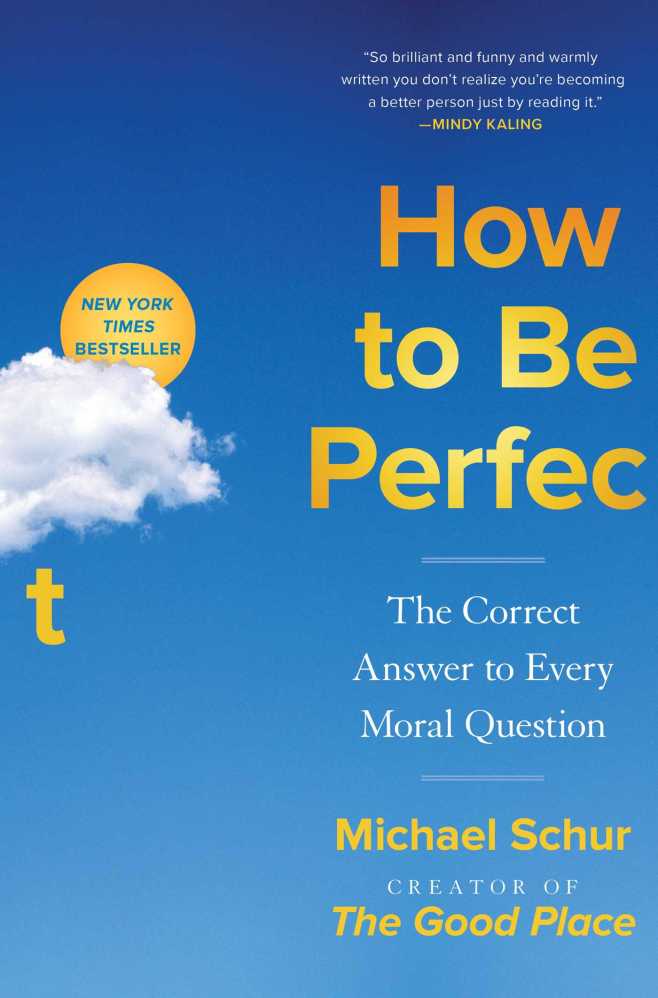
Have you ever wanted to be a better person? Well, I have great news for you. Here at the library, we have a title called How to Be Perfect: The Correct Answer to Every Moral Question (available in print, audiobook on CD, e-book, and e-audiobook). Spoiler alert: It does not exactly have the correct answer to EVERY moral question you might encounter. Sorry to burst your bubble.
What How to Be Perfect does have is a lot of information to help guide us through a wide range of moral dilemmas. In fact, author Michael Schur decided to write this book after the extensive research he did to create the television show The Good Place. If you haven’t watched it, do yourself a favor and check it out from the library or stream it on Netflix. You may then have a greater appreciation for the book, but you can still glean a lot even without the context of the show.
I don’t want to give too much away, but suffice to say the show’s characters explore moral philosophy and ethics in their attempts to be better people and help others to be better, too. Certainly, for this to be even remotely feasible, the creator needed to have a decent grasp of these subjects. So, he worked with experts and did a lot of research, then he was kind enough to share that research in the form of How to Be Perfect. I am not a philosopher or ethicist, and I don’t even tend to enjoy reading nonfiction, but this title offers an accessible, enjoyable overview of the extensive history of moral philosophy and its main schools of thought.
Sounds kind of boring, though, right? Well, it’s not. Michael Schur writes for TV, remember? In addition to The Good Place, he co-created Parks & Recreation. He knows how to keep you engaged and make you laugh, and he uses that knowledge well. While explaining key points of major ethical traditions, Schur also helps us consider some of their shortcomings and the obstacles we may face in applying these concepts.
Overall, he encourages individuals to explore what feels like the right fit for us and to take pieces from each. He also reminds us that we will fail. Constantly. Our obligation, though, is to always keep trying. If you are striving to be a better person, definitely take the time to read this title (or better yet, listen to the audiobook, narrated by the author and numerous cast members from the show). Take comfort in knowing that no one is actually perfect and never will be. We just have to do our best.
Eliana is aChildren’s Research Specialist and Instructor at HCLS Elkridge Branch. She loves reading, even if she’s slow at it, and especially enjoys helping people find books that make them light up. She also loves being outside and spending time with friends and family (when it’s safe).



 CHAPTER CHATS