Mon, Feb 24 | 7 – 8:30 pm HCLS Miller Branch For adults. Register here.
Jeffrey Boutwell discusses his new book,Boutwell: Radical Republican and Champion of Democracy, a biography of family member George S. Boutwell – perhaps the most consequential American political figure you’ve never heard of. During his career from 1839 to 1905, George Boutwell was Governor of Massachusetts, served in the U.S. House of Representatives and the Senate, was treasury secretary for Ulysses Grant and Commissioner of Revenue for Abraham Lincoln, helped create the Republican Party in the 1850s, and forty years later opposed Republican Presidents William McKinley and Teddy Roosevelt over their plans to annex the Philippines following the Spanish-American War.
Boutwell was instrumental in framing the Fourteenth and Fifteenth Amendments, initiating the impeachment of Andrew Johnson, and investigating white vigilante violence against Black people in Mississippi in the 1870s. For seven decades, George Boutwell sought to “redeem America’s promise” through racial equality, economic equity, and the humane use of American power abroad.
Jeffrey Boutwell is a writer and historian living in Columbia, Maryland, after a 40-year career in journalism, government, and international scientific policy. He began his career as a reporter and editor with the famed City News Bureau of Chicago and was a book reviewer for the Chicago Sun-Times. After two years in the Windy City, Boutwell moved to Berlin and then to England, where he received an M.Sc. in Economics and Politics from the London School of Economics. He received a Ph.D. in political science from the Massachusetts Institute of Technology in 1984. He has written and spoken widely on issues ranging from nuclear weapons arms control to Middle East peace to environmental issues.
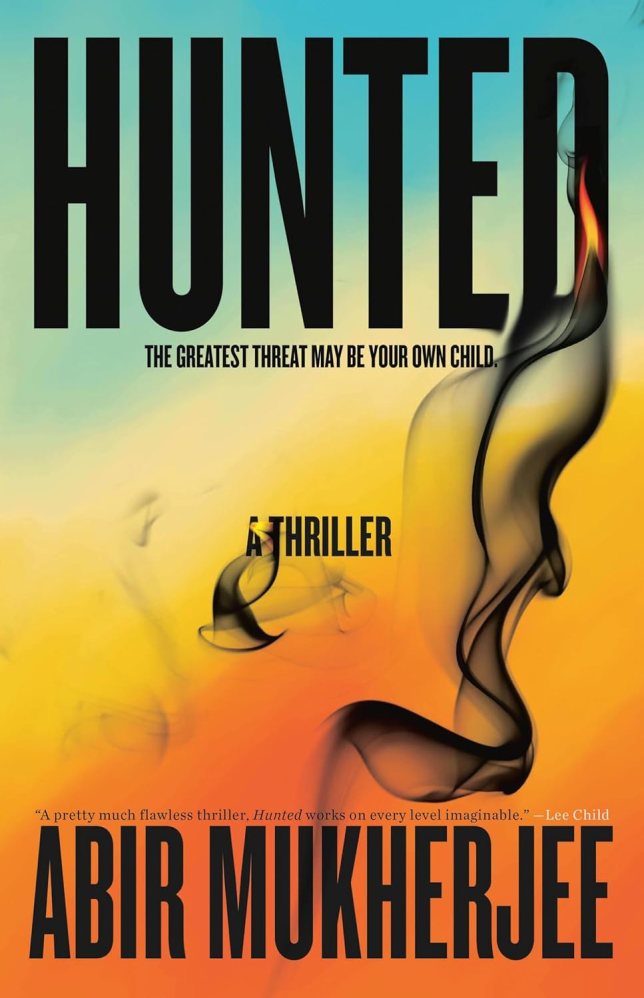
Before I delve into the review of Hunted, I want to let everyone know that I am writing this review under protest. Why, you ask? I have nothing against the book. It was a great thriller, and I am even writing a review for it. My protest is against the author’s decision to leave us with a cliffhanger in his Wyndham and Banerjee series, the last book of which is TheShadows of Men. I was counting days…no, years, for the next one in the series to come out. I was stalking the author’s Instagram profile. Then I saw that he was publishing a stand-alone – Hunted. I will read anything that Abir Mukherjee writes, so of course I got on the holds queue right away and read the book in exactly two sittings. By the way, if you love historical mysteries, you can check out A Rising Man by Abir Mukherjee, the first book in the Wyndham and Banerjee Series.
Based in the fractured landscape of American politics, Hunted is a fast-paced thriller that had me glued to the pages, so much so that I forgot to look up to enjoy the beauty of the crashing waves in front of me. Yes, I read this book at the beach.
There has been an explosion in a mall in L.A, and the Sons of Caliphate has claimed responsibility for the carnage. While checking the grainy CCTV footage of mall security, FBI Special Agent Shreya Mistry spots the scared face of a young girl, Yasmin Malik, who had supposedly planted the bomb. Through intuition and clever deduction, she is just one step behind the culprits who have threatened to cause further mayhem as the country is gripped by election fervor. A right-wing candidate is in a tight race against the Democratic vice president, who is running for the presidency of the United States.
Is it really the work of some militant Islamic jihadist group who wants to tip the balance? From the first evidence, it certainly looks that way. Forces within the Bureau want Shreya to back off from this particular case, since Shreya endangers her life repeatedly in her pursuit of the perpetrators. But, is that the only reason that higher-ups want her off this case? Shreya Mistry, on the other hand, feels like she must work doubly hard to prove her worth in a male-dominated agency, being a woman as well as a person of South Asian origin.
A father in London finds out that his 18-year-old daughter has joined the Sons of Caliphate. A mother in the United States also fears that her son is part of this militant group. Neither of them can believe that their children are cunning or cruel enough to pull off this horrible crime. They feel their children are victims themselves, kidnapped by the group. These two parents come together, determined to find their children and take them home. Will they be too late?
The thriller is certainly a roller coaster ride and definitely a page turner. Like Mukherjee’s other mysteries in my beloved Sam Wyndham Series, social issues are as important to the plot as the mystery. We read about gender inequality, racism, Islamophobia, and other pertinent social issues that are present in our world. The one critique that I have is that the characters lack depth, unlike the characters in his other books. But then again, Mukherjee has set the bar high for his fans. The action and the suspense make up for the less than realistic characters, though. If you are looking for a fast-paced, crisp, suspenseful thriller, look no further.
I grudgingly admit this was an interesting stand-alone, but bring back Sam Wyndham and Sergeant Banerjee, sir. We are waiting!
Hunted by Abir Mukherjee is available in print format.
Piyali is an instructor and research specialist at HCLS Miller Branch, where she facilitates Light But Not Fluffy and co-facilitates Global Reads. She keeps the hope alive that someday she will reach the bottom of her to-read list.
A witty, absurdist satire of the last 500 years, Alexandra Petri’s US History is the fake textbook you never knew you needed!
by Rohini G.
Every morning, before I plunge into the doom and gloom printed on the front page of the newspaper, I take a few minutes to refresh my soul and laugh loudly. Washington Post’s humor columnist Alexandra Petri’s witty perspective on the absurd in our politics (of which there is no dearth), tickles my funny bone, enlivens my gray cells, and infuses my heart with optimism. A full body workout!
What? You haven’t read her column and are unfamiliar with her razor sharp writing? Ah, my friend, what should I offer you – her hilarious article about whether George Santos should resign (It’s the last thing he should do) or her recent satirical perspective on the U.S. Senate – it’s senior living made permanent. Or better yet, come and meet her in-person on Saturday, June 24 at 2 pm at the Miller Branch as she discusses her new book U.S. History: Important American Documents (I Made Up).
As a columnist for The Washington Post, Alexandra Petri has watched in real time as those who didn’t learn from history have been forced to repeat it. And repeat it. And repeat it. If we repeat history one more time, we’re going to fail! Maybe it’s time for a new textbook.
On Petri’s deranged timeline, John and Abigail Adams try sexting, the March sisters from Little Women are sixty feet tall, and Susan Sontag goes to summer camp. Nearly eighty short, hilarious pieces span centuries of American history and culture. Ayn Rand rewrites The Little Engine That Could. Nikola Tesla’s friends stage an intervention when he falls in love with a pigeon. The characters from Sesame Street invade Normandy. And Mark Twain—who famously said reports of his death had been greatly exaggerated—offers a detailed account of his undeath.
Alexandra Petri is a Thurber Prize finalist. Her satire has also appeared in McSweeney’s and the New Yorker’s Daily Shouts and Murmurs. She lives in Washington, DC. She won the National Press Club Angele Gingras Award for Humor Writing 2016, Shorty Award 2016, Forbes 30 Under 30, Fifty Funniest People Right Now (Rolling Stone).
If there is even a single person standing who can see through the political obfuscation on all sides, and spark humorous conversation, then there is, yet, hope for this world.
Foundation, the first book in Isaac Asimov’s Foundation series, is a sci-fi touchstone. I’m sure it’s been called a towering work of genius or a staggering work of brilliance. More importantly, it’s just been adapted for the small screen (I haven’t seen the show, but I’ve heard good things). The story’s three protagonists are a scientist, a politician, and a trader. Asimov explores big scientific, political, and economic ideas, and his protagonists give the reader a clue.
Asimov speculates that we will one day be able to predict the future using science. Psychohistory is born from the blending of (I bet you can guess) psychology and history. It’s used to predict the movements of large groups of people (the masses of humanity living their quietly desperate lives). We meet Hari Seldon, the most accomplished psychohistorian the galaxy has ever seen, on the planet of Trantor. Seldon tells Gaal Dornick, the scientist protagonist, that the current and seemingly stable galactic empire will fall and the galaxy will be plunged into thousands of years of chaos and barbarism. Seldon has a plan that, if executed properly, will save the galaxy thousands of years of chaos. Don’t get too attached to Gaal. Asimov moves through narrators pretty quickly.
According to the plan, Seldon establishes the first Foundation on the remote planet Terminus. He tasks scientists and academics with compiling an encyclopedia of the galaxy’s vast knowledge. They attack their goal with fervor. Meanwhile, the rest of the galactic empire is resting on its laurels and starting to collapse.
Fast forward a few decades and Salvador Hardin is the next narrator (the political narrator). Hardin is a very 60s sci-fi cool customer, space cowboy narrator. At this point Seldon reappears as a hologram (being dead) to provide hints or tips to keep the galaxy moving in the right direction, according to his plan. Hardin, the mayor of the planet Terminus, helps the planet through the first Seldon crisis, which is a time identified as a key turning point in the future of the galaxy. Each crisis must happen a certain way for the plan to be successful.
The last narrator is Hober Mallow, a trader working for The Foundation. At this point, The Foundation produces technological marvels that they trade to the surrounding planets. Most traders spread the religion Hardin created and tied to The Foundation’s technology to new planets. The new planets buy the technology, sometimes accept the new religion, and become regular customers. The traders make money and the surrounding planets become dependent on The Foundation.
Foundationis full of big ideas. Bloated bureaucracies, social elites, centralized governments, hyper-specialized professionals, cynical capitalists, zealous religious fanatics, and downtrodden regular folk populate the pages. It’s a thought-provoking story of the collapse of an empire.
Foundation is also available from HCLS in eBook and eAudiobook format from Libby.
Ben Hamilton works at Project Literacy, Howard County Library’s adult basic education initiative, based at HCLS Central Branch. He loves reading, writing, walking, and talking (all the basics).
Twilight of Democracy: The Seductive Lure of Authoritarianism is a great read for the current moment. The title of the book should give you a fairly good idea of what the book is about. Anne Applebaum’s area of analysis and expertise seems particularly relevant right now. Sadly, she and I agree that hate and the belief in authoritarians has increased in recent times in America. Applebaum discusses how this is also the case in Britain, Hungary, and Poland (countries with which she has experience). Applebaum’s husband is involved in politics in Poland, which provides her an interesting vantage point into the “power elite” (my term).
If you’re not familiar with Anne Applebaum, I would encourage you to read some of her articles in The Atlantic. I am mainly familiar with her work through this magazine. She is a journalist, but I would also describe her as a historian who has authored several highly regarded books on Russian history. She is also currently a senior fellow at Johns Hopkins University’s School of Advanced International Studies. I would describe Anne Applebaum’s politics as different than mine, where she is “center right” and I’m not. We may differ on specific policy prescriptions and perhaps views on liberalism and markets, but we agree that hate and authoritarians are both inimical to democracy.
The book grabs you from the onset by describing a New Year’s Eve party they hosted as the 20th century ended. She details the somewhat raucous party, the guests, and the optimism many attendees shared for liberal democracies in the 21st century. I am younger than Applebaum, but I recall a similar optimism (and perhaps a little worry about Y2K). She then goes on to describe how in the 20 years since this party many of the guests would no longer speak to each other, and how’d she’d cross the street to avoid some of these folks. In our highly polarized and political society we can all share this sentiment to some extent. Perhaps we don’t know Boris Johnson personally, as she does, but we can relate, and her brief biographical sketch of Johnson is indeed indicative of western politics at this moment.
The book is written by a good journalist, and thus it is engaging and thoughtful. It is very Western-focused, but it does concern more than the United States. The similarities of the things happening in these countries are a bit frightening. Personally, I’m remembering the era during the last century when fascism began to spread in the West.
She goes into detail through character sketches of some of the people and the trajectory of their political beliefs. Many were former anti-communists and are now hard-right and authoritarian in nature. She points out that these are not poor, rural people, but actually quite elite, wealthy, and well-educated. She subsequently proffers her theories as to why this is the case, including that of a behavioral economist who suggests about one third of the population, irrespective of political beliefs, has an authoritarian “disposition.” This actually does not surprise me. Applebaum also puts words to the belief of many of these folks that things were better in previous times. The section where she delves into the different types of nostalgia is very interesting.
I don’t agree with everything Applebaum posits, however I’d like to think she’d appreciate that fact. Specifically, I think she discounts corporate power and race issues in America. They’re addressed, but not to my satisfaction. Where I agree with Applebaum is that democracy is messy, it’s problematic, and not everyone is happy. In sum, it’s tough! It’s certainly much easier to be in complete control and get your way all the time. However, I don’t think I have an authoritarian “disposition” and I think getting my way all the time is not good for me psychologically. That said, I hope we’re not in the twilight of democracy.
It’s not exactly a cheerful topic – the most devastating nuclear accident ever to have happened. However, the story of what went wrong is riveting and amazingly complex. More than 30 years ago, on April 26, 1986 at 1:23:58 am, one of the nuclear reactors at the Chernobyl site suffered a massive explosion and containment failure, which led to fallout poisoning in large areas of Ukraine and Belarus. At the time, the Soviet government was more concerned with containing the political and international ramifications than protecting its citizenry. I have to admit that until recently I hadn’t thought much about Chernobyl other than as an unfortunate incident that happened during my teenage years.
A member of the book discussion group that I moderate, Books on Tap, advocated for reading oral histories and books in translation, particularly this one. She argues (and I agree) that it’s a marvelous way to gain insight and perspective from other cultures and points of view. Voices of Chernobyl: The Oral History of a Nuclear Disaster presents the ultimate expression of telling stories “in their own voices.” Svetlana Alexievich, who won the Nobel Prize in Literature, wrote it 10 years after the nuclear accident, and it was more recently translated in 2014. The book presents the written account of her interviews with a wide cross-section of people who lived through the catastrophe and the subsequent years. A surprising number of people returned to their homes or fled to the “open” country as other Soviet Socialist Republics disintegrated into ethnic warfare. They often refer to Chernobyl as “war,” being their only other frame of reference to so many people dying and the subsequent governmental propaganda. Although it can feel a bit repetitive, that sheer recounting from so many different people – teachers, party loyalists, army conscripts, wives, and mothers – drives homes the devastating, ordinary reality of living on top of nuclear fallout.
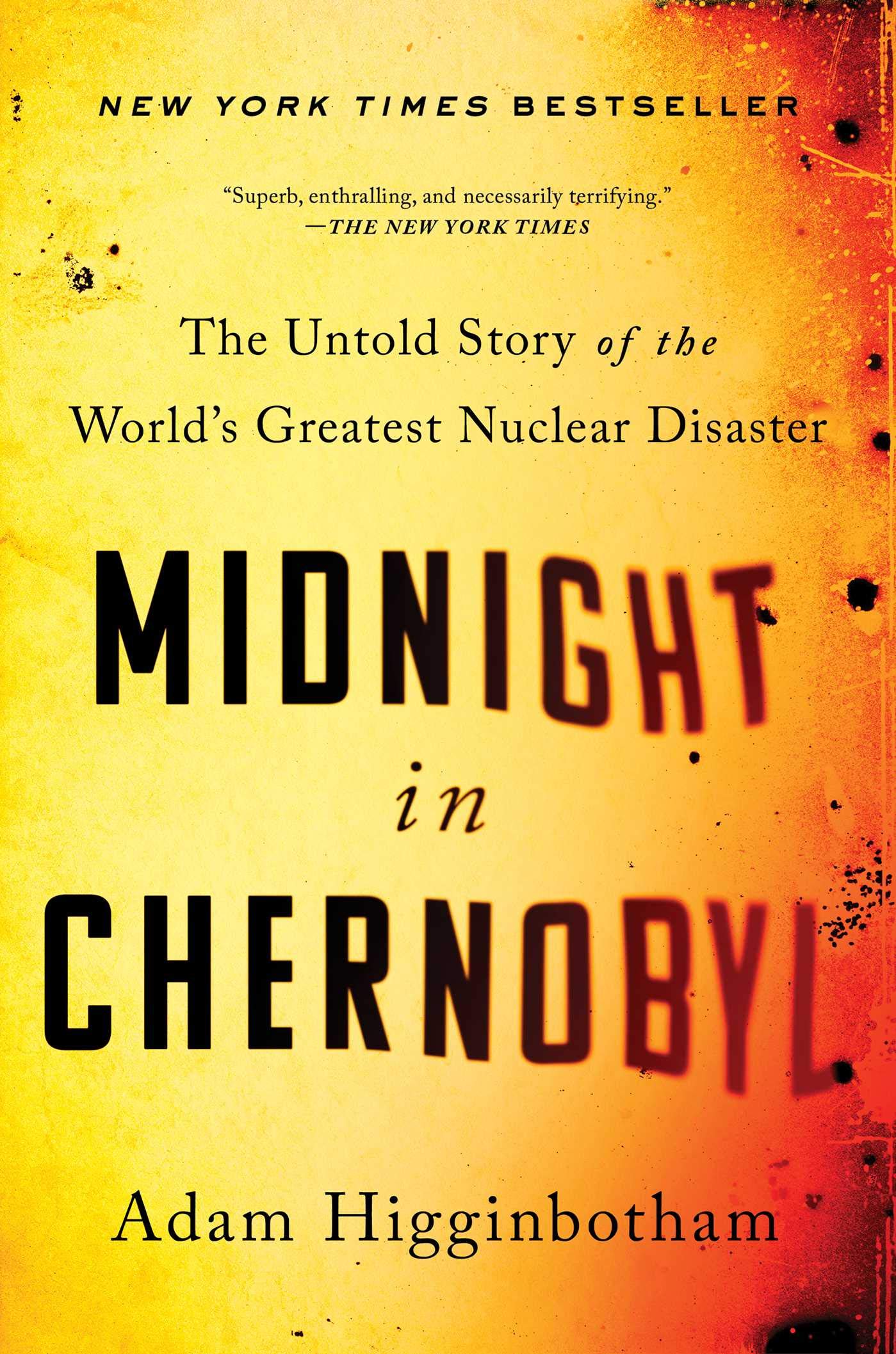
Midnight in Chernobyl by Adam Higginbotham (also an eBook and eAudiobook) offers another side of the story, one rich in politics and science. Where the previous title provides a direct line to individuals, this book takes a much larger overview of the history of Chernobyl – literally starting with the creation of the plant and its company town along a marshy stretch of wilderness. The perfidy of the Soviet institution’s need for results and optics, above any adherence to safety and good practice, was something I had forgotten since the fall of the USSR. The Chernobyl disaster was nonetheless a direct result of the political reality during that time… and in fact contributed to the fall of the communist regime. This book draws on interviews and recently declassified archives to bring the disaster and the people who lived through it to life. Although there’s a short holds list for the book, it’s worth the wait.
HBO aired a five hour, five episode Chernobyl miniseries in 2019 that combined the source material from these two books into an excellent show about what happened during the explosion and in the two years after, available to borrow as DVDs. You can’t turn away from the real-life drama unfolding on the screen, not even knowing the basic outlines of the story. All sources, books and screen, point to the complete cognitive dissonance of dealing with an accident that was largely deemed to be impossible. The show is immensely well-written and well-acted, pulling you in almost despite yourself. Content warning: The middle episode contains some particularly hard scenes of “cleaning up” wildlife and abandoned pets. Here, too, the faces and the voices give a human accounting to an unimaginable tragedy.
The area will not fully return to “safe” for millennia, barring any further contamination. I feel like this was an important moment in time, and only now can we begin to appreciate its history. I also hope it will give us some optimism about human resilience and the ability to solve big problems… because one thing has been made perfectly clear: it could have been so much worse.
Kristen B. is a devoted bookworm lucky enough to work as the graphic designer for HCLS. She likes to read, cook, and take walks in the park.
I read a lot of great authors, but that’s because I read great books! As we have been celebrating Women’s History Month, and HCLS has recommended a cornucopia of great material about and by women, I’d like to recommend the amazing Ursula K. Le Guin.
Le Guin made a name for herself in the male-dominated world of sci-fi and fantasy half a century ago, and she wrote a great book about gender fluidity way before many others broached the topic. Le Guin said she recognized the ability to tell complex tales through the work of genre writer Philip K. Dick. Later, she openly criticized the way he wrote some female characters. Dick agreed, they became friends, and he thanked Le Guin for her influence on his subsequent works. I’d contend that in itself amounts to progress!
A great starting point for Ursula K. Le Guin is watching Worlds of Ursula K. Le Guin on Kanopy. It provides a great introduction to the writer and her work. The interviews with the witty and charming Le Guin are terrific, as are the conversations with Margaret Atwood and Neil Gaiman and others about her influence on their writing and the genre. Gaiman astutely points out that the Harry Potter series owes a great deal to Le Guin’s Earthsea series.
As I alluded to before, her most famous work The Left Hand of Darkness (also available in eBook and eAudiobook format) is a groundbreaking work, not just for the sci-fi/fantasy genre, but also for challenging our conceptions pf western masculinity and of western masculinity and femininity in a clever and subtle way. The protagonist, an envoy to the planet nicknamed Winter, struggles to understand a gender-neutral people using the social constructs of his own culture. Left Hand centers political intrigue and a forced epic journey across an icy planet while giving glimpses at the envoy’s gradual enlightenment. The drama and action of an arduous journey mirrors the personal journey of the protagonist and the relationships he builds.
The Left Hand of Darkness is worth borrowing just to read Le Guin’s amazing introduction concerning science fiction and writing in general. Over the years, she has taken criticism for using the pronoun “he” for the gender-neutral characters in the book. To which she replied that just because the book was finished, it didn’t mean she was finished learning. I like this sort of thinking, the idea that we can all grow more and move forward.
Le Guin’s other popular work The Dispossessed: An Ambiguous Utopia may be the perfect book for now, as the story of two opposing political views on how best to organize a society – collectivism versus individualism. The book examines power and extremes, and interrogates the best way for a society to temper those impulses.
The protagonist Shevek (all names are computer generated) is a scientist from the anarchist commune-like planet, Anarres. Against the wishes of many of his people, he takes the opportunity to collaborate with the scientists of A-lo, on the planet Urras. The latter is a more individualistic, capitalist society. Shevek is attracted to the opportunity to further pursue his work, as he has begun to suspect that his society has some faults. Le Guin uses the protagonist’s perspective and experience to compare the two societies. The chapters alternate between Shevek’s youth and adulthood on Anarres and his present situation in A-lo. I thought this a clever technique, in a sort of nuanced compare and contrast story, but perhaps that’s just my conflicted mind?
I believe Le Guin’s biases are evident, perhaps intentionally, but the book offers a provocative look at entrenched beliefs. The two societies are located on different planets and only know each other via their society’s own information (sometimes called propaganda), very similar to the way each of us arrives at our perspectives, beliefs, and, yes, biases. Le Guin cleverly has each society colloquially reduce the other to one-word epithets; the “propertarians” and “anarchists.” It’s certainly easier to believe we understand each other when we reduce ourselves to singular adjectives.
This would be a great book to have people with opposing viewpoints read and discuss. The fact that Le Guin’s father was an anthropologist is evident in her work. Lastly, I’m inclined to conclude that Ursula K. Le Guin believes any thoughtful ideology should begin with a deeper understanding of each other and the forces that create fear and hate.
Eric is a DIY Instructor and Research Specialist at HCLS Elkridge Branch. He enjoys reading, films, music, doing nearly anything outside, and people.







 CHAPTER CHATS