

By Julie F.
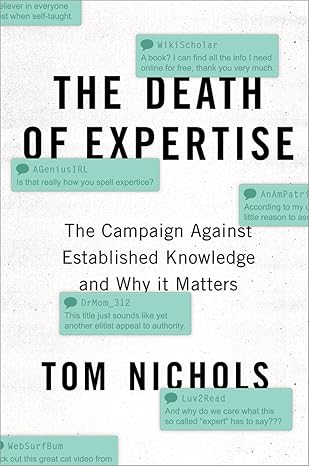
Tom Nichols is a staff writer at The Atlantic, a professor, and a policy professional; I have followed him on social media and read his opinions for years. In this thoughtful analysis, he considers the death of expertise: the sense that previously acknowledged experts aren’t to be trusted and that the layperson can navigate their own way through a sea of information (and mis/disinformation). Looking at the disciplines of education and journalism, the rise of the internet, and the experts themselves (who consult with and influence policymakers), he traces the ways that citizens in our democracy have decided that they have the expertise to make decisions about a host of issues that were previously deferred to specialists (doctors, professors, and other expert advisors).
Nichols convincingly demonstrates how confirmation bias, the commodification of higher education, anti-intellectualism, and millions of web pages with uncurated, dubious information have enabled this often-misguided attitude. Librarians and library workers, take heart! You will appreciate his deep understanding of the nature of our work. My favorite quotes are from (not surprisingly) his chapter on the internet, called “Let Me Google That For You: How Unlimited Information Is Making Us Dumber”:
“The Internet, however, is nothing like a library. Rather, it’s a giant repository where anyone can dump anything, from a first folio to a faked photograph, from a scientific treatise to pornography, from short bulletins of information to meaningless electronic graffiti” (110).
“Research requires the ability to find authentic information, summarize it, analyze it, write it up, and present it to other people. It is not just the province of scientists and scholars, but a basic set of skills a high school education should teach every graduate because of its importance in any number of jobs and careers” (111).
Although his exploration of these concerns left me a little anxious at times for the future of our republic, Nichols wasn’t as cynical as I’d expected, and at the end of The Death of Expertise: The Campaign Against Established Knowledge and Why It Matters, he sums up similar situations we’ve recovered from in the past, when Americans were “capable of shrugging off their self-absorption and isolation and taking up their responsibilities as citizens” (237). Hopefully, a resurrection in interest in participatory democracy and the education of our citizenry will speed that process along.
The Death of Expertise: The Campaign Against Established Knowledge and Why It Matters is available from HCLS in print and as an e-audiobook from Libby.
Julie is an instructor and research specialist at HCLS Miller Branch who finds her work as co-editor of Chapter Chats very rewarding. She loves gardening, birds, crime and espionage fiction, all kinds of music, and the great outdoors.
 CHAPTER CHATS