
Meet the Author: Neon Yang

Meet Author Neon Yang
Wed, May 7 | 12:30 – 1:30 pm
Online. Register at bit.ly/Author-Yang to receive the link for the event.
For adults.

Neon Yang is a queer non-binary author based in the UK. They have been nominated for the Hugo, Nebula, World Fantasy, Lambda Literary, Ignyte, and Locus Awards, and their Tensorate series of novellas (The Black Tides of Heaven, The Red Threads of Fortune, The Descent of Monsters, and The Ascent to Godhood) was an Otherwise Award Honoree. In previous incarnations, Neon was a molecular biologist, a science communicator, a writer for animation, games and comic studios, and a journalist for one of Singapore’s major papers.

The Black Tides of Heaven & The Red Threads of Fortune

Review by Kristen B.

A person with long black hair and a determined scowl, dressed in black robes, sits cross-legged upon a cloud. The art is ornate and swirling like classic Asian paintings.

How do fate and free will coexist? Can they? Is a person’s fate preordained no matter their actions, or can they swim upstream against the current? The Black Tides of Heaven by Neon Yang examines this conundrum through a set of turning points in Sanao Akeha’s life. Born an unexpected twin, Akeha lives their life always in the shadow of their more famous sibling, Mokoya the prophet, who has visions of future events. This novella considers Akeha’s opposition to the roles and responsibilities of being a member of the ruling dynasty. In a series of vignettes from childhood through early adulthood, Akeha makes choices that affect himself and his relationships, his twin, his mother, and maybe the entire nation.

In these books, the magic system is based on elemental powers, such as air, water, and earth, that weave through the Slack. Magic users “tense” to employ the energies available. I really like the idea of tense/slack as a way of projecting power. In another interesting piece of world-building, children are genderless. Each person confirms their chosen gender as they approach adulthood. The twins’ mother, the Protector, rules as a complete authoritarian, with an iron fist in the form of Tensorate pugilists who train at the Great Monastery. Akeha discovers a rebellion of Machinists, who employ physics and chemistry to rival the Tensors. Yang does an excellent job building a rich world that seems both familiar and foreign.

The Red Threads of Fortune follows Mokoya, after the devastating and tragic events of the first book. She has moved on from her role as prophet and now hunts magical beasts in the desert. She’s following rumors of a particularly large and dangerous naga, a dragonish serpent from the Quarterlands where gravity is lighter so the monsters can fly. Rider, who comes from the Quarterlands astride a tamed naga, hunts the same creature, and they team up with Akeha and the Machinists rebellion after the naga attacks a small city. Moyoka eventually finds an answer to the unwanted prophecies that seem to ruin her life. I look forward to reading the next two installments in this complicated world.

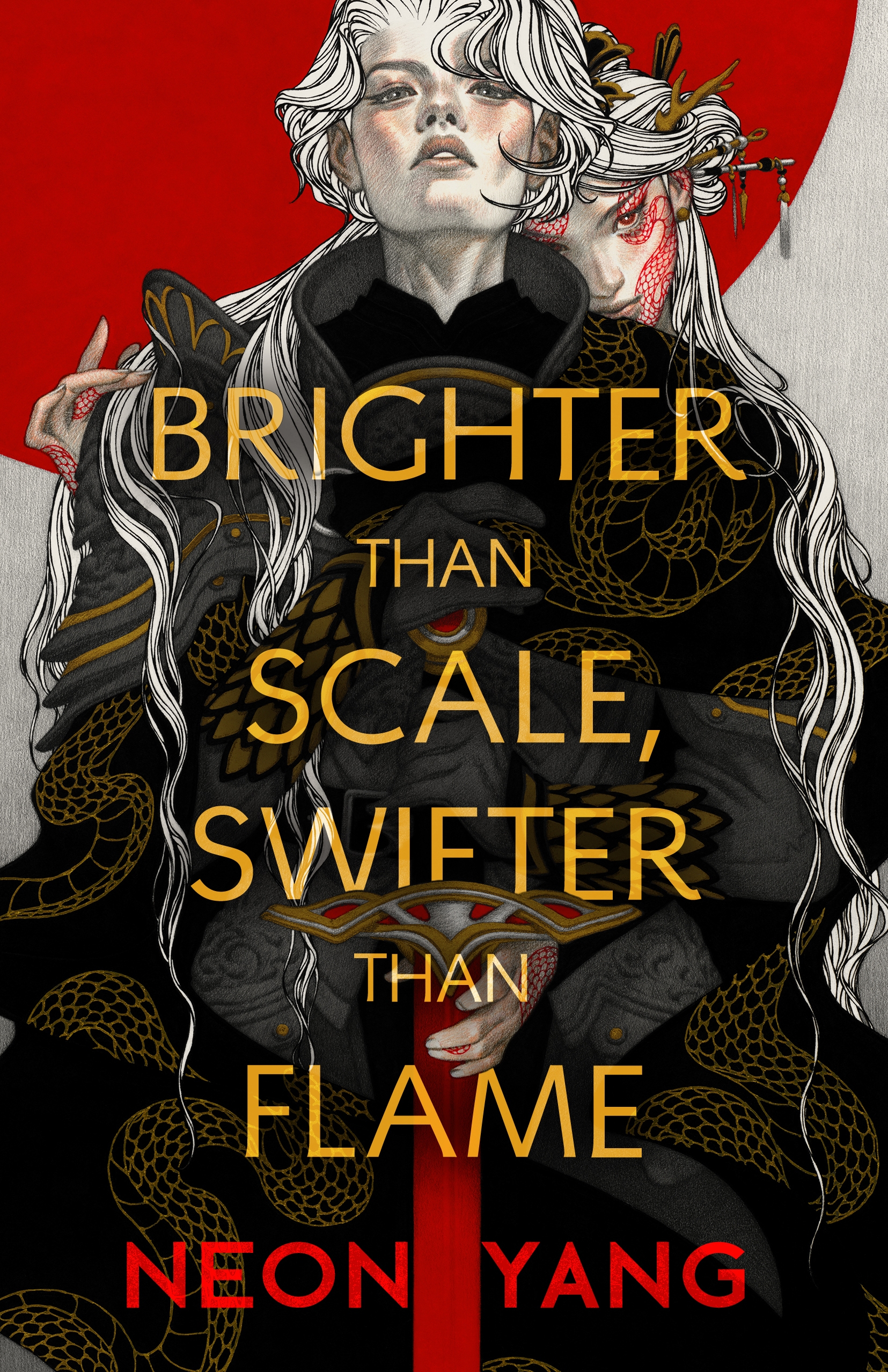
Their latest book, Brighter Than Scale, Swifter Than Flame, is a stunning queer novella about a dragon hunter finding home with a dragon queen. New York Times bestselling author Olivie Blake calls it, “A lovely, intricate gem of a fairy tale about finding yourself in another person and traveling distant lands to finally come home. I loved it.”

Kristen B. is a devoted bookworm lucky enough to work as the graphic designer for HCLS. She likes to read, stitch, dance, and watch baseball (but not all at the same time).

Two Tales of Two Sisters

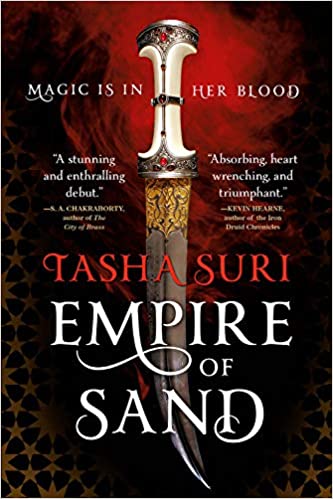
An ornate curved dagger with a jeweled hilt appears against a swirling red background, with "Magic is in her blood" at the top and Tasha Suri, Empire of Sand across it along the bottom.
Book cover of Empire of Sand

by Kristen B.

Empire of Sand opens with a young woman painting a window sill with her blood, looking to ward against the daiva spirits of the wild sands. In some ways, the rest of Tasha Suri’s duology revolves around these older spirits that have been subjugated by the Ambhan Empire – and by those who consider them monsters and those who count them as family. Suri’s books are set in a lush, vibrant world based on the Mughal Empire – complete with vast deserts and verdant oases. Here, the Emperor governs but the Maha rules. Here, the upper class consists solely of Ambhan people and the Amrithi are outcast because of their magic.

Mehr is the privileged child of the regional governor, acknowledged but nonetheless the daughter of an Amrithi courtesan. She possesses the full inheritance of her mother’s people, but is protected by her father’s influence. Mehr lives in an uneasy truce with her step-mother, who has adopted Mehr’s younger sister as her own daughter to be raised as an Ambhan noblewoman. Mehr has no ambition for a noble marriage, but when she is discovered practicing Amrithi magic, she is given little choice.

The Maha rules the Empire through the prayers of his mystics. When Mehr accidentally divulges her abilities, she is forcibly married to the powerful mystic Amun and taken away to live a sequestered life in a distant oasis. At the Maha’s Temple, Mehr learns that she and her husband are expected to perform the Rite of the Bound. This magical rite, a choreographed dance with particular poses and gestures, allows the magic of the desert daiva and older gods to flow through the Maha and into the Empire, extending its territory and influence. Through their practice and discipline, Mehr and Amun learn about each other and the tragedies that brought each to the Maha’s temple.

It is this romance of desperation and rebellion that powers the second half of the book. I read this novel in large gulps, needing to know what happened next. As much as I enjoyed the world building, I truly came to love both Mehr and Amun, rooting for them to find a way to be together and free of the Empire. The underlying themes of colonization and prejudice give Empire of Sand an unexpected sense of gravity. There is no doubt but that individual lives were used and abused for the supposed greater good. The consequences of generations of such cruelty cannot easily be constrained or controlled.

A spear points downward against a patterned blue background, with "A curse is upon the throne" in gold script above "Realm of Ash" overlaying the spear, and "Tasha Suri" at the bottom.
Book cover of Realm of Ash

The second book, Realm of Ash, deals with the unfolding repercussions from Mehr and Amun’s story, but from another perspective entirely. We encounter Mehr’s younger sister, Arwa, again as she makes her way to a distant convent for widowed noblewomen. Arwa was, indeed, raised as an Ambhan noblewoman and married a military officer with a bright future. When the garrison is massacred by daiva, Arwa is one of the few survivors and chooses to absent herself from high society. Not entirely surprisingly, the convent is a hotbed of Imperial politics and Arwa soon finds herself on the way to the capital city to serve in the retinue of a princess.

Where her sister has the magic of the Amrithi rites, Arwa discovers that she has a different ability that allows her to access the memories in her blood, remembrances of her ancestors, in the Realm of Ash. The princess’ illegitimate brother lives in nocturnal solitude, researching and experimenting for a way to restore the Ambhan Empire to its former safety and prestige. Arwa must learn to embrace her Amrithi heritage to help the prince and to accept her own worth. Again, a forbidden romance (Ambhan noblewomen may not remarry) lies at the heart of a rebellion against a court built on deception and corruption. And again, I found myself rooting for these two against all odds.

In some ways I preferred Realm of Ash because it shows more of the interconnected elements of the Ambhan Empire, the military and the regular people of Jah Ambha (the capital city), servants and spies. As Arwa and her prince flee into the desert and join a pilgrimage, the wide variety of life outside of palaces and temples make for a wonderful sense of place and history. The bigger picture at play in the second book is, perhaps, only made possible by the laser focus of the first novel.

The fantasy genre is chock-full of strong heroines, women who can outfight anyone and snark about it after … the term kick-ass is usually employed. Mehr and Arwa gave me a much more grounded reality, finding their courage in the face of terrifying odds. Neither young woman wants to be an agent of change or is a rebel at heart. Both have learned to keep their heads down and mouths shut so as not to attract attention or draw criticism. They do have, however, an unerring sense of fairness and a desire to be allowed to live their own lives, loving whom they choose. These sisters indelibly alter their entire world by being brave enough to take the chances presented to them, sometimes fearlessly and sometimes with only a hope and a prayer.

Kristen B. is a devoted bookworm lucky enough to work as the graphic designer for HCLS. She likes to read, stitch, and take walks in the park.