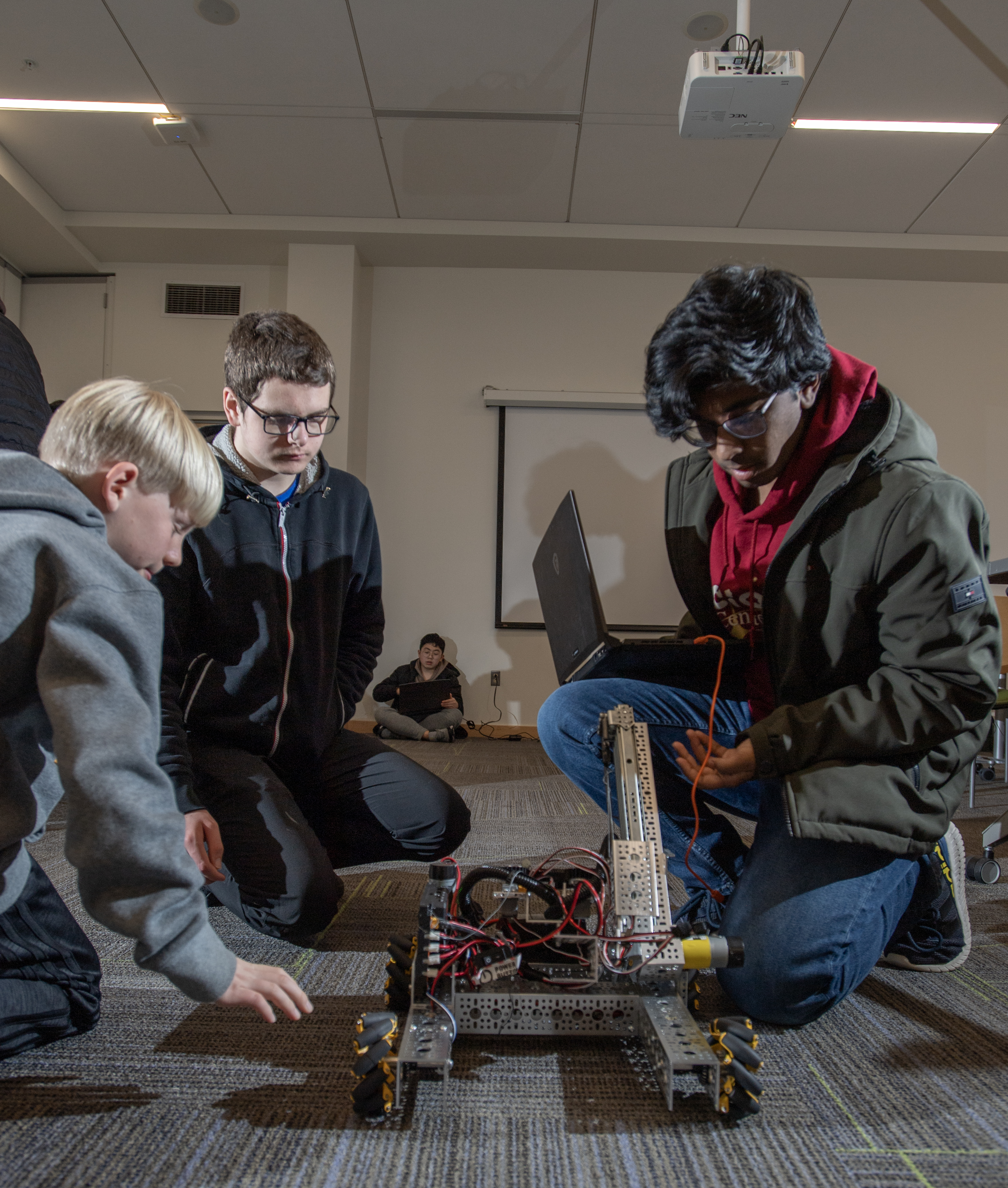
Spring Break with HiTech

HiTech is the library’s award-winning STEAM program for teens. Using advanced teaching tools and technology, our instructors encourage and inspire the next generation of STEAM (science, technology, engineering, art, and math) professionals. Held year-round, our classes foster free expression while teaching critical skills and exciting STEAM concepts.

All spring break classes take place at Savage Branch from March 25 – 28 for middle and high school students. Registration and more information available here.

Origami Engineering
10 – 11 am, Savage Studio
Get hands-on experience in the ancient art of paper folding. Use origami to create structures like solar panels, bridges, and packing materials. Look at tessellating polygons and how these amazing structures
can be used by scientists and engineers.

Wonders of Chemical Reactions 1
10 – 11 am, Carver Lab
Explore chemistry in a fun and colorful environment. Conduct experiments that range from the physical and chemical properties of matter to Thermodynamics and Thermochemistry, and even Acid-Base Chemistry.

Acoustic Science
12 – 1 pm, Savage Studio
Learn about the science of acoustics as you explore the engineering of basic PA systems and small studio setups. Topics include sound, frequencies, dynamic microphones vs condenser microphones, and how to build a speaker/monitor.

STEM Heroes
12 – 1 pm, Carver Lab
Did you know that Mae Jemison made history as the first Black female astronaut? She is also an engineer, a physician, a professor, and an entrepreneur. Explore people throughout history and today who have contributed to the sciences.

Forensic Science: Biology
2 – 3 pm, Carver Lab
Have you ever wondered what goes on during a crime scene investigation? Learn the techniques forensic scientists use, such as fingerprinting, footprinting, and DNA analysis.

Movie Magic: Chroma Key
2 – 3 pm, AV Studio
Dive into the world of video special effects as you create your own reality. Record and edit video as you learn about the chroma key technique and how it evolved over time.

Audio Video Technology Workshop
4 – 5 pm, AV Studio
Record and mix music or create videos in the sound booth and with other equipment.

Cosmology
4 – 5 pm, Carver Lab
Do you watch The Big Bang Theory and want to know more about the Big Bang? Study the origin and development of the universe, and learn how to identify stars, constellations, and planets in the night sky.

Summer Reading Adventures: Friendship Stories

By Eliana H.

Some of you may have already collected your finisher prizes for our Summer Reading Adventure. If you have, congratulations! Great job reading and completing activities. It’s not too late to visit one of our branches to collect your prize if you haven’t. They are available through Thursday, August 31, as long as supplies last. If you’re still working on finishing those last few reads, I have a highlight for you from each of our elementary lists. This time, I’m focusing on friendship stories. 

Grades K-1: 

Amy Wu and the Warm Welcome by Kat Zhang (also available as an e-book)

The cover depicts an array of children and a white kitten, holding a gold and white banner with the book's title written in fuschia.

This book offers a beautiful beginning, showing ways to say “welcome” from around the world even before the title page. Amy is excited to see a new student join her class, but he doesn’t talk at all during the school day, even when she tries very hard to make him feel welcome. When she sees him light up and talk away to his little sister – in Chinese – she’s surprised to see how different he is! Amy thinks hard and comes up with an idea of another way to make him feel welcome. Check the book out to see if Amy succeeds, and be sure to explore the craft idea and note from the author.

Grades 2-3: 

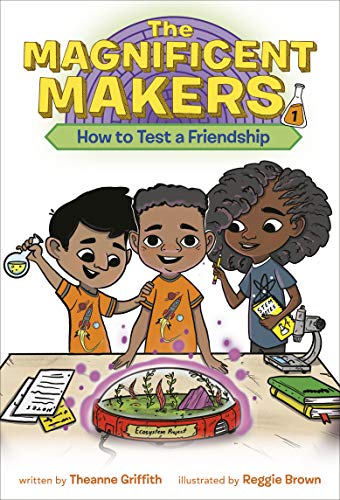
How to Test a Friendship by Theanne Griffith

The book cover shows three students working on a science project involving a miniature ecosystem under a dome, with books and a microscope on a table in front of them. One of them holds an Erlenmeyer flask and another holds a pencil and a booklet that says "STEM notes." All three are wearing t-shirts with science motifs - two have rockets, planets, and stars, and the third has a diagram of an atom.

How to Test a Friendship, the first title in the series Magnificent Makers, introduces readers to third graders Pablo and Violet, best friends who are looking forward to being in the same class and studying science, their favorite subject. When new student Deepak appears and starts making friends with Violet, Pablo is not very excited. But the three suddenly find themselves transported to the Maker Maze when they solve a riddle in science class. They must complete challenges to return to their world, but they will only finish in time if they work together. Can Pablo set aside his hard feelings toward Deepak so that they make it home in time? Do they know enough to solve the puzzles? If your young scientist is feeling inspired, be sure to take a look the STEM activities in the back to try at home! 

Grades 4-5: 

The Witchlings by Claribel A. Ortega 

The cover depicts three of the witchlings - one with a worried expression who is wringing her hands, one with a smug expression with arms crossed, and one wide-eyed, facing forward. There are buildings with peaked roofs and turrets in the background, and the eyes of the Nightbeast are superimposed over the starry night sky.

Readers who enjoy fantasy will love The Witchlings, offering another unique view of magic and the world by the author of Ghost Squad. It’s the night of the Black Moon Ceremony, when Witchlings are placed in their covens, and twelve-year-old Seven Salazar knows exactly where she wants to be: House Hyacinth, with her best friend Poppy. Instead, Seven’s worst nightmare comes true. She’s named a Spare, one of the three witches left over at the end of the ceremony, along with Thorn, who is new to town, and Valley, Seven’s long-time enemy. Spares are stripped of their magic and treated poorly, but Seven invokes the rarely used Clause of the Impossible Task. If she and the other Spares can accomplish the Impossible Task, they will complete their circle and become a true coven. When they learn they need to find and defeat the dreaded Nightbeast, Seven and her coven wonder what they’ve gotten themselves into. Little do they know, Seven, Thorn, and Valley will uncover even darker and more mysterious things lurking in their town of Ravenskill. They need to work together and learn to trust each other if they have any chance of success. Check out The Witchlings to discover whether they manage the impossible and overcome their own pasts and fears, as well as the dark powers working against them.

Be part of HCLS’ Summer Reading Adventures.

Eliana is a Children’s Research Specialist and Instructor at HCLS Elkridge Branch. She loves reading, even if she’s slow at it, and especially enjoys helping people find books that make them light up. She also loves being outside and spending time with friends and family (when it’s safe).

Feeling Curious? Take the Curiosity Challenge!

A teen sits in the biography isles reading at the Miller Branch during a summer reading adventures teen after-hours event.

by Emily B.

Have you embarked on your Summer Reading Adventure yet? If not, head to any HCLS branch to begin your Summer Reading Adventure or participate online through ReadSquared. There are Summer Reading games and prizes for all ages. Visit hclibrary.org/summer/ for all the details on this year’s Summer Reading Adventures.

One of the fun challenges this year for all ages is the Curiosity Challenge. To partake in this challenge, simply read a book on any topic you’re curious about. No matter your interests, we can help you find a book to satisfy your curiosities!

Here are some books to spark your curiosity:

Science: With a wide range of science-related topics covered in these books, you’re sure to learn something new and you might even find additional topics to explore!

The Highlights Book of How: Discover the Science of How the World Works by Libby Romero (CHILDRENS 500R)

Science Superstars: 30 Brilliant Women Who Changed the World by Jennifer Calvert (509.2C)

The Science of Science Fiction by Matthew Brenden Wood (TEEN 500W)

What If? 2: Additional Scientific Answers to Absurd Hypothetical Questions by Randall Munroe (500M)

Entertainment: Learn more about the games, movies, and TV shows you love with behind-the-scenes photos and stories and retrospective analyses.

What is Nintendo? by Gina Shaw (CHILDRENS 338.761S)

Star Wars: The Mandalorian Handbook by Matt Jones (CHILDRENS 791.4572J)

Gamer Girls: 25 Women Who Built the Video Game Industry by Mary Kenney, illustrated by Salini Perera (TEEN 794.8092K)

Blood, Sweat, and Pixels: The Triumphant, Turbulent Stories Behind How Video Games Are Made by Jason Schreier (794.8S)

Best. Movie. Year. Ever.: How 1999 Blew Up the Big Screen by Brian Raftery (791.4309R)

History: Learn the incredible story of World War II Resistance leader Virginia Hall. A Maryland-native, Hall’s work with espionage, reconnaissance, and sabotage were instrumental in the eventual defeat of the Axis powers.

Agent Most Wanted: The Never-Before-Told Story of the Most Dangerous Spy of World War II by Sonia Purnell (CHILDRENS B GOILLOT P)

Code Name Badass: The True Story of Virginia Hall by Heather Demetrios (TEEN 940.5486D)

A Woman of No Importance: The Untold Story of the American Spy who Helped Win World War II by Sonia Purnell (940.5486P)

Be part of HCLS’ Summer Reading Adventures.

Emily is an Instructor & Research Specialist at the Central Branch. She enjoys puzzling, reading, listening to music, and re-watching old seasons of Survivor.

Stress Free Steam

A black and white photo of a paper snowflake in a window, overlooking benches, trees, and garden beds in the Enchanted Garden of the Miller Branch at HCLS.


Feeling stressed?  Relieve some of that tension and join us for Stress Free STEAM. In this low-key, hands-on monthly series, commune with other adults while exploring various topics in Science, Technology, Engineering, Arts, and Math.

Each class session focuses on a different subject and features an engaging and creative hands-on project. Among other inventive projects, previous creative customer favorites have included miniature cabinets of curiosity, Japanese Gyotaku fish prints, and Fibonacci spiral paper sunflowers.

On Thursday, January 5 we will examine the science of snowflakes. Learn why no two snowflakes are alike, among other fascinating facts, before making a unique paper snowflake.

All abilities welcome. Beginners and the non-crafty are encouraged to come. Materials provided.

Stress Free Steam for Adults meets at the Miller Branch on the first Thursday of the month. Register here.

Holly is an Instructor and Research Specialist at the Miller Branch. She enjoys knitting, preferably with a strong cup of tea and Downton Abbey in the queue.

Author Works with Robin Wall Kimmerer

The book cover shows a single braid of yellow sweetgrass stretching horizontally below the title.

Wed, Sep 14, 7 – 8:30 pm
online
Register at bit.ly/braidingsweetgrasshcls

Acclaimed author and scholar Robin Wall Kimmerer explores the dominant themes of her book Braiding Sweetgrass: Indigenous Wisdom, Scientific Knowledge, and the Teachings of Plants, which include cultivation of a reciprocal relationship with the living world. Consider what we might learn if we understood plants as our teachers, from both a scientific and an indigenous perspective.

Robin Wall Kimmerer is a mother, scientist, decorated professor, and enrolled member of the Citizen Potawatomi Nation. Her first book, Gathering Moss: A Natural and Cultural History of Mosses, was awarded the John Burroughs Medal for outstanding nature writing, and her other work has appeared in Orion, Whole Terrain, and numerous scientific journals. She tours widely and has been featured on NPR’s On Being with Krista Tippett and in 2015 addressed the general assembly of the United Nations on the topic of “Healing Our Relationship with Nature.” Kimmerer is a SUNY Distinguished Teaching Professor of Environmental Biology, and the founder and director of the Center for Native Peoples and the Environment, whose mission is to create programs which draw on the wisdom of both indigenous and scientific knowledge for our shared goals of sustainability.

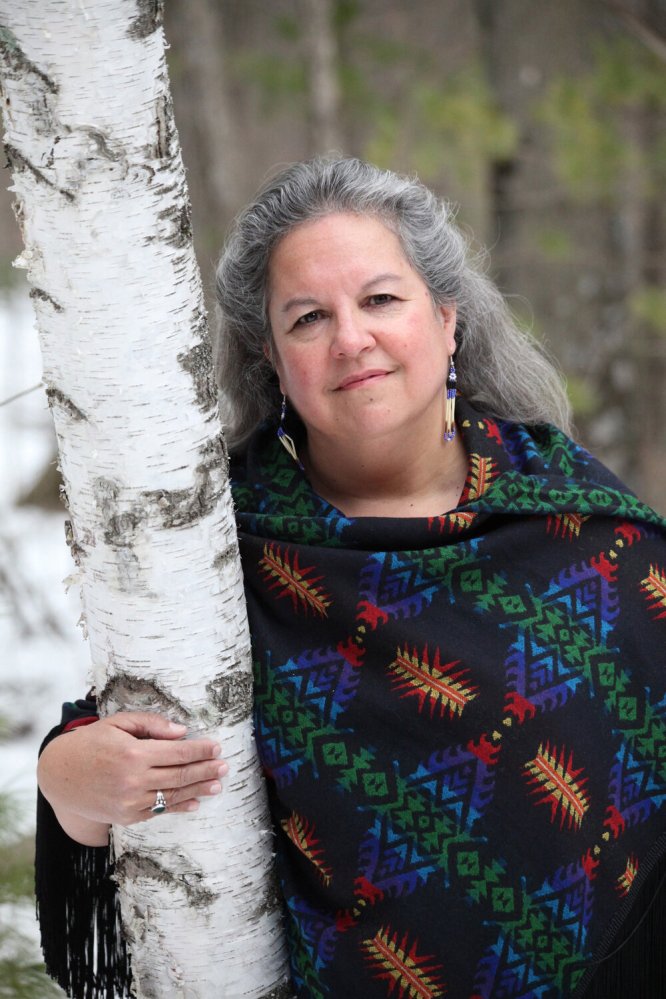
The author, with long grey hair pulled away from her face, leans against a white birch tree. She is wearing a richly colored and patterned poncho and dangling beaded earrings.

As a writer and a scientist, her interests in restoration include not only restoration of ecological communities, but restoration of our relationships to land. She holds a B.S. in Botany from SUNY ESF, an M.S. and Ph.D. in Botany from the University of Wisconsin and is the author of numerous scientific papers on plant ecology, bryophyte ecology, traditional knowledge and restoration ecology. She lives on an old farm in upstate New York, tending gardens both cultivated and wild.

Braiding Sweetgrass is available to borrow in print, e-book, and e-audiobook, or you can purchase online from The Last Word Bookstore.

The event is part of the “Guide to Indigenous Maryland” project. This program is supported in part by the Institute of Museum and Library Services, through the Library Services and Technology Act, administered by the Maryland State Library, as well as by the Prince George’s County Memorial Library System. Maryland Libraries Together is a collaboration of Maryland libraries to engage communities in enriching educational experiences that advance an understanding of the issues of our time. Learn more at bit.ly/indigenousmd

Visit us at the Howard County Fair

STEAM Machine with blue awning deployed sits on a grassy patch, with a popup tent next to it.

Do you love the fair? Deep fried everything? Rides? Awards for livestock and hand-crafts? What’s not to love?

This year, as you come in the front gates, look for Howard County Library System’s new STEAM Machine. Stop by to participate in a STEAM-related activity, watch a demo, or take a tour of our new (air conditioned!) mobile unit. The 33’ Farber diesel bus features a climate-controlled classroom that seats twelve students. It is equipped with Wi-Fi, laptop computers, two 49” LED TVs, sound system, video production equipment, materials, and supplies, including science kits to conduct experiments and complete projects. A 55” LCD monitor and two awnings allow classes to be taught and activities conducted outside.

As the mobile classroom goes out into our community, students can borrow books and other materials on STEAM subjects. Our goal is to transform students into scientists investigating new phenomena and engineers designing solutions to real-world problems.

Tonya Aikens, President & CEO of HCLS, notes, “Howard County Library System is coordinating with community partners to schedule STEAM Machine classes across the county. Our goal is to bring opportunities for hands-on STEAM education to students from under-resourced communities and families who, for an array of reasons, are often unable to come to our branches.”

HCLS instructors will teach most classes with contributions from scientists and engineers from the Maryland STEAM community, who will be recruited for special events. HCLS is collaborating with community partners to determine student aspirations and needs, identify community locations for STEAM Machine visits, and schedule classes and events. 

The STEAM Machine is funded in part by an American Rescue Plan Act (ARPA) Grant through the Institute of Museum and Library Services and administered by the Maryland State Library Agency.

See you at the Fair!

Foundation by Isaac Asimov

The black cover serves as a backdrop to delicate repeating patterns. A second white incomplete circular design on the bottom half draws your eye to a vanishing point.

By Ben H.

Foundation, the first book in Isaac Asimov’s Foundation series, is a sci-fi touchstone. I’m sure it’s been called a towering work of genius or a staggering work of brilliance. More importantly, it’s just been adapted for the small screen (I haven’t seen the show, but I’ve heard good things). The story’s three protagonists are a scientist, a politician, and a trader. Asimov explores big scientific, political, and economic ideas, and his protagonists give the reader a clue.

Asimov speculates that we will one day be able to predict the future using science. Psychohistory is born from the blending of (I bet you can guess) psychology and history. It’s used to predict the movements of large groups of people (the masses of humanity living their quietly desperate lives). We meet Hari Seldon, the most accomplished psychohistorian the galaxy has ever seen, on the planet of Trantor. Seldon tells Gaal Dornick, the scientist protagonist, that the current and seemingly stable galactic empire will fall and the galaxy will be plunged into thousands of years of chaos and barbarism. Seldon has a plan that, if executed properly, will save the galaxy thousands of years of chaos. Don’t get too attached to Gaal. Asimov moves through narrators pretty quickly. 

According to the plan, Seldon establishes the first Foundation on the remote planet Terminus. He tasks scientists and academics with compiling an encyclopedia of the galaxy’s vast knowledge. They attack their goal with fervor. Meanwhile, the rest of the galactic empire is resting on its laurels and starting to collapse. 

Fast forward a few decades and Salvador Hardin is the next narrator (the political narrator). Hardin is a very 60s sci-fi cool customer, space cowboy narrator. At this point Seldon reappears as a hologram (being dead) to provide hints or tips to keep the galaxy moving in the right direction, according to his plan. Hardin, the mayor of the planet Terminus, helps the planet through the first Seldon crisis, which is a time identified as a key turning point in the future of the galaxy. Each crisis must happen a certain way for the plan to be successful. 

The last narrator is Hober Mallow, a trader working for The Foundation. At this point, The Foundation produces technological marvels that they trade to the surrounding planets. Most traders spread the religion Hardin created and tied to The Foundation’s technology to new planets. The new planets buy the technology, sometimes accept the new religion, and become regular customers. The traders make money and the surrounding planets become dependent on The Foundation. 

Foundation is full of big ideas. Bloated bureaucracies, social elites, centralized governments, hyper-specialized professionals, cynical capitalists, zealous religious fanatics, and downtrodden regular folk populate the pages. It’s a thought-provoking story of the collapse of an empire.

Foundation is also available from HCLS in eBook and eAudiobook format from Libby.

Ben Hamilton works at Project Literacy, Howard County Library’s adult basic education initiative, based at HCLS Central Branch. He loves reading, writing, walking, and talking (all the basics).

Chernobyl on Page and Screen

By Kristen B.

It’s not exactly a cheerful topic – the most devastating nuclear accident ever to have happened. However, the story of what went wrong is riveting and amazingly complex. More than 30 years ago, on April 26, 1986 at 1:23:58 am, one of the nuclear reactors at the Chernobyl site suffered a massive explosion and containment failure, which led to fallout poisoning in large areas of Ukraine and Belarus. At the time, the Soviet government was more concerned with containing the political and international ramifications than protecting its citizenry. I have to admit that until recently I hadn’t thought much about Chernobyl other than as an unfortunate incident that happened during my teenage years.

A member of the book discussion group that I moderate, Books on Tap, advocated for reading oral histories and books in translation, particularly this one. She argues (and I agree) that it’s a marvelous way to gain insight and perspective from other cultures and points of view. Voices of Chernobyl: The Oral History of a Nuclear Disaster presents the ultimate expression of telling stories “in their own voices.” Svetlana Alexievich, who won the Nobel Prize in Literature, wrote it 10 years after the nuclear accident, and it was more recently translated in 2014. The book presents the written account of her interviews with a wide cross-section of people who lived through the catastrophe and the subsequent years. A surprising number of people returned to their homes or fled to the “open” country as other Soviet Socialist Republics disintegrated into ethnic warfare. They often refer to Chernobyl as “war,” being their only other frame of reference to so many people dying and the subsequent governmental propaganda. Although it can feel a bit repetitive, that sheer recounting from so many different people – teachers, party loyalists, army conscripts, wives, and mothers – drives homes the devastating, ordinary reality of living on top of nuclear fallout.

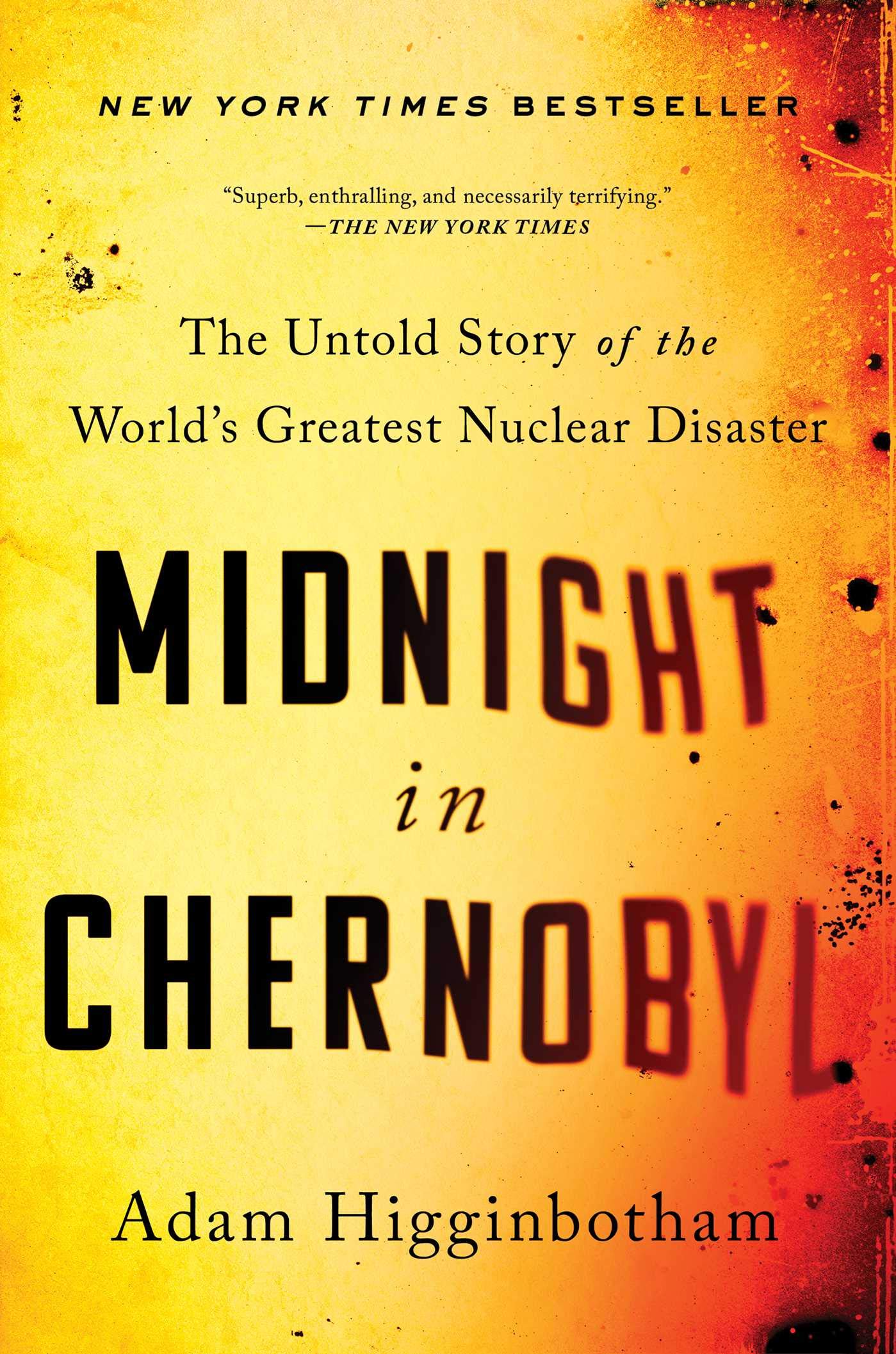
Midnight in Chernobyl by Adam Higginbotham (also an eBook and eAudiobook) offers another side of the story, one rich in politics and science. Where the previous title provides a direct line to individuals, this book takes a much larger overview of the history of Chernobyl – literally starting with the creation of the plant and its company town along a marshy stretch of wilderness. The perfidy of the Soviet institution’s need for results and optics, above any adherence to safety and good practice, was something I had forgotten since the fall of the USSR. The Chernobyl disaster was nonetheless a direct result of the political reality during that time… and in fact contributed to the fall of the communist regime. This book draws on interviews and recently declassified archives to bring the disaster and the people who lived through it to life. Although there’s a short holds list for the book, it’s worth the wait.

HBO aired a five hour, five episode Chernobyl miniseries in 2019 that combined the source material from these two books into an excellent show about what happened during the explosion and in the two years after, available to borrow as DVDs. You can’t turn away from the real-life drama unfolding on the screen, not even knowing the basic outlines of the story. All sources, books and screen, point to the complete cognitive dissonance of dealing with an accident that was largely deemed to be impossible. The show is immensely well-written and well-acted, pulling you in almost despite yourself. Content warning: The middle episode contains some particularly hard scenes of “cleaning up” wildlife and abandoned pets. Here, too, the faces and the voices give a human accounting to an unimaginable tragedy.

The area will not fully return to “safe” for millennia, barring any further contamination. I feel like this was an important moment in time, and only now can we begin to appreciate its history. I also hope it will give us some optimism about human resilience and the ability to solve big problems… because one thing has been made perfectly clear: it could have been so much worse.

Kristen B. is a devoted bookworm lucky enough to work as the graphic designer for HCLS. She likes to read, cook, and take walks in the park.