
Clear by Carys Davies

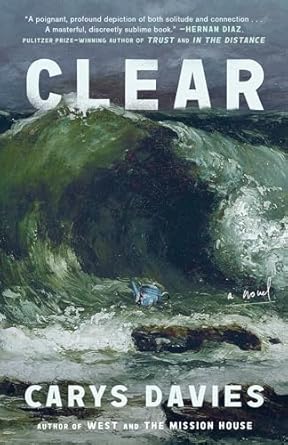
The book cover depicts a large green, black, and white wave turning over some large brown rocks at the shoreline, under a grey sky. What appears to be a metal teapot is floating beneath the waves.

By Piyali C.

The more I read the more I realize how little I know. I was confused about the title of this exquisitely written novel, Clear, that talks about human connections. Why “clear?” I learned the significance in the Author’s Note, where I read about how 474 ministers broke away from the Scottish Church in the year 1843 to rebel against the system of patronage and form the new Free Church. I also learned about the controversial Clearances.

In the novel, John Ferguson is an impoverished priest of the New Church forced to participate in a significant social upheaval in Scotland at the time: the Clearances that began in the Lowlands, spanning from the mid-eighteenth century to the mid-nineteenth century. Farmers were forcibly removed from their lands by the landowners to use those fields for crops, cattle, and sheep. The farmers and their families were dispossessed of their livelihood and forced to move to concentrated lands where they could not produce enough food for sustenance, which resulted in mass exodus to industrialized cities. Many sold all their belongings to find passage on ships to the United States, Canada, or Australia to start anew. 

John Ferguson takes up the job of evicting the lone tenant, named Ivar, of a remote island. Ivar has been living by himself for over a decade with his old horse, a blind cow, and a few hens and sheep. John’s wife, Mary, is opposed to this dangerous journey, but John is adamant about earning enough money to build his own church facility to practice the teachings of the New Church. Upon arrival, John falls off an island cliff, sustaining life threatening injuries. Ivar, the man whom John has come to evict, finds the unconscious John and nurses him back to health. Despite their language barrier, the two men find a connection, while John faces a dilemma about having to disclose to Ivar, his savior and friend, his real reason for the journey. Mary, in the meantime, has had no communication from John; she sells everything to buy passage to travel to the island herself to find out what has happened to him. The story takes an interesting turn when the three main characters come together. 

Clear is not only a story of immense beauty; it is also a big-hearted story of hope, ambition, and most of all, the interconnectedness of human hearts. The paucity of words in the book somehow intensifies the beauty and the depth of the characters, the plot, and the setting. Through the magic of Carys Davies’ beautiful writing, the readers can hear the waves crashing against the rugged rocks of the island, feel the heat of the fire that Ivar builds to stay warm, and taste the slightly burnt milk mixed with cornmeal that Ivar feeds John to sustain his broken body. The book touches all our senses as we read the story. The words transport us onto the island, and we live John and Ivar’s life and feel their connection along with them. We understand Mary’s concern as she frets at the lack of communication from her husband and marvel at the ending, when all three characters converge on the island. What will happen to them next?

Clear by Carys Davies is available in print and e-book formats.

Piyali is an instructor and research specialist at HCLS Miller Branch, where she facilitates two book discussion groups: Light But Not Fluffy and Global Reads. She keeps the hope alive that someday she will reach the bottom of her to-read list.

Conan Doyle for the Defense

The photograph depicts an atlas and an old-fashioned brass lamp with a large white bulb, next to a misty window in a wooden frame. There is also a stoppered glass bottle in the foreground. The entire effect suggests a Victorian home or office.

By Eliana H.

Although I’ve enjoyed many a Sherlock Holmes adaptation in the form of film or television, or even spinoff books, I will admit that I haven’t read the original stories myself. I certainly don’t know a great deal about Sir Arthur Conan Doyle, the famous creator of the residents of 221b Baker Street. I do, however, know quite a bit more now than before reading Conan Doyle for the Defense: The True Story of a Sensational British Murder, a Quest for Justice, and the World’s Most Famous Detective Writer by Margalit Fox. Nonfiction is not my usual wheelhouse, but I will admit my interest was piqued by the book’s cover and description, which happened to be available as an e-audiobook when I was looking for my next listen. (It is also available in print and as an e-book).

The book cover has the title and subtitle in stylized fonts with the effect of an old-time newspaper, superimposed above illustrations of a jeweled necklace and a hammer.

Many people have heard of Sir Arthur Conan Doyle as an author, specifically of the series of detective stories featuring Sherlock Holmes and Dr. John Watson. His impact extends beyond those characters, though. Conan Doyle was trained as a physician himself, and he became enthusiastic about spiritualism in his later life. He also assisted with real-life criminal cases on occasion. One such situation is the focus of Conan Doyle for the Defense. That case involved an emigrant to Scotland who was wrongfully arrested, convicted, and imprisoned for a murder he did not commit. 

Oscar Slater was a German Jew who had traveled to different parts of the world before ending up in Glasgow, Scotland in 1901. Then, in December 1908, a wealthy spinster named Marion Gilchrist was brutally killed in her home in that city. A very tenuous connection was made to Slater, and the prevailing attitudes and crime-solving techniques of the time ensnared him firmly, leading to his conviction and imprisonment in His Majesty’s Prison Peterhead. Eventually, Conan Doyle was able to help win Slater his freedom. 

Fox’s descriptions of the case, the criminal justice system, and the Edwardian time period provided vivid images of the tale as it unfolded. Excerpts of court documents, letters written by Slater, and Conan Doyle’s own texts provide additional insight into the case. The print book includes maps and photographs, as well as extensive notes to support the text. Fans of Sherlock Holmes may be interested to learn more about Conan Doyle’s life and inspiration for his characters, and the miscarriage of justice highlighted in the book can provide a reminder for all of us that there is always more to a case than appears at first glance. 

Eliana is a Children’s Research Specialist and Instructor at HCLS Elkridge Branch. She loves reading, even if she’s slow at it, and especially enjoys helping people find books that make them light up. She also loves being outside and spending time with friends and family (when it’s safe).

Red Bones by Ann Cleeves

The book cover is blue, with a dark sky and the full moon over the shoreline in Shetland.  An isolated white building is in the distance and the moonlight stretches over the water from the foreground to the horizon.

Review by Julie F.

Red Bones, the third book in the Shetland series of mysteries by Ann Cleeves, delves into the family of Sandy Wilson, the young policeman who works for main series character Jimmy Perez. Sandy’s family lives on one of the outlying Shetland islands, Whalsay, in a small community where an archaeologist has recently unearthed bones that may or may not be “ancient history.” When tragedy ensues, Detective Inspector Perez investigates how Sandy’s extended family, as well as the students and professor involved with the dig, might be culpable. Not just a family drama, the story also recounts how an isolated community of individuals gossips, lies, and hides secrets, even from those they love the most.

The novel is also an interesting exploration of Sandy’s character. Early in the book, Perez is, “surprised that Sandy had shown so much initiative, wondered if he should congratulate him or if that would just be patronizing. In the office Sandy was always considered a bit of a joke. Perez had shared the low opinion at times” (35). Based on that description and his actions in the first two books in the series, Sandy could easily develop into a stock plodding detective, uninspired and demonstrating little intelligence or motivation. Instead, we see Perez give him challenges and progressively more difficult assignments throughout the case. He struggles with hard questions, matures, and takes on more responsibility, which is a testimony to Ann Cleeves’ ability to keep her characters multi-dimensional.

One of the things I love most about these books is how the characters and their relationships to one another grow throughout the series. Although the book furthers Perez’s personal story, including his budding relationship with artist Fran Hunter and her daughter Cassie, it is equally Sandy’s story, and that of the generations on the island who share a collective past both desperate and painful.

I listened to the audiobook on CloudLibrary as I read along, and narrator Gordon Griffin, an actor and dialogue coach, conveyed Cleeves’ beautiful, remote setting with dramatic (but never overblown) narration in an authentic accent.

I highly recommend the first two Shetland books, Raven Black and White Nights. If you enjoy the work of Ann Cleeves, look for her DI Vera Stanhope series (the first one is The Crow Trap, available as an ebook) as well as her newest series, Two Rivers, set in Devon, England and featuring detective Matthew Venn. The first book, The Long Call, is also available in ebook and eaudiobook from Libby/OverDrive. And if you enjoy the novels, both Shetland and Vera are available in DVD format at HCLS in television series produced by the BBC and ITV, respectively.

Ann Cleeves is a 2017 winner of the Diamond Dagger of the Crime Writers’ Association, the highest honor in British crime writing. She also won the Agatha Award in the Best Contemporary Novel category for The Long Call. Visit her website to learn more about this remarkable author.

Julie is an instructor and research specialist at HCLS Miller Branch, where she facilitates two book discussion groups – Spies, Lies, and Alibis and Bas Bleu.