The Let Them Theory by Mel Robbins

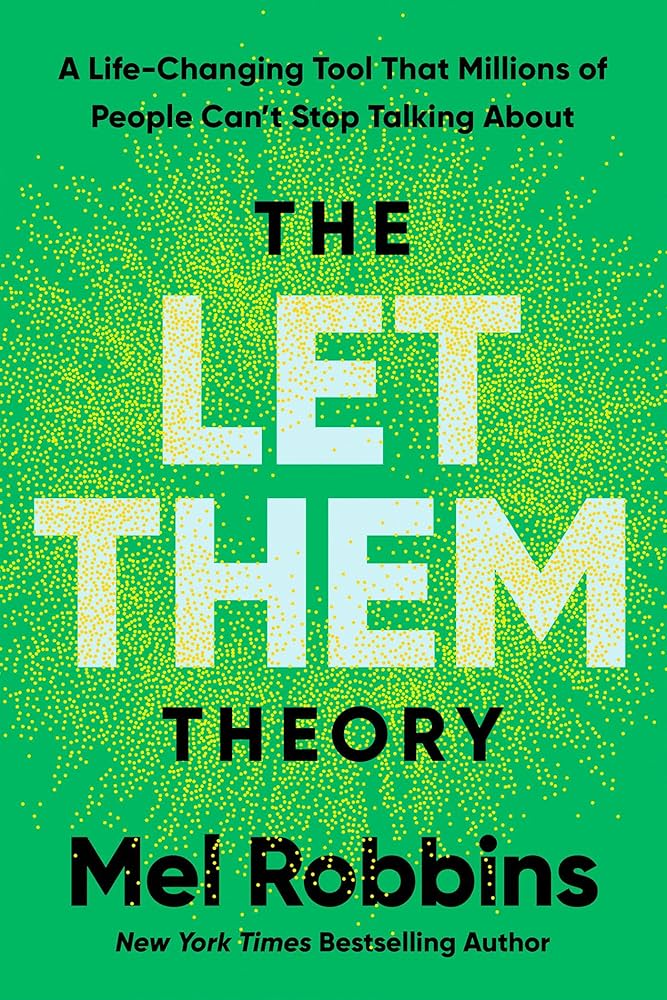
A bright green clor has an explosion of yellow dots, like someone threw confetti at the center of the book.

by Carmen J.

Days before the new year had me ruminating about resolutions and the things I want to accomplish in 2025. Work out more? Eat better? Stop procrastinating about my dreams? Sound familiar? Have you made similar intentions and broke them, and kept them, only to break them again?

This year, I turned to “my friend Mel” – as she regularly coins herself to her millions of followers of The Mel Robbins Podcast and her readers of best-selling titles such as The 5 Second Rule and The High 5 Habit.  I am savoring her latest work, The Let Them Theory: A Life-Saving Tool That Millions of People Can’t Stop Talking About. It’s the book I never knew I needed.

Simply put, the theory puts into sharp perspective how we can’t control others, including their thoughts, emotions, and opinions about us. Similarly, we can’t control when things don’t necessarily go our way. For example: If someone decides they don’t like you or an opinion you have or the way you live your life: Let Them. Often times, there will be nothing you could say or do to change those thoughts, emotions, and opinions. Consequently, what we can control is the next step: Let Me. The Let Me is our reaction, the thing we can control. Sometimes the reaction is no response, or it’s setting boundaries, or having difficult conversations that need to be had. Robbins shares more in-depth strategies and experiences from her own life and from her followers.

If you are one who has people pleased and sucked it up, all in the gallant hope of keeping the peace, Robbins’s book will be a walk through mud: uncomfortable and messy, yet survivable and relatable nonetheless. It’s part of the human condition to wonder and think about the opinions of others and try to check all of the boxes in accordance. What if we vow this year in the face of uncertain times or certainly hard times and with the utmost certainty to let the chips, opinions, and emotions happen. Let Them wash over you without fury but with fearlessness. And Let Me (and Us) make the focused choice not to change course and be OK with any mild discomfort. Let Them, Let Me, Let Us be better for it.

The Let Them Theory: A Life-Saving Tool That Millions of People Can’t Stop Talking About by Mel Robbins is available in print and e-book.

Carmen J. is a teen instructor at HCLS East Columbia Branch. Among her favorite things are great books, all things 80s, shamelessly watching The Bachelor, gardening, and drinking anything that tastes like coffee.

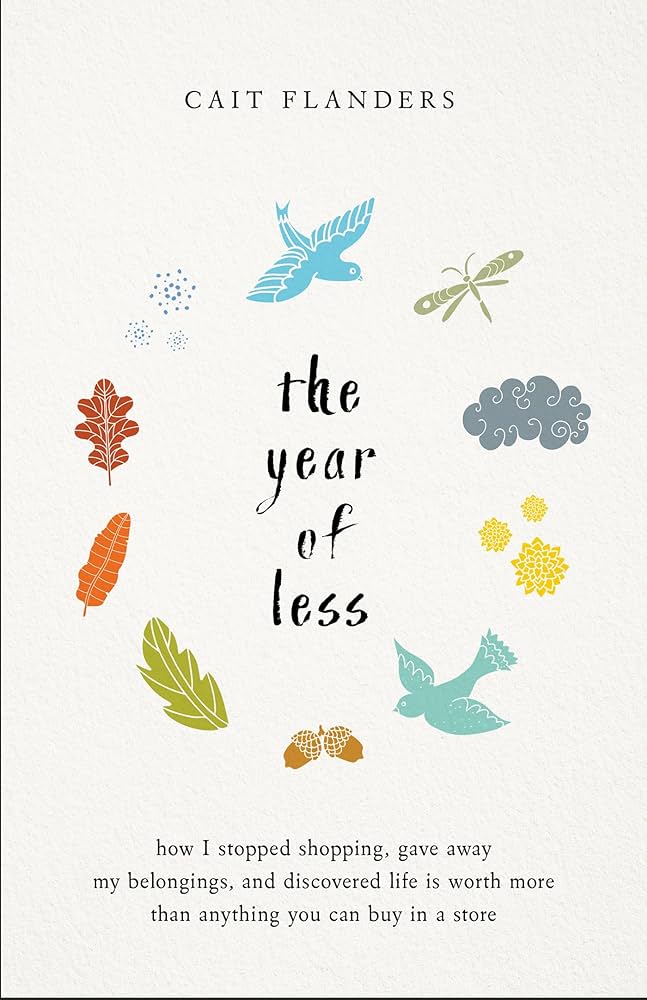
The Year of Less by Cait Flanders

Small colorful illustrations of a birds, flowers, and leaves sit around the title in a minimalist composition.

by JP Landolt

Do not mistake this title for another ode to Marie Kondo’s practice of sparking joy and tidying up, but more as a diary of an experiment created to help a young woman find herself. Themes of addiction, depression, and “doing hard things” fill these pages. Flanders is an established freelance writer, current co-host of the podcast Budget & Cents, and author. Forbes featured her 2015 experiment, described as a year-long shopping ban. That post resulted in book offers and the subsequent publishing of The Year of Less in 2018.

Cait gives us a brief synopsis of all the previous experiments she has completed: a year dedicated to weight loss, another year getting sober, then another getting debt-free as outlined on her former blog (blondeonabudget.ca). She outlines a set of rules designed to de-clutter her life, save money, and live with less.

Admittedly, I almost stopped listening to this book with the introduction. Was this going to be another variation of minimalism from a self-important, self-righteous, affluent-organizational-trend-setter-wannabe? No. She explicitly says she does not judge anyone’s choices. These choices were necessary for her, and she could only share her experience. Once I heard that and put aside my bias, I found Cait to be a sincere young woman who struggled with the same things that most of us do, including weight and self-esteem, debt and savings, and family issues. She sets intentions with these multifaceted experiments which eventually help her accomplish her goals.

She lost 30 pounds, paid down $30K in consumer debt, and finally got sober!

All these accomplishments are monumental achievements alone, and more so in succession! Each of these things are addictions that she combats daily. Flanders made huge, life-changing decisions while battling depression and coming to terms with her sobriety. Most experts would tell you not to do this. Somehow, it worked for her, and that is my only frustration with this book. I am reluctant to say it was her sheer will that pulled her through because that is false. She has admitted that she is naturally organized and does not suffer from any kind of executive dysfunction.

As an aside: If you struggle, and I mean STRUGGLE, with messiness or too much eating, too much buying – just TOO MUCH, I think Keeping House While Drowning may be a much better fit for practical systems and compassionate approaches while being neurodiverse. It’s a memoir with some tips, tricks, and advice in the epilogue.

Cait’s story is inspiring because she takes on the challenges, and she makes it through to the end with measurable data points. This book wraps up neatly; it is easy to find yourself rooting for her and simultaneously jealous of her integrity in satisfying her intentions. My greatest takeaway was this question that Cait started asking herself when facing a purchase (paraphrased): “Am I buying this (item) for who I am or am I buying this for the person I want to be?” 

While this is no “how to,” it is certainly inspirational and logical. If you want a simpler life filled with more quality than quantity, you must let go of things. And the less you have, the less you eventually need. I mean, I could use an extra $17K this year.  

The Year of Less by Cait Flanders is available in print, e-book, and e-audiobook.

JP has worked for HCLS since 2006. She enjoys gallivanting, Jollibee, and all the halo-halo she can eat.

Two Big Books

A line drawing in yellow depicts an old-fashioned square microphone and a bed. Black lettering says, "Gmorning, Gnight! Little pepe talks for me & you"

By Cherise T.

What fits in your pocket, can be read in short bursts, and explodes with wisdom and inspiration? Gmorning, Gnight!: little pep talks for me & you and Keep Moving: Notes on Loss, Creativity, and Change. These can be challenging times for mustering emotional strength and sustaining a prolonged attention span. In terms of meeting these challenges, both are big books. 

Fans of Hamilton may recognize the author of Gmorning, Gnight, Lin-Manuel Miranda. With more than three million followers on Twitter, Miranda inspired many fans with his brief awakening and bedtime messages. He joined forces with illustrator Johnny Sun to publish this volume of spirit-raising tweets. Miranda wisdom includes, “Gmorning! No exact recipe for today. Gather all available ingredients and whip yourself up something delicious,” and “Gnight. Don’t wait until low power mode. Close your eyes. Close all unnecessary apps. Recharge.” A theater person with universal appeal, Miranda and his notes are irresistible. “Good night. You are perfectly cast in your life. And with so little rehearsal too! It’s a joy to watch. Thank you.” This title is available at HCLS also as a print book in Spanish, as an eBook in Libby/Overdrive and as an eAudiobook narrated by Lin-Manuel Miranda himself. 

A salmony-pink cover has simple black types and grey lines

Keep Moving grew out of a series of social media posts by the poet Maggie Smith. Smith was struggling with personal and professional self-doubt during the collapse of her marriage and subsequent divorce. She thought readers might find her journey significant to their own lives. “Keep moving” was her daily admonition and cheer to herself, and because her messages resonated, the number of her Instagram and Twitter followers grew exponentially, hence the idea to create a book.  It is available through HCLS in hardcover and in Overdrive as both an eBook and an eAudiobook read by the author.  

Smith gained international attention with her poem, “Good Bones.” Written in 2015, the poem was not published until the week of the shooting at Orlando’s Pulse nightclub in 2016. Readers connected deeply with the poem in the aftermath of that tragic event. Because of how widely it was shared, “Good Bones” was often referred to as the poem of 2016, and it was later published in a book of the same name. The poem’s popularity surges again during times of crisis, such as the current pandemic. It begins: 

Life is short, though I keep this from my children. 
Life is short, and I’ve shortened mine 
in a thousand delicious, ill-advised ways, 
a thousand deliciously ill-advised ways 
I’ll keep from my children. 

The short notes and essays in Keep Moving reverberate with sorrow, joy, empathy, and fortitude. The author conveys that she’s with the reader struggling to start her day and she’s not going to leave that person behind. Together, Smith and her readers will find a way to persevere and grow. “Trust that everything will be okay, but that doesn’t mean that everything will be restored. Start making yourself at home in your life as it is. Look around and look ahead. KEEP MOVING.” 

Cherise Tasker is an Adult Instructor and Research Specialist at the Central Branch. When not immersed in literary fiction, Cherise can be found singing along to musical theater soundtracks.