
Conan Doyle for the Defense

The photograph depicts an atlas and an old-fashioned brass lamp with a large white bulb, next to a misty window in a wooden frame. There is also a stoppered glass bottle in the foreground. The entire effect suggests a Victorian home or office.

By Eliana H.

Although I’ve enjoyed many a Sherlock Holmes adaptation in the form of film or television, or even spinoff books, I will admit that I haven’t read the original stories myself. I certainly don’t know a great deal about Sir Arthur Conan Doyle, the famous creator of the residents of 221b Baker Street. I do, however, know quite a bit more now than before reading Conan Doyle for the Defense: The True Story of a Sensational British Murder, a Quest for Justice, and the World’s Most Famous Detective Writer by Margalit Fox. Nonfiction is not my usual wheelhouse, but I will admit my interest was piqued by the book’s cover and description, which happened to be available as an e-audiobook when I was looking for my next listen. (It is also available in print and as an e-book).

The book cover has the title and subtitle in stylized fonts with the effect of an old-time newspaper, superimposed above illustrations of a jeweled necklace and a hammer.

Many people have heard of Sir Arthur Conan Doyle as an author, specifically of the series of detective stories featuring Sherlock Holmes and Dr. John Watson. His impact extends beyond those characters, though. Conan Doyle was trained as a physician himself, and he became enthusiastic about spiritualism in his later life. He also assisted with real-life criminal cases on occasion. One such situation is the focus of Conan Doyle for the Defense. That case involved an emigrant to Scotland who was wrongfully arrested, convicted, and imprisoned for a murder he did not commit. 

Oscar Slater was a German Jew who had traveled to different parts of the world before ending up in Glasgow, Scotland in 1901. Then, in December 1908, a wealthy spinster named Marion Gilchrist was brutally killed in her home in that city. A very tenuous connection was made to Slater, and the prevailing attitudes and crime-solving techniques of the time ensnared him firmly, leading to his conviction and imprisonment in His Majesty’s Prison Peterhead. Eventually, Conan Doyle was able to help win Slater his freedom. 

Fox’s descriptions of the case, the criminal justice system, and the Edwardian time period provided vivid images of the tale as it unfolded. Excerpts of court documents, letters written by Slater, and Conan Doyle’s own texts provide additional insight into the case. The print book includes maps and photographs, as well as extensive notes to support the text. Fans of Sherlock Holmes may be interested to learn more about Conan Doyle’s life and inspiration for his characters, and the miscarriage of justice highlighted in the book can provide a reminder for all of us that there is always more to a case than appears at first glance. 

Eliana is a Children’s Research Specialist and Instructor at HCLS Elkridge Branch. She loves reading, even if she’s slow at it, and especially enjoys helping people find books that make them light up. She also loves being outside and spending time with friends and family (when it’s safe).

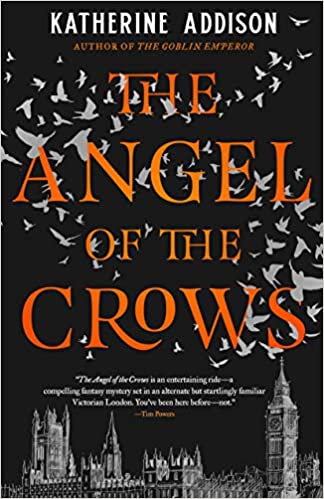
The Angel of the Crows by Katherine Addison

Black background with grey bird silhouettes above the image of British Houses of Parliament. Title appears in red.

By Kristen B.

Sherlock Holmes is a perennial favorite. So many movies and TV shows have delved into Sir Arthur Conan Doyle’s series of short stories and novellas, from House M.D. to Benedict Cumberbatch on the BBC to Robert Downey, Jr’s movies, that the character has entered the common sphere. You really don’t have to explain him and his particular attention to detail.

Katherine Addison’s new novel, The Angel of the Crows, combines Victorian England, the Sherlock Holmes stories, and Jack the Ripper with a supernatural, steampunk milieu that includes angels, Fallen angels, vampires, werewolves, and hellhounds. Angels operate a little differently here: they are only thinking, rational beings with names when they have a habitation. Without a location (usually a public building) to guard, an angel is Nameless and belongs to the collective hive-mind. In the worst case, when an angel loses its habitation, the trauma can cause it to Fall (capital letter necessary) … which can have an impact like a bomb.

You need to know this to understand our intrepid detectives, Crow and Dr. J. H. Doyle. Crow names itself Angel of London but is really managing to hold onto a name and an identity by sheer force of will. The angel is a maniac for helping the local police solve murders and other crimes (and obsesses over the daily papers to this end). Dr. Doyle has returned home from the war in Afghanistan, where an unexpected attack by Fallen angels left behind an interesting assortment of wounds and complications. The two social misfits become unexpected, but oddly compatible, flatmates.

These two get themselves into – and out of – all sorts of predicaments. The structure of the book is fantastic, with the overarching story of solving the Jack the Ripper/Whitechapel murders carrying throughout. The novel, however, divides into several, shorter parts which work as discrete, individual detective stories about missing persons, foreign treasure, and other mundane mysteries – most of which are direct pastiches of Sir Arthur Conan Doyle’s originals. The smaller adventures allow the individual characters to come to life and steal into your heart a little bit at a time. Both Crow and Doyle are wrestling the world for their right to live as they choose – and you root for them as well as their superior sleuthing.

While by no means a strict Sherlock equivalency, the book recognizes and honors its source material. I hope you enjoy it as much as I have. It may, indeed, spur you to reacquaint yourself with the originals, too.

Kristen B. has worked for HCLS for more than 15 years, and currently hosts the Books on Tap discussion group at Hysteria Brewing Company. She loves reading, Orioles baseball, and baking.