The End of the World as We Know It

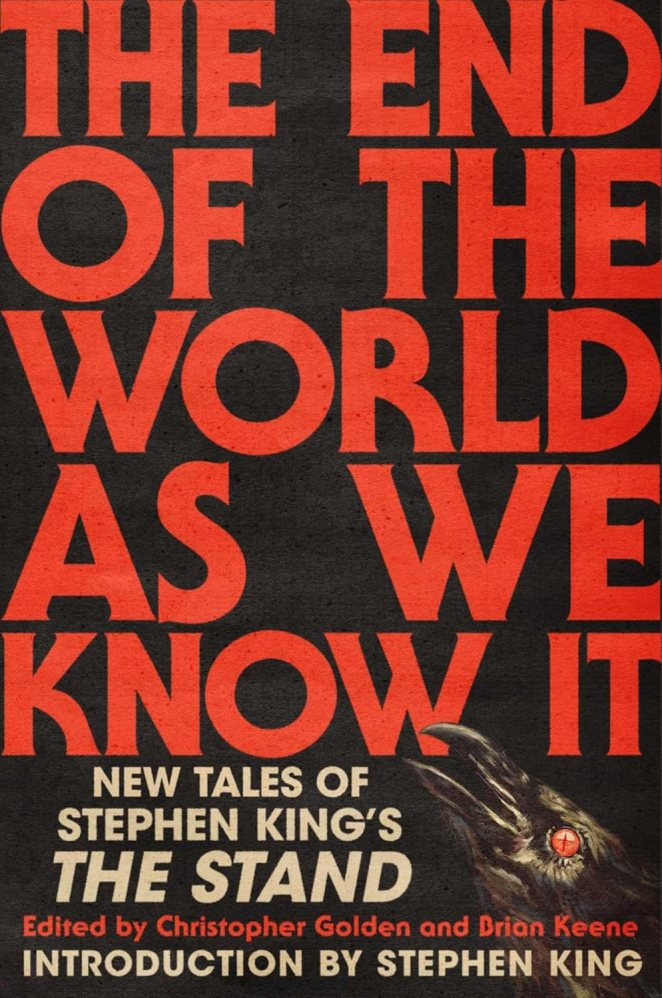
The book cover has a raven with a reddish-orange eye in the lower right corner, with its open beak extended up and looking directly at the viewer.

by Angie E.

In a year that feels like it’s testing every emotional fault line, some readers crave escape through lighthearted rom-coms or cozy mysteries. But for others, especially those feeling raw, anxious, or on edge, those stories can feel like a slap in the face. When the world feels broken, sometimes the only thing that makes sense is reading about the end of it. Two recent releases offer radically different but equally powerful takes on apocalypse: one fictional, one factual, both deeply human. 

For the first time ever, Stephen King has authorized other writers to expand the world of The Stand, his iconic 1978 novel about a pandemic that wipes out most of humanity and pits survivors in a battle between good and evil. Edited by Christopher Golden and Brian Keene, The End of the World as We Know It features 36 all-new stories from a dazzling lineup of authors: Wayne Brady, Caroline Kepnes, Tananarive Due, Paul Tremblay, Alma Katsu, and many more. 

The stories span the initial outbreak, the migrations to Boulder and Las Vegas, and even decades beyond the original novel’s timeline. They’re terrifying, philosophical, and sometimes heartbreakingly tender. For readers who feel like they’re living through their own version of The Stand, this anthology offers catharsis, community, and a reminder that even in collapse, there’s room for hope. 

The book cover shows a shooting star seemingly exploding above a cityscape in shades of blue and yellow, against the backdrop of a night sky and many stars.

If The End of the World As We Know It is a fictional dive into the apocalypse, Everything Must Go by Dorian Lynskey is its nonfiction counterpart, a sweeping, witty, and surprisingly comforting cultural history of how we’ve imagined the end across centuries. Lynskey explores everything from religious prophecies to pandemic fiction, climate collapse, rogue AI, and nuclear dread. He name-checks everything from The Road to Children of Men, The Twilight Zone to The Purple Cloud, weaving together pop culture, science, and philosophy into a rich tapestry of our collective anxieties. 

What makes this book so compelling is its insight: apocalyptic stories aren’t just about destruction, they’re about transformation. They reflect our fears, but also our longing for clarity, justice, and rebirth. For readers struggling in 2025, these books offer more than just entertainment. They offer validation and say: You’re not alone in feeling like the world is ending. And they do it without sugarcoating or false cheer. Instead of asking you to pretend everything’s fine, they invite you to sit with the chaos—and maybe even find meaning in it. 

Angie is an Instructor & Research Specialist at Central Branch and is a co-facilitator for Reads of Acceptance, HCLS’ first LGBTQ-focused book club. Her ideal day is reading in her cozy armchair, with her cat Henry next to her.

Our next chapter starts soon when the blog moves to the newly redesigned hclibrary.org. All the same great reviews and news, plus more library information!

Bauder Book Talk: Meet two of the authors of Blackout

A black illustrated cover where two people standing holding hands, backs to the viewer, with a sketched city in front of them and lots of small windows lit up.

by Carmen J.

What do you get when you have six talented young adult authors, a pandemic, and a beautiful excuse to celebrate many versions of black love and romance? You get Blackout written by Dhonielle Clayton, Tiffany D. Jackson, Nic Stone, Angie Thomas, Ashley Woodfolk, and Nicola Yoon. Even better, you’ll get to see two of the featured authors (Clayton and Woodfolk) at the third annual Bauder Book Talk event on November 6 from 4:30-6:30 pm at HCLS’s East Columbia Branch.

Written and inspired during the 2020 pandemic and set in New York City during a blackout, each author contributes connecting narratives — which can stand alone — about Black teens in the midst of their unique, complicated, joyful, sometimes simple, often spontaneous, intense, surprising romantic journeys. Whether it’s two young men catching feelings on a stalled subway, a couple who must talk through their past relationship over a long walk across town, two girls whose chance encounter ignites a spark in a nursing home, each interwoven story shines to a satisfying conclusion at a Brooklyn block party. 

In particular, Woodfolk’s “Made to Fit,” Clayton’s “All the Great Love Stories … and Dust,” and the closing story titled “Seymour and Grace” (written by Yoon) are stand-outs. Bonus points for Blackout’s inclusion of queer love and the acceptance of the adults in their lives (Made to Fit). The warmth and feel-good feelings of Blackout remain long after the lights are back on.

EVENT HAPPENING ON NOVEMBER 6: Register now!

Celebrate the voices of young Black girls in literature at this year’s Bauder Book Talk. Dhonielle Clayton and Ashley Woodfolk share how their stories center joy, magic, and truth while creating space for Black teens to see themselves on the page. 

Clayton is a New York Times bestselling author and former middle school librarian whose work celebrates Black joy, magic, and possibility. She is the author of The Belles series and the Conjureverse series.

Woodfolk is the critically acclaimed author of The Beauty That Remains and When You Were Everything. Her work explores love, loss, friendship, and the complexities of finding one’s voice. A former publishing professional, Woodfolk is celebrated for her lyrical prose and heartfelt storytelling that resonates deeply with teens. 

Carmen J. is a teen instructor at HCLS East Columbia Branch. Among her favorite things are great books, all things 80s, shamelessly watching The Bachelor, gardening, and drinking anything that tastes like coffee.

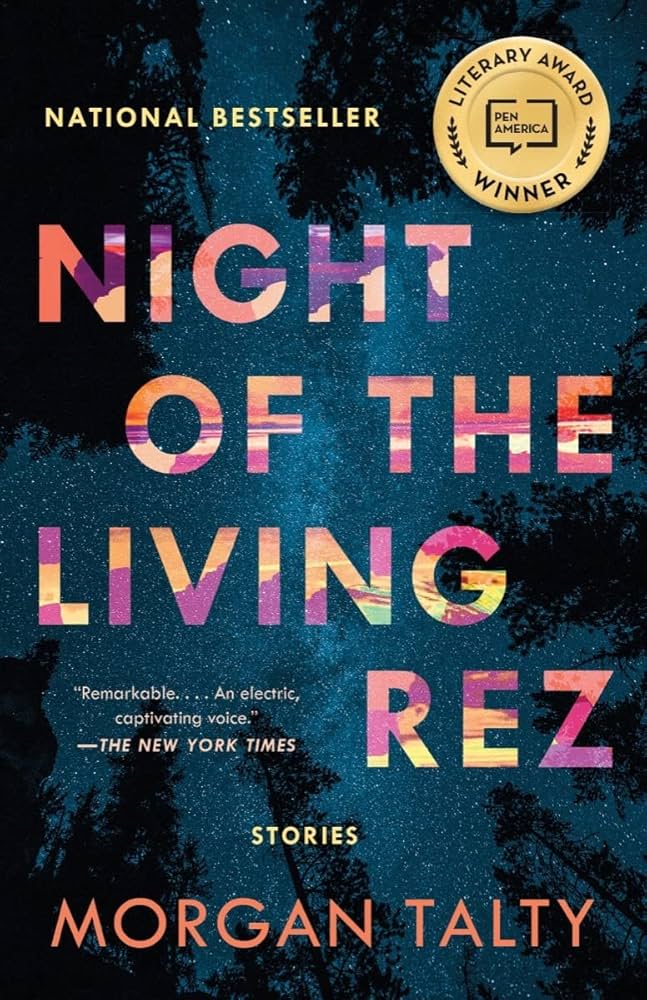
Night of the Living Rez by Morgan Talty

by Kristen B.

My book discussion group (Books on Tap) recently discussed Night of the Living Rez by Morgan Talty. I try to choose books that reflect the time of year, as well as to prioritize authentic voices. This book worked for November because Morgan Talty is a Native American author, and his book collects a series of inter-connected short stories about David and his family and friends on the Penobscot reservation in Maine.

In all honesty, the book is as bleak as any other work that deals with generational trauma and chronic poverty. However, it is laced with gorgeous prose, mostly in scenes describing the local woods and river. Talty has a sense of the poetic that shines through even the most difficult situations – including the description of a car crash that perfectly captures the halting, photo-flash moments of impact and aftermath. Surprisingly, along with the spare dismay of the stories, Talty also offers a pitch-black sense of humor. The sheer absurdity of teenage boys and their antics relieves the otherwise unrelenting sense of nowhere to go and nothing to do that permeates this book. Sometimes it’s true: you have to laugh instead of cry.

Eleven of the twelve chapters are tightly told from young David’s point of view – and his almost complete lack of understanding of what’s happening with the grownups in his life. His relationship to his grandmother is the foundational relationship of the book, as it was for his life. That special love grounds the stories and makes them real, in ways that the cigarettes, drugs, and drinking couldn’t. The love and the bad decisions weave so intimately that the inevitable heartbreak registers as simply, devastatingly true. The tight narrative focus is a fascinating authorial choice, but not until the last section do all the pieces truly come together in any sort of coherent way. It’s worth getting there with adult David, with compassion and forgiveness for the bone-headed youth that he was.

I’m not sure this review is going to convince you to pick up this book, but you should! I was heartened by reactions of the folks in my book club. They found value in the language, the author’s choices of what to share, in the universality of the stories, and in the need to laugh in the face of despair. Night of the Living Rez is a stellar beginning for a new author. I will eventually read Talty’s new novel, Fire Exit, but I need to continue to sit with this volume first.

Night of the Living Rez by Morgan Talty is available in print, e-book, and e-audiobook.

Kristen B. is a devoted bookworm lucky enough to work as the graphic designer for HCLS. She likes to read, stitch, dance, and watch baseball (but not all at the same time).

The World Wasn’t Ready for You by Justin Key

The book cover depicts a variety of geometrical images - a funnel, some parallel lines, and an X - and an arachnid, in various jewel tones against a black background.

by Angie E.

Imagine a collection of stories where Black Mirror (Netflix series) meets Get Out, reminiscent of Octavia E. Butler’s work, blending science fiction, horror, and fantasy to tackle issues of race, class, and prejudice. This thrilling and often heartbreaking debut introduces an extraordinary new voice.

Justin C. Key has been fascinated by monsters since childhood. Growing up reading R. L. Stine’s Goosebumps, he pictured himself heroically battling monsters. However, watching Scream 2, where the only Black couple is swiftly killed off, made him realize that Black and Brown characters in his favorite genre were often the victims or villains—if they appeared at all. In The World Wasn’t Ready for You, Key broadens and redefines the horror genre to delve into themes of race, class, prejudice, love, exclusion, loneliness, and the essence of humanity, exposing the inherent horror within us all.

The opening story, “The Perfection of Theresa Watkins,” begins as a sci-fi love story, but quickly turns nightmarish when a husband employs new technology to transfer his deceased Black wife’s consciousness into the body of a White woman. To secure an early release, a Black inmate joins an experimental medical study in “Spider King” and soon faces disturbing side effects. In the collection’s title story, a father strives to protect his son by teaching him how to maneuver a prejudiced world that perceives him as a threat. “The Quantum Mechanics of the Heart” is an examination of both quantum physics and emotional connections, poignant and intellectually stimulating. Another keeper, “The Last Library,” transports readers to a world where libraries are sentient beings, safeguarding knowledge and memories. The sad beauty of this tale lingers long after the last page.

Key’s writing is lyrical, infused with wonder and empathy. His ability to evoke emotions through speculative scenarios is commendable. Whether it’s a grieving astronaut seeking solace among the stars or a time-traveling violinist chasing echoes of lost melodies, Key’s characters grapple with universal truths. The World Wasn’t Ready for You is a testament to the power of speculative fiction. It challenges conventions, celebrates diversity, and invites readers to question their own existence. Key’s storytelling transcends genres, leaving an indelible mark on the literary landscape.

Angie is an Instructor & Research Specialist at Central Branch and is a co-facilitator for Reads of Acceptance, HCLS’ first LGBTQ-focused book club. Her ideal day is reading in her cozy armchair, with her cat Henry next to her.

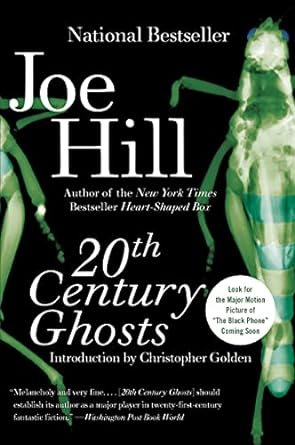
Twentieth Century Ghosts by Joe Hill

The book cover has glowing images of two bugs in iridescent green and blue against a black background.

by Angie E.

I like Joe Hill’s fiction, no matter which selection it is. I am particularly drawn to and sometimes revisit his amazing anthology 20th Century Ghosts. The collection comprises 15 short stories, each with its own unique theme and style. Joe Hill’s versatility shines through as he explores various aspects of horror, from traditional ghost stories to psychological thrillers. The stories are infused with elements of fantasy, science fiction, and dark humor, creating a diverse and engaging reading experience. 

The opening story, “Best New Horror,” sets the tone for the entire collection. It tells the tale of a jaded horror fiction editor who stumbles upon a manuscript that takes him on a horrifying journey into a world he could never have imagined. Hill’s use of meta-fiction in this story adds layers of complexity to the narrative, leaving readers with much to ponder. 

Joe Hill’s ability to create compelling characters makes his fiction unforgettable. Whether it’s a young boy who can transform into a living comic book character in “Pop Art” or the ghost of a movie projectionist in “The Projectionist,” his characters have a depth and humanity that gives the supernatural elements all the more a stirring and relatable feel. Hill’s skill in creating atmospheric settings also permeates the collection. Whether it’s a creepy movie theater, a haunted tunnel, or a sinister roadside attraction, the locations in these stories are as much a part of the narrative as the characters themselves. The sense of place adds to the overall immersion and tension in each tale. 

While horror is its primary genre, 20th Century Ghosts doesn’t rely solely on scares. Many of the stories delve into deeper emotional territory, exploring themes of love, loss, and the complexities of human relationships. “Better Than Home” and “Voluntary Committal” are poignant examples of Hill’s ability to tug at the heartstrings. Joe Hill’s imaginative storytelling is a defining feature of this collection. He doesn’t rely on clichés or tired horror tropes; instead, he constantly surprises the reader with fresh ideas and innovative twists. “My Father’s Mask” and “The Black Phone” are prime examples of his originality and the ability to keep readers on the edge of their seats. 

The titular story, “20th Century Ghosts,” is a beautiful and melancholic piece that serves as a fitting conclusion to the collection. It explores the idea that we are all haunted by the past in one way or another, and Hill’s prose resonates long after the final page is turned. 

Angie is an Instructor & Research Specialist at Central Branch and is a co-facilitator for Reads of Acceptance, HCLS’ first LGBTQ-focused book club. Her ideal day is reading in her cozy armchair, with her cat Henry next to her.

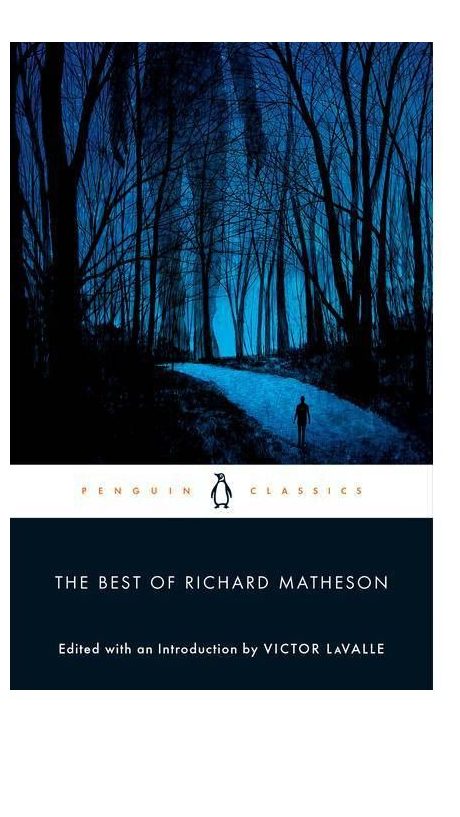
On the Edge of Your Seat with Richard Matheson

A moody blue and black cover shows a solitary figure walking a road through a night time forest.

by Angie E.

The Best of Richard Matheson is like taking a roller coaster ride through the wild and imaginative mind of a literary genius. Now, if you haven’t heard of Richard Matheson, let me tell you more. He’s behind some of the most spine-tingling tales that have ever graced a page. From the eerie darkness of I Am Legend (also a movie) to his episodes of the mind-bending brilliance of The Twilight Zone to the softer, more gentle (and beloved) Somewhere In Time , Matheson knows how to keep you on the edge of your seat. 

The Best of Richard Matheson reads like a greatest hits album for horror, sci-fi, and thriller enthusiasts. The tantalizing collection of his finest short stories, handpicked by author Victor LaValle, showcases his incredible range. It’s a treasure trove for anyone who craves a good dose of suspense, a dash of the supernatural, and a healthy serving of psychological twists. 

One of my favorites is “Button, Button,” a chilling tale that plays with morality and the consequences of our actions. It’s like a game of ethical roulette where you can’t help but question what you would do in the same situation. Matheson has a way of making you think long after you’ve turned the last page. 

“Duel” is another pulse-pounding story that’ll make you think twice before honking your horn at an aggressive driver on the highway. An intense battle of wits, it keeps you gripping the edge of your seat while giving you a newfound appreciation for the safety of your car. It’s also the basis for the 1971 movie of the same name, directed by Steven Spielberg. 

And let’s not forget the goosebumps-inducing classic “Nightmare at 20,000 Feet,” both a classic episode of The Twilight Zone and part of the 1983 film of the same name. If you’ve ever stepped onto a plane and felt a twinge of unease, this story takes that discomfort to a whole new level. Matheson takes a seemingly mundane situation and infuses it with a supernatural twist that leaves a lingering fear of air travel and, perhaps, a reassessment of William Shatner’s acting, if you watch the episode

I adore Matheson’s ability to create vivid characters that jump off the page. Whether it’s a desperate survivor battling hordes of vampires, an ordinary Joe facing off against his darkest fears, or a gentle, sad man searching for love in the past, you find yourself deeply invested in their journeys. Matheson has a knack for blending the extraordinary with the everyday, making it all the more relatable and thrilling. 

The Best of Richard Matheson is a delightful literary cocktail that’s equal parts creepy, mind-bending, and thought-provoking. It’s the kind of book you’ll find yourself devouring in one sitting, staying up late into the night with wide eyes and racing pulse. 

Angie is an Instructor & Research Specialist at Central Branch and is a co-facilitator for Reads of Acceptance, HCLS’ first LGBTQ-focused book club. Her ideal day is reading in her cozy armchair, with her cat Henry next to her.

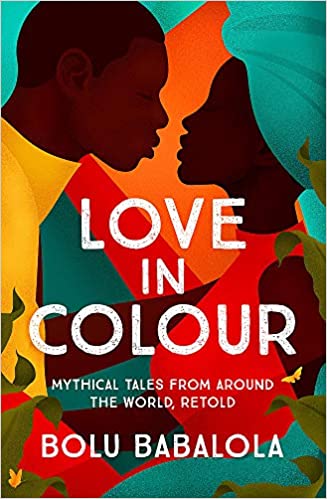
Love in Color: Mythical Tales from Around the World, Retold by Bolu Babalola

Two figures poised to kiss are color blocked in bold color of turquoise, red, and yellow.

by Sahana C.

Some really popular retellings of myths are going around now: The Song of Achilles, Circe, and The Women of Troy, to name a few. But all three have one thing in common: they center Greek and Roman mythology. The world of myth is much more vast than Greek and Roman mythology, and Bolu Babalola weaves her magic around folktales from West Africa, the Middle East, and even China, alongside Greek and Roman myths that she writes through a more diverse slant. She brings these often untold tales to the forefront with her compilation of short stories, Love in Color: Mythical Tales from Around the World, Retold.  

More than just retellings of these myths, however, Babalola brings each story fully into the modern world. Instead of Scheherazade being a trapped princess, she’s a journalist managing some dangerous new sources. Psyche works for Eros’s mother in a fiercely corporate world that she wants to break free from. This, too, is a break from tradition among popular retellings today, and it adds to the timeless nature of the stories by showing just how universal each love story really is.  

The stories are not too long, with just enough context and world building in each to make readers fall firmly in love with the world, to build a new universe around these characters, and make them fall in love with each other. These stories don’t necessarily keep all the magic and mythic details consistent, but the essence of the myth, what it would mean in the modern context, remains the same. Instead of magic crocodile skins that cause them strife in their personal lives, for example, characters have vitiligo, a skin condition that they have to learn to love about themselves.  

Personally, Nefertiti’s story, Zhinu’s, and Thisbe’s have been at the forefront of my mind since reading, each taking the original myth and twisting it into something lovely and appropriate for a modern age, while retaining a timeless quality. The stories revolve around love; love and POC joy are centered with every character. In the ordinarily Eurocentric realm of mythology, Love in Color is the best of romance: poignant, beautiful, complex in plot but simple enough to convey its message. 

I would lean towards reading up about each myth before reading the stories, however. The myths that I had context for, I enjoyed more upon a first read than the others, but after doing some research on the other stories, I went back and enjoyed the less familiar stories just as much on a reread.  

The publisher review for the anthology notes the diversity of the source material, saying, “Focusing on the magical folktales of West Africa, Babalola also reimagines Greek myths, ancient legends from the Middle East, and stories from long-erased places. With an eye towards decolonizing tropes inherent in our favorite tales of love, Babalola has created captivating stories that traverse across perspectives, continents, and genres.” 

Love in Color: Mythical Tales from Around the World, Retold by Bolu Babalola is available in print

Sahana is an Instructor and Research Specialist at the Savage Branch. She enjoys adding books to her “want to read” list despite having a mountain of books waiting for her already.

The Beauty and Art of the Short Story

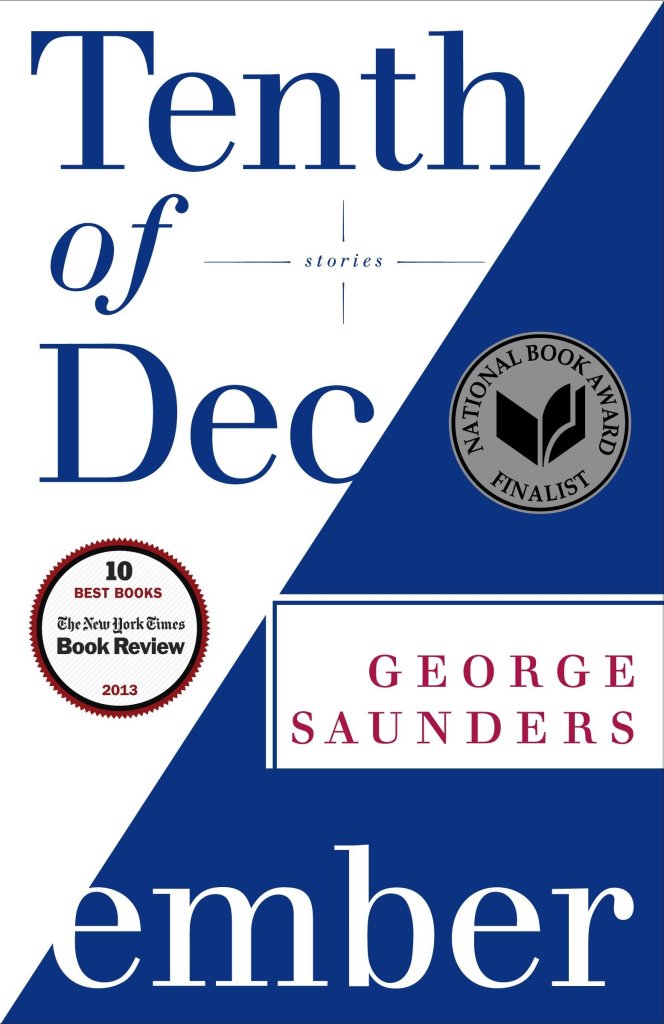
The cover is split diagonally, with a white background in the upper left and a blue background in the lower right. The title is in blue against the white background and white against the blue background.

By Eric L.

I’ve been reading a lot of short stories lately. I’d contend the short story is really its own art form, of which I’m a big fan. In fact, in my book discussion group, Read. Think. Talk., we’ve spent the past quarter reading exclusively short story collections. It makes for a different sort of discussion, and in some ways the long form – a novel or novella – lends itself a bit better to a book discussion. Personally, I like to discuss the characters and situations that change throughout a novel. However, as a group we’ve done short stories plenty of times, and it’s a great opportunity to discuss which ones you like, which ones you didn’t like, and generally how the stories worked, or didn’t, in a short number of pages.

I’ve always enjoyed short stories for their brevity. They are especially well-suited for the time-challenged, modern world we live in. You can just jump into a story when you have a brief period of time, or perhaps need a short respite from whatever else you’re reading (e.g., maybe you’re a student reading textbooks and academic periodicals and would like some fiction in your life). I’ve read some great collections lately.

George Saunders, who mainly writes short stories, is remarkable in the field. His collection Tenth of December is by no means a feel-good read, but the stories are an abstract satirical take on modern-day America. They are collected from The New Yorker, where Saunders contributes stories regularly and where I read a great interview with the author to prepare for our book group discussion. Most of the stories concern disastrous situations and terrible characters that frankly scare you a bit, but somehow they don’t end catastrophically. I would even describe the stories as ending on an optimistic note, which seems like the opposite of how they’re presented on the surface. They’re definitely worth a read, or two.

The book cover shows a young girl riding on a motorbike, sketched in dark blue against a lighter blue background, with the title and the author's name superimposed over the sketch.

The Refugees by Viet Thanh Nguyen is a companion to his excellent book The Sympathizer. Although I’d recommend the latter over the former, I don’t want to denigrate the story collection; it’s just a tall order to compete with that great book about the Vietnamese immigrant experience in America after the Vietnam war. (Please read my review of The Sympathizer here.)

The stories are all colored by Nguyen’s personal experience of being a refugee as a child. Dedicated to “refugees everywhere,” I think the book speaks to the importance of expanding our understanding of what it means to be a refugee. In my mind’s eye, I see people walking with their few possessions without a land or place. While a physical journey of this sort sometimes happens, the next step deals with the ongoing psychological effects of living in a foreign land. Particularly, one that is politically and culturally controlled by people different than you. Nguyen deftly tells stories from the perspective of a man, a child, a younger woman, and an older woman. There is even an interesting commentary about how some refugees perceive others as having it better when one character laments the fact that they’re not Korean.

The book cover shows a formal long-sleeved jacket with an emblem on the front pocket, with long sleeves extending well beyond the hem of the jacket. The jacket is in an off-white color with the details sketched in black, and the background is a bright lawn green.

In February, the book group is considering Welcome to the Monkey House by Kurt Vonnegut, one of my favorite writers, and the library just procured some fresh copies. I’ve always loved his wit, humanism, and the cynical optimism that flavors his satire. Vonnegut began his career and was able to support himself and his family as a writer by selling stories. I learned this recently by watching the documentary Kurt Vonnegut: Unstuck in Time. The collection is worth checking out if only for the great tale “Harrison Bergeron.” I first read this in a freshman college English class (even a slacker like me was game for this short story). Vonnegut tells the story of a futuristic society that has attempted to forcibly make itself completely equitable via technology. For example, if you’re intelligent your brain is zapped when you start to think too much; if you’re physically gifted, you’re saddled with weights; if you’re attractive, you wear a mask, etc. It’s a complicated message that I think I get, or at least I have my own interpretation. However, I don’t want to influence yours. I enjoy art like this, though, and I’d describe it as open-ended and open to interpretation.

The book cover shows a figure in dark overcoat, hood, and gray scarf, against a gray background but facing forward, holding a flashlight that shines a triangular beam down to a circle on the ground in front.

Although I could go on about all the great short story collections I’ve read, I won’t. However, I’d like to mention one final great one. Stone Mattress: Nine Wicked Tales is by Margaret Atwood, another author I love for her wit and great social commentary. These tales are sort of “light horror” stories, which is how I would describe much of Atwood’s writing. I hope it’s not heresy to state here that I think the collection is better than The Testaments. The stories should be read in order, as some are connected. The overarching theme throughout is the experience of being a woman and aging, and they’re all wondrously done.

I have always marveled at those who do the short story well. To tell a story in just a few pages takes craft, specifically, to get people to invest in the plot, scene, and characters. Try it, sometime. It’s not easy.

Tenth of December is available in print from HCLS, as well as in large print and in eBook and eAudiobook format from Libby.

The Refugees is available in print, as an eBook from both CloudLibrary and Libby, and as an audiobook on CD.

Welcome to the Monkey House is available in print and also as an eAudiobook from Libby.

Stone Mattress is available in print, in large print, as both an eAudiobook and an eBook from CloudLibrary, and in eBook format from Libby.

Eric is a DIY Instructor and Research Specialist at the Elkridge branch. He enjoys reading, films, music, doing nearly anything outside, and people.

I’m Waiting for You and Other Stories by Kim Bo-Young

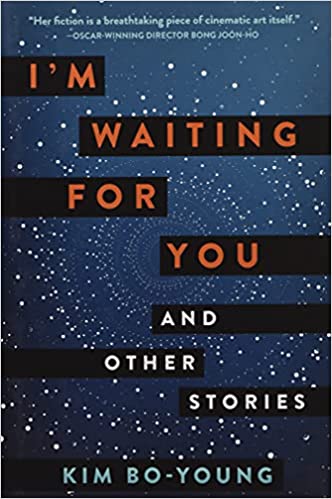
The book cover depicts a deep blue night sky with swirls of distant stars. The title is superimposed in orange and white lettering against strips of black, alternating the words in left and right alignment.

By Sahana C.

As a medium, science fiction has been a way to ask larger questions about what it means to live since Mary Shelley’s Frankenstein. Questions that are a bit too uncomfortable to ask in the context of real life without the buffer of aliens or mind-bending time travel, such as: who are we if we’re taken off of Earth? What does humanity look like broken down to our bare essentials and out of context?  

I’m Waiting for You and Other Stories by Kim Bo-Young follows the precedent set centuries ago, asking readers to consider what love looks like outside the bonds of time, where we can learn about free will, and how hope can manage to exist in the most devastating of circumstances.  

Originally published as three separate novellas, there is still so much overlap as the stories ask you to consider your own humanity. The first story, the eponymous “I’m Waiting for You,” is epistolary, told through letters from the point of view of a man writing to his fiancée as he tries to time his interstellar journey just right so that he will meet her at the church they decided upon in time for their wedding day. The unnamed main characters, through a comedy of errors and well-meaning but decidedly bad decisions, are left trying to catch up with one another as they fast-forward through time. He is increasingly isolated as he travels through time and space, but all the while it is his love of his fiancée that keeps him human.  

The second and third story are connected, “The Prophet of Corruption” with a soft multiverse-centric epilogue in “That One Life.”  The two stories follow god-like beings who experience a sort of reincarnation in order to learn more about their nature and the nature of the world, and who think of corruption as what happens when they are disconnected from the whole. The story reminded me at times of the short story “The Egg” by Andy Weir (who also wrote The Martian) with the ideas of reincarnation but made wholly new for the universe Kim Bo-Young manages to create. There were moments where I felt like I was floating outside of the narrative, but I was never far enough away to escape orbit – existential but not just for the sake of an “I’m-smarter-than-you, let’s see an audience try to puzzle this out” existentialism. It’s hard but worth it, thinking about our place in the world and what we mean to one another. 

The final story, “On My Way,” brings us full circle back to the couple from “I’m Waiting for You” and returns to the epistolary format established in the first story. We see the letters that the woman sent her fiancé this time around, and her interstellar travels have been completely different from his. The two are juxtaposed, not only by being from the perspective of a man versus a woman, but by the circumstances surrounding each protagonist. The former deals with the impact of isolation in times of despair while the latter considers group dynamics in times of disaster.  

The first and last story are about love beyond the bounds of time; what is it about us that makes us human? How far can we go before we lose our humanity? They consider the everlasting nature of hope, but manage to stay honest while avoiding any sort of cheesiness. They discuss what love looks like, with both protagonists making promises they aren’t sure the other person will ever get to hear, promising I will love you if we are the last people on Earth and out of all the people in the world, I chose you, over and over again.  

The first story, as Kim Bo-Young explains in the author’s notes at the end, was written as part of a proposal. It took me a while to understand how something that appeared so tragic would be the best way to propose marriage to a loved one; it feels so unanchored and dire at moments, but it is the fact that through it all, the protagonist is still there, persevering, forcing himself to survive, that shows the romance.  

It’s a translated work, which reinforces the idea that translation is an art form and a version of composition in and of itself – there are no stuttering moments that remind you that it is not originally written in English. In fact, I forgot until I read the end notes, emails between the author and the translator, context for the short stories, and the author’s motivations and original audiences. I might even recommend reading the notes before the stories themselves; I wish I had. 

I’m Waiting for You and Other Stories by Bo-Young Kim is available in print.

Sahana is an Instructor and Research Specialist at the Savage Branch. She enjoys adding books to her “want to read” list despite having a mountain of books waiting for her already.

Climate Change Short Stories: An Inconvenient Book Club

The illustration shows a futuristic scene of a woman walking through a green wood; she wears boots and has a long blonde braid down her back. Various creatures in the darkened wood are illuminated as if they were made up of stars from the sky, and there are background stars above as well.
Illustration by Rebekka Dunlap, from the short story “The Tree in the Back Yard” by Michelle Yoon

By Susan Thornton Hobby

Climate change is scary, and cli-fi short stories are here to help.

“Right here, right now is where we draw the line. The world is waking up. And change is coming whether you like it or not.” – Swedish climate activist Greta Thunberg, age 18

Change is coming, both in the climate, and with luck, in human behavior. Reading about climate change is frightening, and sometimes shuts people down. But as many climate activists have explained, there is hope.

Environmental and animal activist Jane Goodall said it well: “I do have reasons for hope: our clever brains, the resilience of nature, the indomitable human spirit, and above all, the commitment of young people when they’re empowered to take action.”

But reading alarmist nonfiction doesn’t always reach the heart. Story, however, seems to sneak through our defenses and climb straight into our souls. Climate fiction, a genre of literature sometimes shortened to “cli-fi,” pioneered with J. G. Ballard’s novels of climate change (especially the 1962 classic The Drowned World) and Frank Herbert’s 1965 novel Dune (see the review).

Since March 2019, HoCoPoLitSo recording secretary Susan Thornton Hobby and climate educator Julie Dunlap have led a climate fiction book club at Howard County Library System. Attendees are interested in literature that explores the facts and mysteries of Earth’s changing climate, and we have read and discussed eight incredible novels to date.

We’re mixing things up in January, and have chosen to read the award winners of a climate fiction short story contest sponsored by Grist Magazine’s Fix Solutions Lab. Organizers of the contest, Imagine 2200: Climate Fiction for Future Ancestors, urged writers to envision the next 180 years of equitable climate progress.

Sponsored by the National Resources Defense Council, the contest is “an uprising of imagination,” as Fix describes it. The winning stories, a dozen pieces of short fiction by authors including Black, Indigenous, disabled, and queer authors, conjure hope, anger, frustration, joy, and contemplation about the future of our planet in the impending climate crisis.

“Whether built on abundance or adaptation, reform or a new understanding of survival, these stories provide flickers of hope, even joy, and serve as a springboard for exploring how fiction can help create a better reality,” writes Tory Stephens, who works at Fix and spearheaded the contest. Join us in reading and discussing these stories on Thursday, Jan. 6, from 7 to 8 pm, at HCLS Miller Branch. Register here. The stories, and a terrific glossary of cli-fi terms, including afrofuturism (looking at you Octavia Butler), solar punk, and ecotopia, are available here.

Susan Thornton Hobby is the HoCoPoLitSo recording secretary as well as co-leader of the Inconvenient Book Club at HCLS Miller Branch.