
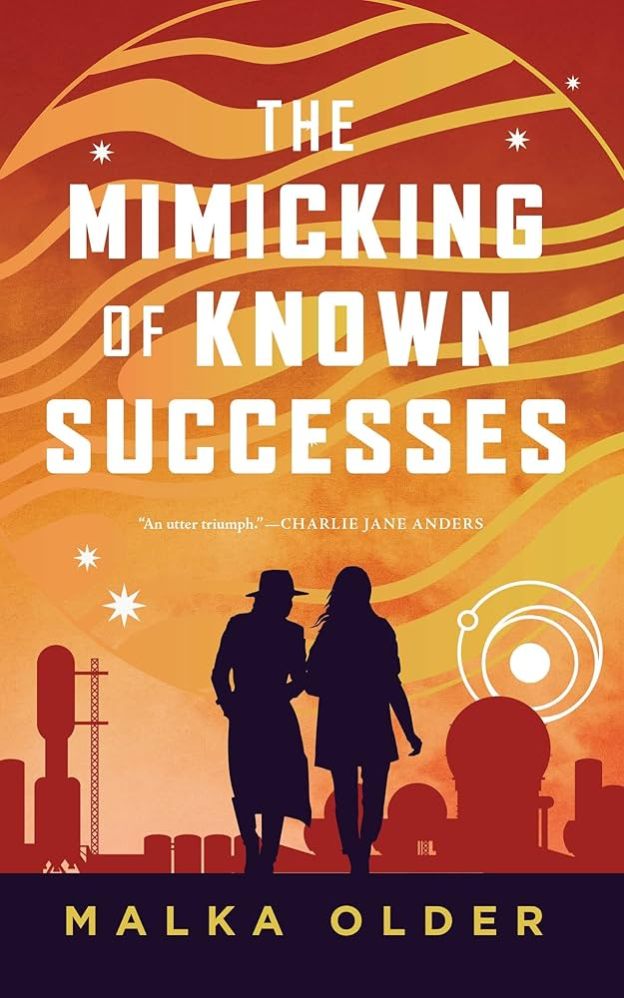
Mossa and Pleiti series by Malka Older

by Kristen B.

The first two books in a series by Malka Older take place about 500 years in the future. Humanity no longer lives on Earth, a planet we have rendered uninhabitable. Instead, we colonized Jupiter – known as Giant – and some of its moons. A series of platforms and railways encircle the big gas planet, on which farms, businesses, and Valdegeld University exist (or in some cases, subsist). There are three major schools at the university: Classics, Modern, and Speculative. Classics studies literature, history, biology, and more from our planet of origin, trying to figure out how the pieces of well-balanced biospheres (ones not continually in crisis) operate. Modern looks at the issues facing the populace where they are now. Speculative also looks to return to Earth, among other goals, but not (necessarily) to restore it to its former glory. University-level research appears to be the biggest enterprise and employer, upon which the survival of the species relies. It’s rather a pointed observation, given the modern American penchant to argue with experts and deny scientific advancement.

I pieced together most of this synopsis from the information around the edges of Older’s first two short novels in a mystery series that is planned to run for at least five books. Pleiti is tenured faculty at Valdegeld, with a specialty in classic literature. Mostly, she researches how the various elements of biospheres worked together by reading books published when those animals lived on Earth. Mossa is an Investigator, the equivalent of a police detective, who spends most of her time searching for lost people. The two were lovers in their past, who, as the series begins, perhaps look to rekindle their romance.

The two installments to date are a lovely combination of science fiction, college politics, and detective mystery. Pleiti and Mossa are enigmatic people, but you find yourself wanting to know more about them as individuals and a couple.

The Mimicking of Known Successes: A man from the university takes a railcar to a remote platform, then promptly disappears. Mossa is pretty sure that he didn’t jump to his death into the planet, and she ends up at Pleiti’s campus asking questions and looking for help. University politics and personalities mix badly with personal ambitions to see Earth restored. Favorite pieces include atmoscarves, the sheer quantity of scones and tea consumed, and the existence of the mauzooleum where “ancient” breeds of animals are carefully bred and studied. I had to make an effort to keep reading through a fairly slow set-up and was rewarded with an exciting, and rather unexpected, conclusion.

The Imposition of Unnecessary Obstacles: I enjoyed this one more, when I could enjoy the mystery without working to understand the world-building. Mossa and Pleiti once again join forces to solve a case involving missing persons – and a subsequent murder – that requires them to do a fair amount of traveling, including to the moon Io and the far side of Giant. Gourmet snacks once again play a not-inconsiderable role as our valiant pair completes some quality sleuthing. There’s also the mention of an opera named Murderbot, which was a high-quality tidbit. I gobbled up this book over a weekend and appreciated the slightly faster pacing and tighter timeline.

A third installment is scheduled to be published in June, The Potency of Ungovernable Impulses, and I’m already looking forward to it.

Kristen B. is a devoted bookworm lucky enough to work as the graphic designer for HCLS. She likes to read, stitch, dance, and watch baseball (but not all at the same time).

The World Wasn’t Ready for You by Justin Key

The book cover depicts a variety of geometrical images - a funnel, some parallel lines, and an X - and an arachnid, in various jewel tones against a black background.

by Angie E.

Imagine a collection of stories where Black Mirror (Netflix series) meets Get Out, reminiscent of Octavia E. Butler’s work, blending science fiction, horror, and fantasy to tackle issues of race, class, and prejudice. This thrilling and often heartbreaking debut introduces an extraordinary new voice.

Justin C. Key has been fascinated by monsters since childhood. Growing up reading R. L. Stine’s Goosebumps, he pictured himself heroically battling monsters. However, watching Scream 2, where the only Black couple is swiftly killed off, made him realize that Black and Brown characters in his favorite genre were often the victims or villains—if they appeared at all. In The World Wasn’t Ready for You, Key broadens and redefines the horror genre to delve into themes of race, class, prejudice, love, exclusion, loneliness, and the essence of humanity, exposing the inherent horror within us all.

The opening story, “The Perfection of Theresa Watkins,” begins as a sci-fi love story, but quickly turns nightmarish when a husband employs new technology to transfer his deceased Black wife’s consciousness into the body of a White woman. To secure an early release, a Black inmate joins an experimental medical study in “Spider King” and soon faces disturbing side effects. In the collection’s title story, a father strives to protect his son by teaching him how to maneuver a prejudiced world that perceives him as a threat. “The Quantum Mechanics of the Heart” is an examination of both quantum physics and emotional connections, poignant and intellectually stimulating. Another keeper, “The Last Library,” transports readers to a world where libraries are sentient beings, safeguarding knowledge and memories. The sad beauty of this tale lingers long after the last page.

Key’s writing is lyrical, infused with wonder and empathy. His ability to evoke emotions through speculative scenarios is commendable. Whether it’s a grieving astronaut seeking solace among the stars or a time-traveling violinist chasing echoes of lost melodies, Key’s characters grapple with universal truths. The World Wasn’t Ready for You is a testament to the power of speculative fiction. It challenges conventions, celebrates diversity, and invites readers to question their own existence. Key’s storytelling transcends genres, leaving an indelible mark on the literary landscape.

Angie is an Instructor & Research Specialist at Central Branch and is a co-facilitator for Reads of Acceptance, HCLS’ first LGBTQ-focused book club. Her ideal day is reading in her cozy armchair, with her cat Henry next to her.

Gravity’s Rainbow by Thomas Pynchon

A flat full book cover from back across the spine to the front: It is predominately orange with a bright yellow spiral on the front, with the title and author centered, above a row of townhomes. The back has a quote, "A screaming comes across the sky ..."

“This is some kind of a plot, right?” Slothrop sucking from a velvet pipe. 

Everything is some kind of plot, man,” Bodine laughing 

“And yes but, the arrows are pointing all different ways,” Solange illustrating with a dance of hands, red-pointed fingervectors. Which is Slothrop’s first news, out loud, that the Zone can sustain many other plots besides those polarized upon himself . . . that these are the els and busses of an enormous transit system here in the Raketenstadt, more tangled even than Boston’s – and that by riding each branch the proper distance, knowing when to transfer, keeping some state of minimum grace though it might often look like he is headed in the wrong way, this network of all plots may yet carry him to freedom. He understands that he should not be so paranoid of either Bodine or Solange, but ride instead their kind underground awhile, see where it takes him. . . . 

By Ian L.

I fear, dear reader, that in even attempting to describe the manifold plots contained within Gravity’s Rainbow, the constraints by which I am bound have already caused me to fail in my endeavor. Which is to say, this book is a challenge to read but even more so to describe. This novel challenges your understanding of what a novel should be. 

Gravity’s Rainbow, described as the least-read must-read of the English literary canon, is perhaps the post-war post-modern novel. Anthony Burgess, of A Clockwork Orange fame, described the novel as, “the war novel to end all others.” It is often spoken about alongside James Joyce’s Ulysses, another book notorious for being considered either a great work of literature or completely incomprehensible. I am sympathetic to the former, but I understand how people believe the latter. The narrative and prose are confusing from the launch. Gravity’s Rainbow plays with its narrative distance in much the same way that our brains do while we are dreaming. A scene might open on one character and follow them for a beat; then, the focus flies into the head of another and digs deep into their individual psychology, history, or worldview.

While we are following these various and sundry characters, many of whom are not our “main” character (which itself is a harder question to answer than you might expect), the narrative is also running along a track parallel to our real history. Pynchon’s prose is impeccably diverse, in both its form and subject. The story is interspersed with poems and songs sung by and about the people who populate this novel. Several of the “chapters” could easily be independent short stories. The narrative meanders and diverges into reveries on myriad topics: historical events, artistic movements, psychology, chemistry, physics, genocide, philosophy, and even esoteric “sciences.” Pynchon’s words manage to be witty and evocative, beautiful, and hilarious, as well as harrowing and even vulgar. Truly so. I do not have the digital real estate to expand on that point, let alone most aspects of this novel. 

Ostensibly, Pynchon’s novel is set during the final stages of World War II. The German military has been rapidly manufacturing and deploying the V-2 rocket, the first ever long-range guided ballistic missile. It screams across the sky so fast you only hear it if you survive. An initial ensemble of secret intelligence operatives catches word of a strangely serialized rocket and an unknown device included in its schematics. The 00000 Rocket and the mysterious Schwartzgerät form the central gravity well around which this novel’s narrative revolves. It is an awesome medley of carefully researched facts mixed with Pynchon’s creative labyrinth of fiction. The novel is initially disorienting, by design, aimed at confusing the reader’s understanding of what is “actually happening” within the narrative. The characters experience this feeling, too.

One recurrent theme throughout the novel is the ever-mounting presence of paranoia. The characters struggle under overarching and competing plots. They buckle under the questioning of whether anything they have ever done has helped anyone. The War has consumed them, and only too late do they realize the War Machine does not exist on both sides. It is a superposition that collapses all sides into itself. This maddening descent is humanized by Pynchon through his characters, who are irrevocably altered by their situation. Each undergoes a derangement of the self, a severing and mutilation of their minds and bodies, or for some, their souls.  

If there was a word we could use as a through line for the vast wasteland that is Gravity’s Rainbow, it might be “Preterite.” Grammarians probably recognize this word as a fancy term for the simple past tense. I imagine most people are not thinking about Christian Eschatology in their day to day. To put it simply, the Preterite, according to Calvinist doctrine, are those who are not predestined for salvation. The characters we follow are among the Preterite, the passed-over and forgotten who are used by the Elite and the Elect. Those who must live in the wake of what war wrought. It would seem trite to state something so simple as “War is Bad.” Gravity’s Rainbow is full of themes that can seem stupidly obvious when stated outright. It is not these answers that earn Pynchon his accolades, but how he moves toward his answers. That is something that must be experienced, not explained.  

Much like the end of the novel, I want to close this out with an abrupt pivot toward the mystical. Within many mystical traditions, whether hermetic or religious, lies the belief that profound truths cannot be readily grasped by the uninitiated or faithless. To expose these truths too hastily is to rob them of their power. To put it another way, for a revelation to be of any consequence, its content must first be hidden.

Knowledge is like light; the ten-tons of rocket-powered symbolism and the concentric layers of narrative are a prism which refracts and disperses the light into a visible rainbow. Without the prism the light is visible but unfiltered. The diverse cast of characters, the disparate circumstances they find themselves in, even the story of Byron (the sentient immortal light bulb), are all pieces of the prism. Pynchon expertly constructed this obfuscating puzzle to reveal something prescient about the world we inherited. Despite being published 50 years ago, I would wager its relevance has never been less in question. More than ever, we live under the shadow of Gravity’s Rainbow.  

Gravity’s Rainbow is available in print, as well as an e-audiobook and an audiobook on CD. The audiobook, skillfully narrated by George Guidall, brings Pynchon’s words into great relief and were an indispensable aid in completing the book. 

Ian is an Instructor and Research Specialist at East Columbia Branch. After finally finishing Gravity’s Rainbow, he is not sure what to do with himself. Infinite Jest stares at him dauntingly from his shelf. If anyone asks, he – never – did the “Kenosha,” kid.

The Singing Hills Novellas

The three novella coves in a row, in pinks, oranges, and blues.

by Kristen B.

Novellas have gained in popularity recently, and I suspect it’s because you get the satisfaction of a complete story without committing to a doorstop of a book. This holds particularly true in the speculative fiction genre, where 500+ page tomes are the norm. Nghi Vo is a master of this short form.

She has crafted a series of stories that follow cleric Chih of the Singing Hills Monastery as they travel, collecting stories as they go. Singing Hills specializes in history and folklore. The most reliable way Chih can elicit a story from someone happens when they tell one version of a tale. Their listener often says something to the effect of, “that’s not how I heard it,” and proceeds with the “correct” version. Chih is accompanied by a talking hoopoe bird with perfect recall named Almost Brilliant – but their interactions are entirely so. You can enjoy three installments to date, with a fourth coming this fall.

The Empress of Salt and Fortune (which won Hugo and Locus awards for best novella) is an amazing story of empire and ambition, with important details found in what is omitted as much as in what is overt. Chih visits a mostly abandoned country estate, where the only person living there happens to be the maidservant (and lover) of the former empress. She certainly has a story to tell our Singing Hills cleric! It’s one well worth the price of mild disorientation as you put the pieces of a major event together with Chih. Vo recounts this seemingly unimportant woman’s story in elegant, poetic language and imagery.

When the Tiger Came Down the Mountain may offer the best example of survival by asking for the corrected version of a story. As long as Chih keeps the tigers talking, they stay (mostly) safe until an expected contingent of mammoths can arrive to scare the hunters away. Tigers, you see, are proud creatures, clearly superior to humans. Just ask them. They also fall in love and prey to tricky foxes. The glory of this installment comes from understanding tigers as people – who are also hungry animals who regard Chih as a snack. It’s a wonderful story about relationships, empire, and living up (or down) to expectations.

Into the Riverlands brings Chih into the orbit of a group of travelers. This time they are in the riverlands, a delta area full of braided streams and marshlands where many rival martial arts masters co-exist – sometimes peacefully, often not. Here, Almost Brilliant shines by having a familiarity with the legendary personalities and combat styles involved. Again, beginning a story often elicits other versions and corrections. This installment offers more adventure, starting with the initial brawl in a tavern and ending with a spectacular battle. Many clues and inferences come together for an entirely satisfying conclusion.

I can’t wait to see where Chih and Almost Brilliant go next. Several colorful threads stitch these stories together: a non-Western milieu in the fantastical empire of Ahn; mostly humble, working-class protagonists, who nonetheless make a difference in their world; and cheerful acceptance of a generally queer outlook on the world. Beyond Chih’s non-binary identity, the books celebrate that love comes in many forms. We must all be true to our hearts, which is not a bad theme for some light-hearted books.

Kristen B. is a devoted bookworm lucky enough to work as the graphic designer for HCLS. She likes to read, stitch, dance, and watch baseball in season (but not all at the same time).