Factories to Folksongs

by Ian Lyness-Fernandez

Why does the United States celebrates Labor Day on the first Monday of September? As a child, I never gave it much consideration. Any importance was overshadowed by having the day off from school. The answer lies in the checkered history of the American labor movement, which is as much about setbacks as it is about resilience. Workers fighting for their rights, from the railroads to the streets of Chicago, were often met with violent resistance. Nonetheless, those hard-won victories have shaped the experience of modern workers to this very day.

American labor is by its nature intersectional, with roots in the economic and social divides that culminated in the Civil War and shaped the centuries to follow. It is a history where the shop floor, Sunday service, and the union hall shared the same spaces. The advancement of technologies, from railroads to steel drills, brought both opportunity and exploitation. These emerging conditions forced workers to organize, not just for wages but for dignity. As these struggles unfolded, they drew upon the power and potential of immigrant communities, civil rights groups, preachers, and artists alike.

Music has been a constant companion of the laborer, carrying meaning and messages farther than words alone. From the plantations and fields came spirituals like Go Down, Moses, which turned suffering into a promise of deliverance. John Henry commemorates the toil of railroad laborers and transforms it into a ballad of defiance. Folksingers gave voice to the dignity of ordinary folk, whose effort and struggle sustain the very functioning of our society. Later artists like Pete Seeger and Woody Guthrie would carry this tradition forward, inspiring generations of protest music.

If you’re interested in learning more about the labor movement in the United States, check out this list of resources available at HCLS.

From Factories to Folksongs
For adults. Register here.
Celebrate Labor Day through the exploration of the music, industrial advancements, and struggles that define this long history.
Fri, Sep 5 | 11:30 am – 1 pm
HCLS East Columbia Branch

Ian Lyness-Fernandez is not quite used to being an Instructor at HCLS East Columbia Branch. He hopes his passion for learning can somehow translate into a skill for teaching.

The World Wasn’t Ready for You by Justin Key

The book cover depicts a variety of geometrical images - a funnel, some parallel lines, and an X - and an arachnid, in various jewel tones against a black background.

by Angie E.

Imagine a collection of stories where Black Mirror (Netflix series) meets Get Out, reminiscent of Octavia E. Butler’s work, blending science fiction, horror, and fantasy to tackle issues of race, class, and prejudice. This thrilling and often heartbreaking debut introduces an extraordinary new voice.

Justin C. Key has been fascinated by monsters since childhood. Growing up reading R. L. Stine’s Goosebumps, he pictured himself heroically battling monsters. However, watching Scream 2, where the only Black couple is swiftly killed off, made him realize that Black and Brown characters in his favorite genre were often the victims or villains—if they appeared at all. In The World Wasn’t Ready for You, Key broadens and redefines the horror genre to delve into themes of race, class, prejudice, love, exclusion, loneliness, and the essence of humanity, exposing the inherent horror within us all.

The opening story, “The Perfection of Theresa Watkins,” begins as a sci-fi love story, but quickly turns nightmarish when a husband employs new technology to transfer his deceased Black wife’s consciousness into the body of a White woman. To secure an early release, a Black inmate joins an experimental medical study in “Spider King” and soon faces disturbing side effects. In the collection’s title story, a father strives to protect his son by teaching him how to maneuver a prejudiced world that perceives him as a threat. “The Quantum Mechanics of the Heart” is an examination of both quantum physics and emotional connections, poignant and intellectually stimulating. Another keeper, “The Last Library,” transports readers to a world where libraries are sentient beings, safeguarding knowledge and memories. The sad beauty of this tale lingers long after the last page.

Key’s writing is lyrical, infused with wonder and empathy. His ability to evoke emotions through speculative scenarios is commendable. Whether it’s a grieving astronaut seeking solace among the stars or a time-traveling violinist chasing echoes of lost melodies, Key’s characters grapple with universal truths. The World Wasn’t Ready for You is a testament to the power of speculative fiction. It challenges conventions, celebrates diversity, and invites readers to question their own existence. Key’s storytelling transcends genres, leaving an indelible mark on the literary landscape.

Angie is an Instructor & Research Specialist at Central Branch and is a co-facilitator for Reads of Acceptance, HCLS’ first LGBTQ-focused book club. Her ideal day is reading in her cozy armchair, with her cat Henry next to her.

Expressing Your Creativity

by Sahana C.

With the start of the new year comes the chance to start afresh, to explore new interests or hone old skills, and to follow through on resolutions that allow you to unlock your creativity. What better place to get inspired than the library? Across our branches, we’ve got innovative technology and tools to make your creative visions come to life. From the Makerspace at Glenwood Branch to the DIY Education Center at Elkridge Branch all the way to the A/V Lab at Savage Branch, there’s plenty to inspire your imagination.

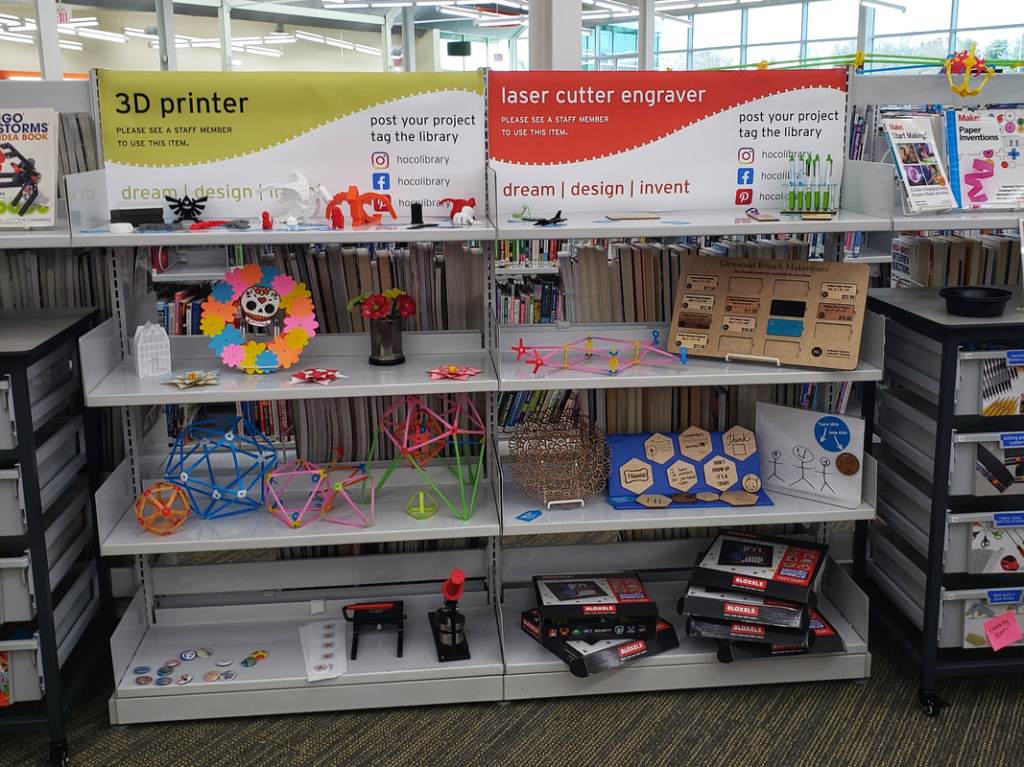
Signs advertising a 3D printer and laser cutter engraver, with examples of projects created by them on the shelves beneath, including keepsake ornaments and 3D printed flowers.
Creations from the Makerspace at HCLS Glenwood Branch.

The Makerspace at Glenwood is a one-stop shop for all things design. With tinker bins, there’s opportunity for crafting and inventing in all sorts of innovative ways. The 3D printer is a professional grade machine and with a Glowforge, Cricut, large-format printer, a digital memory station, and a recording booth, there’s plenty to explore. The Makerspace area serves people ages eight and up, but for younger folks, the Builder’s Barn is a great place to bring designs into life. While some of the Makerspace products have associated costs for materials, you can design from start to finish. You can take Makerspace classes at Glenwood Branch. If you don’t have time to make your project, though, the Maker-To-Order system allows for HCLS staff to print or cut your fully designed files.

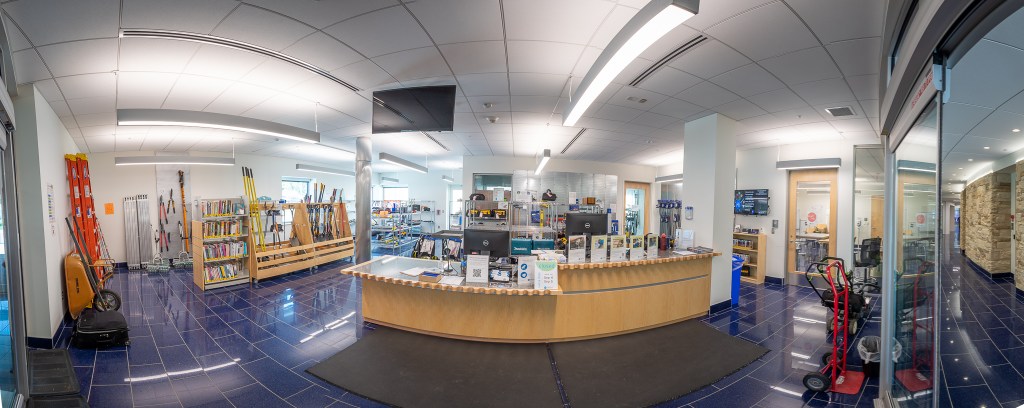
The photograph centers the customer service desk at the Elkridge branch's makerspace, with a wheelbarrow, ladders, and an array of books and tools to the left and behind, and a dolly and other equipment to the right.
The DIY Education Center at HCLS Elkridge Branch.

The DIY Education Center boasts a vast collection of tools for all ages, ranging from baking, biking, camping, crafts, gardening, or home improvement. The instructors are always excited to help those interested in engaging with the available tools at DIY classes held at Elkridge. The DIY Education Center even has a studio, a “mess-friendly” classroom, and a workspace. To borrow from the DIY collection, you must have a DIY library card, available to those 21 and older, who live, work, or attend school in Maryland.

Library customers stand outside a recording booth, which contains a microphone and a set of headphones draped over the mic stand.
Recording booth in the A/V Lab at HCLS Savage Branch.

The A/V Lab at Savage Branch also boasts a recording booth and 3D printer. During regular A/V Lab hours, a staff member can answer basic questions about the computer software. You can use the instruments in place, and as always, classes cans help familiarize you with each tool. Schedule a one-on-one appointment at the Savage Branch & STEM Education Center page on hclibrary.org.
If you want to find out more about how to unlock your creativity at the library this year, check out our classes, and visit us at the Makerspace, the DIY Education Center, or the A/V Lab.

Craft Works
For adults. Register here.
Let your creativity shine in a relaxed and welcoming environment. Each month, learn about different art media and explore new techniques.
Classic Book Flowers
Tue Feb 8 2-3:30 pm Central Branch.

A/V Lab
For teens and adults. Registration preferred here.
Drop-in to use the equipment in the A/V Studio. Record and mix music or create and edit movies with the help of a HiTech instructor. Walk-ins welcome.
Every Wednesday 5 – 7 pm Savage Branch.

Book Earrings and Charms
For teens & adults. Register here.
Make unique jewelry inspired by your favorite books.
Tue Feb 27 7 – 8:30 pm Elkridge Branch.

Sahana is an Instructor and Research Specialist at the Savage Branch. They enjoy adding books to their “want to read” list despite having a mountain of books waiting for them already.

eReader Labs

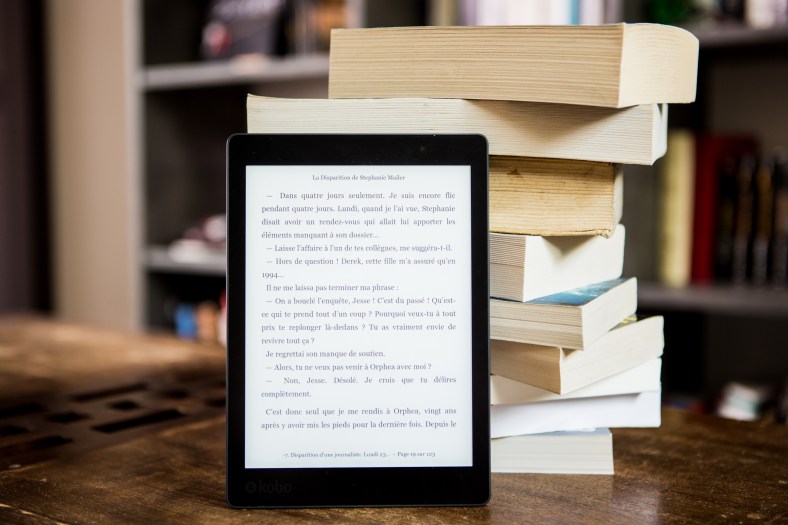
The photograph shows a spiral notebook with a pen and eyeglasses laying on the cover, next to a mug of coffee, with an e-reader resting on the corner of the notebook.
Photo by Aliis Sinisalu on Unsplash.

So you received a new e-reader for the holidays, and it’s still in the box. Or, perhaps you bought one several years ago but are tired of paying full retail price for books you only read a single time. Want to learn how to use Howard County Library System’s free e-book and e-audiobook resources? We demonstrate and give tips on how to use Libby, cloudLibrary, and Hoopla, with a Q&A time. Bring your preferred device, and we will get you started using our e-book resources.

Libby: Download e-books, e-audiobooks, or e-magazines to your computer, tablet, Kindle, Nook, or smartphone. Use Maryland OverDrive’s website to send e-books to your Kindle, or use Libby, the free mobile app, to borrow and read instantly on your mobile device. Libby is available for free in the iTunes App Store, Google Play, and Microsoft.

cloudLibrary: Use the free cloudLibrary app to browse, check out, download and read popular best-selling e-books or listen to e-audiobooks. Not compatible with Kindle Paperwhite e-readers.

Hoopla: For free, stream and temporarily download movies, television shows, music albums and audiobooks from major Hollywood studios, record companies and publishers. Not compatible with Kindle Paperwhite e-readers.

Bring your questions!

We work with you and your device, at your skill level, and provide information and guidance to develop the e-reader skills you are seeking or to resolve whatever issue you are facing. Please bring your device and your questions, so we can help you on your e-book or e-audiobook learning journey!

HCLS Miller Branch offers four upcoming sessions of eReader Lab:

Tue., Dec 19 | 11 am -12 pm. Register here.
Tue., Jan 16 | 11 am – 12 pm. Register here, beginning January 2.
Tue., Feb 20 | 11 am – 12 pm. Register here, beginning February 1.

World AI Week

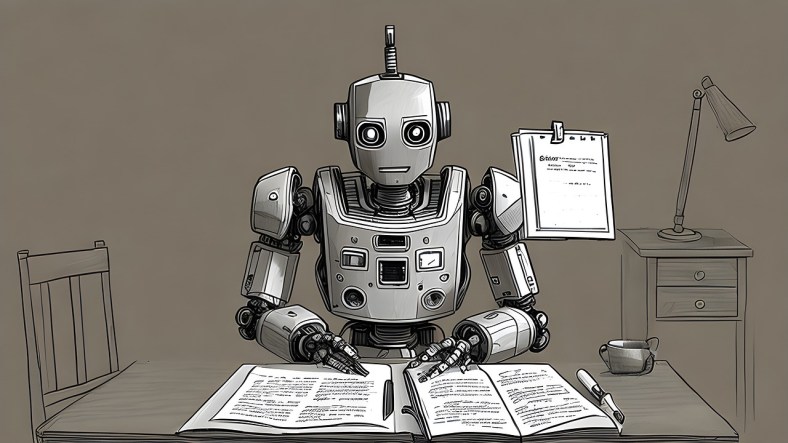
The image shows a robot seated at table, reading written materials placed in front of it. A chair is off to the side of the table and a smaller table with a lamp is in the background.

by Sahana C.
There has been a lot of controversy around artificial intelligence floating around in the public subconscious this year, good news and bad working in tandem. On one hand, AI could be used to clean the ocean! On the other, writers and actors alike have been striking because of strange clauses in studio contracts involving AI. This tangle, this never-ending back and forth, coupled with fearmongering from generations of sci-fi media like Ex Machina, is exhausting after a certain point. And I understand that for a lot of people it’s frightening. The thought that we’re creating something so quickly that forefathers of the industry are asking to slow it down, that we are launching something we don’t fully understand the implications of or the ethical implications of, it all compounds. But the easiest way to fight fear of an unknown thing is to be informed, and it seems like AI is here to stay. So we need to be learning about it and using it too.

Artificial intelligence is utterly pervasive, showing up through things like ChatGPT, and while it can be used for writing papers (though it usually doesn’t do the best job and is fairly obvious), it can also be used as an editor, as a practice interviewer, as a summary tool. Google has started to introduce it slowly into its Drive suite. Adobe has introduced it into Lightroom and Photoshop to help photographers and editors make their edits in a much timelier fashion. There are countless uses, all of which can help us make more polished versions of our crafts.

We have to be careful about overstepping in the arts; it’s not acceptable that AI compiles works from artists to create art, and it should not be used to replace creatives. Artificial intelligence isn’t a creative force and while it can perhaps produce a result, a person is almost always going to make better art.

AI is a tool, one that we can use. It doesn’t have to be scary robot overlords of lore. It’s something to be aware of, and most importantly, to combat disinformation. It’s something to explore, just so we know enough to be educated.

October 9-14 is World AI Week, hosted in Amsterdam this year, where they will be making announcements about innovation in AI. We’ll hear about the ways industry is hoping to use artificial intelligence, and some of the leaders in this field will be able to interface directly with the users. It’s an important week for learning, and we’ll be paying close attention.

If you are interested in learning more about AI more generally, you can go to Gale Courses with your library card and take “Introduction to Artificial Intelligence” for free. At Byte-sized Intelligence: Lunch and Learn on October 10 (see box), we debrief you about the basics of artificial intelligence and any updates we’ve learned on the first day of World AI Week. And of course, if you, like me, process the world most effectively through literature, our collection has plenty for you to sink your teeth into.

Byte-Sized AI: Lunch & Learn
Tuesday, Oct 10 | 12 – 1 pm
Savage Branch
For adults. Register at bit.ly/HCLS_bytesized
Explore one of the most exciting and rapidly evolving fields in technology! Anyone who is interested in learning about AI, regardless of technical background or experience, can join the discussion about recent advancements.

Sahana is an Instructor and Research Specialist at the Savage Branch. They enjoy adding books to their “want to read” list despite having a mountain of books waiting for them already.

Byte-Sized Intelligence: A Crash Course on AI

The image shows a robot seated at table, reading written materials placed in front of it. A chair is off to the side of the table and a smaller table with a lamp is in the background.

by Sahana C.

Thursday, April 20 at 7 pm
In person; Savage Branch
Register

Libraries have come a long way – from a time when including a table of contents was the most innovative, revolutionary advancement in conducting research to the advent of search engines. How we interact with information, how we keep ourselves informed, and how we use the tools at our disposal have all evolved.  

Artificial intelligence (AI) is the next wave of that evolution. Though it’s the subject of many science fiction novels, its real-world applications are wildly interesting. Artificial Intelligence refers to the development of computer systems that can perform tasks that would typically require human intelligence. These tasks may include speech recognition, image analysis, and decision-making. AI is already being used in a variety of fields, from healthcare to transportation, and its potential applications are only growing. 

Savage Branch is having a crash course and conversation about the fascinating world of AI on Thursday, April 20. We plan to explore the basics of AI, looking at what it is, how it’s used, and its potential impacts on society. Whether you’re a tech enthusiast or just someone who’s interested in staying up-to-date on the latest technological advancements, there’s something for you! 

In our AI class, you’ll learn about the different types of AI and their real-life examples. For example, machine learning is a type of AI that allows computer systems to learn and improve from experience, without being explicitly programmed. Deep learning is another type of AI that uses neural networks to process and analyze large amounts of data. We’ll also explore natural language processing, which enables computers to understand and interpret human language. 

But it’s not just about the technical aspects of AI. We’ll also delve into the ethical considerations surrounding AI, such as bias and privacy concerns. As AI becomes more integrated into our daily lives, it’s essential to evaluate the potential impact on society and address these issues. 

Our AI class is designed for anyone who wants to learn about this exciting and rapidly evolving field, regardless of technical background or experience. Our experienced instructors guide you through the basics of AI in a clear, structured, and informative manner. Don’t miss this opportunity to explore one of the most transformative technologies of our time. 

The possibilities of Artificial Intelligence appear to be limitless. And what’s more – some of this blog post was generated by AI. I asked it to analyze my other writing to create a blog post on this class in my style, and I think it did a decent job. Did you catch anything that felt off? If you want to learn more, to discuss how this is possible, or just play with the possible applications, join us at Savage on April 20 to learn more. 

Sahana is an Instructor and Research Specialist at the Savage Branch. They enjoy adding books to their “want to read” list despite having a mountain of books waiting for them already.

Visit us at the Howard County Fair

STEAM Machine with blue awning deployed sits on a grassy patch, with a popup tent next to it.

Do you love the fair? Deep fried everything? Rides? Awards for livestock and hand-crafts? What’s not to love?

This year, as you come in the front gates, look for Howard County Library System’s new STEAM Machine. Stop by to participate in a STEAM-related activity, watch a demo, or take a tour of our new (air conditioned!) mobile unit. The 33’ Farber diesel bus features a climate-controlled classroom that seats twelve students. It is equipped with Wi-Fi, laptop computers, two 49” LED TVs, sound system, video production equipment, materials, and supplies, including science kits to conduct experiments and complete projects. A 55” LCD monitor and two awnings allow classes to be taught and activities conducted outside.

As the mobile classroom goes out into our community, students can borrow books and other materials on STEAM subjects. Our goal is to transform students into scientists investigating new phenomena and engineers designing solutions to real-world problems.

Tonya Aikens, President & CEO of HCLS, notes, “Howard County Library System is coordinating with community partners to schedule STEAM Machine classes across the county. Our goal is to bring opportunities for hands-on STEAM education to students from under-resourced communities and families who, for an array of reasons, are often unable to come to our branches.”

HCLS instructors will teach most classes with contributions from scientists and engineers from the Maryland STEAM community, who will be recruited for special events. HCLS is collaborating with community partners to determine student aspirations and needs, identify community locations for STEAM Machine visits, and schedule classes and events. 

The STEAM Machine is funded in part by an American Rescue Plan Act (ARPA) Grant through the Institute of Museum and Library Services and administered by the Maryland State Library Agency.

See you at the Fair!

I Am An E-book Convert

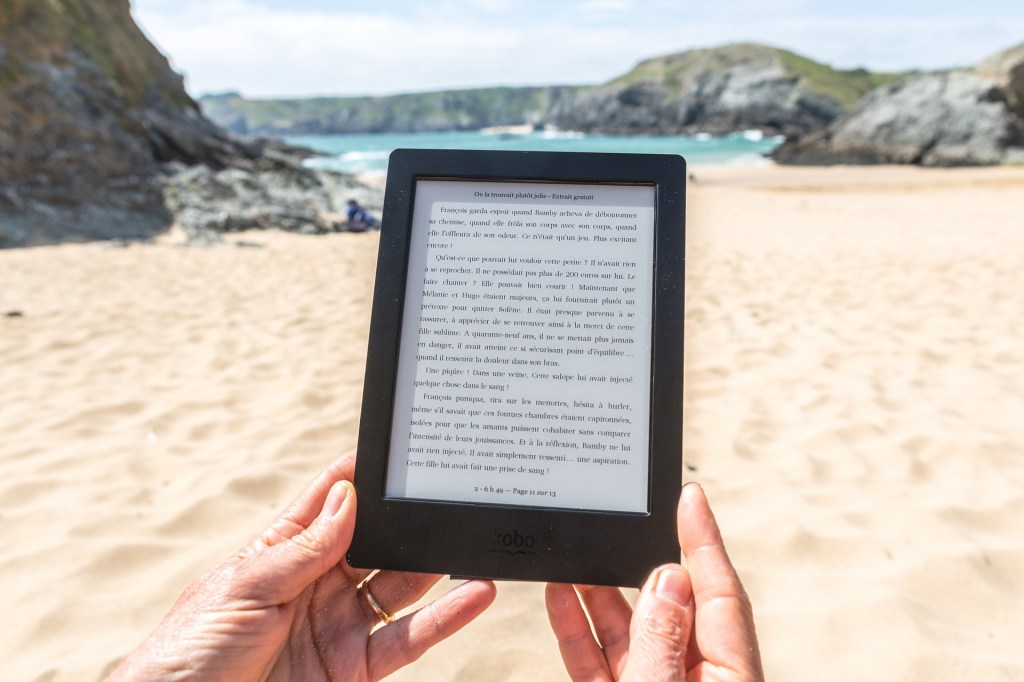
The image shows a pair of hands holding an ereader with a remote sandy beach, rocky hills, and a turquoise sea and hazy blue sky in the background.

By Alan S.

I am a recent convert to the pleasures of an e-book. I appropriately played the T-Rex who needed help in a recent Facebook video. I have always preferred physical books over eBooks, enjoying the feel of holding a book in my hand more than the feel of a tablet or phone. I resisted the call of eBooks for a while. Working in a library, all of those printed books were right in front of me. Why choose to look at a screen? What would ever make me choose to read a book on a device?

The first thing that changed my feelings about the electronic version was packing for trips, especially those requiring plane travel. When taking a road trip, it is easy to fill a bag with books and throw them in the trunk. This is not so simple when you are packing for a plane ride. I started packing one or two physical books, then downloading a few e-books as a backup. I still usually take at least one physical book on a trip, but tend more toward eBooks when traveling. I’m sure my family likes the extra space to pack other things.

An increase in the number of audiobooks I listened to also led to an increased use of eBooks. My car is still equipped with a CD player, so a book on CD is an option, but there are benefits to an eAudiobook. The biggest is the lack of a need to change CDs. I hated listening to a book in the car and getting to the end of a CD with no safe way to change to continue the book. With eAudio, the book continues without your help. I have also learned the joy of increasing the speed on some books. When reading for an assignment, or if the reader reads very slowly, I can listen at a faster speed and still enjoy the book (I might also be a tad impatient).

If you are ready to join me as an eBook convert, see HCLS’ resources.

If you need help accessing your eBooks or with any of our other online resources, please join us for live Online Tech Time Wednesday, July 22 at 11:30 am. Other sessions of this useful class will be offered in the future.

Alan has worked for HCLS for just under 25 years, currently at the Savage Branch. He enjoys reading, television, and most sports.

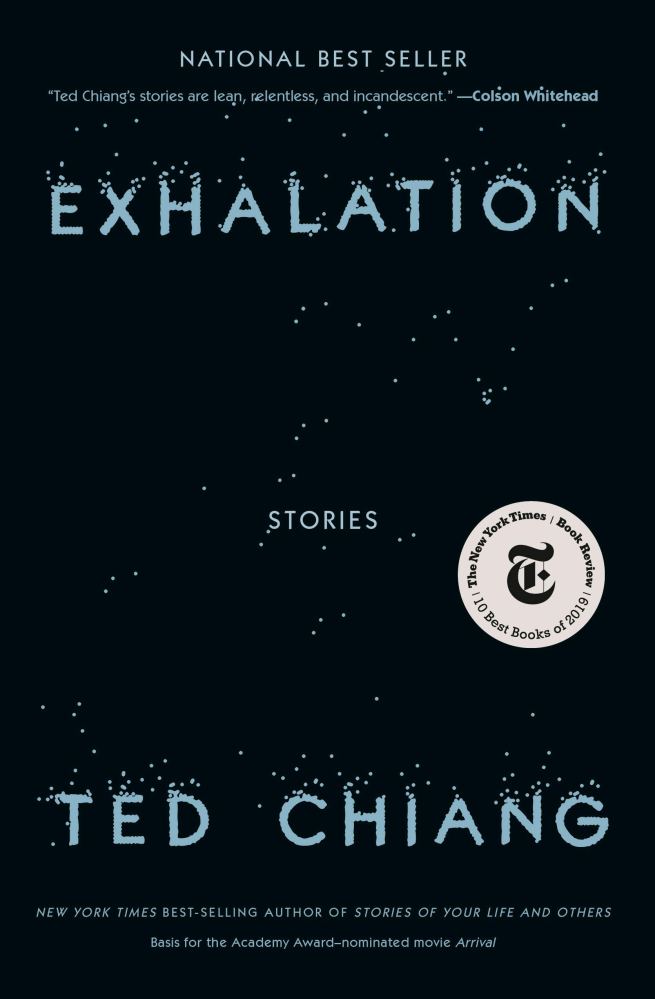
Exhalation by Ted Chiang

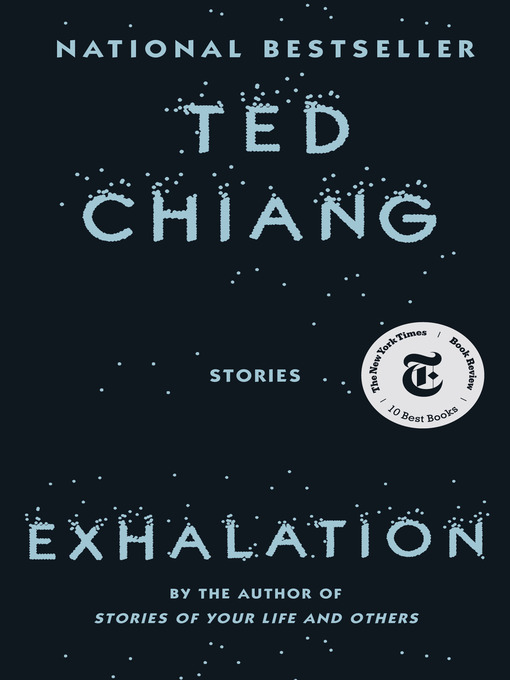
The cover shows a dark background with the title and author's name in slate blue graphics. The letters look like they are dissolving into stars, with the dark background as outer space.

By Eric L.

Ted Chiang is not only a writer, he’s a computer scientist who is employed as a technical writer, as far as I know. This is Chiang’s second short story collection (a story from his previous collection, Stories of Your Life and Otherswas adapted into the movie Arrival). 

Frankly, I was rather surprised that Exhalation was selected by The New York Times Book Review as one of the best fictional books of 2019, but it’s well deserved. That said, I’d implore you to give this collection a read even you’re not into sci-fi. These stories, like all great science fiction, are only superficially about science and the future.  

Although Chiang alludes to the technical aspects of whatever he’s describing, it’s all just the backdrop. Like all the great sci-fi writers, he uses imagined technological advancements of the future as the setting to tell beautiful existential tales. His stories concern how societies employ technology and, subsequently, how it changes individuals in profound ways.

There is a story about “raising” a computer program/avatar that not only interacts in virtual reality, but also actual reality. One story concerns a rigid time travel portal; another is about the perils of a robot nanny; an interesting one is about a mechanism attached to the eye that can record every moment (you can share the footage with your friends). My favorite features a machine that gives users the ability to communicate with a version of themselves that has made different life choices. 

I hope these descriptions will not scare readers away. It seems odd to even contemplate how rapid technological advancement could not change us. Some of the stories are better than others but they’re all worth a read, and I don’t think they’re overly melancholy. Recurring themes include acceptance, free will, masculinity, and control.  

I find Chiang’s work similar to that of Philip K. Dick. Chiang even describes how one of the stories included was inspired by an old Dick short story. Although I wanted to interpret the stories myself, I couldn’t resist reading the story notes at the end of the collection.

Special thanks to my book discussion group for helping me think through some of these ideas through a conversation over the internet.

Exhalation is also available as an eaudiobook through OverDrive/Libby and CloudLibrary, and as an ebook through OverDrive/Libby

Eric is a DIY Instructor and Research Specialist at the Elkridge branch. He enjoys reading, films, music, doing nearly anything outside and people.