
Shakespeare: The Man Who Pays the Rent by Judi Dench

A light blue cover with a small watercolor illustration of a tree above text that reads: Judi Dench. Then, Shakespeare in a big script above copperplate type: The Man Who Pays the Rent.

by Kristen B.

If you have ever wanted an in-depth, behind the scenes look at Dame Judi Dench’s formative years with the Royal Shakespeare Company, have I got a book for you! If you haven’t but have a fondness for the Bard, you still want to get your hands on this book. And if you simply love to listen in on two friends trading stories from their past and arguing over details, this one is for you, too – it’s that much fun!

Dame Judi Dench and her good friend Brendan O’Hea engage in a series of conversations in Shakespeare: The Man Who Pays the Rent, during which they discuss Shakespeare and acting, and – in all honesty – just dish about various productions. You can almost hear the teacups in the background. It’s fascinating to eavesdrop on them quarreling about interpretation or reminiscing about pranks and misdeeds. They cover some of the best-known plays, such as Twelfth Night, Macbeth, and Romeo and Juliet, but they also spend time with Coriolanus, The Merry Wives of Windsor, and The Winter’s Tale. I was simply amazed by how much of each play Judi Dench can apparently recite from memory – entire sequences, from multiple parts.

I assume the physical book is lovely, but the audiobook is pure gold. Barbara Flynn provides Dame Judi’s voice, and you would think that you’re listening to a younger version of the great actress (which you essentially are). She talks about her favorite parts, her views for the motivation of various characters, how Shakespeare manipulates the audience, and more details about stagecraft. She also tells stories about being mostly naked and painted green, sharing rooms, and having a ton of fun with other (now revered) fellow actors.

As she says, ““Everything you have felt or are yet to feel is all in there in his plays: oppression, ambition, loneliness, remorse, everything….Shakespeare has examined every single emotion….His writing has the capacity to make us feel less alone.” This book helped me remember exactly that! I laughed, I learned, and I was gloriously entertained.

Shakespeare: The Man Who Pays the Rent by Judi Dench and Brendan O’Hea is available in print, e-book, and e-audiobook.

Kristen B. is a devoted bookworm lucky enough to work as the graphic designer for HCLS. She likes to read, stitch, dance, and watch baseball (but not all at the same time).

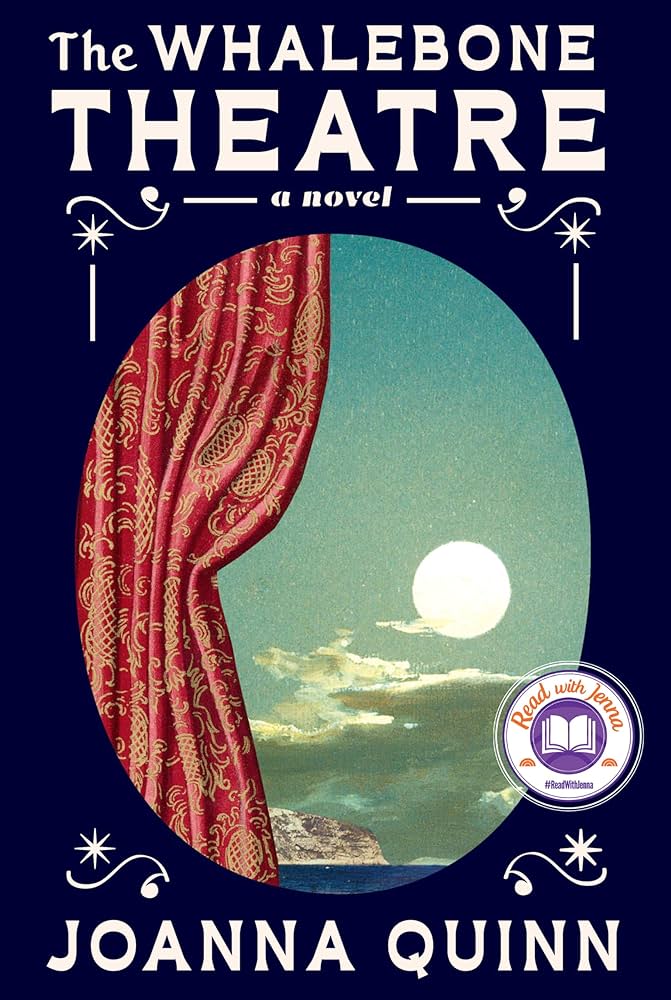
The Whalebone Theatre by Joanna Quinn

Within an oval frame, a red curtain pulls back to the left to show the cliffs of Dover beneath t

by Kristen B.

A friend suggested a good rule for reading: only one World War II-adjacent book each year. Well, I’ve already spent this year’s allowance, and it was a good one!

The Whalebone Theatre by Joanna Quinn begins during the interwar period, set at a grand country estate, Chilcombe, on the southern coast of England. Cristabel Seagrave is a lonely little girl with an immense imagination. Her mother died in childbirth, and the story gets underway with her father bringing home a new bride. England’s laws being what they are, the family needs a male heir to keep the estate. A set of minor tragedies and expected resolutions ensue, all of which lead up to the day that Cristabel discovers a dead whale on Chilcombe’s beach.

With this highly cinematic scene, set against a quiet sea and a rising sun, the book finally gets underway. Cristabel hauls herself up the side of the leviathan and plants her flag, literally, in its blubber as her two younger stepsiblings turn up to watch and cheer her on. It’s clear that the trio of Cristabel, Flossie, and Digby make a minor clan in and of themselves, running mostly feral as their adults are caught up in the bohemian lifestyle of the rich and entitled in the Roaring Twenties. Interestingly enough, her stake cannot stand because all sea-washed flotsam automatically belongs to the Crown. In the end, the Crown doesn’t want it and the poor whale spends the rest of the summer slowly rotting upon the shore, much to the entertainment of the children.

Also discovered upon the beach that day is Taras – an itinerant Russian painter living a risque, socially liberal life-style. His paramours are old friends with Flossie and Digby’s mother, and so ensues a longstanding relationship between both parents and children. Taras eventually has the grand idea of moving the whale’s ribs to build a theater within Chilcombe’s estate. Under Cristabel’s direction, the children, their adults, and other willing locals stage a variety of plays, including a retelling of the Iliad and Shakespeare’s The Tempest. One of the Bard’s final plays, The Tempest carries certain themes throughout the book – including shipwreck and exile, civilization and monstrosity, and power and integrity. The book glosses over the 1930s with a set of newspaper clippings detailing the annual summer performances at the theater.

When the story recommences, World War II is well underway. One of the adults who came and went from Chilcombe turns out to be a high-ranking member of the British intelligence ministry. He enlists first Digby, then Cristabel into becoming agents in occupied France. Meanwhile, Flossie maintains the home estate and becomes a Land Girl as the war rages on. The story careens through the final years of the conflict, with uncertainty and anxiety at every turn as our intrepid trio make their separate, but always inter-connected, ways in the world.

In the end, it all comes together back at Chilcombe. No one is quite the same in the aftermath of war – family, friends, servants, and locals. I greatly enjoyed the book with its gorgeous language, despite its quiet devastations that rang absolutely true to me. At the end of The Tempest, Prospero says, “Now my charms are all o’erthrown, And what strength I have’s mine own.” What strength remains belongs solely to the women of this story, home at last. I suspect this is a title I will linger over and think about at odd moments. Certainly, it resonated with other recent books adjacent to WWII where the smaller stories and sacrifices carry the story.

The Whalebone Theatre by Joanna Quinn is available in print, e-book, and e-audiobook.

Kristen B. is a devoted bookworm lucky enough to work as the graphic designer for HCLS. She likes to read, stitch, dance, and watch baseball (but not all at the same time).

In Conversation: Pierre Jean Gonzalez

The photograph depicts actor Pierre Jean Gonzalez in his starring role as Alexander Hamilton, wearing a white shirt, pants, vest, and cravat, with a brown overcoat with gold buttons. His head is turned to the side and he is gazing into the distance.
Photo credit: @ Joan Marcus

By Cherise T.

Fans of Hamilton know the impressive acting, singing, and dancing skills required to bring to life the musical’s complex characters. Hamilton showcases multiple musical genres, innovative choreography, and insightful portrayals of historical figures responsible for the founding of the United States. We are excited to share highlights from our conversation with one of the show’s remarkable stars whose work impacts the artistic content we will see in the future.

The photograph is of Hamilton star Pierre Jean Gonzalez, wearing a black shirt and facing the camera.
Photo credit: @ Ambe J. Photography

Growing up in the Bronx, Pierre Jean Gonzalez never saw himself represented in the television shows he watched. Today, he is starring in the national touring company of Hamilton, and is the co-founder of DominiRican Productions, whose “mission is to see People of Color on both sides of the camera.” The creation of the production company was part of his “pandemic journey” to “address issues of representation.” He feels grateful that “because of Hamilton, I’m able to use my status to help others.” 

What’s it like playing Alexander Hamilton? “Challenging” and “amazing.”

Is BIPOC casting in musical theater important and why? To summarize, it has changed Pierre’s life as well as the lives of other creative people and audience members.

How are opportunities for underrepresented and marginalized communities created? Case study: DominiRican Productions.

We examined these issues and took audience questions at our September 20 event at HCLS Central Branch. The evening featured a screening of DominiRican’s award-winning experimental short, release, directed by Pierre, featuring a poem and performance by Cedric Lieba Jr., the cofounder of DominiRican Productions, and Pierre’s fiancé. Explore their inspirational projects at https://dominiricanproductions.com.

The photograph depicts Pierre Jean Gonzalez looking at books from the HCLS Central Branch equity collection with instructor and research specialist Ash Baker.
Instructor and Research Specialist Ash B. highlights the HCLS Central Branch Equity Resource Collection for Pierre Jean Gonzalez.

The focus of Pierre’s biography surrounds his advocacy for Latinx and LGBTQ+ opportunities on stage, on screen, and behind the camera. He and Cedric used the pandemic’s constraint on their acting careers as a chance to construct a unique artistic venture highlighting original voices and fresh talent to viewers. Inspired in part by the musical heritage, humanity, and diverse casting of Lin-Manuel Miranda’s work in Hamilton, Pierre builds and supports projects that might otherwise never be produced. His dedication to inclusion and community is clear, and we were all motivated by his empowering message of kindness and empathy in art. Pierre shared his personal coming out story as well as guidance for all of us to live our truth, share our stories, and lift up those around us.

Pierre Jean Gonzalez is on the stage at HCLS Central Branch, speaking into a microphone in front of an audience.
Pierre Jean Gonzalez in conversation with Cherise Tasker, Instructor and Research Specialist, at HCLS Central Branch.

Howard County Library System was excited to host this talk with Hamilton star Pierre Jean Gonzalez. Although registration for this event filled almost immediately, please watch our Classes & Events page for daily updates on future presentations and interactive sessions: https://howardcounty.librarycalendar.com.

Cherise Tasker is an Adult Instructor and Research Specialist at the Central Branch. When not immersed in literary fiction, Cherise can be found singing along to musical theater soundtracks.