The Ministry of Time by Kaliane Bradley

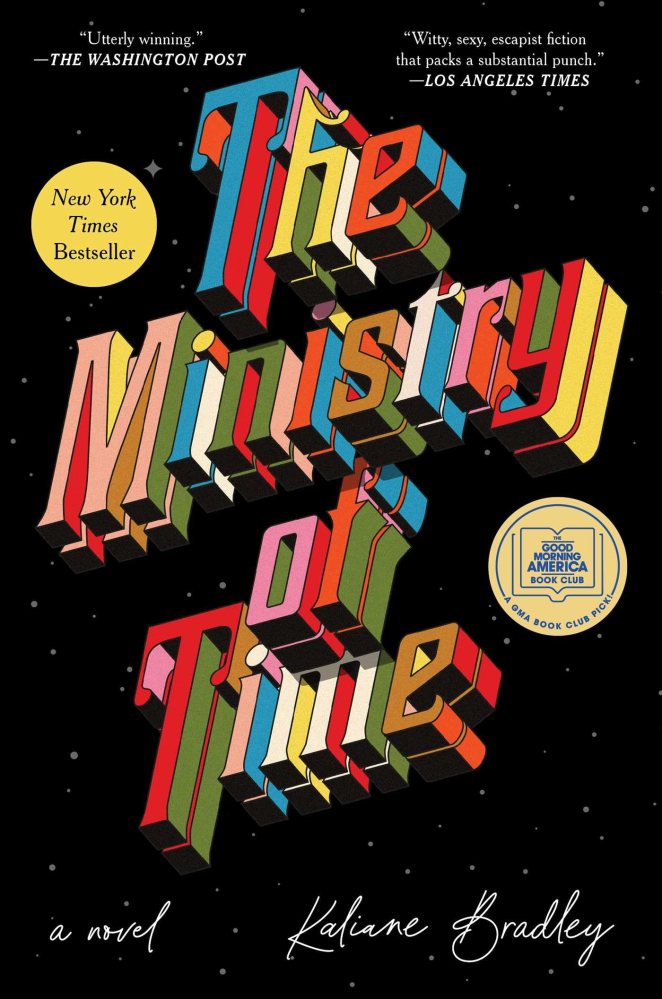
Brightly colored, large italicized lettering appears doubled on a black cover. Stickers added for New York Times best seller and the Good Morning America Book Club.

by Kristen B.

As the story begins, the main character is finishing a series of rather hush-hush job interviews. When she learns she got the new position, she hears the words, “We have time travel.” Welcome to The Ministry of Time by Kaliane Bradley, which plays with the notion that sometime in the future, we figure out how to travel in time.

It’s one of the biggest question about time travel: Can we improve the present – avert some disaster – by changing the past? This story seems a little different, more scientific at the start – wondering if it’s even possible for humans to exist outside of their own time. The Ministry devises an experiment where they “rescue” certain individuals known to have died in tragic or terrible ways: a doomed trip to discover the Northwest Passage, a plague house in the 1600s, the trenches of WWI, and other such horrible histories. Those individuals feel more like they’ve been kidnapped than rescued.

The book’s narrator, who gets that job with the Ministry (but never a name), is assigned to be a bridge between Graham Gore, officer of the Royal Navy in the early nineteenth century, and her time period in near future London. She insists on referring to him as being Victorian, but his time was actually just before Victoria’s reign began. The first third of the book delights in Gore’s observations of modern life and conveniences. But clearly, something is amiss in the Ministry. The main character just can’t quite figure it out but strange happenings keep occuring, like her handler being assassinated at a public event and certain time travelers being invisible to scanners. Other things don’t add up either, although it becomes clear there are warring factions within the Ministry. No one is quite sure who to trust.

Graham and our narrator spend almost all their time together: learning modern skills like riding a bike (which eventually improves to a motorcycle), touring museums, and going to pubs with other time traveler/bridge pairs. One session admiring a Turner exhibit at the Tate is particularly insightful. Graham becomes good friends with two other people out of time, one of whom is my favorite character. Maggie was left to die in a plague house, but she comes to embrace London’s club scene and dating apps where she can be openly gay. These friendships prove to be crucial not only to the characters’ well-being, but to the ultimate resolution of the story.

On top of the fascinating premise, the author has a gorgeous way with words. One character is described as, “Despite being out of uniform, he looked oddly formal, as if he was as the sole person in serif font.” I don’t want to spoil the surprise of this excellent debut. What ensues in the second half of the book is a complete mash-up of time travel, spy thriller, and romance into a beautifully written novel about the dangers of colonialism. Bradley really does tell you everything you need to know in the first chapter, only I didn’t realize it until I re-read it after the devastatingly bonkers ending. This is a book I’ll think about often and already have plans to re-read.

You can borrow the book in print or large print now, but there’s a bit of wait for the e-book and e-audiobook versions.

Kristen B. is a devoted bookworm lucky enough to work as the graphic designer for HCLS. She likes to read, stitch, dance, and watch baseball (but not all at the same time).

Two Fun Series for Young Readers

By Monae R.

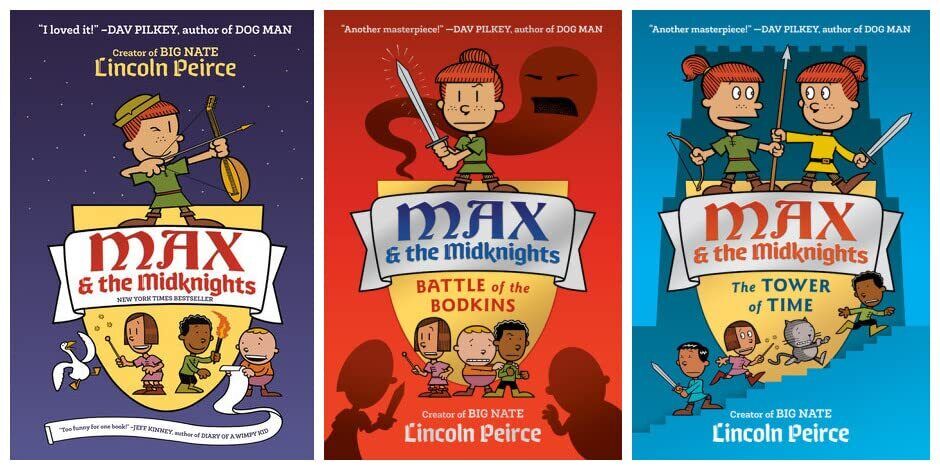
The picture is a collage of the three book covers in the series, with cartoon illustration of Max and his cohort with swords and bows and arrows.

Max and the Midknights is a children’s series that mixes between graphic novel and a chapter book styles. These are great for readers who enjoy the ‘Big Nate’ graphic novels because they were written by BIG NATE himself. Parents know the true author, but let the kids be amazed. Follow this story as Max and his friends travel through medieval times, with foes and kings and magic.

In Max and the Midknights we are introduced to Max, Kevyn, Simon, Millicent, and Uncle Budrick: a group of young children and a single adult who travel through medieval times to overthrow an unjust king and restore the land of Byjovia to its original glory. Filled with humor, readers will love this story and the sequels. Finished book one and want more? Don’t worry. Follow the midknights in Battle of the Bodkins as they discover a new type of villain called Bodkins, who are trying to take over Byjovia. Continue with The Tower of Time, where you can travel through time and be reintroduced to a few villains and even friends in the conclusion to the epic series.

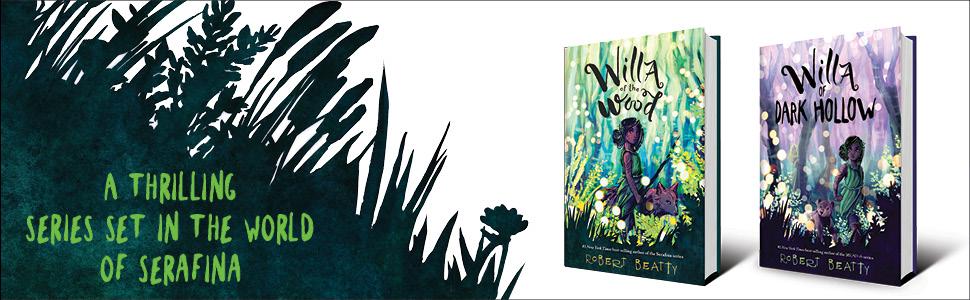
The picture shows some foliage in dark green silhouette on a hill, with the book covers for the first two books in the series to the right.

No matter if you have read the Serafina series, the Willa duology by Robert Beatty will have you wrapped and engulfed in its story. You can listen to the audio, read the physical book, have it on your Kindle and tablet. Follow Willow as she looks for the truth her clan has hidden from her and her generation. Determined to uncover her clan’s history, Willa makes her way through the forest making unlikely friends and learning not to judge a book by its cover or believe what everyone tells you. Sometimes, you need to discover the truth yourself. If that does not convince you, read this small snippet of Willa escaping a treacherous place and protecting those close to her.  

“She could feel herself getting farther away from them with every step she took. Her heart swelled with hope that she was going to make it. But as she ran away, Lorcan pulled back his arm and hurled his killing spear like a javelin. It shot through the air and struck her in the neck with a shocking blow and knocked her to the floor. She looked down toward the end of the corridor, and the last thing she saw was Nathaniel’s children disappearing into the escape hole”.  

The adventure does not end there. Guaranteed to bring you tears of both joy and sadness, Willa’s story comes to a loving, surprising, and happy conclusion in Willa of Dark Hollow.  

Monae is a Children’s Instructor and Research Specialist at HCLS East Columbia Branch.

Am I Southern? Does It Matter? 

A Black woman with short hair looks pensively downward. Along the bottom, a black and white photo of slave quarters is superimposed, and the edges are faded like an old photograph.

by Eric L.

I recently read Kindred by Octavia Butler in my book discussion group. It was my first exposure to Butler, and I like both her style and the book overall quite a bit. We also read the graphic novel as a supplement. I recommend it, too, as the illustration and style were excellent.

Written in the 1970s, the plot concerns a Black woman from Los Angeles who is mysteriously transported back to the antebellum south, specifically to the eastern shore of Maryland. It continues to happen, and each time the protagonist remains a bit longer. The time she stays in the past is greater than the length of time she is missing from 1970s L.A. It goes without saying that the past is terrible for a Black woman. 

Hence my question about being southern. As someone from Baltimore, I tend to view myself as an “enlightened north-easter.” However, the racial history of this country is something that should be given some thought. It’s not just a southern plantation owner issue that ended in 1863.

Dana is a writer. Her husband is also a writer, and he is white. I’d rather not give too much away so you can read the book to determine why this is happening, but in a little bit of a spoiler, she has relatives on this plantation that she returns to again and again. One of them, who eventually becomes the plantation owner, is white; the other is a Black woman, technically a “free” woman. It’s not exactly the freest environment even if you’re not enslaved.

Her reminiscence about how she met her husband is sweetly romantic and interspersed throughout the book. The juxtaposition of the recent past, the present, and the distant past is an interesting story technique. At one point, her husband purposefully holds on to her during one of her time travels in an effort to accompany her. As a white man, he obviously has a much higher social standing than she does and hopes to provide some protection. He is successful, to some extent. She wonders if he will somehow be changed by spending time in this time period. Really, she’s wondering how anyone could not be changed, herself included.  

The discussions and disagreements between the two of them about common misunderstandings between men and women, Black people and white people, are telling. The whole book offers a compelling study in empathy. The protagonist’s own status as a free Black woman and a visitor to the plantation, along with her relations with both white people and enslaved persons, highlight ideas of jealousy and privilege. That said, Butler deftly deals with the concept of how we all think we’d comport ourselves in oppressive situations. When one’s actual survival is at stake, how outspoken could anyone be with a very real threat of state-sanctioned terror and beatings?  

To be clear: this is not a defense of race relations in the 1970s, or now for that matter. The protagonist experiences profound culture shock (e.g., I could beat you for speaking to me that way). For me, this story further acknowledges the history of those who resisted and fought back against nearly insurmountable odds. The protagonist is forced to reckon with her own privilege in the antebellum south and her relatively comfortable life in 1970s America. She leads you to this by thinking that, in just a few years, Harriet Tubman begins bringing enslaved people to freedom. As a reader you wonder, how? 

This book is the type of fiction that weaves a thought-provoking story with great social and moral commentary. It is my kind of read: messy, complicated, and realistic (except for the time travel). 

In sum, I think I am southern. Maybe many Americans are?

Kindred is available in print, e-book, and e-audiobook.

Eric is a DIY Instructor and Research Specialist at Elkridge Branch. He enjoys reading, films, music, doing nearly anything outside, and people.

I’m Waiting for You and Other Stories by Kim Bo-Young

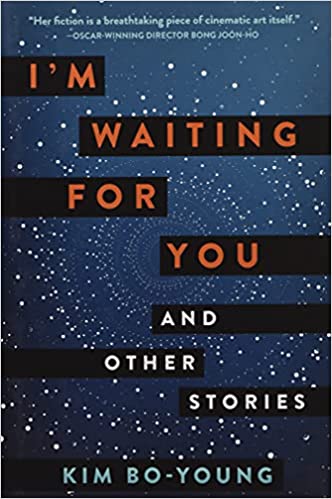
The book cover depicts a deep blue night sky with swirls of distant stars. The title is superimposed in orange and white lettering against strips of black, alternating the words in left and right alignment.

By Sahana C.

As a medium, science fiction has been a way to ask larger questions about what it means to live since Mary Shelley’s Frankenstein. Questions that are a bit too uncomfortable to ask in the context of real life without the buffer of aliens or mind-bending time travel, such as: who are we if we’re taken off of Earth? What does humanity look like broken down to our bare essentials and out of context?  

I’m Waiting for You and Other Stories by Kim Bo-Young follows the precedent set centuries ago, asking readers to consider what love looks like outside the bonds of time, where we can learn about free will, and how hope can manage to exist in the most devastating of circumstances.  

Originally published as three separate novellas, there is still so much overlap as the stories ask you to consider your own humanity. The first story, the eponymous “I’m Waiting for You,” is epistolary, told through letters from the point of view of a man writing to his fiancée as he tries to time his interstellar journey just right so that he will meet her at the church they decided upon in time for their wedding day. The unnamed main characters, through a comedy of errors and well-meaning but decidedly bad decisions, are left trying to catch up with one another as they fast-forward through time. He is increasingly isolated as he travels through time and space, but all the while it is his love of his fiancée that keeps him human.  

The second and third story are connected, “The Prophet of Corruption” with a soft multiverse-centric epilogue in “That One Life.”  The two stories follow god-like beings who experience a sort of reincarnation in order to learn more about their nature and the nature of the world, and who think of corruption as what happens when they are disconnected from the whole. The story reminded me at times of the short story “The Egg” by Andy Weir (who also wrote The Martian) with the ideas of reincarnation but made wholly new for the universe Kim Bo-Young manages to create. There were moments where I felt like I was floating outside of the narrative, but I was never far enough away to escape orbit – existential but not just for the sake of an “I’m-smarter-than-you, let’s see an audience try to puzzle this out” existentialism. It’s hard but worth it, thinking about our place in the world and what we mean to one another. 

The final story, “On My Way,” brings us full circle back to the couple from “I’m Waiting for You” and returns to the epistolary format established in the first story. We see the letters that the woman sent her fiancé this time around, and her interstellar travels have been completely different from his. The two are juxtaposed, not only by being from the perspective of a man versus a woman, but by the circumstances surrounding each protagonist. The former deals with the impact of isolation in times of despair while the latter considers group dynamics in times of disaster.  

The first and last story are about love beyond the bounds of time; what is it about us that makes us human? How far can we go before we lose our humanity? They consider the everlasting nature of hope, but manage to stay honest while avoiding any sort of cheesiness. They discuss what love looks like, with both protagonists making promises they aren’t sure the other person will ever get to hear, promising I will love you if we are the last people on Earth and out of all the people in the world, I chose you, over and over again.  

The first story, as Kim Bo-Young explains in the author’s notes at the end, was written as part of a proposal. It took me a while to understand how something that appeared so tragic would be the best way to propose marriage to a loved one; it feels so unanchored and dire at moments, but it is the fact that through it all, the protagonist is still there, persevering, forcing himself to survive, that shows the romance.  

It’s a translated work, which reinforces the idea that translation is an art form and a version of composition in and of itself – there are no stuttering moments that remind you that it is not originally written in English. In fact, I forgot until I read the end notes, emails between the author and the translator, context for the short stories, and the author’s motivations and original audiences. I might even recommend reading the notes before the stories themselves; I wish I had. 

I’m Waiting for You and Other Stories by Bo-Young Kim is available in print.

Sahana is an Instructor and Research Specialist at the Savage Branch. She enjoys adding books to her “want to read” list despite having a mountain of books waiting for her already.

Oona Out of Order by Margarita Montimore

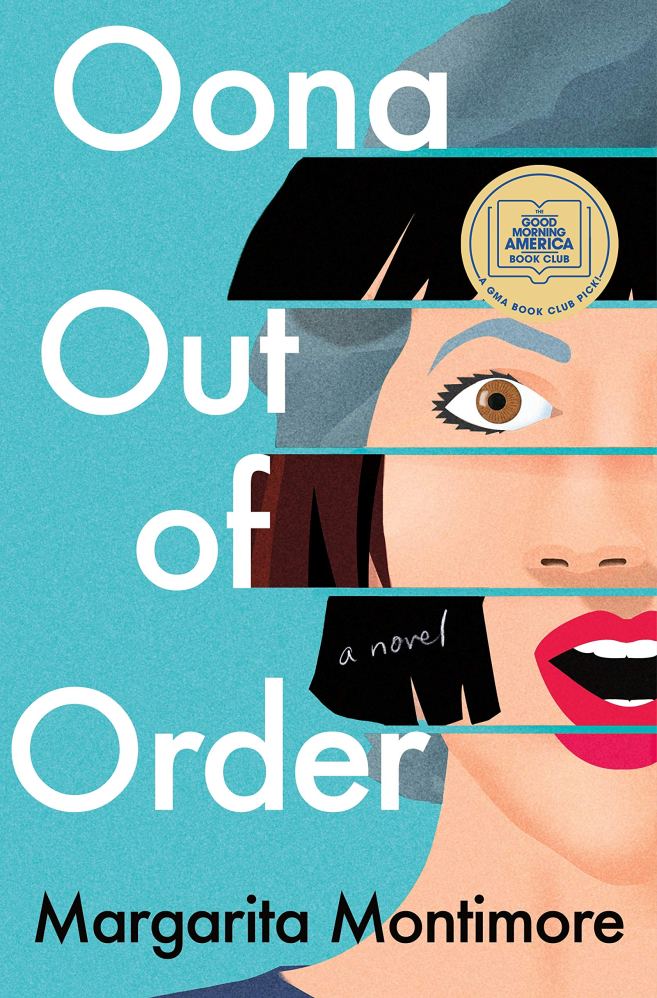
The bright blue cover shows the sliced up illustration of white woman with short dark bobbed hair with eyes and mouth wide in suprise. The portrait is only halfway on the right side of the book and the sliced strips are disjointed.

by Kristen B.

Oona Out of Order is a slightly different sort of time travel novel … Oona’s mind jumps randomly from year to year into her chronologically aging body, always on her birthday, which happens to be January 1.

Imagine never being quite sure what year you’re in, although you’re always you. What would your touchstones be? For Oona, it’s her mom and, for later years, her personal assistant.

As the novel begins, Oona enjoys a rocking New Years Eve party with her boyfriend, the band they are in, and most of her friends, and she’s about to turn 19. De rigueur teen drama plays out all around, but there are some real decisions that Oona has to make soon, decisions that set the stage for the rest of the book. She can either skip out on college and go on a European tour with the beloved boyfriend and the band (opening for other, larger acts) or she can do a year abroad in London with her bestie from childhood.

Only when the clock strikes midnight, Oona finds herself completely disoriented at age 51. That turns out to be a quiet year, taking stock and figuring out what’s what. In subsequent years, Oona jumps around from party-hard years in the New York club scene, to a brief foray into married life, to traveling the world.

Montimore was smart about creating the structure of her impressive debut. She never explains or solves the time-traveling issue; it’s just a given. She also sets up Oona as being independently wealthy after some good bets and smart stock trading given her knowledge of future years. Managing her portfolio (literally a set of folders) is her only job, leaving her free to absorb each year as it comes. Being based largely in New York helps a lot, too, as she can always find another facet of life to become immersed in.

There’s also Oona’s mom, who helps her (mostly) to bridge the years and explain what’s going on. In fact, Madeleine may be my favorite character, who is trying her best to live her own life as well as take care of her daughter’s chaos. Not always an easy relationship, it rings true in many ways as it’s the only one that Oona manages to sustain for much of the book. Oona’s love for music provides the other constant in her life, to the point that you might be tempted to listen to some Velvet Underground and Blondie as you read.

Monitmore gives us a fun book that doesn’t take itself too seriously, but nonetheless asks questions about what it means to live a good, meaningful life. It does also give some closure to the big questions facing Oona at the beginning of the book – which she gets to answer with a lot more maturity and experience than most 19-year-olds have at their disposal. Don’t you wish you could tell your teenage self a few things?

Oona Out of Order is available as a book, an eBook, and an eAudiobook.

Kristen B. is a devoted bookworm lucky enough to work as the graphic designer for HCLS. She likes to read, stitch, and make soup in the winter.

Thrilling through Space & Time: Dark Matter & The Gone World

By Khaleel G.

As a genre, science fiction can be daunting to new readers. For some, the size of the books can threaten one’s attention span and bookbag; for others, the density of the language, with strange technical terms and invented rules, can be as repelling as a tractor beam in reverse. 

But fear not, gentle reader! Sci-fi is such an incredibly wide field, with myriad sub-genres within it, that there’s a story for any reader. I’d like to highlight two novels, both of which deal in the manipulation of time and space, but with enough flavor, tone, and character writing to carry you all the way to the final page.

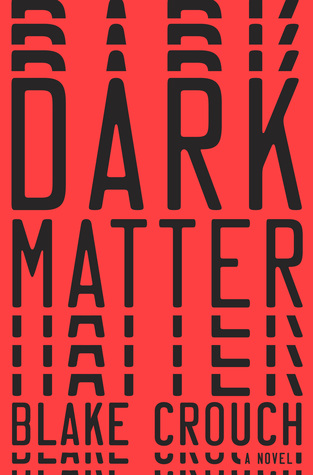
The book cover shows the lettering of the title and author's name in black lettering, overlapping themselves several times, against a red background.


Dark Matter by Blake Crouch seems initially like a crime thriller. Jason Dessen is on his way home from work, through the streets of Chicago, when he’s abducted by a stranger, who asks him, “Are you happy in your life?” After being knocked unconscious, he awakens, surrounded by strangers, all welcoming him back into a life he never lived. 

Any adult has those idle moments, wondering about what might’ve been – if they’d taken that job, or if they’d stayed with that person, or if they’d had the chicken instead of the fish at that one dinner, that one time. For Jason, that train of thought becomes real and absolutely alien. In short order, he realizes that this is a parallel world to his own, where he made a slightly different choice in careers…which resulted in his alternate self creating dimension-hopping technology. No biggie!

Worse yet, in this world, Jason didn’t marry his wife, and they didn’t have their child. Once these stakes are established, the novel fully becomes a thriller, as Jason struggles against the forces of man and physics to get back to his world and family.

The story bounces between worlds upon worlds, Jasons upon Jasons, but we never lose the plot’s thread. The mechanics of parallel worlds are clearly established, and the rules are not confusing.  By the end of the book, those rules have been pushed to their limits, but the pace and tension of the plot kept me engaged, absorbing the science-y bits alongside the emotional ones. The intertwining of those two strands – the emotional and the scientific – was so effective, I read this book in two sittings. It is THAT captivating!


On the other end of the space-time continuum, The Gone World by Tom Sweterlitsch explores time travel, but differently than other related tales like Back to the Future. Back in the 80s, a secret division of the US Navy discovered time travel, using it to explore and discover new futures. The book properly begins, though, in 1997, as Shannon Moss is working for the Naval Criminal Investigative Service. A Navy SEAL’s family has been murdered in West Virginia, and a girl has gone missing. What seems like a heinous but human crime is revealed to be much more, as Moss investigates ’97 and years, and decades, beyond.

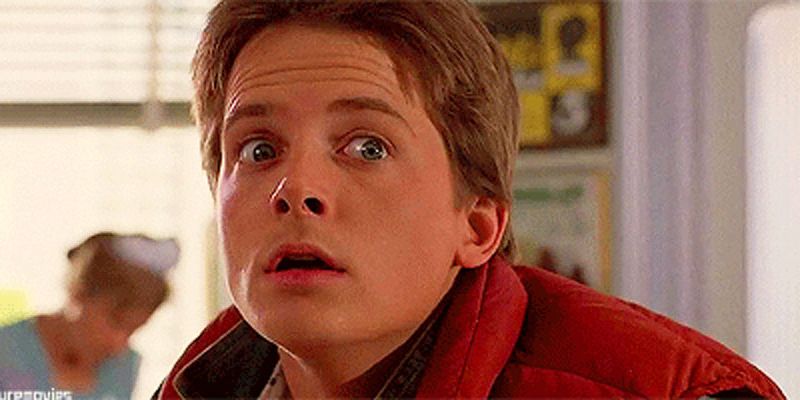
The picture is of actor Michael J. Fox in his role as Marty McFly in the film Back to the Future, wearing a red puffy vest and collared denim shirt, with wide eyes indicating shock or surprise.
This book doesn’t play by Back to the Future rules…


The Navy’s time travel system doesn’t operate by popular rules, like Marty McFly’s “go back to 1950 to make sure your parents meet” sort. Instead, a person is sent only into the future, from that particular and exact moment in time. The future they experience is a sort of bubble, one in which all events played out exactly as they were set up at that moment of the time traveler’s departure. If this sounds confusing, rest assured that Sweterlitsch explains it far better than I. Like Dark Matter, the book lowers you slowly into the science, letting the human drama lead the pace.

In practice, time travel allows Moss to jump decades into West Virginia’s future, when neighbors and witnesses are more amenable to talk about this old, grisly murder. It also means that Moss can see how the world changed in her absence, as her family and friends think she simply disappeared. Astoundingly, the story takes place almost entirely within West Virginia and surrounding areas, as Moss bounces between 1997 and various points in the future; this grounds the story in a gritty reality of detectives, seedy motels, and criminal hideouts, not unlike its genre sibling, True Detective.

Did I mention there’s also this looming apocalypse in the future, called “the Terminus?” And in every possible future the Navy’s travelers go to, it’s still there, destroying Earth – and with each time travel leap, it seems to be arriving sooner? So while the main thrust of the plot has roots in Appalachia and crime fiction, there is still Deep Time, lost Navy starships, bizarre future evolutions of mankind, amid moments of time itself bending and cracking – all under this looming, seemingly inevitable threat.

Sweterlitsch combines snappy character writing, attention to detail, and readable action sequences to make this rather thick book into a page-turner, one that kept me up deep into the night to get to the next twist. It is a mix of grisly murders, police procedural, and cosmic horror – and I haven’t read anything quite like it elsewhere.

The book cover shows an icy landscape at night, with frozen trees and stars against a deep blue night sky.

The Gone World is smart and complicated, while also a non-stop thrill ride; its finale left me (as all my favorite books do) suddenly returned to my own body, yet my mind refused to stop and leave the story. Over the next few days, I would return to re-read sections, and I’m contemplating another read very soon (perhaps the audiobook from Overdrive?). 

And that’s the magic of great sci-fi!  The story can be about space armadas, alien princesses, time travel, or dimension-hopping – it doesn’t matter, as long as the author can wholly transport the reader into a world that’s different, but still human. As long as it leaves you in a state of wonder.

Dark Matter by Blake Crouch and The Gone World by Tom Sweterlitsch are available in print from HCLS, and in eBook (Dark Matter | The Gone World) and eAudiobook (Dark Matter | The Gone World) from Libby/Overdrive. Dark Matter is also available in CD audiobook from HCLS

Khaleel has worked at the Miller Branch since 2015, though he’s been back and forth between HCLS and high school, college, and graduate school since 2003.