After surviving a series of devastating traumas, including the loss of both parents and a harrowing act of violence, Bonnie Lincoln wins the lottery in Ashley Hutson’s novel One’s Company. Instead of buying a new house in the traditional sense, she moves to an isolated mountain compound and hires staff to construct an exact replica of the 1980s sit-com Three’s Company set, complete with everyone’s apartment units.
In what she now calls home, Bonnie attempts to live as each of the show’s characters, cycling through their wardrobes, their quirks, their scripted joy. It’s a surreal and (I have to say bizarre!) premise, but Hutson manages it with such clarity that it never feels absurd, even if does seem alarming yet somehow inevitable. There’s something hauntingly familiar about the way Bonnie seeks refuge in nostalgia. In a world that often feels too sharp, too loud, too cruel, Bonnie’s retreat into the sitcom world of Three’s Company feels less like madness and more like a desperate kind of hope.
As a child of the 70s and early 80s who watched and adored Three’s Company during its original prime time run and in reruns, I get it. I have lived there once, in front of the screen. But Bonnie’s journey is a reminder that even though nostalgia can be a balm, it can also be a blade. What makes One’s Company so affecting is its refusal to pathologize Bonnie. Her choices are extreme, even worrisome, but they are also deeply human. Who among us hasn’t longed to disappear into a simpler world, one where problems resolve in 22 minutes and laughter is guaranteed? Bonnie’s obsession is not just escapism, it’s a taking back of control, a rewriting of her own narrative in a world that has repeatedly written over her.
Angie is an Instructor & Research Specialist at Central Branch and is a co-facilitator for Reads of Acceptance, HCLS’ first LGBTQ-focused book club. Her ideal day is reading in her cozy armchair, with her cat Henry next to her.
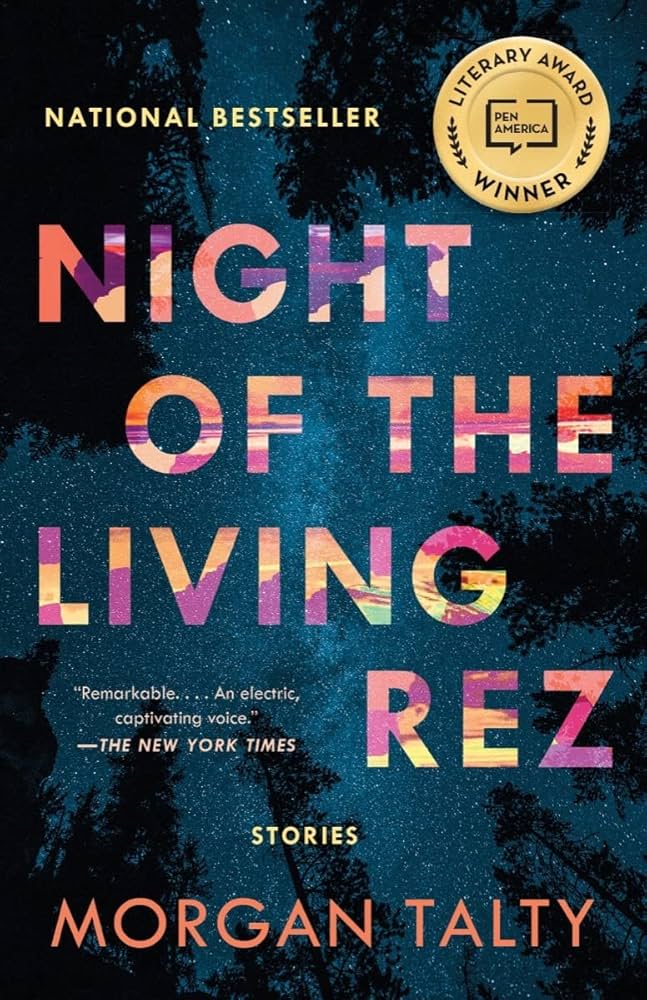
My book discussion group (Books on Tap) recently discussed Night of the Living Rez by Morgan Talty. I try to choose books that reflect the time of year, as well as to prioritize authentic voices. This book worked for November because Morgan Talty is a Native American author, and his book collects a series of inter-connected short stories about David and his family and friends on the Penobscot reservation in Maine.
In all honesty, the book is as bleak as any other work that deals with generational trauma and chronic poverty. However, it is laced with gorgeous prose, mostly in scenes describing the local woods and river. Talty has a sense of the poetic that shines through even the most difficult situations – including the description of a car crash that perfectly captures the halting, photo-flash moments of impact and aftermath. Surprisingly, along with the spare dismay of the stories, Talty also offers a pitch-black sense of humor. The sheer absurdity of teenage boys and their antics relieves the otherwise unrelenting sense of nowhere to go and nothing to do that permeates this book. Sometimes it’s true: you have to laugh instead of cry.
Eleven of the twelve chapters are tightly told from young David’s point of view – and his almost complete lack of understanding of what’s happening with the grownups in his life. His relationship to his grandmother is the foundational relationship of the book, as it was for his life. That special love grounds the stories and makes them real, in ways that the cigarettes, drugs, and drinking couldn’t. The love and the bad decisions weave so intimately that the inevitable heartbreak registers as simply, devastatingly true. The tight narrative focus is a fascinating authorial choice, but not until the last section do all the pieces truly come together in any sort of coherent way. It’s worth getting there with adult David, with compassion and forgiveness for the bone-headed youth that he was.
I’m not sure this review is going to convince you to pick up this book, but you should! I was heartened by reactions of the folks in my book club. They found value in the language, the author’s choices of what to share, in the universality of the stories, and in the need to laugh in the face of despair. Night of the Living Rez is a stellar beginning for a new author. I will eventually read Talty’s new novel, Fire Exit, but I need to continue to sit with this volume first.
Kristen B. is a devoted bookworm lucky enough to work as the graphic designer for HCLS. She likes to read, stitch, dance, and watch baseball (but not all at the same time).
Tana French’s The Searcher offers homage to the American Western, from its namesake The Searchers to John Wayne’s True Grit. In this slightly updated version, Cal Hooper retires from the Chicago PD to a small town in the west of Ireland. He’s an outsider, looking to start a new life after leaving his job and getting divorced. He’s focused on making the house he bought livable before winter arrives.
Cal’s cop senses come to high alert unexpectedly. He eventually figures out that a local teenager has been spying. Trey Reddy comes from a family generally unapproved of in Ardnakelty and is desperately looking for a missing big brother. The two form an uneasy relationship as Cal agrees to do a little sleuthing about Brendan’s disappearance and Trey helps with chores around the house, refinishing an old desk and painting the walls. At heart, Cal is a doer and fixer – hence the extensive retirement project. It’s easier to put his professional skills to use helping with Trey’s cause than to deal with the emotional fallout of the past and present. Cal even has a theory about how all most young men need is the equivalent of a horse, a gun, and a homestead.
A slow burn mystery then unspools around the whereabouts of Brendan Reddy, involving local lads, drug dealers from Dublin, and whatever is terrorizing the local sheep. Cal wrestles with taciturn country folk plus his continued confusion over how and why his marriage ended. The author does a marvelous job of winding the past and the present together as Cal tries to make sense of it all. As I attempted to put the pieces of the puzzle together, it resolved into the idea of a small town trying to keep on keeping on, without examining any preconceived notions too closely. And, perhaps, not being quite as friendly to newcomers as it originally seemed. The scene at the local pub involving shots of poteen that literally make Cal go a little cross-eyed might be one of my favorites. The gift of gab can disguise as much as it reveals. A little humor can serve to distract and deceive equally so. The Irish are masters at it.
Ireland itself serves almost as another character, with the townsfolk, the shops, the sheep, and the countryside itself. French’s descriptions of mists and bogs and biting winds are simply lyrical. They paint such vivid pictures that I could imagine the landscapes almost better than I could the characters. This book is just begging to be made into a movie with clear cut characters, a plot that wraps you up in its mysteries, and gorgeous scenery. I’d watch it (although I usually like the book better).
You may know the actress Selma Blair from her notorious same-sex kiss in Cruel Intentions or her frenemy role inLegally Blonde. Most recently, she has been a Multiple Sclerosis (MS) advocate, following her diagnosis in 2018. She is also the creator of an ability-inclusive beauty brand, Guide Beauty. And even if you knew none of this or all of this, her 2022 memoir Mean Baby shows us another side of Selma Blair: gifted writer.
Mean Baby takes us on a sometimes-meandering journey of Blair’s childhood marked by trauma, her adventures in the career pursuit of acting, motherhood challenges, addiction battles, family and romantic relationships, and her MS diagnosis and advocacy. Between the pages, you’ll uncover an impressive writer with an eye for exposing the good, the bad, and the ugly of a life well-lived. Although not a light-hearted read nor a page-turner, you will find Blair’s detailed accounts are those to savor and reflect upon. Mean Baby showcases the life of a survivor, thriver, and fighter with the vivid writing of a robust storyteller.
Carmen J. is a teen instructor at HCLS East Columbia. Among her favorite things are great books, all things 80s, shamelessly watching The Bachelor, gardening, and drinking anything that tastes like coffee.
When a novel is set in the reader’s hometown, appreciation for the story and characters extends beyond the book’s contents. When a novel is set somewhere new to the reader, that place is no longer foreign and unknowable. Literature expands memories, builds connections, creates new journeys, and fosters empathy.
Books by veterans, about veterans, and regarding veterans’ friends and families offer diverse perspectives of consequential events and everyday perseverance. Veterans can, perhaps, find shared experiences. For non-veterans, there are bridges to understanding. Ben Fountain’s depiction of experiencing post-traumatic stress disorder in Billy Lynn’s Long Halftime Walk is unforgettable. To some, an NFL halftime show featuring Destiny’s Child would be entertaining but to this story’s young Iraq War Army soldiers, it’s terrifying.
In his debut novel, The Yellow Birds, Iraq War veteran Kevin Powers takes on the burdens veterans face when they return home. Private John Bartle struggles to understand his own behavior in Iraq, as well as his debts and responsibilities to superiors and fellow soldiers. Veterans may relate to Bartle’s emotional efforts to move forward with his life beyond the battlefield. Readers who have never been in the military become immersed in Bartle’s psychological conflicts. He feels surrounded by death as he fights to survive both in Iraq and back home in Virginia.
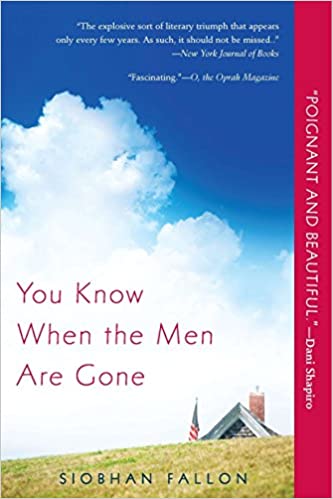
Short story collections offer multiple viewpoints of war in one volume. Siobhan Fallon’s You Know When the Men are Gonefocuses primarily on the family left behind, particularly military spouses in Fort Hood, Texas. The stress on these characters exceeds loneliness. Their attempts to cope with deployments are seen in actions as seemingly mundane as a shopping trip to the PX or as drastic as abandoning one’s spouse.
National Book Award winner Redeploymentby Marine veteran Phil Klay deftly presents the outlooks of men who entered the military from varied backgrounds. The stories are heavy but often humorous as Klay addresses the absurdities inherent in active duty as well as in the abrupt return to civilian life as a veteran. Often disturbing, the situations encompass violence and PTSD but also forgiveness and compassion.
Cherise Tasker is an Adult Instructor and Research Specialist at the Central Branch. When not immersed in literary fiction, Cherise can be found singing along tomusical theater soundtracks.
When I was a child, my mind wandered a lot, and most often it would wander to the dark places, as though drawn there by instinct
Sean Phillips
I am a huge fan of John Darnielle, the author of Wolf in White Van. He records music as The Mountain Goats and released two stellar albums in 2020. New albums aside, the album that matches best with Wolf in White Van is 2012’s Transcendental Youth; more on that later.
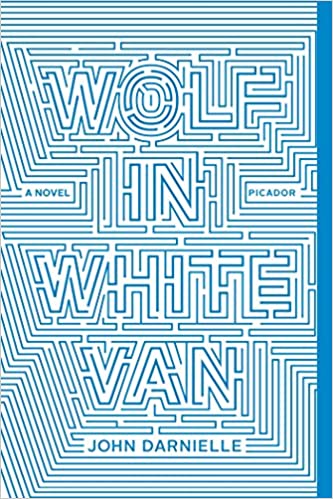
More pertinent to this review, John Darnielle is an accomplished novelist and a 2020 judge for the National Book Awards. His 2014 novel Wolf in White Van, also available from HCLS as an eAudiobook from Libby/OverDrive, is what this review is really all about.
Wolf in White Van is kind of a tragic novel filled with darkness, piercing insights, humor, and a lot of unanswered or unanswerable questions. Is Sean Phillips, the protagonist of the book, the titular wolf? That is the question that I kept asking myself after I finished reading it.
Present-day Sean lives alone. A traumatic event in his past left him disfigured and dependent on daily visits from a nurse. He is self-employed as the creator and manager of a pen and paper role-playing game called Trace Italian. Young Sean hatched the idea for a role-playing survival game that participants play through the mail during his long stay in the hospital recovering from the event.
Players pay Sean to explore his vision of a post-apocalyptic future where they chase the rumor of a safe haven called Trace Italian. Monthly or weekly they send him their moves and he tells them what happens next and gives them options for their next move. Two of Sean’s most dedicated players recently suffered a tragic accident because of decisions they made inspired by his game, and he faces the real-life consequences of their actions.
Young Sean is an enigma. Friends and family demand logic, reason, motivation, and rational explanations for his eccentric behavior, but he can’t provide his family with the answers they seek. The reader follows young Sean through episodes that inexorably move him toward the trauma that will change his life.
The novel has a fuzzy quality. The jumps from the present to episodes in the past keep the reader off-balance. The alternate reality of Sean’s role-playing game adds to the uneasy feeling of the novel. Some chapters jump into Trace Italian and describe how players navigate the harsh realities of Sean’s created world. I don’t want to give away the twists and turns, so I’ll stop.
The novel is the story of Sean, Sean’s family and friends, and the people playing Sean’s game. It is also filled with nostalgia. John Darnielle is a collector. He collects memories and feelings. That feeling you got when you watched static on the TV late at night in a kind of trance? John Darnielle remembers it and writes about it. That weird C-movie you watched on Saturday afternoon when you were a kid and no one else remembers ever existing? He remembers it. In fact, he has a VHS copy around here somewhere.
I don’t think Sean is a wolf in a white van. I mentioned earlier that Transcendental Youth might be the best album to pair with this book, and I think that is because of a certain thematic cohesion. On the first track, a track named after the late Amy Winehouse, John Darnielle sings:
Let people call you crazy for the choices that you make Climb limits past the limits, jump in front of trains all day And stay alive Just stay alive
Wolf in White Van is full of people making choices that are A: hard to understand for everyone else, and B: dangerous or harmful. Darnielle doesn’t celebrate harmful choices, but he does explore life around those choices. Darnielle writes episodes of levity, kitsch, and nostalgia, but overall this is a book filled with more questions than answers and leaves the reader with the feeling that there might not be answers to some questions.
Ben Hamilton works at Project Literacy, Howard County Library’s adult basic education initiative, based at HCLS Central Branch. He loves reading, writing, walking, and talking (all the basics).








 CHAPTER CHATS