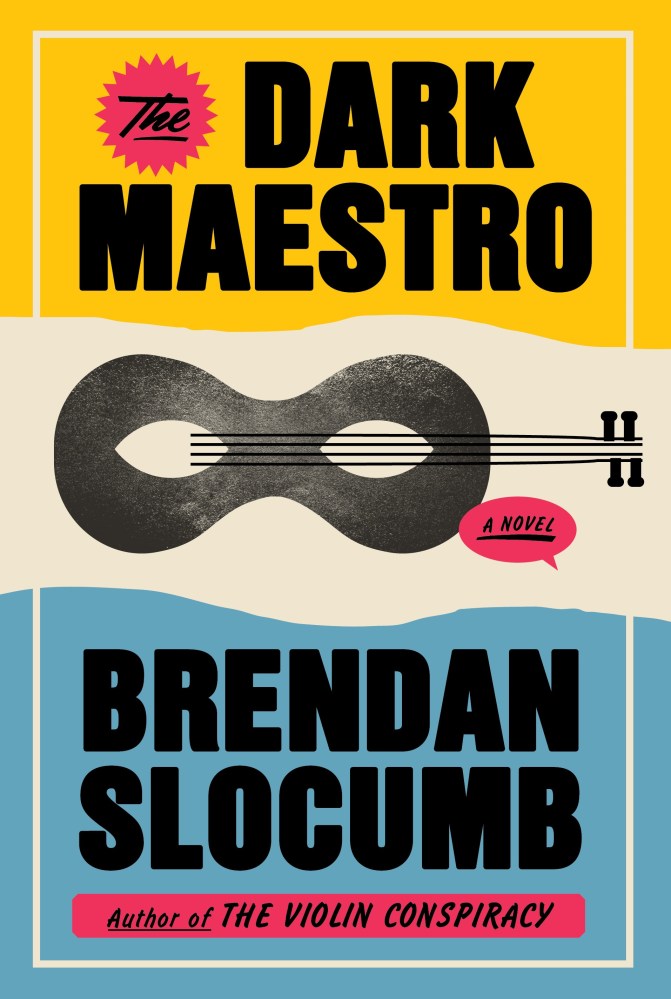
Author Works: The Dark Maestro by Brendan Slocumb For adults. Register at bit.ly/Author-Slocumb Tue Sep 16 5:30 – 6:30 pm Book Signing 6:30 – 7:30 pm Author Event East Columbia 50+ Center 6610 Cradlerock Way, Columbia (adjacent to library)
His cello made him famous. His father made him a target.
Curtis Wilson is a cello prodigy, growing up in the Southeast DC projects with a drug dealer for a father. But through determination and talent, and the loving support of his father’s girlfriend, Larissa, Curtis claws his way out of his challenging circumstances and rises to unimagined heights in the classical music world — even soloing with the New York Philharmonic.
And then, suddenly, his life disintegrates. His father, Zippy, turns state evidence, implicating his old bosses to the FBI. Now the family, Curtis included, must enter the witness protection program if they want to survive. This means Curtis must give up the very thing he loves most: sharing his extraordinary musical talents with the world. When Zippy’s bosses prove too elusive for law enforcement to convict them, Curtis, Zippy, and Larissa realize that their only chance of survival is to take on the cartel themselves. They must create new identities and draw on their unique talents, including Curtis’s musical ability, to go after the people who want them dead. But will it be enough to keep Curtis and his family alive?
A propulsive and moving story about sacrifice, loyalty, and the indomitable human spirit, The Dark Maestro is Slocumb at the height of his powers.
Brendan Nicholaus Slocumb was raised in Fayetteville, NC, and holds a degree in music education (with concentrations in violin and viola) from the University of North Carolina at Greensboro. For more than twenty years he has been a public and private school music educator and has performed with orchestras throughout northern Virginia, Maryland, and Washington, DC. He is currently based in DC.
Author Works: The Art Thief: A True Story of Love, Crime, and a Dangerous Obsession by Michael Finkel For adults. Register at bit.ly/Author-Finkel Wed Sep 17 7 – 8 pm online: register to receive a link
Stéphane Bréitwieser is the most prolific art thief of all time. He pulled off more than 200 heists, often in crowded museums in broad daylight. His girlfriend served as his accomplice, and his collection was worth an estimated $2 billion… but he never sold a piece, and instead displayed his stolen art in his attic bedroom.
He felt like a king. Until everything came to a shocking end.
The Art Thief, a spellbinding portrait of obsession and flawed genius, Michael Finkel gives us one of the most remarkable true-crime narratives of our times, a riveting story of art, theft, love, and an insatiable hunger to possess beauty at any cost.
Bauder Adult Battle of the Books is a new Friends & Foundation of HCLS fundraiser event launching as part of the Library’s 85th birthday celebration. It’s an adults-only reading competition where teams of 3–5 people read six preselected books and compete in a trivia challenge held at local restaurants. Proceeds will support some of your favorite Friends’ sponsored initiatives, such as author events, summer reading, Project Literacy graduation, and the youth Battle of the Books.
If you gravitate toward dark mysteries and enjoy problematic twists, this book was written for you! The characters and their respective lives are brimming with turmoil and ugly secrets. We get an intimate account of two (very) different women and the people and problems that orbit their lives. Be warned: There’s realistic trauma and difficult, uncomfortable themes. Yet, there is also a drive for justice threading through the harrowing tension. This book depicts a true crime podcast tinged with the vulnerable, gory details of all these characters’ lives blowing up after an arduous, intense burn. If you listen to the audiobook, be prepared for the enhanced uneasiness that comes through in the dialogue.
I mean, morbid curiosity is relatively normal. Most people scratch that itch by watching some FBI procedural show or reading a dark romance paperback, or even just leaning a little bit closer into a friend’s salacious gossip. That’s not enough for Alix Summer in None of This Is True by Lisa Jewell. Alix knows that morbid curiosity is also very profitable, and this is the unexpected carrot which I believe leads to her ruin.
Everything begins with what appears to be a chance encounter between birthday twins. Josie Fair is celebrating her birthday by having dinner with her husband at a pub she’s only ever walked past. She finds herself out of place, contemplating the lackluster life she’s living and how desperate she is for change. As if the universe hears Josie’s silent prayer, Alix Summer appears. Alix is a breeze. She glides gracefully into the pub to celebrate her own birthday at a prominent decorated table seated with beautiful people. Popular and important, Alix is effortless. Effervescent. The picture of perfection. Everything Josie feels she is not. It’s at this very moment when Josie’s snap judgement and ill-informed comparison sets our story in motion. Little does Alix know that her life (and Josie’s) will be irrevocably changed.
None of This Is True is curious. It is frustrating, tense, upsetting, and strangely satisfying. Puzzle out the truth…if you can. And for the love of all things good, don’t ignore the small voice that clues you into what’s happening just so you can get what you want. I promise you it’s not worth it. But reading this book definitely is!
This is a True story. The events depicted took place in Minnesota in 2006.
At the request of the survivors the names have been changed.
Out of respect for the dead, the rest has been told exactly as it occurred.
What defines the ‘truth’ of a story? Is it accuracy to the literal account of events, or that it resonates with a more elusive truth about our perceptions of ourselves and the world? Every episode of Fargo opens with the passage above, adjusted for the specific time and place of the season’s focal bedlam. Each season is independent, although loose connections unite each season into a shared world with Easter eggs for the eagle-eyed viewer. But each season is a ride along, a shocking and surreal crime wave that disrupts the deceptively quaint communities of the Midwest.
Watching Fargo is like having an intimate view into two trains hurtling towards an inevitable collision. It is tense and dramatic, unpredictable and quirky. As if the trains were full of seemingly supernatural criminal murderers and diffident Minnesotan house-spouses who would use phrases like “You betcha” and “Aw Jeez” even as the world burns down around them. A mix of crime drama and magical realism with a substantial dose of Minnesota Nice, all brought to a boiling point.
I cannot overstate my love for this series. The creative aesthetics behind the production are unlike anything else on TV. The sets are gorgeous; nigh-eternal winters loom over the Midwestern plains, enhancing a sense of stasis that stands in contrast to the rupturing of the status quo. The music fills the show with an exciting dynamism. The theme song is stellar, evoking a kind of folk melody that is nostalgic, yet somber and plaintive. As it pertains to the larger show, the music is curated to great effect. The soundtrack is a diverse mix of iconic songs of the time and original compositions, which all serve to influence the emotions of any given scene.
However, it is the writing that stands above all else. The framing device which opens each episode always fills me with anticipation. Borrowed from the original Coen Brothers’ film, the statement “This is a true story” calls to mind Truman Capote’s creative nonfiction novel In Cold Blood, which itself serves as a founding inspiration for true crime as a literary genre. Stories about crime have always drawn audiences, but true crime’s magnetism is unique. The next two lines of the opening comment on respect, for the living and the dead. The contrasting means of showing this respect are wryly humorous. One wouldn’t be remiss in wondering if the calls for respect are a means to an end so that the story can be told. Perhaps elements of these stories compel us to share them, as a lesson to be learned or a chance to understand something better.
However, contrary to the opening lines, Fargo is fiction. Many of us are familiar with films that take liberties with their claims of truthfulness (looking at you, The Conjuring). Fargo is different. The show revels in the contradiction of this deliberate and ironic narrative choice. This narrative flourish prepares the audience for a cavalcade of untrustworthy narrators. Truth is, unfortunately, not easily uncovered.
The police investigations which act as a through line for the series are not the pinnacle of competent detective work. There is neither a Sherlock nor a Hercule Poirot to be found. Instead, we are presented with a motley crew of eccentric characters possessed each by their own perspective, and everyone is wrestling for control. Their actions are influenced by their respective worldviews and the lengths they will go to ensure their particular truths remain unimpeachable. When these characters are pitted against each other, their perspectives paint a dynamic portrait of what it looks like to live in our world.
This interplay reveals discussions on all manner of philosophical and political topics. Uncovering the reference behind each episode title is a fun bonus game for an active viewer. I want to focus on one particular example from Fargo’s second season entitled “The Myth of Sisyphus.” Season two takes place in 1979 and covers the grisly collision between a hapless couple who accidentally killed a member of the local Gerhardt crime family, the vengeful crime family in question, the encroaching Fargo mob, and the state troopers who are trying to prevent the violence from spreading. The season opens with the words of Jimmy Carter:
It is a crisis of confidence. It is a crisis that strikes at the very heart and soul and spirit of our national will. We can see this crisis in the growing doubt about the meaning of our own lives. And in the loss of unity and purpose.
Fargo places Carter’s crisis of confidence in direct conversation with Albert Camus’ essay on Absurdism, “The Myth of Sisyphus,” with a handful of characters reading the essay.Camus’ essay discusses how we crave meaning and purpose in our lives but are confronted by a world that has no meaning and is defined by chaos. In the classic myth, Sisyphus was cursed to push a boulder up hill, which ultimately rolls back down once it reaches the top. Sisyphus must then return to the boulder and begin pushing it again. Forever. The myth represents futility and the struggle against meaninglessness. Arguably, none of the characters gained a great comprehension of this essay. Some of them flatly reject the framework of the essay, but nonetheless act in ways that exemplify Camus’ different propositions for responses to the Absurd. Through the contrasting reactions to the text and the responses to increasingly absurd circumstances, we see the show develop its philosophical inquiry into the issue.
This inquiry is not accomplished without a lot of heart. Fargo is ultimately hopeful. The largest source of friction, the catalyst of all chaos, stems from the inability to communicate and the resulting misunderstanding chips away at our sense of unity. Giving up is not an option, or at least, not a particularly good one. We make meaning in our lives through the things we cherish, that we wish to protect or pay our attention to. Whatever trial or tribulation, we face those challenges to preserve what is valuable. To do otherwise is tantamount to letting it fade.
Fargo is special for how it juggles this stylistic blend. It presents humor and horror together with sentimentality. None overshadows the other. Fantastic casting choices breathe life into the writing. No matter how quirky the characters may be, they embody a sense of realism that makes the world feel alive and not too distant from our own, especially now in our own bizarre and heightened reality. Sometimes, even truth must be disguised for others to regard it. Fargo uses the medium of fiction to bypass our skepticism and take us on a journey through and around the strange heart of the modern world. And it makes sure that the journey is going to be wild and fun along the way.
If your interest is piqued, the good news you can borrow the first three seasons of Fargo on DVD. Season 5 of Fargo is currently airing on FX and select streaming services.
Ian is an Instructor and Research Specialist at East Columbia Branch.He is a huge nerd with too many interests to list here. Currently, he is fixated on the interconnection between history and fiction. His favorite kind of stories are stories about stories.
Although I’ve enjoyed many a Sherlock Holmes adaptation in the form of film or television, or even spinoff books, I will admit that I haven’t read the original stories myself. I certainly don’t know a great deal about Sir Arthur Conan Doyle, the famous creator of the residents of 221b Baker Street. I do, however, know quite a bit more now than before reading Conan Doyle for the Defense: The True Story of a Sensational British Murder, a Quest for Justice, and the World’s Most Famous Detective Writer by Margalit Fox. Nonfiction is not my usual wheelhouse, but I will admit my interest was piqued by the book’s cover and description, which happened to be available as an e-audiobook when I was looking for my next listen. (It is also available in print and as an e-book).
Many people have heard of Sir Arthur Conan Doyle as an author, specifically of the series of detective stories featuring Sherlock Holmes and Dr. John Watson. His impact extends beyond those characters, though. Conan Doyle was trained as a physician himself, and he became enthusiastic about spiritualism in his later life. He also assisted with real-life criminal cases on occasion. One such situation is the focus of Conan Doyle for the Defense. That case involved an emigrant to Scotland who was wrongfully arrested, convicted, and imprisoned for a murder he did not commit.
Oscar Slater was a German Jew who had traveled to different parts of the world before ending up in Glasgow, Scotland in 1901. Then, in December 1908, a wealthy spinster named Marion Gilchrist was brutally killed in her home in that city. A very tenuous connection was made to Slater, and the prevailing attitudes and crime-solving techniques of the time ensnared him firmly, leading to his conviction and imprisonment in His Majesty’s Prison Peterhead. Eventually, Conan Doyle was able to help win Slater his freedom.
Fox’s descriptions of the case, the criminal justice system, and the Edwardian time period provided vivid images of the tale as it unfolded. Excerpts of court documents, letters written by Slater, and Conan Doyle’s own texts provide additional insight into the case. The print book includes maps and photographs, as well as extensive notes to support the text. Fans of Sherlock Holmes may be interested to learn more about Conan Doyle’s life and inspiration for his characters, and the miscarriage of justice highlighted in the book can provide a reminder for all of us that there is always more to a case than appears at first glance.
Eliana is aChildren’s Research Specialist and Instructor at HCLS Elkridge Branch. She loves reading, even if she’s slow at it, and especially enjoys helping people find books that make them light up. She also loves being outside and spending time with friends and family (when it’s safe).
It’s changed since you were here, or else it hasn’t It was special, it was deadly It was ours and then it wasn’t – The Mountain Goats
By Ben H.
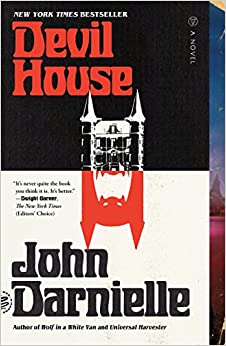
An entertaining book full of mystery, empathy, and suspense, Devil House is also a thoughtful examination of authorial responsibility. John Darnielle excels at building meaning by layering stories. As the frontman of The Mountain Goats, he’s a storytelling genius. He’s magical and efficient. He’s an all-time great songwriter.
Speaking of authorial responsibility, I should state upfront that I think Darnielle is a better songwriter than he is novelist. Devil House would have benefited from heavy editing. That being said, I like the book and I consider my responsibility as the author of this review now satisfied.
Devil House is the story of true crime writer Gage Chandler. Chandler fictionalizes true stories for money, the job of all novelists, really, but he isn’t Thomas Wolfe writing about Asheville. Chandler writes the new Hulu documentary about a mother who poisoned her kids or a couple who killed boarders and buried them under the hyacinths. Chandler writes books that are adapted for the small screen and become the must watch shows of the week. He approaches the gruesome devil house murders of Evelyn Gates (the greedy landlord) and Marc Buckler (the sleezy real estate mogul wannabe) the same way he approached previous cases, but things get complicated.
The titular house is the center of the novel and serves as a cipher for all the characters. Chandler, Buckler, Gates, Seth, Alex, and Derrick all revolve around its foundations in one way or another. It’s Chandler’s next project; it’s work. Buckler and Gates see it as an asset or potential asset. High school students Derrick, Seth, and Alex use the abandoned house as a hideout. They make it a castle. It’s a safe place to sleep at night. Many of the highlights of the book occur when Chandler describes the boys and their relationship with the house.
Chandler’s methods are extreme. He’s the Daniel Day Lewis of true crime writers. Joaquin Phoenix ain’t got nothing on Gage Chandler. He lives where the crimes were committed (he literally moves into the building known as devil house). He holds items held by those involved as if they were talismans. He haunts eBay looking for paraphernalia tangentially connected to the case. He becomes the victims. He becomes the murderer. Chandler recreates lives based on evidence left behind. He imagines conversations and relationships based on the contents of a junk drawer. He establishes character and personality based on notebooks full of doodles. He gives his characters depth. He uses empathy to create details and narratives for his characters; but has he cold-heartedly monetized empathy?
While living in devil house, an old case that involves the murder of two students by their high school teacher, which Chandler turned into the book The White Witch of Morro Bay, comes back to haunt him. He receives a devastating letter from someone questioning his depiction of a certain character. Chandler prides himself on being fair to his characters, but how can you be fair to someone’s son when to you they are just a character you have partially fleshed out? His resolve shaken, he questions his methods and his career.
For those thinking that what this book sounds like it needs is a medieval section in middle English, you’re in luck! For me, this strange interlude emphasized the depth of the world-building that Derrick, Seth, and Alex were doing. It’s like I always say, “whan that Aprille with his shoures soote, / The droghte of March hath perced to the roote.” I also always say that if you can cut the section in middle English from the book you wrote in 2022, you should.
As in Wolf in White Van, Darnielle moves back and forth in time, weaving patterns and stacking stories. The payoff is well worth it. I reread the reveal a couple of times because it was so satisfying. The obvious takeaway for me was a critique of true crime books, shows, and movies. Devil House also offers a commentary on how society treats its vulnerable members. Whatever meanings you find inside Devil House, I think you’ll enjoy exploring most of its pages.
Harbor me when I’m hungry Harbor me when I’m hunted – The Mountain Goats
Ben Hamilton works at Project Literacy, Howard County Library’s adult basic education initiative, based at HCLS Central Branch. He loves reading, writing, walking, and talking (all the basics).
“Searching for a missing person, after that first week, is a believer’s game” (219).
The Cold Vanish: Seeking the Missing in North America’s Wildlands is a gem of a book, written by Jon Billman, a fiction and journalism professor at Northern Michigan University. He also writes for Outside magazine, where I found the article that was the germ of the idea for The Cold Vanish. Billman tells the stories of a myriad of the disappeared, people who seemingly stepped off a trail at Mesa Verde or Yellowstone or Olympic and were never seen again. He intertwines their (shorter) stories with the book-length account of Randy Gray, father of Jacob Gray, a young man who parked his bike on the side of the road in Olympic and vanished into the woods of northern Washington. Although the disappearance is Jacob’s, the story really belongs to Randy, as we see the lengths he goes to in order to keep hope alive and continue the search for his son. Randy is a character – a Christian hippie surfer and building contractor, full of boundless energy and humor, enthusiastic, and generous. He is also willing to explore (if not exactly embrace with open arms) any theory that might locate Jacob and give him and his family some closure. My favorite anecdote about Randy: “Randy Gray cannot tell a lie, and so declares the two avocados rolling around somewhere in the back of the Arctic Fox when the customs agent asks if we have any produce. The agent pretends she doesn’t hear him, hands our passports back, and welcomes us to Canada” (274).
One of the stories really struck a chord with me. I’ve been to Mesa Verde, and walked the trail Billman mentions from the interpretive center to Spruce Tree House – “more of a sidewalk – it’s wheelchair accessible for less than a quarter mile, where visitors can view the [Anasazi cliff] dwellings from the shade of the overhanging cliff” (119-120). Yet 51-year-old Mitchell Dale Stehling disappeared while walking that trail and was not found until last year (his remains were located after the book was published, in August 2020). No other park visitor has stayed missing from Mesa Verde since the park was founded, and the area encompasses just over 50,000 acres. How could someone disappear off of a trail adjacent to the park’s gift shop?
The accounts of the disappeared have many explanations, some plausible, some completely off-the-charts crazy. I love a book like this that takes a journalistic viewpoint and presents the theories without passing comment; a book about conspiracy theories *not* written by a conspiracy theorist. In that respect, The Cold Vanish resembles another of my favorites in this genre, Where Bigfoot Walks: Crossing the Dark Divide by Robert Michael Pyle. In that book, acclaimed naturalist Pyle explains why the flora and fauna of the Pacific Northwest would be conducive to the existence of the Sasquatch – should such a creature exist. Like Pyle’s book, Billman’s presentation is open-minded and even-handed, and he makes valid observations and connections about why someone like Randy Gray might entertain the wild ideas of psychics and Bigfoot hunters. “Randy is the ultimate optimist. He’s wildly curious. The seeker from the Who song. ‘What else do I got?’ he says. ‘What else can I do?'”(217). Billman makes the reader understand Randy’s quiet desperation for any tenuous thread to follow.
He also explores other stories and disappearances: people who choose to go missing, the hunt for the Utah survivalist “Mountain Man” Knapp (who evaded authorities for seven years by breaking into remote cabins and stealing food and guns), and the serial killers in the Great Basin and in the Yosemite area who sought victims in remote wilderness areas. One of the best anecdotes is about Alan Duffy, a bloodhound trainer and handler who teaches his dogs, Mindy Amber and R.C., to search for the missing with a single verbal cue – either “Gizmo!” for cadavers, or “Find!” for a living person.
The book will leave you full of wonder at the majesty and hidden depths in what might seem like a benign, unspoiled setting, but which really harbors dangers that amateurs and enthusiasts ignore to their peril. You will also ponder the number of missing persons cases still unsolved: where are the (still) disappeared in our national parks and wild places, and will they ever be found?
The Cold Vanish is also available from HCLS as an eaudiobook from Libby/OverDrive.
Julie is an instructor and research specialist at HCLS Miller Branch. She loves gardening, birds, books, all kinds of music, and the great outdoors.




 CHAPTER CHATS