Sigh, Gone by Phuc Tran

The book cover shows a school picture of the author as a child, against a gray background. He is wearing a white shirt with a collar beneath a peach sweater.

By Holly L.

When I first glimpsed the cover of Phuc Tran’s powerful 2020 memoir, Sigh, Gone, I chuckled at the title. Sigh Gone—hahaha, I get it! As in Saigon. As in Vietnam, the country Tran fled with his family as a little boy in the mid-70s. The unsubtle title perfectly suits the story of, “a misfit’s memoir of great books, punk rock, and the fight to fit in.” In his debut book, Tran tells a compelling coming-of-age story of a book-obsessed punk in small-town Pennsylvania. His case for the transformative power of books struck a chord with me, as a library worker. As an Asian American who also came up in 1980s America, I empathized with Tran’s struggle to fit into a society that was relentlessly calling his American-ness into question.   

Each of the book’s sections is titled with a famous work of literature, the prologue being Oscar Wilde’s The Picture of Dorian Grey. The opener is a scene from Carlisle Senior High School in Carlisle, Pennsylvania, a small town in the Susquehanna Valley. Tran is sizing up the new kid, Hoàng Nguyễn, whose arrival marks Phuc’s demotion as the (meaning only) Vietnamese kid at his school. “@#$% that kid,” he thinks. Rather than seeing Hoàng as a potential comrade, Tran regards him as “a fun-house mirror’s rippling reflection of me…I was filled with loathing.” By this time, as an eleventh-grade Asian kid who had finally achieved “insider status”—acceptance among his punk crew and being better read than any of his classmates—Tran saw Hoàng as only a distorted picture of who he might have been had he not assimilated so well.

The story begins in earnest in 1978 with Tran’s earliest memory. He’s in the eat-in kitchen of his family’s first apartment in the United States, having fled Vietnam three years earlier. While his mother prepares dinner and his father tries to make sense of some bills with his limited grasp of English, Tran asks his dad, “Ba, what’s my name?” The question arises from playground encounter when another kid asked Tran his name and he didn’t know how to reply. Among all the nicknames and endearments he was labeled with by his family, he didn’t know which name to give. Young Tran felt he needed a name, an English name, that would make sense to his playmates. After a minute of consideration, Tran’s dad decided that the actual Vietnamese pronunciation of his name (which sounds more like Fuhp, with a rising tone at the end) would be too confusing to Americans, and he settled on Phuc (sounds like Fook, rhymes with Luke), which Tran adopts, referring to it as an alter ego.

Tran’s story takes us from childhood through adolescence with identity being a central theme. As he forms friendships and battles racist bullies, Tran struggles to define who he is, along with where he and his family fit in a mostly white working-class town. He expresses an ambivalence about his community, “(as refugees) random strangers had saved us. And random strangers were cruel to us, too.” Violence is another thread running through the memoir, inflicted upon Tran by school bullies and members of his own family.

He finds refuge and a means of self-fortification through books (first comics then Western classics) and later, music, specifically punk rock and its rebellious, non-conformist subculture. Tran’s scuffed Doc Martens and rotation of band T-shirts represent an identity of his choosing, not one imposed upon him by society. As Tran’s reinvention into honor-roll skate punk becomes complete, we see a growing alienation from his family, whose notions of success and assimilation don’t align with his own. One exception being Tran’s second-hand store hauls, approved of by his thrift-conscious father.

Some reviewers criticized Tran’s memoir as lacking in nuance and maturity, but I loved how he channeled the voice of his teenage self in all its egocentric, pained, misunderstood glory. In the best scenes I felt like I was right there, hanging out with his crew, cheering them on when they successfully fled the cops on their skateboards during their annual “Running of the Pigs.” By the end of the book, I felt a kind of pride in this self-made young man, considering how far he had gone, what he had endured, and who he had become. I almost wished for another few chapters detailing the adventures that awaited Tran beyond graduation. But that was the end of the story, at least until he writes another memoir. Sigh, gone. 

Sigh, Gone is available from HCLS in print and also in e-audiobook and e-book formats.

Holly Learmouth is an Instructor & Research Specialist at HCLS Miller Branch. She enjoys reading widely, knitting sporadically, and baking as often as she gets the chance.

The Mountains Sing by Nguyen Phan Que Mai

Deep green mountains fade to brilliant yellow and orange to the top and bottom of the cover. Dark branches cross the orange sections, with leaves traced in gold.

by Kristen B.

A highly lyrical novel, The Mountains Sing talks about the price of war and who pays it. At one point, one of the characters muses that if only everyone could spend more time reading books, maybe we would spend less time fighting wars. It seems like a particularly timely sentiment.

Set in Vietnam, The Mountains Sing is told between a grandmother and her granddaughter, with one timeline taking place during the 1950s and the other in the 1970s. Both decades were particularly turbulent ones, covering the rise of the Viet Minh, the Land Reform movement, and the war between north and south that so fatefully embroiled America.

America has repeatedly told the story of its Vietnam War, particularly in films such as Apocalypse Now and Full Metal Jacket. Nguyen’s book provides another perspective, almost entirely. A noted author and poet in her homeland, this is her first novel in English. On her website, she explains that the second language allowed her to frame a story that she didn’t necessarily know how to tell in her native tongue.

Tran Dieu Lan was born to a well-to-do farming family that owned their land and employed several people in their hometown in the middle region of Vietnam. Politics eventually brought the downfall of the small landowners, forcing Dieu Lan to flee her home with five children in tow, grieving her oldest who escapes separately. She slowly, reluctantly leaves them in relative safety along the long walk north to Hanoi, promising to come back to find them once she’s settled.

Her granddaughter, Huong (or Guava), grows up in Hanoi and goes to school during the worst of the American bombing raids and after as the communist government establishes itself. The two women live together in the old city while all the members of the in-between generation are taken away by the war in one way or another. Huong’s own troubles and those of her extended family illustrate the trials of ordinary Vietnamese people during the turbulent times. She struggles to understand the adults in her life, and how the war changed them.

As the book progresses, Dieu Lan rediscovers her entire family as she originally pledged – both as children when they fled their village and later as the war ends. Grandma’s story is an agonizing portrayal of the hard choices women make to survive.

The title references a small native bird. Huong’s father carves a wooden version for her while he’s gone to war. The name of the bird translates to “the mountains sing” for its constant song, but its survival became endangered after Agent Orange was used on the upland regions. The symbolic heart of the book, the wooden carving comforts Huong and reminds us of the fragile nature of peace and the continued hope that, one day, the mountains will sing again.

The title is also available as an eBook and an audiobook on CD.

Kristen B. is a devoted bookworm lucky enough to work as the graphic designer for HCLS. She likes to read, stitch, dance, and watch baseball (but not all at the same time).

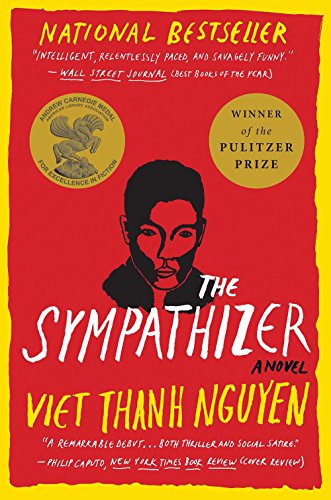
The Sympathizer by Viet Thanh Nguyen

A red cover with a yellow border features an illustration of a Vietnamese man's face. Includes award stickers for the Pulitzer Prize and the Andrew Carnegie Medal for Excellence in Literature

by Eric L.

I may have opened another post like this, but if you’ve not read The Sympathizer by Viet Thanh Nguyen, do yourself a favor. It won the Pulitzer Prize in 2015, and awards aside, it’s a great book.  

The Sympathizer is an “epistolary-like” novel, as the entire thing is written as a confession of a spy from the north who has deeply infiltrated the south, and the American support apparatus. He is an aide to a general, and really has a good feel for the elite as well as those of lower social stature. 

Superficially, it is the story of the child of a Vietnamese teenager and a French priest, who does not fit in because of his parentage and is teased and taunted. In turn, this creates a protagonist of conflicted mind and spirit who artfully chronicles his experiences in Vietnam and America. He makes the profound comment that it is really the immigrants who should be the anthropologists of American society, as well as many other insightful observations throughout the book. 

He chronicles the chaotic escape from Vietnam (you’ve probably seen the footage) when the United States withdrew in 1975. When one views this sort of thing, they’re horrified by the carnage and desperation, but I’d not considered the bureaucratic tasks such as making lists of who evacuates and the intermediary steps. Spoiler alert: the Vietnamese don’t just land in their suburban American homes on a direct flight from Saigon. Sadly, these events seem apropos right now irrespective of your feelings about American wars and intervention globally. I could not even imagine trying to escape my country for fear of political reprisal. 

As someone of a certain generation, I grew up watching the fictional films about the Vietnam War and worried about the specter of the reinstatement of the draft. Perhaps, more broadly, the Vietnam War was the degradation of the cultural capital and hubris that the United States, as a country, carried until this loss. I always felt for the boys who were involuntarily ripped from their lives and sent across the world as soldiers in an ideological battle they likely only rudimentarily understood. It’s a logical reaction, since they were the protagonists of these films, if not the heroes at least sympathetic anti-heroes, and they were like me. 

A Vietnamese character comments that this cold war has always felt hot to them. That said, it’s enlightening for me to read a work of art by a Vietnamese expatriate like Nguyen (by the way, it’s set to be an HBO miniseries). The details concerning the quotidian lives that many of his compatriots lead in the US (California to be specific), and how it’s difficult for former men of power to become relatively powerless in their new country, are very well done. One portion of the book even chronicles the protagonist’s experience working as consultant for a movie about Vietnam, loosely based on Apocalypse Now (if you have not seen this film, borrow it and watch it).  

The Sympathizer (also available as an eBook) is a page turner, a spy novel, a thriller, and oddly humorous; however, I would not describe it as straight satire. In my opinion, what makes this debut novel great is that it is the work of a free thinker and an excellent writer. It may seem banal to say that there is a lot going on in this novel (it may even be worth a second read), but I’m not sure how else to phrase this. Nguyen’s writing is dense, but not difficult to read, and the story just flows. I intend to read his collection of short stories, The Refugeesand eventually the sequel, The Committed, which was published in 2021. Try them, you may like them.