
Black Woods Blue Sky by Eowyn Ivey

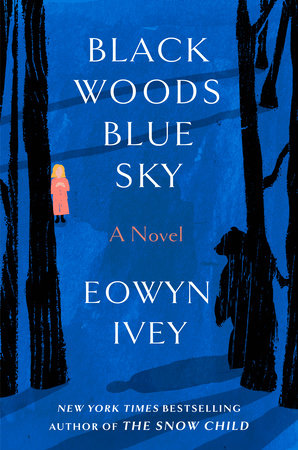
The book cover depicts a girl with blonde hair and a peach-colored dress or cloak and dark boots, in the blue of a darkened woods with black trees casting shadows on the ground. One tree conceals a bear, who is looking at the girl and whose shadow more closely resembles that of a human.

By Piyali C.

Riveting, dark, and deeply atmospheric, Black Woods Blue Sky by Eowyn Ivey took me straight into the untamed wilderness of Alaska. I walked the difficult yet vibrant terrains of several mountains, trails, and streams with strong and resilient Birdie, delightful little Emaleen, and quiet, enigmatic Arthur Neilsen.

Birdie is a single mother as a 26-year-old, who is trying her best to give her six-year-old daughter, Emaleen, a good life. Birdie works at a roadside bar in a small town in Alaska and lives in a little cabin given to her by the bar owner, Della. She tries her best to toe the line that is expected of her as a mother and an adult. But this life feels constrained; Birdie wants something bigger and better for herself and Emaleen. She aspires to live the life that she knew as a young girl – happy and free in the wilds of nature. 

Birdie had heard about the mysterious Arthur Neilsen, who lives a quiet and solitary life in the black woods. She gets to know him better when Arthur brings little Emaleen back to safety after she gets lost in the woods looking for Birdie. Arthur is somewhat of a legend in the small hamlet where Birdie lives. He grew up in the village but left his parents to live as a recluse deep in the forest, far from human civilization. He visits the village very rarely. His quiet presence, his knowledge of the local flora and fauna, the mysterious scar on his face, and his inscrutability pique Birdie’s interest in him. She feels a certain reticence in Arthur which she cannot seem to breach when she tries to get close to him. Arthur does not stay away from her either, as he keeps coming back from the woods to sit in silence next to Birdie.

Arthur’s quiet life in the great unknown appeals to our young protagonist and she decides to move into Arthur’s shack, along with Emaleen. The shack is nestled deep in the forest and only accessible via flight. At the beginning, there is immense joy in discovering each other and making a good life amid expansive natural beauty. Gradually, however, Arthur disappears for days on end without an explanation, and an inexplicable darkness creeps in along with the approaching winter. Birdie is afraid for her safety and the safety of her daughter, but she finds the freedom of this new life irresistible. Birdie is caught between her desire to live her life on the edge and her instinct to bring her daughter back to safety and lead a predictable life. The choice that Birdie makes will have life-changing consequences. 

The masterful blend of fairy tale with stark reality makes this book unpredictable, enigmatic, and unputdownable. The characters come alive on the pages and the voice of each character sounds authentic. Emaleen talks to us in the voice of a six-year-old. Birdie’s voice reveals the conflict within her, trying to be a responsible mother but also yearning for freedom and fulfillment as a young woman. Arthur doesn’t say much, but the dark secret that he carries within him becomes clear in the paucity of his soft-spoken words.  

Some reviews mention that this story is inspired by the popular fairy tale Beauty and the Beast. Personally, I did not find many similarities except the fact that a pretty young woman falls in love with a physically unattractive, quiet man. This story is a powerhouse in its own right, one that I believe would be a good choice for a book club. The flawed characters, the formidable and beautiful wilderness of Alaska, the gorgeous prose, the plot, the relationship between man and nature, the whiff of fairy tale infused within the story, Birdie’s choices and the consequences of those – all of these would spark a great discussion. 

Black Woods Blue Sky by Eowyn Ivey is available in print and as an e-book and e-audiobook from Libby.

Piyali is an instructor and research specialist at HCLS Miller Branch, where she facilitates two book discussion groups: Light But Not Fluffy and Global Reads. She keeps the hope alive that someday she will reach the bottom of her to-read list.

The Cold Vanish

The book cover is an aerial photograph of a mountainous area covered in conifers, with a cloudy gray-white mist settled over the dark green of the treetops.

“Searching for a missing person, after that first week, is a believer’s game” (219).

The Cold Vanish: Seeking the Missing in North America’s Wildlands is a gem of a book, written by Jon Billman, a fiction and journalism professor at Northern Michigan University. He also writes for Outside magazine, where I found the article that was the germ of the idea for The Cold Vanish. Billman tells the stories of a myriad of the disappeared, people who seemingly stepped off a trail at Mesa Verde or Yellowstone or Olympic and were never seen again. He intertwines their (shorter) stories with the book-length account of Randy Gray, father of Jacob Gray, a young man who parked his bike on the side of the road in Olympic and vanished into the woods of northern Washington. Although the disappearance is Jacob’s, the story really belongs to Randy, as we see the lengths he goes to in order to keep hope alive and continue the search for his son. Randy is a character – a Christian hippie surfer and building contractor, full of boundless energy and humor, enthusiastic, and generous. He is also willing to explore (if not exactly embrace with open arms) any theory that might locate Jacob and give him and his family some closure. My favorite anecdote about Randy: “Randy Gray cannot tell a lie, and so declares the two avocados rolling around somewhere in the back of the Arctic Fox when the customs agent asks if we have any produce. The agent pretends she doesn’t hear him, hands our passports back, and welcomes us to Canada” (274).

One of the stories really struck a chord with me. I’ve been to Mesa Verde, and walked the trail Billman mentions from the interpretive center to Spruce Tree House – “more of a sidewalk – it’s wheelchair accessible for less than a quarter mile, where visitors can view the [Anasazi cliff] dwellings from the shade of the overhanging cliff” (119-120). Yet 51-year-old Mitchell Dale Stehling disappeared while walking that trail and was not found until last year (his remains were located after the book was published, in August 2020). No other park visitor has stayed missing from Mesa Verde since the park was founded, and the area encompasses just over 50,000 acres. How could someone disappear off of a trail adjacent to the park’s gift shop?

The accounts of the disappeared have many explanations, some plausible, some completely off-the-charts crazy. I love a book like this that takes a journalistic viewpoint and presents the theories without passing comment; a book about conspiracy theories *not* written by a conspiracy theorist. In that respect, The Cold Vanish resembles another of my favorites in this genre, Where Bigfoot Walks: Crossing the Dark Divide by Robert Michael Pyle. In that book, acclaimed naturalist Pyle explains why the flora and fauna of the Pacific Northwest would be conducive to the existence of the Sasquatch – should such a creature exist. Like Pyle’s book, Billman’s presentation is open-minded and even-handed, and he makes valid observations and connections about why someone like Randy Gray might entertain the wild ideas of psychics and Bigfoot hunters. “Randy is the ultimate optimist. He’s wildly curious. The seeker from the Who song. ‘What else do I got?’ he says. ‘What else can I do?'”(217). Billman makes the reader understand Randy’s quiet desperation for any tenuous thread to follow.

He also explores other stories and disappearances: people who choose to go missing, the hunt for the Utah survivalist “Mountain Man” Knapp (who evaded authorities for seven years by breaking into remote cabins and stealing food and guns), and the serial killers in the Great Basin and in the Yosemite area who sought victims in remote wilderness areas. One of the best anecdotes is about Alan Duffy, a bloodhound trainer and handler who teaches his dogs, Mindy Amber and R.C., to search for the missing with a single verbal cue – either “Gizmo!” for cadavers, or “Find!” for a living person.

The book will leave you full of wonder at the majesty and hidden depths in what might seem like a benign, unspoiled setting, but which really harbors dangers that amateurs and enthusiasts ignore to their peril. You will also ponder the number of missing persons cases still unsolved: where are the (still) disappeared in our national parks and wild places, and will they ever be found?

The Cold Vanish is also available from HCLS as an eaudiobook from Libby/OverDrive.

Julie is an instructor and research specialist at HCLS Miller Branch. She loves gardening, birds, books, all kinds of music, and the great outdoors.