Author Works with Chimamanda Adichie

Sun, Nov 23 | 2 –3 pm
HCLS Miller Branch
For adults. Register at bit.ly/Author-Adichie

Chimamanda Adichie, the bestselling and award-winning author of Americanah and We Should All Be Feminists— converses about her new novel, Dream Count. In this highly anticipated new release, Adichie tells the story of four women and their loves, longings, and desires.

The story’s main character, Chiamaka, is a Nigerian travel writer living in America. Alone in the midst of the pandemic, she recalls her past lovers and grapples with her choices and regrets. Zikora, her best friend, is a lawyer who has been successful at everything until, broken-hearted, she must turn to the person she thought she needed least. Omelogor, Chiamaka’s bold, outspoken cousin who works as a financial powerhouse in Nigeria, begins to question how well she knows herself. And Kadiatou, Chiamaka’s housekeeper, proudly raising a daughter in America, faces unthinkable hardship that threatens all she has worked to achieve.

In Dream Count, Adichie trains her fierce eye on these women in a sparkling, transcendent novel about the very nature of love itself. A reflection on the choices we make and those made for us, on daughters and mothers, on our interconnected world, Dream Count pulses with emotional urgency in language that soars with beauty and power.

Chimamanda Ngozi Adichie was born in Enugu, Nigeria in 1977. She grew up on the campus of the University of Nigeria, Nsukka, where her father was a professor and her mother was the first female registrar. She studied medicine for a year at Nsukka then left for the US at the age of 19 to continue her education on a different path. She graduated summa cum laude from Eastern Connecticut State University with a degree in Communication and Political Science.

She has a Master’s Degree in Creative Writing from Johns Hopkins University and a Master of Arts degree in African History from Yale University. Her first novel, Purple Hibiscus, won the Commonwealth Writers’ Prize, and her second novel, Half of a Yellow Sun, won the Orange Prize. Her 2013 novel Americanah won the US National Book Critics Circle Award and was named one of The New York Times Top Ten Best Books of 2013. Her latest book, Dream Count, won the Women’s Prize for Fiction.

Our next chapter starts soon when the blog moves to the newly redesigned hclibrary.org. All the same great reviews and news, plus more library information!
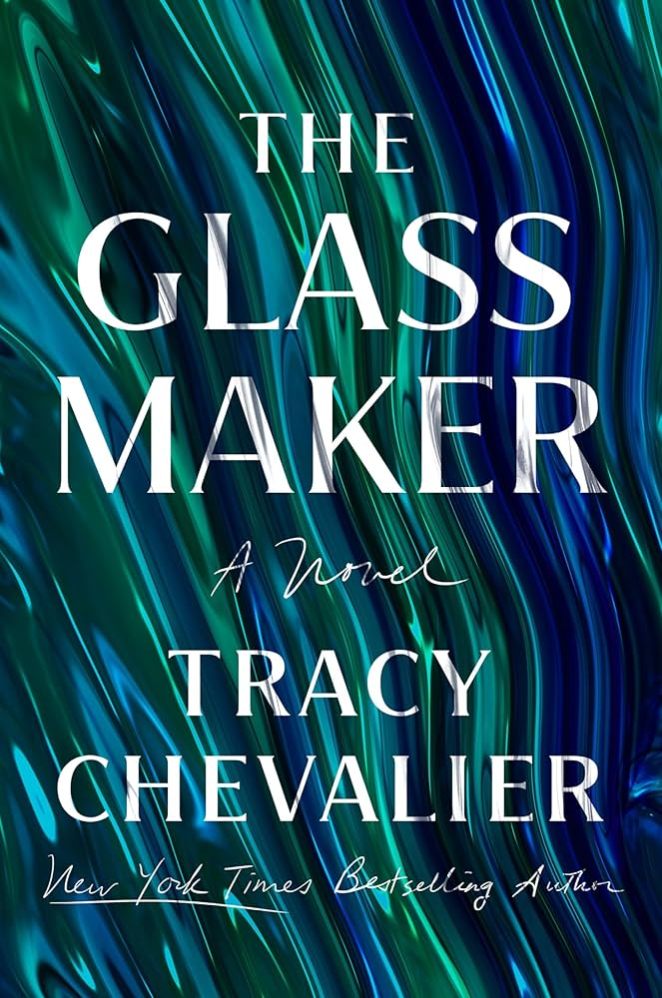
The Glassmaker by Tracy Chevalier 

White letter appears above and within wavy strands of green and deep blue glass.

by Piyali C.

The story begins in 1486 on the island of Murano, where glass blowers create their masterpieces in relative quiet, separated from bustling and chaotic Venice by a body of water. Orsola Rosso is the eldest daughter in a family of esteemed glass blowers. Although she is interested in creating art with glass, she is relegated to household chores because women are not allowed to be in the maestros’ studios. The exception to this rule is Maria Barovier, a historical glass maker in Murano in the 15th century. Maria makes a brief appearance in Tracy Chevalier’s story as an inspiration to our young protagonist and as a woman who lends a hand to Orsola to help her fulfill her dream. With Maria’s encouragement, young Orsola learns to make glass beads from a woman in the Barovier family.

Except for her mother, Laura, Orsola must keep her skill a secret – particularly from her moody older brother Marco as he cannot tolerate Orsola’s ambition. The Glassmaker is a story about Orsola’s ascent as an established artist of glass beads, if not a maestro, during a time when women were expected to keep house, have and raise children, and support the men at work by sweeping up their broken glass. But Orsola and the other women in the Rosso family defy patriarchy in their own ways, like women have done through the centuries despite the shackles that men have tried to foist upon them. 

This book displays Chevalier’s magical ability to conjure up Murano and Venice through her descriptions. She truly transports her readers to the chaos of Venice as it undergoes changes through the centuries and relatively tranquil Murano where glassmakers create their art far away from the traders and merchants of Venice. Orsola’s growth from a young girl to a strong woman with an acute sense of business is a pleasure to witness. The depth and fullness of the characters make them come alive in the readers’ minds. But all these we have come to expect from Chevalier, a maestra in her own craft. What fascinated me most was how Chevalier manipulates time to tell her story.

She urges the readers to skim a rock in the water that connects Murano to Venice. As the rock lightly touches the water and gets ready to skim to the next part, time advances fast, sometimes 70 to 100 years while Orsola’s age and those who matter to her advance only 4 or 5 or 7 years. As the rock touches the water again, Chevalier pauses to tell the story of Orsola and her family, and their lived in experience during that historical era. Then the rock skips again and we take off with it, fast forwarding several decades or even centuries.

This way, Chevalier makes her protagonist live through plague, wars, domination of Murano, heartbreak, creative triumphs and finally, in modern times, Covid. As we skim through centuries, we are mesmerized by Orsola’s growth, her strength and the strength of the women who surround her, pull her up, support her, and chart their own paths with sheer determination. As we fall in love with Orsola, we cannot help but fall in love with Murano as Chevalier gently glides us through the calles, lagoons, markets, and gondolas. We seek to return to its quiet lifestyle after a rambunctious rendezvous with Venice along with Orsola when she goes there to meet with merchants to sell her beads. 

I did not wish for the book to end. But like all good things, this story also ended filling my heart with love and my head with images of Venice and Murano through centuries. 

The Glassmaker by Tracy Chevalier is available in print, large print, e-book, and e-audiobook formats. 

Piyali is an instructor and research specialist at HCLS Miller Branch, where she facilitates two book discussion groups: Light But Not Fluffy and Global Reads. She keeps the hope alive that someday she will reach the bottom of her to-read list.

Someone Else’s Shoes by Jojo Moyes

The bright red cover contains large text and a skyline made in shades of blue along the bottom.

by Piyali C.

I attribute partial credit to Jojo Moyes for my job at the library. It was 2012 when I interviewed for Instructor and Research position at Miller Branch. One of the assignments was to present an author to the interview panel for a fictional author visit. I had just finished reading Me Before You by Moyes, and I did not hesitate for a moment to decide which author I would be presenting. I got the job. Since then, I have read almost all of her novels partly because I feel indebted but mostly because I love her style of writing and her stories. When I discovered her latest book, Someone Else’s Shoes was coming out, I put my name on the wait list early. 

I was not sure I would like this book when I first started reading it. It seemed too predictable – a story of two middle-aged women, diametrically opposite in character, social standing, and circumstances. Nisha Cantor is the wife of a billionaire whose husband drops her like hot potato, leaving her penniless, for a younger woman. Nisha is relentless in her anger to get back what she has lost. She has no money, no prospects, and is on the verge of being homeless, yet she has her attitude, her brusqueness, her determination, her optimism, and her resilience. Despite her situation, she does not get my sympathy. I do not believe Moyes wanted the reader’s sympathy for Nisha Cantor. She is almost unlikeable, insensitive. She is forceful and not in a good way. A woman wronged, she will have her revenge. Love her or hate her, you cannot ignore her. 

Samantha, the opposite of Nisha, is beaten down by life. Her husband, Phil, is severely depressed; her boss at work is a pathetic, misogynistic man who constantly disrespects Sam despite her excellent work. Sam, however, needs the job since Phil can hardly get up from the couch due to his mental health. She has arrived at that precarious age when women start becoming invisible. Sam holds up her family single-handedly yet slowly fades as an individual. She is bullied, ignored, taken for granted, and yet she sees no way out. 

One day at the gym, Sam mistakenly takes Nisha’s bag instead of her own, which contains a pair of red Christian Louboutin shoes. Those shoes become a catalyst for many changes in this novel’s characters. The pair of Louboutin shoes not only changes lives, fosters friendships, and brings justice but it also serves as a double entendre to show what it means to step into other people’s shoes and see life through a different lens.  

This book is a lighthearted read that explores various emotions – love, female friendship, empathy, humanity, to name a few. The readers will, perhaps, know that the end carries no surprises, but I did not mind. As I read on, I got deeply invested into the lives of the two protagonists. I started to care. If you are in between heavy books or going through a reading slump and need a light yet engaging read, this may be the book for you. 

Someone Else’s Shoes by Jojo Moyes is available in print, e-book, e-audiobook, and cd audiobook formats. This book is also included in our Adult Summer Reading 2023: Fiction (Relationships) list.  

Piyali is an instructor and research specialist at HCLS Miller Branch, where she facilitates Light But Not Fluffy and co-facilitates Global Reads. She keeps the hope alive that someday she will reach the bottom of her to-read list.

Be part of HCLS’ Summer Reading Adventures.

The Kitchen Front by Jennifer Ryan

Image of a woman in a red shirt, red lipstick, and a white apron holding a cookbook across her chest. Red gingham boarder

by Kristen B.

The Kitchen Front by Jennifer Ryan could be easily categorized (and perhaps dismissed) as “women’s fiction” since it offers a solid look at four women’s lives in 1942 Britain. I rather despair of idea that novels about women and their daily travails are some how less weighty or less literary than more masculine options. This book is a highly readable reminder that not all the wartime effort took place on the continent and upon the seas, amid spies and battles. The first page provides a list of what a week’s worth of rations were for an adult – and let me tell you, it wasn’t much! Rationing continued in the UK for more than a decade after the end of the war, and I have wondered if we could have sustained that kind of national effort. We tend to look back at the 1950s of a time of growth and prosperity in the US (although not for all demographics), but it was a very different prospect for our allies.

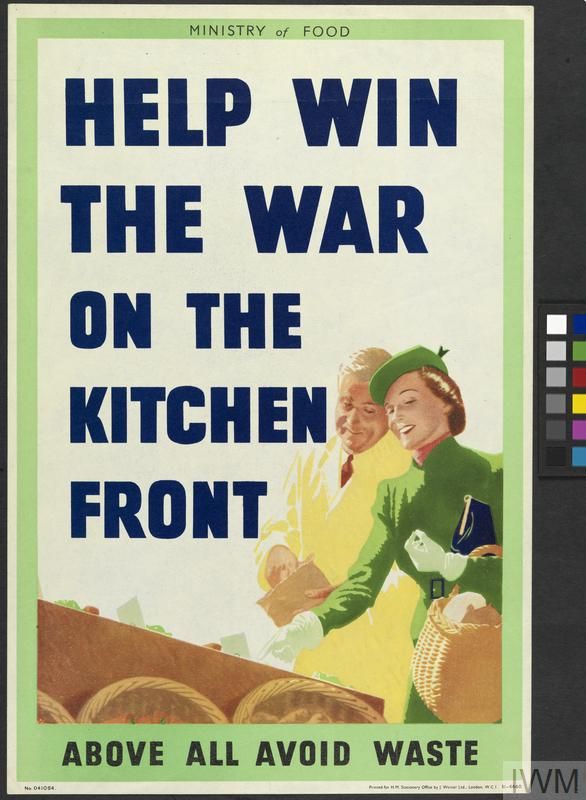
World War II poster featuring a woman in gloves and hat talking to a grocer that read: Help Win the War on the Kitchen Front.

It naturally fell to women to figure out how to make rations stretch to feed their families. In the days before packaged or frozen foods, everything was local and homemade, and the reality was that nobody got enough to eat by modern standards. Gardens (along with pigs, chickens, and bees) were a survival strategy, not just patriotic palaver. The BBC really did host a show called The Kitchen Front, which included ideas and recipes to make rations work and stretch – whether it was tinned sardines, Spam, or some other unfamiliar type of protein, like whale meat. This book starts with that show and adds a fictional local contest to find a relatable female host.

Of the four main characters and contestants in the book, Audrey spends her entire waking life working to feed her family and maintain their house. Her husband was an early RAF casualty, and she has three growing, hungry boys. Her husband was also an artist who mortgaged their home to the rafters, and she is left baking pies and cakes to try to make ends meet. Her home and garden become the center of the story in crucial ways.

The other three main characters each have their own private battles to fight. Gwendoline is Audrey’s sister, though she married up with the local fat-cat businessman and landowner. While a social success, the marriage and the man have proven to be unhappy decisions. The kitchen maid and apprentice cook at Gwendoline’s manor house, Nell, needs a little confidence in her own skills. She provides a young, hopeful perspective. The final woman, Zelda DuPont, worked as a French-trained chef in fancy London hotels before the war brought her to head the canteen at Gwendoline’s husband’s pie making factory. Zelda has fought tooth and nail to succeed in a man’s world before an unscrupulous, handsome cad leaves her heading to the country, an unmarried mother to be.

The convenient machinations of the contest and various plot lines bring all four women together, with Gwendoline having a connection to each of the women but Audrey operating as the beating heart of the story. The plot is mostly predictable, but I didn’t mind that at all. The characters are so wonderful, each in her own way, that I loved spending time with them. Not only did I need to know who wins the BBC contest, I enjoyed their unique points of view and individual struggles. Is it better to marry for love or money and position? Is it better to have a career or raise a family? It is better to be in service or more independent? There are no right answers, but women still struggle with these questions and the myth of “doing it all.” But when we support each other and do it together, everyone wins.

The Kitchen Front is available in print, large print, ebook, and eaudiobook.

Kristen B. is a devoted bookworm lucky enough to work as the graphic designer for HCLS. She likes to read, stitch, dance, and watch baseball (but not all at the same time).