March’s Women’s History Month and April’s National Poetry Month offer the perfect chance to celebrate some remarkable women poets in our collection. Across generations, their voices have turned shared experiences into art at all levels, teaching us about love, identity, resilience, and nature. Here are a few notable names whose works you should check out:
Emily Dickinson must be included in any list about women poets. She wrote with an intensity and originality that set her apart in 19th-century American literature. Her compact, untitled poems challenge conventions, exploring themes of death, nature, and the self with wit and depth.
Maya Angelou, a powerhouse of literature and activism, weaves autobiography and poetry to speak of struggle and triumph. Her groundbreaking poem “Still I Rise” affirms the resilience of the human spirit and is a testament to hope despite all odds.
Joy Harjo was the first Native American U.S. Poet Laureate, and her work reflects that identity. Her poems often blend moments from her heritage and upbringing with vivid musicality. Her anthology, Living Nations, Living Words brings many Native poets to the forefront and connects past injustices to present resilience.
Mary Oliver is a consummate naturalist. Her poetry, though deceptively simple in form, encourages readers to reflect on nature’s quiet wisdom and the profound lessons it offers. These are the perfect poems to meditate on, mull over, and chew on. Oliver is also the author of one of the seminal handbooks about reading and writing poetry, A Poetry Handbook.
Rupi Kaur is the most contemporary by far on this list but she deserves a mention for her contemporary style, which has redefined poetry for a digital age. With poignant reflections on love, trauma, and healing, Kaur connects with a new generation of readers through her evocative, minimalist verse.
Amanda Gorman, the first National Youth Poet Laureate, brings her background, her activism, and her fire to her poetry. She was first put on the map with her poem “The Hill We Climb,” which is a testament to community, togetherness, and solidarity.
Ada Limón, the current U.S. Poet Laureate, captures the beauty and complexity of everyday life. Her work is both profound and accessible, imbued with a rich emotional resonance.
Celebrate these poets by exploring their works, available in our collection. Let their words inspire you this spring!
Family Story and Craft: Poet-Tree Families, ages 6+. Ticket required. Celebrate National Poetry Month by listening to some poetry and creating a Poet-Tree craft. Tue, Apr 29 at 6:30 – 7 pm HCLS Miller Branch
Beginning Saturday, we celebrate Women’s History Month throughout March. Established in 1981 as a memorial week, it grew to the entire month in 1987. It’s purpose is to commemorate and encourage the study, observance and celebration, “of the vital role of women in American history.” From Betsy Ross to Diana Ross, women have made a wide variety of contributions to our culture and society.
Join us for a few classes early in the month, and visit the library’s calendar often for more opportunities to celebrate. There’s an adage, sometimes attributed to Eleanor Roosevelt, that says, “Well behaved women seldom make history.” It certainly holds true for Zelda Fitzgerald, DC’s madams, and Dorothy Parker!
Zelda Fitzgerald’s Journey Sat, Mar 1 | 2 – 3 pm HCLS Miller Branch For adults. Register here.
Historian Jack Burkert gives glimpses into the fascinating life of Zelda Fitzgerald, the “First Flapper” of the Jazz Age. Born in comfortable circumstances in Montgomery, Alabama, the twenty-year-old Zelda Sayre married F. Scott Fitzgerald, beginning their tumultuous life together. Their adventures took them across America and through Europe, writing both short stories and novels, while Zelda sought artistic fulfillment. By 1930, early signs of her mental illness coupled with his alcoholism made their partnership of greatness a distant dream. Through twenty years of treatment, a maturing Zelda paints, dances, writes, and slowly recovers, creating a life story few could imagine.
Off the Mall, DC: Madams of DC Fri, Mar 7 | 12 – 1 pm online For adults. Register here.
Step into the lesser known history of Washington, D.C.’s red light district and learn about the lives of the women who shaped it. Washington, D.C. experienced an unprecedented rise in prostitution during and after the Civil War. During this period, Pennsylvania Avenue became D.C.’s most notorious red-light district, from the ramshackle “boarding houses” of Murder Bay to the glamorous pleasure houses of Marble Alley, all within sight of the Capitol. Also, a new profession for women was rising, that of the “female lobbyist.” This virtual tour introduces you to some of the most notorious women of mid-19th century DC.
Presented in partnership with Off the Mall D.C. founder and guide, Katie Kirkpatrick
Dorothy Parker: Unique American Writer Thu, Mar 13 | 7 – 8 pm HCLS Glenwood Branch For adults. Register here.
Writer, poet, screenwriter, playwright, and essayist Dorothy Parker was known as the wittiest woman in America in the mid-20th century. In an era when the printed word was powerful and readers voraciously consumed written comments, critiques, and opinions, her sharp writing appeared in the New Yorker, Vanity Fair, and other publications. Readers anxiously awaited her next words as her clever quotations became legendary, but her personal life was often troubling: alcohol, divorce, and suicide attempts continued through her life. Learn about the legacy of this unique contributor to the American literary tradition from historian Jack Burkert.
Do you know when Women’s History Month began? I didn’t until I started writing this post and realized I knew very little about the annual commemoration. It began in 1981 with Women’s History Week; then in 1987, Congress passed legislation designating March as Women’s History Month. Since 1995, presidents have issued proclamations and celebrated the contributions of certain historical figures during this time. That’s all within my lifetime! Maybe I’m more “historical” (read old) than I like to think.
HCLS has a couple of classes on the topic, along with always-available free online tools. For example, the Liberty Magazine Archives (1924-1950), listed under magazines and newspapers, includes valuable insight into everyday life in the United States during the Depression Era and World War II. American women sought advice about writing to servicemen, using their husbands’ names, and being drafted. Greta Garbo even wrote a guest piece in 1932 called “Why I Will Not Marry.” You can use a variety of other historical databases to research biographies and certain historical events, like the Seneca Falls Convention. You can also always chat with an HCLS staff member to find books and other resources on a specific topic.
On March 16, author and jewelry historian Elyse Zorn Karlin discusses how the suffragettes, and those who supported them, used jewelry and other accessories to express their politics. Register for “Making a Statement: Jewelry and Other Adornments of the Suffragist Movement” to participate via Zoom.
There are certain women with whom I have always been fascinated. Growing up in Maryland, Harriet Tubman was always part of our local history and I can’t remember not knowing about her. I was always intrigued by her story of courage in escaping slavery, but also her determination to bring others to freedom. The recent movie, Harriet, knocked my socks off, and I plan to watch it again soon.
Dr. Richard Bell joins us on March 23 to talk about the two Harriets: Beecher Stowe and Tubman. Many people, including President Abraham Lincoln, believed that Beecher Stowe’s novel Uncle Tom’s Cabin helped precipitate the Civil War. Lincoln may just as well have been talking about Harriet Tubman, the most famous conductor on the Underground Railroad. When asked about why he chose these two historical figures, Dr. Bell replied, “I consider Harriet Tubman a truly great American, a woman who fought for freedom against the toughest possible odds on the Underground Railroad. Harriet Beecher Stowe is less well-known today than Tubman, but back before the Civil War it was the other way around. Too often we forget the central roles that American women played in driving the United States towards the reckoning of the Civil War.” Register to participate via Zoom. Dr. Richard Bell is Professor of History at the University of Maryland and the author of Stolen: Five Free Boys Kidnapped into Slavery and their Astonishing Odyssey Home.
Join us for any and all of these opportunities! I hope you celebrate the women in your life along with all the women who have contributed in every way throughout history. If you’d like to read more on the subject, here are several lists: adult fiction, adult nonfiction, and books for children and teens.
Kristen B. is a devoted bookworm lucky enough to work as the graphic designer for HCLS. She likes to read, stitch, and take walks in the park.
Every March, we celebrate Women’s History Month in the United States. March 8 has been honored as International Women’s Day since 1911, with nations around the world celebrating the movement toward women’s rights. This annual celebration gives us the opportunity to honor women past and present who have paved the way for continued progress for all. This includes trailblazers in politics, arts, sports, science, and more. Look back at those who have come before and be inspired to soar to new heights with these reads for all ages about amazing women.
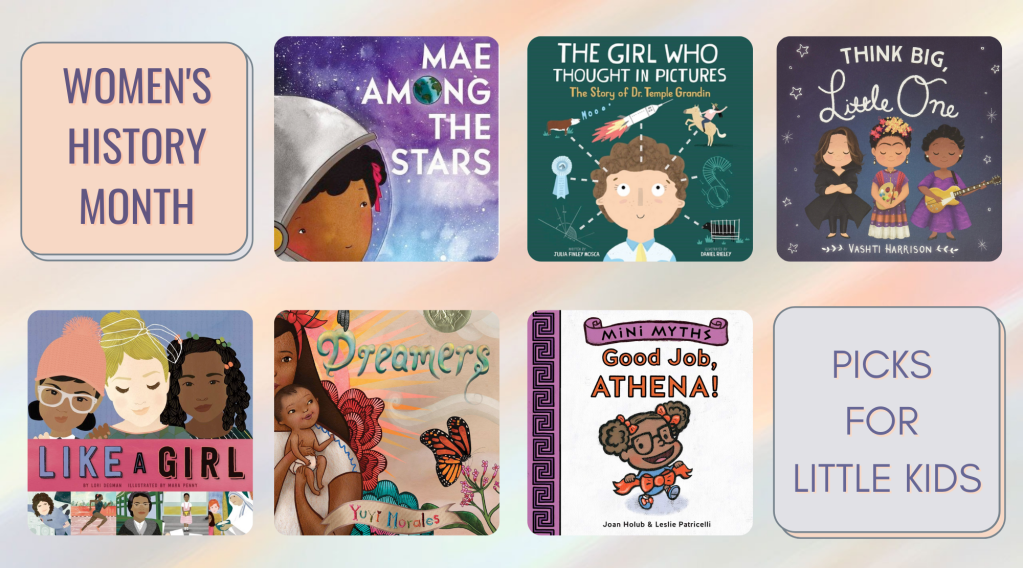
Little ones will love the delightful pictures and rhyming verse in this true American shero story. Diagnosed with autism as a girl, Temple Grandin embraced her unique way of thinking to help her invent revolutionary new ways to take better care of farm animals. A special note from Temple Grandin to readers is also included, along with a timeline and fun facts.
Join your little one in reading this picture book inspired by the real-life story of Dr. Mae Jemison. Mae starts off with a dream to see the earth and later becomes the first African American woman in space. Burrington’s illustrations bring this story to life and will inspire your little one to reach for the stars!
Like a Girl by Lori Degman, illustrated by Mara Penny
In this beautifully illustrated tribute to girl power, readers are introduced to 24 women who blazed trails in their respective fields. The author highlights all the wonderful things you can do “like a girl” and invites her audience to think about the ways they can change the world. More details about each subject are included in the back of the book.
Coraline, a curious and adventurous young girl, moves into a new flat with her parents. While exploring her new home, she discovers a door to another world where she finds another mother and another father who want her to stay and be their daughter forever. At first, Coraline thinks this world is better than her own, but she soon realizes things are not as they seem in this other world and something terrible lurks behind its perfect facade.
Forget about a princess needing a knight (or anyone else) to save her. These collections of folk tales from a wide range of countries showcase smart, strong, brave women. Learn about heroes who overcame harsh conditions, rescued their people, and fought for what was right as you explore cultures from around the world. The first title is an updated version of the second, with two additional stories.
At 13 years old, Aĭsholpan Nurgaĭvyn became the first woman – and youngest person – to ever win Mongolia’s famous Golden Eagle Festival. In her inspiring memoir that will resonate especially with tweens and young teens, Aĭsholpan takes pride in sharing about her legendary Kazakh heritage, while also challenging traditional gender customs to train and compete with her beloved eagles. To learn more about Aĭsholpan’s amazing experiences, you can also check out the award-winning subtitled Kazakh-language documentary of her story – available on DVD.
The word feminism makes some uncomfortable, and many people define it in different ways. This book introduces readers to pioneers of feminism in the United States along with modern leaders who continue to fight to empower women in every arena. Explore what feminism is and what it means to you as you read the range of ideas and perspectives presented in Feminism: Reinventing the F-Word.
Cecile Richards grew up in Texas, where her parents, one of whom was the first woman governor of the state, taught her the importance of working for change, including making trouble. This young reader’s edition of her biography shares the lessons Richards learned along the way and highlights the people who have supported her in her journey. Read Make Trouble to feel inspired to push for progress and empowered to fight for what is important to you.
Last year celebrated the 100th anniversary of the 19th Amendment to the Constitution, which gave women the right to vote in the United States. The fight to reach that goal encompassed decades of passionate work, including marches, protests, and even lawbreaking, on the part of many women working together. Votes for Women! provides a glimpse into the lives and experiences of many suffragists, including the uglier moments in the battle for women’s right to vote.
In a witty, conversational, and occasionally sarcastic tone, Hannah Jewell explores the extraordinary lives of 100 women throughout history from all over the world. Sorted into chapters like Wonderful Ancient Weirdos, Women Who Wrote Dangerous Things, and Women Who Punched Nazis, the stories of these women range from triumphant to tragic, but never fail to inspire, and Jewell’s humor and enthusiasm for her subjects never fails to entertain.
That’s What She Said offers a brief introduction to over thirty influential women from various areas of life – some well-known and some women with whom readers may not be familiar. Author and artist Kimothy Joy’s beautiful watercolor illustrations add to the enjoyment of this informational book. This is a great place to start for an overview of women’s history, or to find women or subjects that inspire deeper investigation.
Ursula K. Le Guin’s classic The Left Hand of Darkness is a book about political intrigue and a forced epic journey across an icy planet (probably the fodder for a good miniseries). The book has the drama and action of an arduous journey as well as a personal journey of the protagonist to appreciate those different from him through the relationship he builds. The protagonist, an envoy from another planet, struggles to understand a gender-neutral people using the social constructs of his own culture.
If you want to explore more exhibits and offerings in honor of Women’s History Month, take a look at the Library of Congress’s Women’s History Month page.
The Elkridge Branch + DIY Education Center opened the doors of its new building in March 2018. All our staff wish that we could see you in person, but we are happy to help you discover new reads while we are apart.







 CHAPTER CHATS