
Revisiting Old Favorites

A colorful boxed set of all seven Chronicles of Narnia books.

by Sahana C.

Sometimes mere escapism isn’t enough. Sometimes you need to really dig deep and find a distraction from endless online scrolling, so you can sit down and get back to a book. Sometimes you need to revisit an old – and I mean nostalgic old – favorite.

I’ve been rereading The Chronicles of Narnia by C. S. Lewis for much of February, after not touching them in any way for maybe 15 years. Let me tell you – some of it really does not hold up. I chose to listen to the books this time, chasing, perhaps, some long-lost childhood feeling of being read to and trying to visualize the world as each chapter progressed. It made all the blatant anti-Arab sentiment a lot worse, and it made obvious the problematic writing of an Oxford don existing safely within the walls of the British Empire at her zenith.  

Still, I found myself caught up in the magic, in the sheer scope of the ever-expanding world Lewis built. Even when the metaphors hit you over the head, even when the pacing is uneven, there’s something about these books — some mix of whimsy, sincerity, heart, and adventure — that draws readers back, generation after generation.  

I’ve read the books in publication order before. This time I went for in-world chronology, and it’s apparent that The Magician’s Nephew is not a strong start to the series, as fun as the story is. As a starting point for the world, The Lion, the Witch, and the Wardrobe is the quintessential Narnia book for a reason – the highs and lows are epic, the enemy looms, and the heroes are authentic and full of heart. The backdrop of the second World War is apparent throughout, and the in-world nostalgia lends a sparkle over the whole story. The wonder of Lucy’s first steps into Narnia and the cozy charm of Mr. Tumnus’ home are hard to beat.

Prince Caspian and The Voyage of the Dawn Treader are fun for being some of our first repeats with characters and through-lines within Narnia itself. Despite being one of the worst offenders in terms of blatant Orientalism, The Horse and His Boy will always have a special place in my heart as a pure adventure story, moving from Calormen to Archenland. It’s fun to experience Narnia during the reign of the Pevensies. Much like Dawn Treader, The Silver Chair expands the world around Narnia, giving us Marshwiggles and Bism. It has a heavy atmosphere that leads well into the final, most apocalyptic book, The Last Battle, where finally Narnia ends. Listening to each book (about five hours long each, and available on Libby) does make it obvious that C.S. Lewis had an agenda, but all fairy tales can give us morals if we’re looking.

Do these books still work? Yes and no. There’s plenty to critique, but the sense of wonder remains. If nothing else, rereading them made me realize how much childhood nostalgia smooths over the flaws of beloved books. But maybe that’s what revisiting old favorites is for — seeing them clearly, appreciating what they gave us, and questioning what they left out.  

Sahana is the Communications Strategist at HCLS. They enjoy adding books to their “want to read” list despite having a mountain of books waiting for them already.
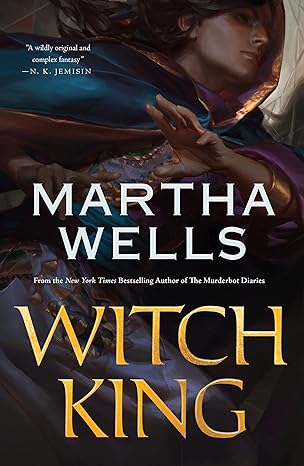
Witch King by Martha Wells

The cover image depicts a person in blue, purple, and gold finery, turned in one direction with eyes closed and hands extending in the other direction.

by Kristen B.

He’s not just a demon, he’s THE demon. And honestly, Kaiisteron is one of my favorite characters from the past year. Maybe not quite in possession of “a heart of gold,” he nonetheless loves his friends and tries to do right in the world.

Witch King by Martha Wells opens with Kai returning to consciousness, confused and worried about being disembodied – basically a ghost. It’s a disorienting start to a mystery full of politics and betrayal, as we have to figure out what’s going on along with the demon. He immediately resolves the need for a body (and revenge) and goes looking for his best friend, Ziede. She is a Witch who can no longer sense her wife, Tahren – a nearly immortal being who switched sides in the last war. Kai and Ziede, along with an abandoned orphan and other people picked up along the way, immediately set out to find Tahren and figure out what has happened in the year they were imprisoned.

From that point on, the novel intersperses the current timeline with the story of how all these powerful people met each other and changed the world. They were part of a rebellion, upending the power-hungry Hierarchs who were conquering the world. As usual, Martha Wells provides world building that’s miles deep and centuries long. This world feels real and lived in, so the stakes matter. Except that the full, entire stakes are not crystal clear until past and present come together in a surprising, satisfying ending with plenty of twists and turns.

This book definitely rewards a second read. The first time through I was more concerned with figuring out who was who and what was happening. Wells throws you into the deep end and slowly parcels out clues and details. The stakes are so much higher than a missing spouse or a betrayed friendship. The second time, I could appreciate the sheer genius of how the two timelines fit together and inform each other. Once again, Kaiisteron’s actions and his loyalty to the man who saved him changes the fate of his world. I hope Wells writes more in this world, but this is a fantastic standalone as is.

Kristen B. is a devoted bookworm lucky enough to work as the graphic designer for HCLS. She likes to read, stitch, dance, and watch baseball in season (but not all at the same time).

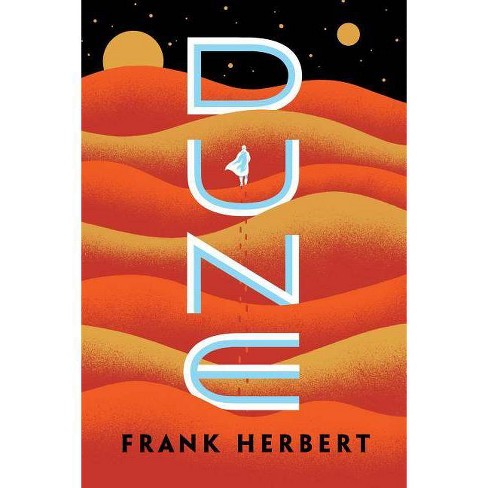
Dune by Frank Herbert

Orange and yellow waves of color suggest sand dunes. Title appears in bright white type vertically in the center, with a silhouetted figure within the "U". A black space sky is across the top, with stars.

By Eric L.

There has been quite a lot of buzz concerning the new Dune film, especially since with the new trailers being released. Frankly I’m a bit excited, too, although the theatre release has been delayed repeatedly (now scheduled for Oct 22, 2021). However, I can’t say that I’m a Dune fan from way back, since I had never read any of the 18 books in the series until recently.  

I host the HCLS book discussion group Read. Think. Talk. on the first Monday of the month. More often than not, we read and discuss classic, social, and philosophical sci-fi. Several members of the group wanted to read Dune (the original). Although I had a desire to read it, and with the new movie and an HBO series on the way, it seemed like a great time to familiarize myself with the source material. However, I was a bit reluctant, as it’s not a great idea to suggest a 600-plus page book, with three appendices and a glossary of terms, for a book discussion group. Moreover, I’ll concede I’m still a bit intimidated by long books!  

The plot centers around young Paul Atreides whose world is upturned when his family/house must relocate to the desert planet Arrakis, colloquially called Dune. A rival house, Harkonnen, was governing Dune and wants to wrest back control because of the planet’s valuable natural resource melange (also called spice). House Atreides is the more admirable of the two rival houses for a variety of reasons, not the least of which is the Harkonnen leader is a despicable person.

Melange enables interplanetary travel both via the pilot and as a fuel. It possesses a psychedelic effect, and people also ingest it as a mind-altering substance. Melange is only found in the sands of Dune, and harvesting it is a very dangerous endeavor because of the giant sandworms (the worms were really all I knew about Dune). The indigenous Fremen are the only folks who are able to survive in the desert with its extreme climate and dearth of water. 

Paul has an interest in the Fremen from the outset, even before a series of events place him in contact with them. I don’t want give away too many details concerning the drama and intrigue that lead to House Atreides losing control of the planet, but they make for a good read. The Fremen believe Paul to be their chosen leader and they have a common interest in defeating the Harkonnens.

This sort of story should all seem familiar, with revenge, an oppressive greedy regime, and the oft-repeated white male savior trope. However, Dune has some interesting differences. Paul is accompanied on his journey by his mother, Jessica, the unmarried concubine of his father and a member of the “Bene Gesserit.” One of the shadowy organization’s key tenets is controlling one’s thoughts to control how the body reacts. The members are taught to hone their intellect and possess the ability to persuade people using their words. They are not popular in the largely patriarchal society and are often and pejoratively referred to as “witches.” Jessica, against the rules of the Bene Gesserit, taught young Paul their ways. This skill set is the reason that some of the Fremen think he may fulfill their prophecy. 

There are interesting power dynamics between Jessica and Paul, their feelings about each other, and how individual goals change throughout the story. Other strong female characters exist as well, including Paul’s love interest. Author Frank Herbert was apparently also interested in Zen and peyote, and the book is very much a product of the late 1960s. It is undeniably long but moves quickly. The action scenes are not drawn out, in fact I found their brevity interesting. I liked that the political buildup was described more, which seems closer to reality to me. 

Dune has drama, intriguing characters, some philosophical issues, and an interesting environmental message. I half-read the appendices but found them rather dry without getting a feel for the characters first. That’s just me; perhaps you may like to have a complete understanding of the “world” before getting into the story. 

On the continuum of science fiction and fantasy (if there is one), I lean to the former. I’d argue this is more fantasy, although it’s debatable. At any rate, the book contains new words, lots of new names, worlds, and families, all of which are difficult to pronounce. This is a book that’s worth your time and great source material for a film. The new film will tell the story in two parts, unlike the 1984 David Lynch film, which is an interesting story in and of itself (I’d recommend it). 

In sum, one can get lost in another world and time in this book, and perhaps it’s nice to take a respite from current affairs for a bit. 

While you have to reserve the book right now because others are enjoying all of our copies, it is worth the wait to read. Also available as an eBook and an eAudiobook from Libby/Overdrive.

Eric is a DIY Instructor and Research Specialist at the Elkridge branch. He enjoys reading, films, music, doing nearly anything outside, and people.