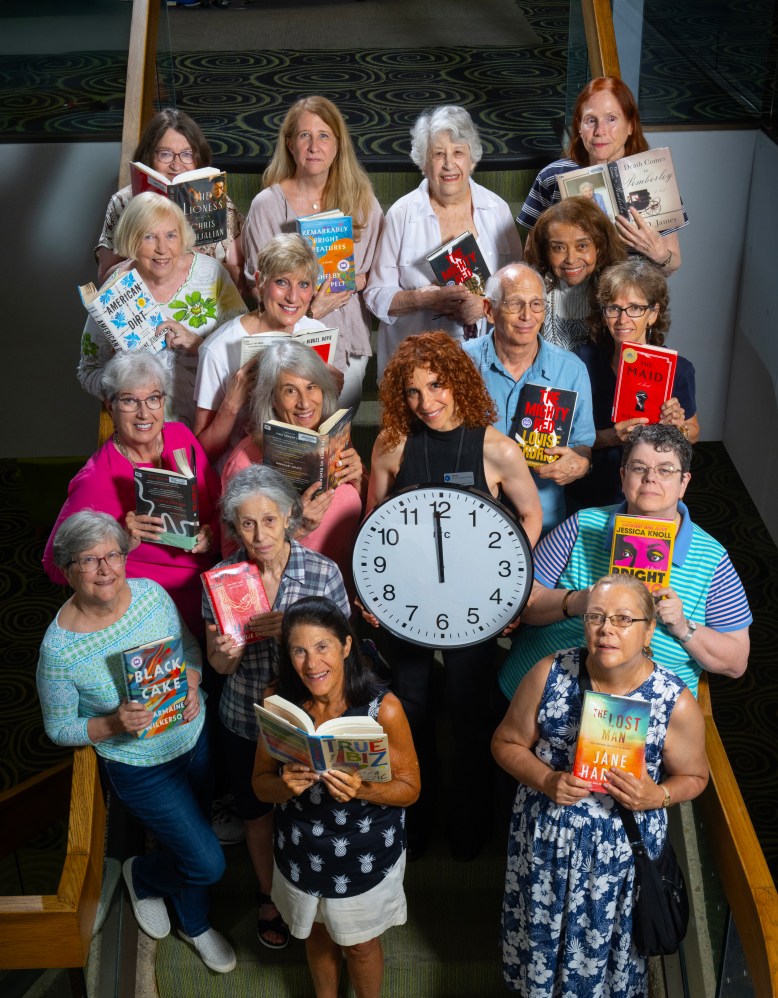
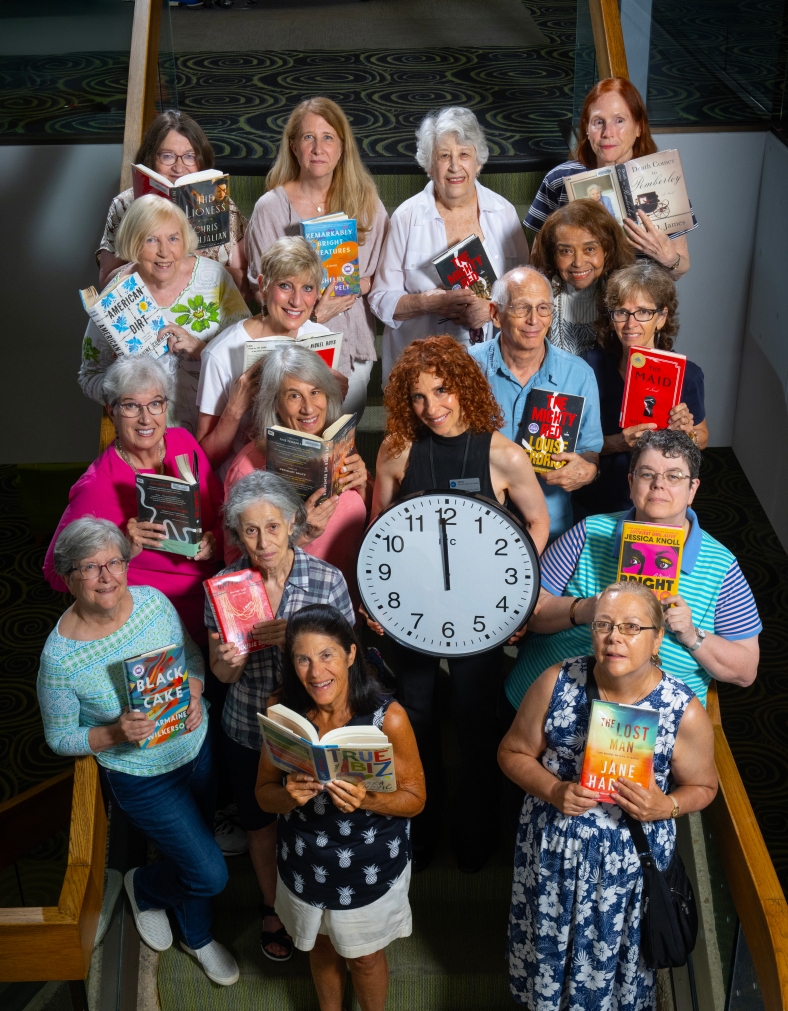
The Noontime Book Club is the longest running book club in the HCLS system. They gather at HCLS Central Branch.
by Wendy C.
As Howard County Library System (HCLS) celebrates its 85th birthday this year, I’ve found myself flipping through a mental scrapbook—page after page of memories and moments since I first started in 2010. It’s been a rich and satisfying journey, filled with more book recommendations than I could count and some of the most passionate readers and coworkers one could hope to know. When I became an Instructor and Research Specialist at the Central Branch, I landed in a dream team of literary champions affectionately known as the Fictionistas. These were (and still are!) some of the most brilliant book minds around. They mentored me, encouraged me, and perhaps most importantly, welcomed me into their bookish fold.
One of the most meaningful invitations came early on when I was asked to help facilitate Noontime Book Club, lovingly known as Noontime Books. This wasn’t just any club. It was founded in 1993 as Noontime With Books by Marge Trautman, a true trailblazer and the OG Fictionista. Community members were encouraged to come on their lunch breaks, eat, and talk about books. Marge had retired by the time I came on the scene, but her influence lingered in every discussion circle and on every dog-eared reading list.
Marge recently passed away at the age of 81. While we are saddened by her loss, we are comforted knowing that her spirit is alive and well in the very club she started. Month after month, rain or shine, in-person or virtual, some members have been showing up for over a decade, testament to the powerful sense of community and curiosity Marge helped spark. There’s something incredibly special about gathering midday to unpack a story together, be it mystery, memoir, or modern classic. Noontime Books isn’t just about reading. It’s about connecting, questioning, and sharing a slice of life over lunch and literature.
So as we celebrate HCLS’s incredible 85-year journey, I tip my hat to the Fictionistas, to Marge, and to every reader who ever leaned in a little closer during book club to say, “Wait, did anyone else notice that part?
Click for a listing of all the HCLS book clubs that have meetings soon, and many more return in September.
Wendy Camassar is an Instructor and Research Specialist at the HCLS Central Branch and facilitates Noontime Books discussion group. In her spare time, she enjoys reading fiction, thrifting, and volunteering for Success In Style at Savage Mill.
Since 2009, March 31 has been recognized internationally as Transgender Day of Visibility. Created by trans community member Rachel Crandall-Crocker, the day is meant to spark hope and spread awareness of trans lives, especially through trans joy.
General awareness of trans-ness has increased in the past 15 years; however, visibility does not always mean progress. Over the past three years, Americans (across all political parties) have grown less supportive of policies that support trans people (ex. protection against job and housing discrimination) and more supportive of policies that cause harm and restrict trans rights, particularly relating to athletics, restrooms, and healthcare (Pew Research).
The majority of Americans, particularly those aged 50+, report they do not personally know a transgender person. Perhaps that’s why the trans community has become such an easy target for disinformation and scapegoating. If a sizeable majority of the population personally knew trans and nonbinary people – truly knew us, as peers and coworkers and friends, as humans trying to live our lives as best we can – then perhaps we would be guaranteed more safety and bodily autonomy.
In the spirit of trans joy, all are invited to celebrate the trans community at the following events:
This Friday (Mar 28), join HCLS for a free Trans Day of Visibility celebration hosted by the Howard County LGBTQIA+ Commission, in partnership with the Office of Human Rights and Equity. The event takes place at the Elkridge 50+ Center from 4 – 7:30 pm with read-alouds, arts and crafts, games, and a dance party. More info here.
On Monday, March 31, 10 am – 12 pm & 3 – 5 pm, join us at Central Branch to make buttons, zines, collages, and vision boards. From 4 – 5 pm, a representative from Community Allies of Rainbow Youth (CARY) shares resources and answers questions.
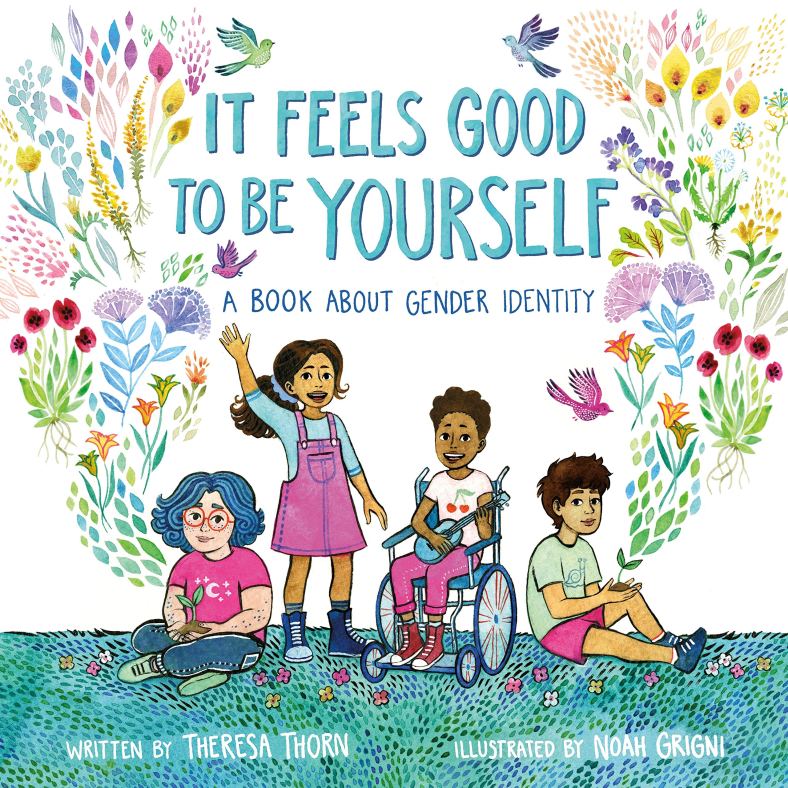
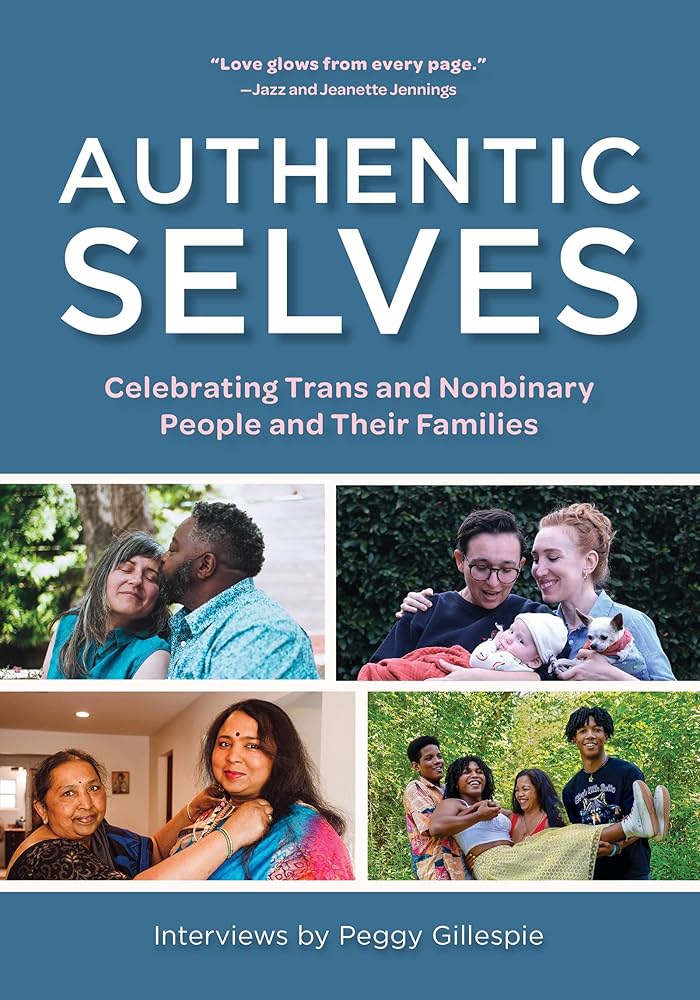
Below is a robust roundup of titles from our collection, most of them authored by trans people. Regardless of your gender identity and personal background, there’s something here for everyone; I hope you check one out and learn something new!
Ash is an Instructor and Research Specialist at HCLS Central Branch with a passion for information literacy and community engagement. They love music, gardening, hiking, and cuddling with their golden retriever.
In the late 80s, when I first discovered the novels of Jacqueline Susann and Jackie Collins, I used to place paper bag covers over them to hide the title information and, I suppose, my shame in reading them. Nowadays, in the age of e-books, where no one has to know or can see what you’re reading, I am not at all shy about sharing my love of these two authors.
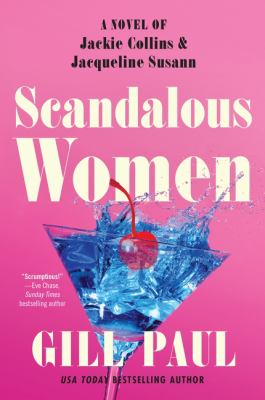
Scandalous Womenbrings to life the dynamic and groundbreaking careers of both iconic ladies. Set in the 1960s, the story follows these trailblazing and vibrant women as they navigate the male-dominated world of publishing, facing rampant sexism and societal backlash for their bold, provocative works.
Nancy White, a young editorial assistant becomes the unlikely link between these two literary powerhouses. As Jackie and Jacqueline strive to top the bestseller charts, they form an unexpected friendship, sharing their struggles and triumphs in a world that often seeks to silence them. Though there is no real world evidence to suggest they were friends in real life, Gill Paul has said that she loves to imagine that they could have been.
Paul weaves together the personal and professional lives of these women, highlighting their resilience, ambition, and the price they pay for their success. Scandalous Women is written in the style and spirit of both authors and is a fun, yet ultimately serious look at writing as a woman in the 1960s. The way she captures their spirit, especially Susann’s, is pitch-perfect and is one of the reasons the book stays with you long after you finish. The good news is, if you like Gill Paul, she has written several other novels, just as compelling and enjoyable to read.
To see Jaqueline Susann discuss literature (and that meshes well with what Scandalous is trying to say) click here:
Angie is an Instructor & Research Specialist at Central Branch and is a co-facilitator for Reads of Acceptance, HCLS’ first LGBTQ-focused book club. Her ideal day is reading in her cozy armchair, with her cat Henry next to her.
The perfect alchemy of romance, humor and quirky originality.” —Sophie Cousens,New York Times bestselling author
Sarah Adler was folding laundry. A decidedly boring task. To distract herself, Sarah Adler told herself a joke, which then transformed itself into a clever romance novel with a honest and funny con-woman, a chatty ghost, and a hazel-eyed farmer. Now that is some fascinating alchemy!
I am curious about this mundane-to-magical process of writing and plan to ask some serious questions when Sarah Adler visits the library on July 27. Sarah plans to offer a candid behind-the-curtain look at writing and publishing genre fiction, as well as a discuss the book itself. She will focus on different writing precepts for creating compelling stories and specifically analyze high concept romance and premise vs. plot.
To meet with Sarah Adler, visit HCLS Miller Branch on Saturday July 27 at 3 pm and REGISTER to save your spot.
More about Happy Medium:
A clever con woman must convince a skeptical, sexy farmer of his property’s resident real-life ghost if she’s to save them all from a fate worse than death. Fake spirit medium Gretchen Acorn is happy to help when her best (read: wealthiest) client hires her to investigate the unexplained phenomena preventing the sale of her bridge partner’s struggling goat farm. Gretchen is happy to help a nice old man finally retire and put some much-needed cash in her pockets at the same time.
Of course, it turns out said bridge partner isn’t the kindly AARP member Gretchen imagined—Charlie Waybill is young, hot as hell, and extremely unconvinced that Gretchen can communicate with the dead. (Which, fair.) Except, to her surprise, Gretchen finds herself face-to-face with Everett: the very real, very chatty ghost that’s been wreaking havoc during every open house. And he wants her to help ensure Charlie avoids the same family curse that’s had Everett haunting Gilded Creek since the 1920s.
Sarah Adler is a USA Today bestselling author of romantic comedies about lovable weirdos finding their happily ever afters. Her debut novel, Mrs. Nash’s Ashes, was a New York Public Library Best Book of 2023. Her second, Happy Medium, is a USA Today bestseller. She received both her BA in History and American Studies and MA in History from American University in Washington, DC, where she focused on 19th and early 20th century U.S. culture.
She lives in Maryland with her husband, daughter, and very mischievous cat.
A witty, absurdist satire of the last 500 years, Alexandra Petri’s US History is the fake textbook you never knew you needed!
by Rohini G.
Every morning, before I plunge into the doom and gloom printed on the front page of the newspaper, I take a few minutes to refresh my soul and laugh loudly. Washington Post’s humor columnist Alexandra Petri’s witty perspective on the absurd in our politics (of which there is no dearth), tickles my funny bone, enlivens my gray cells, and infuses my heart with optimism. A full body workout!
What? You haven’t read her column and are unfamiliar with her razor sharp writing? Ah, my friend, what should I offer you – her hilarious article about whether George Santos should resign (It’s the last thing he should do) or her recent satirical perspective on the U.S. Senate – it’s senior living made permanent. Or better yet, come and meet her in-person on Saturday, June 24 at 2 pm at the Miller Branch as she discusses her new book U.S. History: Important American Documents (I Made Up).
As a columnist for The Washington Post, Alexandra Petri has watched in real time as those who didn’t learn from history have been forced to repeat it. And repeat it. And repeat it. If we repeat history one more time, we’re going to fail! Maybe it’s time for a new textbook.
On Petri’s deranged timeline, John and Abigail Adams try sexting, the March sisters from Little Women are sixty feet tall, and Susan Sontag goes to summer camp. Nearly eighty short, hilarious pieces span centuries of American history and culture. Ayn Rand rewrites The Little Engine That Could. Nikola Tesla’s friends stage an intervention when he falls in love with a pigeon. The characters from Sesame Street invade Normandy. And Mark Twain—who famously said reports of his death had been greatly exaggerated—offers a detailed account of his undeath.
Alexandra Petri is a Thurber Prize finalist. Her satire has also appeared in McSweeney’s and the New Yorker’s Daily Shouts and Murmurs. She lives in Washington, DC. She won the National Press Club Angele Gingras Award for Humor Writing 2016, Shorty Award 2016, Forbes 30 Under 30, Fifty Funniest People Right Now (Rolling Stone).
If there is even a single person standing who can see through the political obfuscation on all sides, and spark humorous conversation, then there is, yet, hope for this world.
April is National Poetry Month. We need at least that long to appreciate all the wonderful poets and poems that enrich our lives. Poetry allows us the see the world in new ways. The rhythms and allusions of poetry open views or thoughts that ordinary prose simply cannot elicit through standard structures. Whether recounting lengthy epics like the Iliad or appreciating life’s little joyous moments with Mary Oliver, poetry’s language can transport us.
Do you have any favorites? Do any memorized pieces live in your mind? I first read Dylan Thomas‘ “Do Not Go Gentle Into That Good Night” the year my father was diagnosed with cancer. “Rage, rage, against the dying of the light” has been with me ever since. In less fraught circumstances, my sister memorized Shel Silverstein‘s “Sick” when she was in elementary school – it’s still fun to recall its whimsical truth as adults. I know quite a few people who can recite all the nonsensical words of the heroic “Jabberwocky,” from Lewis Carroll’s classic story, Through the Looking Glass – famously performed by the Muppets, in case you haven’t seen it.
We invite you to celebrate a month of poetry. Whether you borrow a volume or anthology of poetry, or attend a class, we hope that you take a moment or two to enjoy some wonderful words. And, on April 27 – official Poem in Your Pocket Day – you can keep handy an old favorite or a new, original composition to share throughout the day.
Creating from Wounds: A Generative Workshop Adults. Register. The power of poems is that they allow us to create from disaster, making something out of the brokenness to process and cope. In this workshop, Meg Eden shares tools that she has used in writing her latest poetry collection. Compose using interactive prompts, then receive resources to continue with your writing. Sat, Apr 15 12:30 – 1:30 pm Savage Branch
Poets Corner Ages 6-11, 45 minutes. Ticketed; free tickets available 15 minutes before class starts. There’s a poem in your head just shouting to come out! Discover the tools poets use to create verses that sparkle and shine. Read, write, and have fun sharing poems! Sat, Apr 22 2 – 2:45 pm Elkridge Branch
Playful Poetry Ages 6-9, 45 minutes. Ticketed; free tickets available 15 minutes before class starts. April is National Poetry Month – celebrate by joining us to hear and share fun poems from a variety of creators. Participants are welcome to bring a poem they love to share with the group. Maybe you will even be inspired to compose a poem of your own! Thu, Apr 27 5 – 5:45 pm Elkridge Branch
Kristen B. is a devoted bookworm lucky enough to work as the graphic designer for HCLS. She likes to read, stitch, dance, and watch baseball in season (but not all at the same time).
I’ve been reading a lot of short stories lately. I’d contend the short story is really its own art form, of which I’m a big fan. In fact, in my book discussion group, Read. Think. Talk., we’ve spent the past quarter reading exclusively short story collections. It makes for a different sort of discussion, and in some ways the long form – a novel or novella – lends itself a bit better to a book discussion. Personally, I like to discuss the characters and situations that change throughout a novel. However, as a group we’ve done short stories plenty of times, and it’s a great opportunity to discuss which ones you like, which ones you didn’t like, and generally how the stories worked, or didn’t, in a short number of pages.
I’ve always enjoyed short stories for their brevity. They are especially well-suited for the time-challenged, modern world we live in. You can just jump into a story when you have a brief period of time, or perhaps need a short respite from whatever else you’re reading (e.g., maybe you’re a student reading textbooks and academic periodicals and would like some fiction in your life). I’ve read some great collections lately.
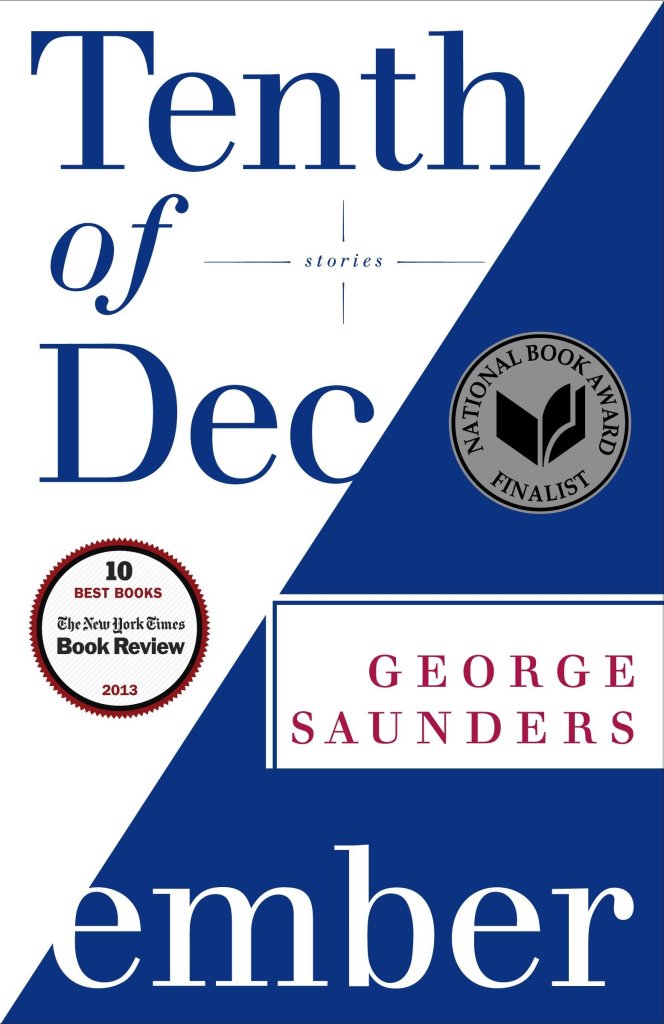
George Saunders, who mainly writes short stories, is remarkable in the field. His collection Tenth of December is by no means a feel-good read, but the stories are an abstract satirical take on modern-day America. They are collected from The New Yorker, where Saunders contributes stories regularly and where I read a great interview with the author to prepare for our book group discussion. Most of the stories concern disastrous situations and terrible characters that frankly scare you a bit, but somehow they don’t end catastrophically. I would even describe the stories as ending on an optimistic note, which seems like the opposite of how they’re presented on the surface. They’re definitely worth a read, or two.
The Refugees by Viet Thanh Nguyen is a companion to his excellent book The Sympathizer. Although I’d recommend the latter over the former, I don’t want to denigrate the story collection; it’s just a tall order to compete with that great book about the Vietnamese immigrant experience in America after the Vietnam war. (Please read my review of The Sympathizer here.)
The stories are all colored by Nguyen’s personal experience of being a refugee as a child. Dedicated to “refugees everywhere,” I think the book speaks to the importance of expanding our understanding of what it means to be a refugee. In my mind’s eye, I see people walking with their few possessions without a land or place. While a physical journey of this sort sometimes happens, the next step deals with the ongoing psychological effects of living in a foreign land. Particularly, one that is politically and culturally controlled by people different than you. Nguyen deftly tells stories from the perspective of a man, a child, a younger woman, and an older woman. There is even an interesting commentary about how some refugees perceive others as having it better when one character laments the fact that they’re not Korean.
In February, the book group is considering Welcome to the Monkey House by Kurt Vonnegut, one of my favorite writers, and the library just procured some fresh copies. I’ve always loved his wit, humanism, and the cynical optimism that flavors his satire. Vonnegut began his career and was able to support himself and his family as a writer by selling stories. I learned this recently by watching the documentary Kurt Vonnegut: Unstuck in Time. The collection is worth checking out if only for the great tale “Harrison Bergeron.” I first read this in a freshman college English class (even a slacker like me was game for this short story). Vonnegut tells the story of a futuristic society that has attempted to forcibly make itself completely equitable via technology. For example, if you’re intelligent your brain is zapped when you start to think too much; if you’re physically gifted, you’re saddled with weights; if you’re attractive, you wear a mask, etc. It’s a complicated message that I think I get, or at least I have my own interpretation. However, I don’t want to influence yours. I enjoy art like this, though, and I’d describe it as open-ended and open to interpretation.
Although I could go on about all the great short story collections I’ve read, I won’t. However, I’d like to mention one final great one. Stone Mattress: Nine Wicked Talesis by Margaret Atwood, another author I love for her wit and great social commentary. These tales are sort of “light horror” stories, which is how I would describe much of Atwood’s writing. I hope it’s not heresy to state here that I think the collection is better than The Testaments. The stories should be read in order, as some are connected. The overarching theme throughout is the experience of being a woman and aging, and they’re all wondrously done.
I have always marveled at those who do the short story well. To tell a story in just a few pages takes craft, specifically, to get people to invest in the plot, scene, and characters. Try it, sometime. It’s not easy.










 CHAPTER CHATS