

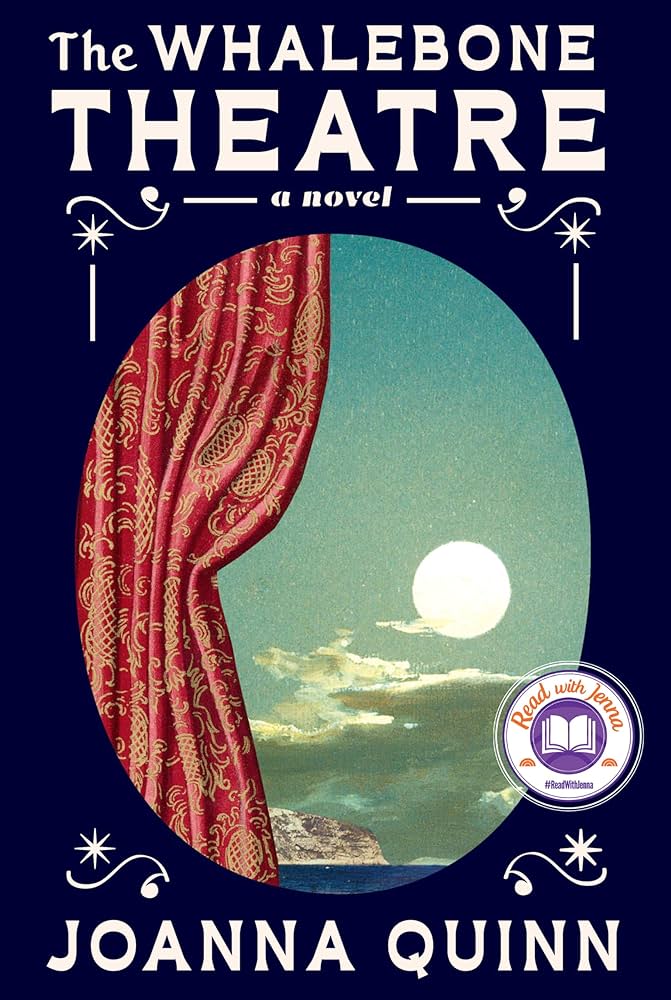
by Kristen B.
A friend suggested a good rule for reading: only one World War II-adjacent book each year. Well, I’ve already spent this year’s allowance, and it was a good one!
The Whalebone Theatre by Joanna Quinn begins during the interwar period, set at a grand country estate, Chilcombe, on the southern coast of England. Cristabel Seagrave is a lonely little girl with an immense imagination. Her mother died in childbirth, and the story gets underway with her father bringing home a new bride. England’s laws being what they are, the family needs a male heir to keep the estate. A set of minor tragedies and expected resolutions ensue, all of which lead up to the day that Cristabel discovers a dead whale on Chilcombe’s beach.
With this highly cinematic scene, set against a quiet sea and a rising sun, the book finally gets underway. Cristabel hauls herself up the side of the leviathan and plants her flag, literally, in its blubber as her two younger stepsiblings turn up to watch and cheer her on. It’s clear that the trio of Cristabel, Flossie, and Digby make a minor clan in and of themselves, running mostly feral as their adults are caught up in the bohemian lifestyle of the rich and entitled in the Roaring Twenties. Interestingly enough, her stake cannot stand because all sea-washed flotsam automatically belongs to the Crown. In the end, the Crown doesn’t want it and the poor whale spends the rest of the summer slowly rotting upon the shore, much to the entertainment of the children.
Also discovered upon the beach that day is Taras – an itinerant Russian painter living a risque, socially liberal life-style. His paramours are old friends with Flossie and Digby’s mother, and so ensues a longstanding relationship between both parents and children. Taras eventually has the grand idea of moving the whale’s ribs to build a theater within Chilcombe’s estate. Under Cristabel’s direction, the children, their adults, and other willing locals stage a variety of plays, including a retelling of the Iliad and Shakespeare’s The Tempest. One of the Bard’s final plays, The Tempest carries certain themes throughout the book – including shipwreck and exile, civilization and monstrosity, and power and integrity. The book glosses over the 1930s with a set of newspaper clippings detailing the annual summer performances at the theater.
When the story recommences, World War II is well underway. One of the adults who came and went from Chilcombe turns out to be a high-ranking member of the British intelligence ministry. He enlists first Digby, then Cristabel into becoming agents in occupied France. Meanwhile, Flossie maintains the home estate and becomes a Land Girl as the war rages on. The story careens through the final years of the conflict, with uncertainty and anxiety at every turn as our intrepid trio make their separate, but always inter-connected, ways in the world.
In the end, it all comes together back at Chilcombe. No one is quite the same in the aftermath of war – family, friends, servants, and locals. I greatly enjoyed the book with its gorgeous language, despite its quiet devastations that rang absolutely true to me. At the end of The Tempest, Prospero says, “Now my charms are all o’erthrown, And what strength I have’s mine own.” What strength remains belongs solely to the women of this story, home at last. I suspect this is a title I will linger over and think about at odd moments. Certainly, it resonated with other recent books adjacent to WWII where the smaller stories and sacrifices carry the story.
The Whalebone Theatre by Joanna Quinn is available in print, e-book, and e-audiobook.
Kristen B. is a devoted bookworm lucky enough to work as the graphic designer for HCLS. She likes to read, stitch, dance, and watch baseball (but not all at the same time).

 CHAPTER CHATS