Native American Heritage Month: Beauty and Sadness

The book cover depicts two feathers facing in opposite directions, sketched in brown ink against a bright orange background, with the title in yellow lettering.

By Eric L.

Native American Heritage Month is almost finished for this year, but you are free to let it go a little longer into December and check out some great related works of art from the library, including the distinguished debut novel by Cheyenne and Arapaho writer Tommy Orange and a modern classic from director Terrence Malick.

There There by Tommy Orange (available in a variety of formats) is not a traditional novel, in that many of the characters don’t interact with one another, nor is it a traditional collection of short stories. Each chapter is a deep character profile explicated from the character’s perspective and written in a small amount of space. There There is beautifully crafted, in my humble opinion, with these very short, somewhat disconnected chapters from a variety of characters’ points of view not being an easy way to tell a story. However, it works really well and I recommend reading it. 

The characters are Native American, or part, in ancestry. Although the larger narrative is about the experience of individual characters, the connecting plot device is an upcoming powwow at the Oakland Coliseum. Some plan to attend, some plan to dance in the ceremony, some are organizing it, others are working on grant-funded projects related to Native Americans, and some plan to rob it. 

I could broadly say that the book talks about identity, or the loss of identity and the confusion experienced by some urban Native Americans. I recall a friend telling me that There There is sad, and to be sure, it is; however, the stories are powerful, engaging, and beautifully written. In other words, it’s not a feel-good read, and it’s tough sometimes. 

Most of the younger characters feel confused and/or apathetic about being Native American in modern America. They’ve not lived, or their parents did not live, on the “rez,” as they call it. I think what makes this a great book is that it doesn’t so much concern the facts of the past, but rather their impact on the present. This is a very interesting and apropos topic in America right now, as some say we need to forget the past and move forward. I’d contend this may be easier for some than others. And perhaps a better understanding of how the past effects the present could benefit all of us. Prior to one part of the book Orange uses the profound James Baldwin quote, “People are trapped in history and history is trapped in them.” 

I did learn some things about modern Native American history – for example, the red power movement and the occupation of Alcatraz Island. The occupation is an interesting moment in the recent past, and illustrative of Orange’s larger commentary about people’s place within America. 

One character has an interaction with a woman on public transportation in Oakland while he is in full dancing regalia on his way to the powwow. She asks him some innocuous polite questions, and he responds in part that he is going to a powwow at the Oakland Coliseum and that she should come check it out. He thinks to himself that she can now tell the story later over dinner about how she saw and spoke with a real Indian on the train today, and that that is as close as most Americans would like to get. 

Margaret Atwood called it “an astonishing debut.” And until I read this praise, I was not aware it was a debut, because it’s that good. I concur with Atwood’s opinion, and it makes me excited for his future books. 

This work brought to mind the film The New World on Kanopy, which if There There concerns the now, then the movie depicts colonial America and indigenous people. I’m a fan of the director Terrence Malick’s films. He makes impressionistic films, and although this may sound pretentious, simply put, it contains beautiful cinematography (mostly nature shots) and sparse dialogue. The Thin Red Line and The Tree of Life, Malick’s popular and award-winning films starring Sean Penn and a bevy of other great actors, are also great (you can borrow these in DVD format). 

The New World concerns the arrival of the English and the settlement of the colony in Jamestown, Virginia. The cast features terrific actors (Colin Farrell, Christian Bale, Q’orianka Kilcher, and Christopher Plummer). It was filmed in Virginia, and Malick employed academics to recreate the villages and the extinct Powhatan language and used native actors. The film is partially based on John Smith’s account of Pocahantas, the verity of which is a bit suspect. Nevertheless, it succeeds in depicting very different groups with clashing motivations, and it’s visually stunning. 

In sum, both these works are beautiful AND sad.

Eric is a DIY Instructor and Research Specialist at the Elkridge branch. He enjoys reading, films, music, doing nearly anything outside, and people.


Happy Thanksgiving!

A metal watering pail holds fall greenery and herbs, and three small gourds sit on the wooden table at its base.

by Kristen B. and Julie F.

Wishing you and yours a very happy Thanksgiving! The past year and a half have brought trying times, which makes taking a moment to give thanks an exercise in hopefulness. Here’s to hoping we’re in an even better place by this time next year! If you wish to do some reading (it is the blog, after all) about gratitude, check out these lists: adult fiction, adult nonfiction, and for children and teens.

We would like to take a minute to express our gratitude to you, our loyal Chapter Chats readers. We, along with many colleagues here at the library, began this enterprise shortly after the pandemic struck. We were working from home and not very sure how it was all going to work out. We have now surpassed 230 entries that have spanned reviews of books, movies, and online resources, classes and events, and other library news. Thank you for sticking with us!

HCLS is open again now, as you surely know, and our statistics are once again proving why we rate as a 5-Star Library. We reopen the Glenwood Branch in a little over a week on Dec 4, and we hope to see you there and at any of the other branches soon.

On behalf of all the HCLS staff who write for Chapter Chats, enjoy your celebrations this holiday season with family, friends, and loved ones. Happy Thanksgiving!

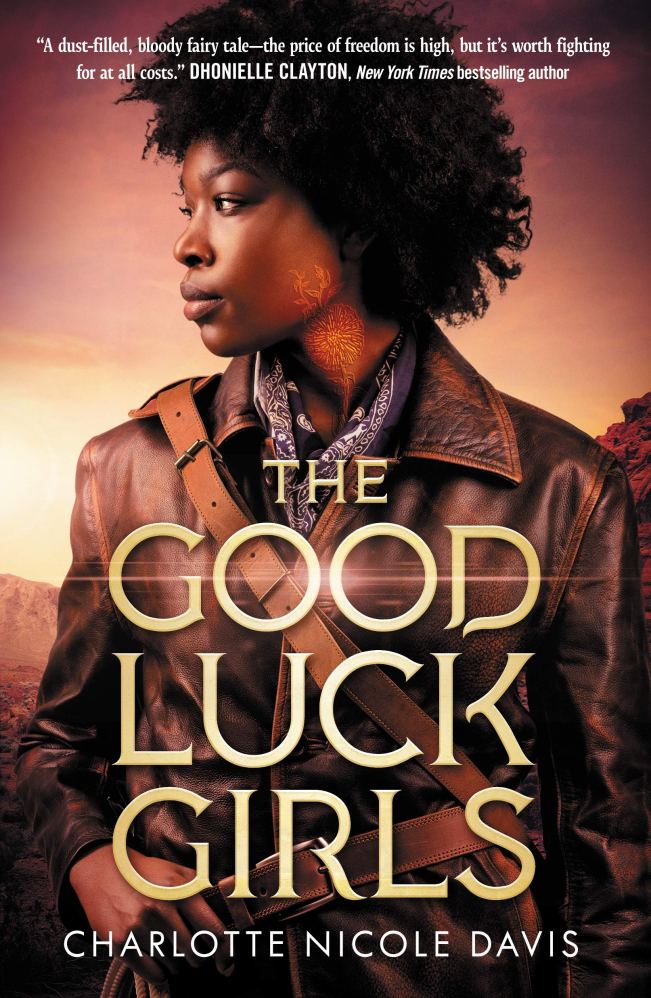
The Good Luck Girls by Charlotte Nicole Davis

The cover shows a young Black woman looking to the left, dressed for the trail in a leather coat and a strap for a bag across her chest. She has a floral tattoo on the side of her neck.

by Kristen B.

The Good Luck Girls is a flat-out running adventure of escape and escapade, complete with undead monsters, bank robberies, and a secret rebel base. In the country of Arketta, good luck girls are sold to “welcome houses” as children, basically into indentured servitude where they start as housemaids until they graduate to serving customers more personally. The male patrons of welcome houses are called “brags” by the women who work there. This book is filled with so many smart details that make it real.

Favors are the magical tattoos that mark the girls’ throats and match their names, which cannot be removed or covered without dire consequences. The girls in this story will do almost anything to remove those favors and be free of the welcome house. Meet the girls:

Aster, the protector, is the big sister and the one who has gumption to say, “time to go, girls.”

Violet, the favorite and the survivor who may have regrets, also has the secret information to get everyone to safety.

Tansy, the herbalist and medic, is the heart of the bunch who keeps everyone pointed in the same direction.

Mallow, the fighter, meets life with fists up but learns the hard way how to pick which fights are worth having.

Clementine, the catalyst and Aster’s younger sister, has a catastrophic Lucky Night and becomes the reason this group of girls flees into the wilderness. She wants so much more from life than a Welcome House can offer.

After Clementine’s debut ends with a very important brag dead in her bed, the girls figure out how make an escape, heading North to freedom. The girls follow clues from the story of Lady Ghost passed from good luck girl to good luck girl, but no one knows the truth – although Violet claims to have special knowledge. They discover a male guide to take them through rough country, who brings all the usual complications. He is also looking for redemption and a new life, and makes the difference for surviving in the deep wilderness. The group learns to rely on and (maybe even a little bit) love each other like family.

There are some solid themes underlying all the fun, including gender and race issues. These young women demonstrate their abilities to do what’s necessary to achieve their goals, despite physical and emotional trauma. As they reclaim their identities and their independence, questions arise about who the law protects and serves and when a little rebellion is a good thing. Honestly, I rooted for the girls during their first bank heist … even if it’s a crime.

I gulped this book down over one weekend. I can’t wait to see what these girls do next as I am pretty sure that each one of them is entirely capable of making her own good luck.

The Good Luck Girls is available in traditional print, book on CD, and as an eBook.

Kristen B. is a devoted bookworm lucky enough to work as the graphic designer for HCLS. She likes to read, stitch, and take walks in the park.

Witch Hat Atelier

Cat lies next to a copy of Witch Hat Atelier and other manga books. Cover shoes a young girl with blonde hair with blue witch robes flying around her, wearing a large conical hat with a tassel.

by Eliana, a teen volunteer at Savage Branch

Witch Hat Atelier by Kamome Shirahama boasts magnificent artwork, a lively world, and a complex cast of characters. It is classified as shounen (for teen boys) but is friendly for all demographics. The adult cast also actively works to protect and care for the child cast, something seldom seen in shounen and young adult media due to the limitations adults can sometimes pose in a story. Shirahama typically frames her arcs across two volumes, so I suggest reading two at a time.

In Volume 1, our main character, Coco, is the daughter of a seamstress out in the countryside. The people of this world use inventions made by witches – such as a spring of water that cleans itself after every use or cobblestone pathways that glow when you step on them – in their day to day lives. Having seen all of these inventions, Coco wishes dearly for magic.

After a series of unfortunate events, Coco is orphaned and initiated as a student of Qifrey’s atelier. Volume 1 follows Coco’s initiation and journey into the magical world.

A BRIEF INTRODUCTION TO THE GIRLS
Coco is the main character. She is also unfamiliar with much of the magical community, its history, and its customs. From a technical standpoint, Coco is a vehicle what allows the mangaka to explain her world. We learn about the setting as Coco does. From a narrative standpoint, Coco’s newness to the world around her means that she brings fresh ideas and solutions to the table. Since she knows only a handful of basic spells, she must use them creatively. One early example is her solution to the first test, retrieving a rare herb from the top of a series of floating mountains.

Aggot is a ambitious student. She practices day in and day out. Aggot shares a workspace with Coco and feels that Coco has not earned her place at the atelier. As a matter of fact, it is Aggot who hurries an unprepared Coco into the first test. Aggot often overexerts herself due to pride. However, Aggot’s technical expertise tempers Coco’s more experimental ideas. Since Aggot has the most understanding of magic she is able to assist Coco in implementing a solution without collateral damage.

Richeh is a taciturn and sleepy young girl. She is aloof and only draws spells she enjoys. Richeh has a favorite hiding place filled with glowing ribbons. I personally relate to Richeh the most, but since she does not take much of an active role in volume one, I will refrain from discussing her in depth.

Tetia is a cheerful young lady with curly twintails. She is the most welcoming to Coco when she first arrives. Tetia believes happiness comes in twos. When she grows up, Tetia hopes to be someone who can bring happiness to many people. This does not mean that Tetia is one-note either. Tetia does get angry, but she is also a genuinely kind and empathetic person. It is Tetia’s wish to provide happiness and comfort that leads to the solution to the conflict in the second arc of volume one.

ON THE SETTING
The story largely takes place in a rural/pastoral community. It is earlier than the typical fantasy story, so it is a refreshing change of scenery. Additionally, the casting method of magic is unique. Spells are not cast by way of incantation or ritual but with drawing sigils in a very specific ink.

Two main factions operate within the setting. The Knights Moralis are the enforcers of the magical community. In the past, when magic was common knowledge, people used it to their own ends and caused grevious harm. Nowadays, magic is kept secret from the public. Any and all magic that changes the human body or the natural world is forbidden. Any member of the community suspected of casting forbidden spells will have their memory erased. It is illegal for witches to cover their faces. The Brimmed Caps are opposed to the Knights Moralis. They believe that the Knights have gone too far in restricting knowledge. Healing spells, after all, are among the forbidden spells.

Free Practice Driving Tests for Cars, Motorcycles & CDL

Open two-lane road with double yellow line leading into the distance of snow-topped mountains. Bright sky with white clouds take up the top two thirds of photo.

Driving-Tests.org, in partnership with Howard County Library System, offers free practice tests for those looking to obtain driving licenses or permits for cars, motorcycles, and commercial vehicles in Maryland. According to users, the practice test questions are very similar to the actual questions you may find on the MD MVA official exams. Essentially, if you’ve studied the appropriate handbooks cover-to-cover and aced all the practice tests, you should feel pretty confident going into your scheduled exam.

This resource provides you with the necessary handbooks to read online or download. Plus, audio versions of the cars and motorcycles handbooks are available if you’d prefer to listen. According to the application, they advertise an industry-leading 95.2 percent success rate and being “73 percent more effective than the driver’s manual alone, based on a nationwide survey.”

The practice tests for drivers’ licenses and permits touts nearly 500 questions, which are categorized into order of difficulty: easy, hard, and hardest. There is also an exam simulator which mimics the MVA exam. The questions are pulled from an extensive database which promises new questions each time you practice. The motorcycle section is arranged similarly with 312 questions that are randomized on the exam simulator. Each test reminds takers of their allowed number of mistakes in order to pass.

The CDL section offers eight general knowledge tests, a marathon general knowledge test of all 417 questions, plus an exam simulator pulling 50 questions at random. Specialized tests for HazMat, School Bus, Passenger Vehicles, Air Brakes, Double/Triple Trailers, Tankers, and Combination Vehicles are also included. Pre-Trip inspection videos and testing are also at the ready.

These tests can help a range of users: teenagers getting their learner’s permit, parents assisting aforementioned teens, adults who’ve moved or are planning to move to another state, newcomers to the US, test-takers with only a few days left before their exam, and those who prefer to prepare on their own instead of paying for and/or attending driving school. Whatever your situation, this database of free practice tests at hclibrary.org is your best resource for preparing for your licensure.

JP has worked for HCLS since 2006. She loves playing with her new orange tabby kittens, Mando & Momo.

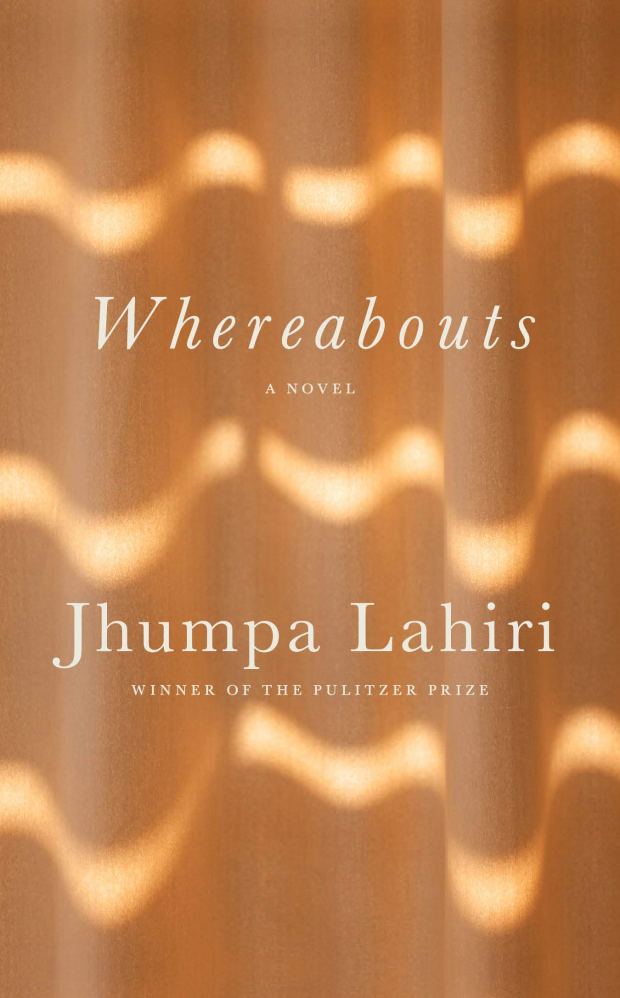
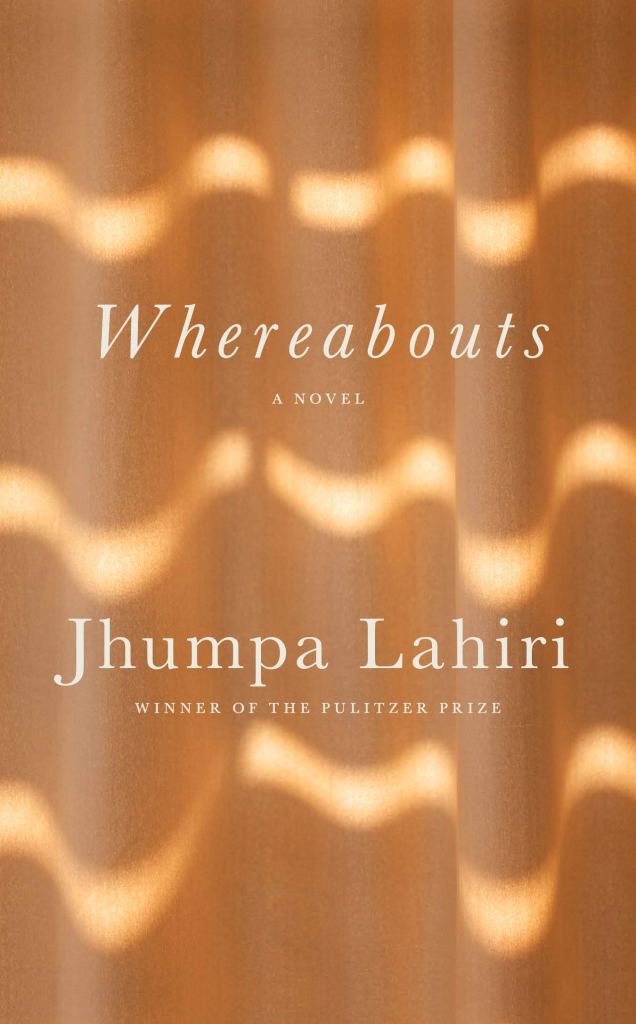
Whereabouts by Jhumpa Lahiri

The book cover depicts a pale orange curtain falling waves, with dappled stripes of bright yellow sunlight across it. The title and author's name, with "winner of the Pulitzer Prize," are superimposed in white script.

By Piyali C.

In the simple, succinct, and gorgeous prose that is her trademark, Jhumpa Lahiri, the Pulitzer Prize-winning author of The Namesake, Interpreter of Maladies: Stories, and other works, writes about the observations of a single, unnamed woman living alone in an unnamed city in Italy in Whereabouts. Each chapter in this book reads like a page from a beautifully crafted journal. They are chronicles of our protagonist’s day to day life – be it walking over a bridge where she occasionally comes across her ex-boyfriend, or her sojourn to her favorite sandwich store where she buys the same lunch every day, or her trip to the swimming pool where she meets women who share their stories with each other verbally, or even the stories they share through each hard-earned wrinkle on their faces or their swollen feet or the extra flesh in their midsection. The woman of our story quietly listens. Through her ruminations about her past we come to know about her parents, their eccentricities, her relationship with them, her mother’s financial dependence on her father, and her subsequent financial education to her daughter which influences the woman’s monetary decisions all her life (and not necessarily in a helpful way).

The narrator is lonely sometimes, and sometimes she cherishes her solitude. She is frustrated with the sameness of her life sometimes, and sometimes she is content simply sitting at the piazza in front of her apartment observing frenetic activities in her neighborhood. She falls asleep at night reassured by the noise of traffic and wakes up deep in the night, disconcerted at the silence around her when the sounds of automobiles have ceased. She could be any of us – a juxtaposition of contrasts – and perhaps this ‘everywoman’ trait of the protagonist makes the book and her so relatable.  Her keen sense of observation is what many of us lack these days. It was such a joy to see the world – her world and for a short time our world, too – through her eyes. Even after the book ended, I seemed to linger by the side of the piazza eyeing the sandwich store and looking at the men and women living their lives in that unnamed city in Italy. This is a deeply contemplative novel made up of vignettes from a middle aged woman’s everyday life. There is no catastrophic event in this story, no climax or anti climax. It simply tells the tale of life and in doing so it becomes strangely captivating. At the end of the day, I agree with the description that the publisher provides for this short novel – “Whereabouts is an exquisitely nuanced portrait of urban solitude…”

I would like to share a snippet just to whet your appetite for this truly beautiful literary novel so you can borrow it from Howard County Library System for your next read. There is a passage where the woman comes face to face with the man she once loved in the middle of a bridge. Lahiri writes

“We stop in the middle and look at the wall that flanks the river, and the shadows of pedestrians cast on its surface. They look like skittish ghosts advancing in a row, obedient souls passing from one realm to another. The bridge is flat and yet it’s as if the figures – vaporous shapes against the solid wall – are walking uphill, always climbing. They’re like inmates who proceed, silently, toward a dreadful end” (6-7).

This is simply one example of many where I felt Lahiri painted pictures for me with her words.

Whereabouts is also available in large print and in eBook and eAudiobook format via Overdrive/Libby. Whereabouts is Jhumpa Lahiri’s first novel written in Italian, as well as the first time she has self-translated a full-length work.

Piyali is an instructor and research specialist at the Miller Branch of HCLS, where she co-facilitates both Global Reads and Strictly Historical Fiction.

Twilight of Democracy (I hope not)

The book cover shows the title, "Twilight of Democracy: The Seductive Lure of Authoritarianism," and the author's name, "Anne Applebaum," accompanied by "Winner of the Pulitzer Prize." The words are in white except for "Authoritarianism," which is in red. The background of the cover is in gradating shades of blue.

By Eric L.

Twilight of Democracy: The Seductive Lure of Authoritarianism is a great read for the current moment. The title of the book should give you a fairly good idea of what the book is about. Anne Applebaum’s area of analysis and expertise seems particularly relevant right now. Sadly, she and I agree that hate and the belief in authoritarians has increased in recent times in America. Applebaum discusses how this is also the case in Britain, Hungary, and Poland (countries with which she has experience). Applebaum’s husband is involved in politics in Poland, which provides her an interesting vantage point into the “power elite” (my term). 

If you’re not familiar with Anne Applebaum, I would encourage you to read some of her articles in The Atlantic. I am mainly familiar with her work through this magazine. She is a journalist, but I would also describe her as a historian who has authored several highly regarded books on Russian history. She is also currently a senior fellow at Johns Hopkins University’s School of Advanced International Studies. I would describe Anne Applebaum’s politics as different than mine, where she is “center right” and I’m not. We may differ on specific policy prescriptions and perhaps views on liberalism and markets, but we agree that hate and authoritarians are both inimical to democracy. 

The book grabs you from the onset by describing a New Year’s Eve party they hosted as the 20th century ended. She details the somewhat raucous party, the guests, and the optimism many attendees shared for liberal democracies in the 21st century. I am younger than Applebaum, but I recall a similar optimism (and perhaps a little worry about Y2K). She then goes on to describe how in the 20 years since this party many of the guests would no longer speak to each other, and how’d she’d cross the street to avoid some of these folks. In our highly polarized and political society we can all share this sentiment to some extent. Perhaps we don’t know Boris Johnson personally, as she does, but we can relate, and her brief biographical sketch of Johnson is indeed indicative of western politics at this moment. 

The book is written by a good journalist, and thus it is engaging and thoughtful. It is very Western-focused, but it does concern more than the United States. The similarities of the things happening in these countries are a bit frightening. Personally, I’m remembering the era during the last century when fascism began to spread in the West. 

She goes into detail through character sketches of some of the people and the trajectory of their political beliefs. Many were former anti-communists and are now hard-right and authoritarian in nature. She points out that these are not poor, rural people, but actually quite elite, wealthy, and well-educated. She subsequently proffers her theories as to why this is the case, including that of a behavioral economist who suggests about one third of the population, irrespective of political beliefs, has an authoritarian “disposition.” This actually does not surprise me. Applebaum also puts words to the belief of many of these folks that things were better in previous times. The section where she delves into the different types of nostalgia is very interesting. 

I don’t agree with everything Applebaum posits, however I’d like to think she’d appreciate that fact. Specifically, I think she discounts corporate power and race issues in America. They’re addressed, but not to my satisfaction. Where I agree with Applebaum is that democracy is messy, it’s problematic, and not everyone is happy. In sum, it’s tough! It’s certainly much easier to be in complete control and get your way all the time. However, I don’t think I have an authoritarian “disposition” and I think getting my way all the time is not good for me psychologically. That said, I hope we’re not in the twilight of democracy.

Twilight of Democracy: The Seductive Lure of Authoritarianism is also available in large print and as an eBook and an eAudiobook from Libby/OverDrive.

Eric is a DIY Instructor and Research Specialist at the Elkridge branch. He enjoys reading, films, music, doing nearly anything outside, and people.
Walking in Someone Else’s Shoes

The cover has the author and title in black and white lettering against a sea green background.

by Cherise T.

When a novel is set in the reader’s hometown, appreciation for the story and characters extends beyond the book’s contents. When a novel is set somewhere new to the reader, that place is no longer foreign and unknowable. Literature expands memories, builds connections, creates new journeys, and fosters empathy.

Books by veterans, about veterans, and regarding veterans’ friends and families offer diverse perspectives of consequential events and everyday perseverance. Veterans can, perhaps, find shared experiences. For non-veterans, there are bridges to understanding. Ben Fountain’s depiction of experiencing post-traumatic stress disorder in Billy Lynn’s Long Halftime Walk is unforgettable. To some, an NFL halftime show featuring Destiny’s Child would be entertaining but to this story’s young Iraq War Army soldiers, it’s terrifying.

The cover depicts two soldiers, weapons drawn, seemingly patrolling a desert area with mottled orange sands and sky and a yellow sun at the horizon.

In his debut novel, The Yellow Birds, Iraq War veteran Kevin Powers takes on the burdens veterans face when they return home. Private John Bartle struggles to understand his own behavior in Iraq, as well as his debts and responsibilities to superiors and fellow soldiers. Veterans may relate to Bartle’s emotional efforts to move forward with his life beyond the battlefield. Readers who have never been in the military become immersed in Bartle’s psychological conflicts. He feels surrounded by death as he fights to survive both in Iraq and back home in Virginia.

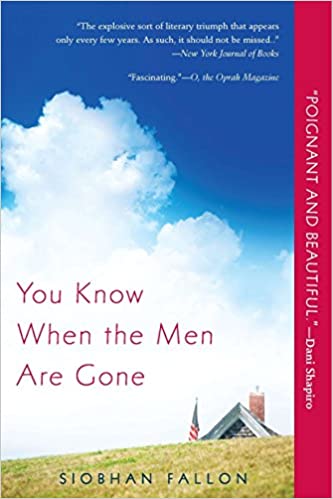
The cover depicts a white cloud against a deep turquoise sky, with a field rising to a hill in the foreground and just the upper floor and chimney of a house depicted behind the hill, with the United States flag flying in front.

Short story collections offer multiple viewpoints of war in one volume. Siobhan Fallon’s You Know When the Men are Gone focuses primarily on the family left behind, particularly military spouses in Fort Hood, Texas. The stress on these characters exceeds loneliness. Their attempts to cope with deployments are seen in actions as seemingly mundane as a shopping trip to the PX or as drastic as abandoning one’s spouse.

The cover depicts a soldier in fatigues, cap and boots with his duffel bag on the ground beside him, in what appears to be an airport or other waystation with a concrete floor and white tiled walls.

National Book Award winner Redeployment by Marine veteran Phil Klay deftly presents the outlooks of men who entered the military from varied backgrounds. The stories are heavy but often humorous as Klay addresses the absurdities inherent in active duty as well as in the abrupt return to civilian life as a veteran. Often disturbing, the situations encompass violence and PTSD but also forgiveness and compassion.

Cherise Tasker is an Adult Instructor and Research Specialist at the Central Branch. When not immersed in literary fiction, Cherise can be found singing along to musical theater soundtracks.

Don’t Underestimate a Good Craft

The photo shows a shadowbox format of birch tree branches and falling yellow and orange leaves against a pale background in a white frame, with a brown and a tan stone in the foreground. All are placed on a wooden tabletop.
Join fellow crafters at Tezukuri Crafternoon on Wednesday, November 10 to create this delightful fall display!

By Peter N.

First of all, a well-deserved welcome back to all of our customers! We have so enjoyed seeing your faces (or at least, half of them) in our branches once again, particularly for in-person classes and events like the one we’re sharing here.

Were you one of the regular participants in Create by Music at the Miller Branch in the pre-pandemic times? Well, good news! We are back but we have re-branded. Create by Music is now Tezukuri Crafternoon. What does that mean? Well, Tezukuri translates to “handmade” in Japanese and Crafternoon…well, that’s just craft combined with afternoon.

The photo shows the word "Tezukuri" in Japanese, followed by "Tezukuri Crafternoon" in English.

Each first Wednesday of the month, join us for a relaxing afternoon hour of crafts and conversation. No artistic talent required! And if you’re looking for a selection of titles from our collection to check out about handmade crafting, please enjoy this list of items from our catalog.

Register for our next Tezukuri Crafternoon on November 10th at 2 pm here. Ages 19+.

Peter is an Instructor and Research Specialist at the Miller Branch and LIVES for the upcoming sweater weather.

Celebrate Native American Heritage

Four pictures in a row picture a storyteller, singer, hoop dancer, and cover of We Are Water Protectors.

Join the celebration of Native American Culture and Resilience on Saturday, Nov 6 from 11 am to 3 pm at HCLS East Columbia Branch.

In an interview with Ani Begay Auld, member of the Navajo Nation and owner of Navabedine.com, she wants you to know, “We are still here. A lot of people put Native Americans into this certain time frame … like we’re relics from the past.” Nearly 600 federally recognized Native Nations exist, with dozens more recognized solely by states. Here in Maryland, the Piscataway Conoy and the Accohannock Nations are recognized, and Howard County sits on land that belonged to the Susquehannock nation. At one time, at least eight nations lived in Maryland.

Auld also recommends that you, “Seek out films or books written by native authors and look at the land that you’re on.” The author of the award-winning children’s book, We Are Water Protectors, will be part of the FREE event that also features dancing, singing, drumming, storytelling, children’s crafts, vendors, Navajo Tacos, and more. The line-up includes:

  • Rose Powhatan, Storyteller
  • Lance Fisher, Singer
  • Angela Gladue, Hoop Dancer
  • Chris Eaglehawk, Traditional Dance
  • Karelle Hall, Nanticoke Toe Dance
  • Sonny Elm, Smoke Dance
  • AND
  • Carole Lindstrom, author and #1 New York Times bestseller and winner of the 2021 Caldecott Medal, at 2 pm

This event is a collaboration between Nava Be Diné, Howard County Library System, County Executive Calvin Ball, and Howard County Office of Human Rights and Equity.

This free event will be held outside the HCLS East Columbia Branch unless inclement weather causes the event to move inside the branch. Masks are required.

Registration is optional and appreciated.