Is the Future Bright? 

A bright yellow cover, with a Warhol-like pink and yellow face above the title in bold block letters.

By Cherise T.

The eyes. The hot pink. The electric yellow. The cover of Bright Young Women demands attention and so does its story. Attempting to avoid bias, I tend to barely scan flyleaves and reviews. I don’t want to know before I find out for myself. I read just enough words to get a hint of the plot. For this book, “serial killer” was all I needed to see for me to put the book back on the shelf. Although I’m a big Dexter fan, I did not want to volunteer for more sleep-disturbed nights and uneasy days. But then a coworker recommended it, so I took the plunge. 

The idea of writing about a serial killer from the perspective of an attack survivor is not innovative in and of itself. However, author Jessica Knoll has written a unique feminist perspective on the Ted Bundy story. The murdered and assaulted are bright young women living in the academically highest-achieving sorority governed by its formidable president, Pamela Schumacher. Pamela expertly controls all aspects of her sisters’ lives, from maintenance of the sorority house to fashion advice. On the fatal night when her closest friend is murdered, Pamela crosses paths with the killer (referred to only as “the Defendant”), becoming the only reliable eyewitness.  

Forty-five years later, Pamela, now an attorney, is notified that there is additional information on the crime, and so begins the reader’s journey between past and present. We follow the events of that 1978 night at Florida State University. We meet Tina Cannon who travels to Florida in 1978 to meet Pamela. Tina hopes to link the 1978 atrocities to the 1974 disappearance of her friend in Washington state. The detectives resist connecting the two events, and the many murders and attacks in between, to one killer. 

The triumphs of this novel emerge in Pamela’s and Tina’s narratives. While researching Ted Bundy after I finished this book, I learned even more about the significance of the decisions Knoll has made in crafting this historical fiction. She intentionally addresses how the police and university behaved in the wake of the murders. Knoll takes on the cavalier treatment of the students after the trauma and how they were expected to return to school without additional security or support. She describes the often absurd content of the trials and the cases’ news coverage. She includes the public’s ongoing fascination with the mysterious man who evaded capture and was eagerly embraced as intelligent and attractive despite factual evidence to the contrary. 

The concept of media manipulation of readers and viewers has contemporary resonance. This novel skillfully develops each character’s perspective without losing track of the timeline of evidence. Bright Young Women simultaneously exposes how far society has come and how far it has yet to go in addressing the ways facts are researched and presented.

Bright Young Women is available from HCLS in print and in e-book and e-audiobook formats.

Cherise Tasker is an Adult Instructor and Research Specialist at the Central Branch. When not immersed in literary fiction, Cherise can be found singing along to musical theater soundtracks. 

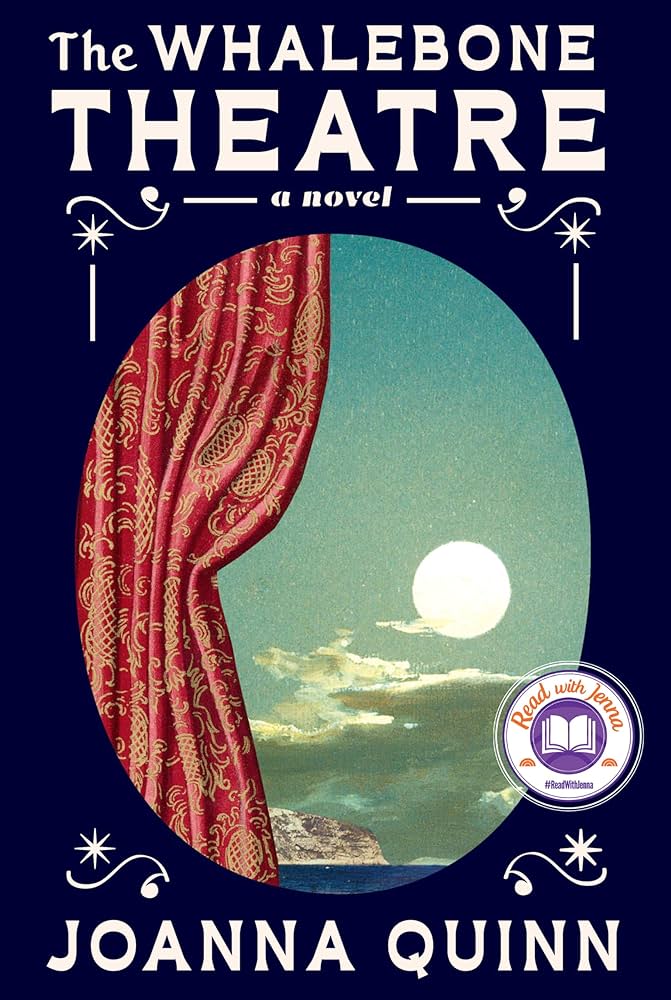
The Whalebone Theatre by Joanna Quinn

Within an oval frame, a red curtain pulls back to the left to show the cliffs of Dover beneath t

by Kristen B.

A friend suggested a good rule for reading: only one World War II-adjacent book each year. Well, I’ve already spent this year’s allowance, and it was a good one!

The Whalebone Theatre by Joanna Quinn begins during the interwar period, set at a grand country estate, Chilcombe, on the southern coast of England. Cristabel Seagrave is a lonely little girl with an immense imagination. Her mother died in childbirth, and the story gets underway with her father bringing home a new bride. England’s laws being what they are, the family needs a male heir to keep the estate. A set of minor tragedies and expected resolutions ensue, all of which lead up to the day that Cristabel discovers a dead whale on Chilcombe’s beach.

With this highly cinematic scene, set against a quiet sea and a rising sun, the book finally gets underway. Cristabel hauls herself up the side of the leviathan and plants her flag, literally, in its blubber as her two younger stepsiblings turn up to watch and cheer her on. It’s clear that the trio of Cristabel, Flossie, and Digby make a minor clan in and of themselves, running mostly feral as their adults are caught up in the bohemian lifestyle of the rich and entitled in the Roaring Twenties. Interestingly enough, her stake cannot stand because all sea-washed flotsam automatically belongs to the Crown. In the end, the Crown doesn’t want it and the poor whale spends the rest of the summer slowly rotting upon the shore, much to the entertainment of the children.

Also discovered upon the beach that day is Taras – an itinerant Russian painter living a risque, socially liberal life-style. His paramours are old friends with Flossie and Digby’s mother, and so ensues a longstanding relationship between both parents and children. Taras eventually has the grand idea of moving the whale’s ribs to build a theater within Chilcombe’s estate. Under Cristabel’s direction, the children, their adults, and other willing locals stage a variety of plays, including a retelling of the Iliad and Shakespeare’s The Tempest. One of the Bard’s final plays, The Tempest carries certain themes throughout the book – including shipwreck and exile, civilization and monstrosity, and power and integrity. The book glosses over the 1930s with a set of newspaper clippings detailing the annual summer performances at the theater.

When the story recommences, World War II is well underway. One of the adults who came and went from Chilcombe turns out to be a high-ranking member of the British intelligence ministry. He enlists first Digby, then Cristabel into becoming agents in occupied France. Meanwhile, Flossie maintains the home estate and becomes a Land Girl as the war rages on. The story careens through the final years of the conflict, with uncertainty and anxiety at every turn as our intrepid trio make their separate, but always inter-connected, ways in the world.

In the end, it all comes together back at Chilcombe. No one is quite the same in the aftermath of war – family, friends, servants, and locals. I greatly enjoyed the book with its gorgeous language, despite its quiet devastations that rang absolutely true to me. At the end of The Tempest, Prospero says, “Now my charms are all o’erthrown, And what strength I have’s mine own.” What strength remains belongs solely to the women of this story, home at last. I suspect this is a title I will linger over and think about at odd moments. Certainly, it resonated with other recent books adjacent to WWII where the smaller stories and sacrifices carry the story.

The Whalebone Theatre by Joanna Quinn is available in print, e-book, and e-audiobook.

Kristen B. is a devoted bookworm lucky enough to work as the graphic designer for HCLS. She likes to read, stitch, dance, and watch baseball (but not all at the same time).

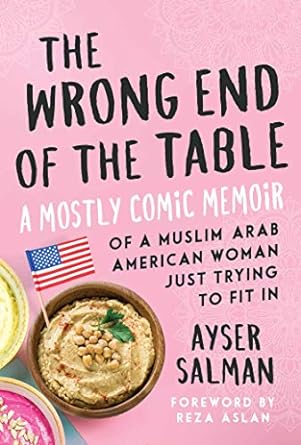
The Wrong End of the Table: A Mostly Comic Memoir of a Muslim Arab American Woman Just Trying to Fit in by Ayser Salman 

The book cover shows a wooden bowl of hummus topped with chickpeas and cilantro, with an American flag on a toothpick poking out of the bowl at the side.

By Piyali C.

I always seek out memoirs written by immigrants, because I am curious whether my experiences in a new country mirror the experiences of others. Everyone’s life is unique; however, facing micro aggressions, intentional or unintentional, seems to be a common theme in each of our stories. That, and trying to find a place at the table. It takes time for immigrants to understand the culture and traditions of the country they emigrate to and it also takes time for them to be understood. An immigrant expends time and energy making sense of their new environment and is accepted (hopefully). The process is not seamless or easy, though. Often, we find ourselves at the wrong end of the table. Ayser Salman explains this beautifully in her memoir, The Wrong End of the Table: A Mostly Comic Memoir of a Muslim Arab American Woman Just Trying to Fit in.

The oldest child of an Iraqi family who fled the fascist regime of Saddam Hussein to give their children better opportunities in the United States, Salman found herself to be the only child in her Columbus, Ohio school of Arab descent, someone who had trouble pronouncing rr’s in the way that the English language demands. In Ohio, little Ayser discovered McDonald’s Egg McMuffins, Barbie dolls and, much to her surprise, kids playing doctor everywhere. This was also a time of struggling to fit in and assimilate with her blonde and blue-eyed White peers. Often confused, often treated differently, often facing derogatory comments about ‘her people’ being terrorists, Ayser Salman navigated through her life, pursuing her career in films and gaining strength of character as an independent Arab American woman. Her parents raised her to be a strong woman and a proud Muslim. While growing up, Salman felt misunderstood and discriminated against due to her identity as an Iraqi American woman, but once she understood intersectionality, she realized the extent of intersectionality existing in our society and felt like she belonged.

Her family, during her teenage years, moved to Saudi Arabia for a few years before returning to Lexington, Kansas. Despite the oppressive rules governing women during the 1980s in Saudi Arabia, Ayser found a sense of belonging among the girls she went to school with, as they shared her religion, culture, and traditions. In Saudi Arabia, she did not stick out like a sore thumb like she did in America. She related to the girls she went to school with, and they formed deep friendships as they experienced puberty together. It was a great irony that in a country where women were repressed, Ayser felt a certain kind of release. 

Once Ayser left for college, she ceased being ‘different ‘ and found acceptance among her peers to some degree. College, unlike her high school, was a microcosm of the world, where people with diverse identities came together for higher education. There was a level of acceptance of differences that Ayser had never experienced before. But 9/11 brought new challenges and she again found herself at the wrong end of the table, vociferously trying to prove to the world that Muslims are not terrorists.  

Ayser Salman talks about racism and micro aggressions in her memoir, but she coats them with a veneer of lighthearted, witty narrative. The racism is made more poignant due to her self-deprecating humor. She writes about her dating experiences with both Arab and non-Arab men, as well as her strong female friends who always had her back but sometimes failed to understand her culture or were insensitive about her Arab identity. She also pays homage to her fierce mother, her scholarly father, and her siblings. Ayser’s conversations with her mother made me laugh out loud, reminding me of similar conversations I have had with mine. 

Ayser Salman’s writing is lucid and flows beautifully. Her humor in describing and responding to serious subjects makes the reading experience delightful. If you are interested in memoirs and/or learning about immigrant experiences like I am, this is a great book for you.  

The Wrong End of the Table: A Mostly Comic Memoir of a Muslim Arab American Woman Just Trying to Fit in by Ayser Salman is available in print format.

Piyali is an instructor and research specialist at HCLS Miller Branch, where she facilitates Light But Not Fluffy and co-facilitates Global Reads. She keeps the hope alive that someday she will reach the bottom of her to-read list.

National Library Week with Honorary Chairperson Meg Medina

The book cover shows Merci sitting on the steps outside her home next to a bike with a cell phone in her hand. Her grandparents are looking out of a window towards her and smiling, and there is a green car with a driver and passenger in the background. There are palm trees and a bright orange-pink sunset on the horizon.

By Jean B.

It’s time to celebrate libraries! We think every week is Library Week, but this annual event focuses attention on how libraries support and enrich our lives. Meg Medina observes:

“From book groups to lending sports equipment to providing a safe after-school hangout space and so much more, libraries support us wherever we find ourselves on the roadmap through life’s journey.”
In fact, libraries are there at life’s starting line, offering parents and caregivers of newborns, infants, and toddlers the opportunity to talk, sing, read, and play together in a positive environment. Early trips to the library may be a social lifeline for new parents as well as a fertile ground for growing confident, enthusiastic readers – it’s the very first chapter in a child’s educational experience!

“!Cuéntame!: Let’s talk books!” continues Medina, who is the Honorary Chairperson of National Library Week and National Ambassador for Young People’s Literature, and it’s the perfect way to celebrate National Library Week 2024.

Let’s talk about Medina’s award-winning books for kids. Merci Suárez Changes Gears, winner of the Newbery Award in 2019, opens a window into the lively world of a Cuban American family and the confusion of starting middle school. We can all can relate to the uncertainty and change that comes with middle school, but Merci Suárez experiences more than the usual bumps. As a scholarship student at Seaward Pines Academy, Merci finds herself on the outside. Her life at Las Casitas, the three little pink houses that sit side by side and hold her extended family together in a maelstrom of love and drama, is clearly different from that of her classmates. Her family shapes her life every day, whether she is playing soccer with her Papi’s team, hanging out with her grandparents, Lolo and Abuela, or babysitting her wild twin cousins. All that togetherness!  It’s a blessing and curse for a sixth grader trying to figure out how she fits in. On top of that, her beloved Lolo is behaving in strange and worrisome ways, and nobody wants to talk about it with Merci.   

In this book and the two books that follow it – Merci Suárez Can’t Dance and Merci Suárez Plays it Cool – Meg Medina opens a conversation about a universal theme – dealing with change – but immerses us in a specific setting that reflects her own experience as a Cuban American. With Spanish words and phrases sprinkled throughout the story and wonderful descriptions of foods, celebrations, and rituals familiar to this community, we see common problems from a new perspective, one that is infused with Florida heat and Cuban spice. Merci advances a grade with each book in the trilogy and learns to navigate the whole range of middle school challenges, from cliques to crushes, while adjusting to changes at home, too, as her brother goes to college and her grandfather’s health declines.  

The image shows two girls facing each other, nose to nose, in front of a moving truck with boxes inside, with the book title written on the side of the truck. Fall leaves and an apartment building are in the background.

Not into middle school drama? Medina portrays strong Latina girls in tough situations with honesty, humor, and heart for other age groups as well.  In the sweet picture book Evelyn Del Rey is Moving Away, her young heroine faces the loss of her best friend and neighbor, but the bond of friendship proves more powerful than distance.  In the award-winning YA novel Yaqui Delgado Wants to Kick Your Ass, Medina takes on high school bullying as experienced by Piddy Sanchez, a girl stressed by school and family issues.   

The book cover depicts the book's title on a locked, blue school locker.

Pick any of Medina’s books and you come away with a lot to talk about. The characters are real and their struggles and relationships are totally relatable. It’s everyday family life. At the same time, reading these stories told through a rich, cultural lens broadened my own experience and showed me something new in the everyday.    

“!Cuéntame!” Let’s have a conversation! Isn’t that what the Freedom to Read is all about?  

Merci Suarez Changes Gears is available in print, as an audiobook on CD, as a digital audiobook, and in e-book format.

Evelyn Del Rey Is Moving Away is available in print in English and Spanish and in e-book and e-audiobook formats, as well as in an animated adaptation on DVD.

Yaqui Delgado Wants to Kick Your Ass is available in print.

Jean B. is a Children’s Instructor and Research Specialist at the Central Branch who loves reading books for all ages when she isn’t enjoying the outdoors.

Mixed Plate: Chronicles of an All-American Combo by Jo Koy

Jo Koy poses against a bright red backdrop, holding his suit jacket out between his pinched fingers and with his

by JP Landolt

My man Jo Koy bombed as the host of the Golden Globes. As I was reviewing some of the clips, my heart fell. This was NOT the Jo Koy I knew. I can’t help wondering where it went wrong, and I felt even worse about the kind of awful press he was getting. Comments like “Who even was this guy?” and “What a loser!” kept popping up in these online clips. I felt myself wanting to defend him and to prove to people that Jo Koy was truly funny. Unfortunately, hosting gigs like that are tough. They can sour (or sweeten) the masses to you, especially as a comic. And goodness me, even I know that a friendly roast of Taylor Swift is a “no-no” these days!  

If you get a chance to watch his numerous Netflix specials and pick up his book Mixed Plate, I believe you’ll gain more of an appreciation for Jo Koy. I am absolutely biased as I am also a “mixed plate” like he is – half Filipino and half white. 

You know, aside from my brother and me, the only Jewish-Filipino person I had ever heard of in the 90s was Rob Schneider, one of our most beloved comedians. I heard of Jo Koy through Filipino friends and family who alerted me to the fact there was a Filipino American comic who was crushing it (thanks for the heads up). He’d been grinding for years and made his way onto “Chelsea Lately” as a panelist. I saw one of his specials on Comedy Central in the early 2010s and would continue to look for Jo Koy material and find random snippets on YouTube. Finally, by 2017, Live from Seattle was on Netflix. I shared this with my husband and he, too, has become a Jo Koy fan.   

My family revels in comedians. We had cassettes of comedians that we’d listen to over and over. In fact, we had the same Richard Pryor cassette that Jo Koy references in this book. In the 90s I loved In Living Color, All That, and any comedy sketch show I could find. And SNL? SNL in the 90s was ripe with talent: Dana Carvey, Adam Sandler, Chris Farley, David Spade, and the rest of them. I remember Eddie Murphy in red leather, George Carlin and his bad words, and today I enjoy Jo Koy, Tiffany Haddish, Tom Segura, and others. When he finally “makes it,” he starts name-dropping his idols who soon become friends. Most surprising (and hilarious) is his friendship with Jon Lovitz!

Other revelations in this book proved to me just how incredible humor is. Some things make you laugh to keep from crying, and others make you laugh until your cheeks are wet with tears! The struggles in this book are so painfully real. There’s the struggle of not being enough, then there’s the struggle of not having enough. Growing up impoverished and mixed can amplify those feelings of not really belonging and simultaneously doing whatever you can to be seen. Jo Koy lived this reality, and I felt it in his words. Humor and shared experiences bring people together. There’s about seven pages of thank you’s at the end of this book, and it’s only a short testament to how much this book was created with love and gratitude. Jo Koy seems to have a happily ever after, and I’m here for it!

Mixed Plate is available from Howard County Library System in print and as an e-book.

JP has worked for HCLS since 2006. She enjoys gallivanting, Jollibee, and all the halo-halo she can eat.

Star Trek: The Next Generation

The book cover is a photograph of Patrick Stewart facing the camera, hands crossed in front of him and smiling slightly. He is wearing a light green shirt and a gray jacket.

By Eliana H.

I grew up watching Star Trek: The Next Generation, and Jean-Luc Picard will always be my captain. With family connections to Yorkshire, his home county in England, I’m especially fond of Sir Patrick Stewart. He grew up a scant three miles from the hotel where we used to stay when visiting relatives. Even if you are not a Trekkie, you probably would recognize the classically-trained actor from his depiction of Professor Charles Xavier in X-Men and its sequels. If you’ve missed all of those, you might have spotted him in the recent Super Bowl ad for Paramount+, in which he wore a very old-fashioned football uniform and threw a “Hail Arnold” as Creed sang in the background. I enjoyed his performances throughout the Star Trek franchise as well as in the X-Men films, Jeffrey, and more, so I was excited to see that Sir Patrick Stewart had a new memoir out. I have very positive associations with his voice and was especially delighted to see that he narrates the audiobook. 

Making It So is a nod to one of his signature lines as Captain Picard, one that my father happened to enjoy using as well. I don’t read a lot of memoirs, so I was glad that it kept my interest. I learned a lot about Patrick Stewart’s humble beginnings, the work he had to put in to succeed in the world of British theater, and how he ended up playing his most recognized iconic roles. I will admit that some of what I learned about his personal life tarnished the shine a bit, as he was not always a good partner. Still, it was a pleasure to feel more connected to one of my childhood icons. I found myself wishing that I could go back in time to see some of the stage performances that I wasn’t aware he was engaged in during my adult lifetime! Thankfully, Sir Patrick Stewart indicates in the book that he has more to share with the world, so I anticipate opportunities to appreciate his artistry in the future. In the meantime, I’m working on watching Blunt Talk, one of his more recent television shows. 

Making It So is available from Howard County Library System in print, in e-book and e-audiobook formats, and as an audiobook on CD.

Eliana is a Children’s Instructor and Research Specialist at the Elkridge Branch and co-chair of the HCLS Equity Committee. She loves reading, even if she’s slow at it, and especially enjoys helping people find books that make them light up. She also loves being outside and spending time with friends and family (when it’s safe).

The Sewing Girl’s Tale: A Story of Crime and Consequences in Revolutionary America by John Wood Sweet

A dark cover showing a young woman's profile and a braid draped over her shoulder. A set of award stickers runs down the left.
Version 1.0.0

By Piyali C.

My co-worker and I facilitate a class at HCLS Miller Branch called What’s On Your Shelf? Fiction and Non-Fiction Book Chat, which takes place on the second Thursday of each month at 2 pm. We gather to talk about our favorite books, either read that month or in the past. My co-facilitator and I share two or three of our favorite reads and then open the floor for participants to share what they have been reading. My partner makes a lovely PowerPoint presentation of our picks, and I take feverish notes about all the suggestions from participants. We then compile the list and send it out to the group. If someone does not have a book to share, they are welcome to listen.

I look forward to this class with joy and apprehension. Joy, because I get to hear about amazing books. Apprehension, because after each session my to-read list gets longer. But, as one of the participants in the class pointed out to me, the beauty of being a bibliophile is always having a robust to-read list and the resources (like a free public library) to access them. Anyway, all this goes to say that the book I am about to review, The Sewing Girl’s Tale, was suggested by one of the What’s On Your Shelf? participants. I hope you join us for our April session – register here.

In The Sewing Girl’s Tale, author John Wood Sweet brings to light a fascinating piece of history with his superb historical detective skills. In 1793, Lanah Sawyer, a seventeen-year-old seamstress in New York, is assaulted and raped by twenty-six-year-old Harry Bedlow, a member of the upper echelon of society. Often when such assaults occurred, the women were considered ruined and ostracized. Loss of virginity was synonymous with loss of status, prestige, and standing in society. For the most part, the men went on to marry and live successful lives while the victims vanished into obscurity and shame. Lanah decides to fight back with the support of her stepfather, John Callanan.

She brings a lawsuit against Harry Bedlow and the case is brought to trial. What follows is a fascinating legal drama where the key players are white men looking out for other white men, trying to keep them from the noose as the punishment for rape was hanging. Lanah has to testify in court, in front of a packed house, recounting and reliving the horror that was inflicted upon herself. At some point during this legal battle, New York’s top lawyers get involved, including Alexander Hamilton. 

The author does a fascinating job of bringing post-Revolutionary War New York to life, exposing the rampant sexual exploitation of women, class privilege, and sexual double standards. Interestingly, women of a certain class and color were considered victims, as their sexual innocence was considered a virtue. The city at least heard their cases of assault if they wished to file a report against their assailants. Black or poor women did not merit the same treatment. It was heartening to read, however, that when this case caught the attention of the people of New York, women took up pens. They wrote under pseudonyms and ignited an intense debate about holding men accountable for their deeds and considering the previously-mentioned sexual double standard. It could not have been easy for them, given the shackles placed on women at the time, but they spoke out to pave the way for younger generations. 

As I read the book, I kept thinking how some aspects of rape cases have remained the same, when women are not believed, men get off easily, and women must recount their most traumatic experience repeatedly in front of a large number of people to find justice. 

The Sewing Girl’s Tale: A Story of Crime and Consequences in Revolutionary America by John Wood Sweet is available in print format. 

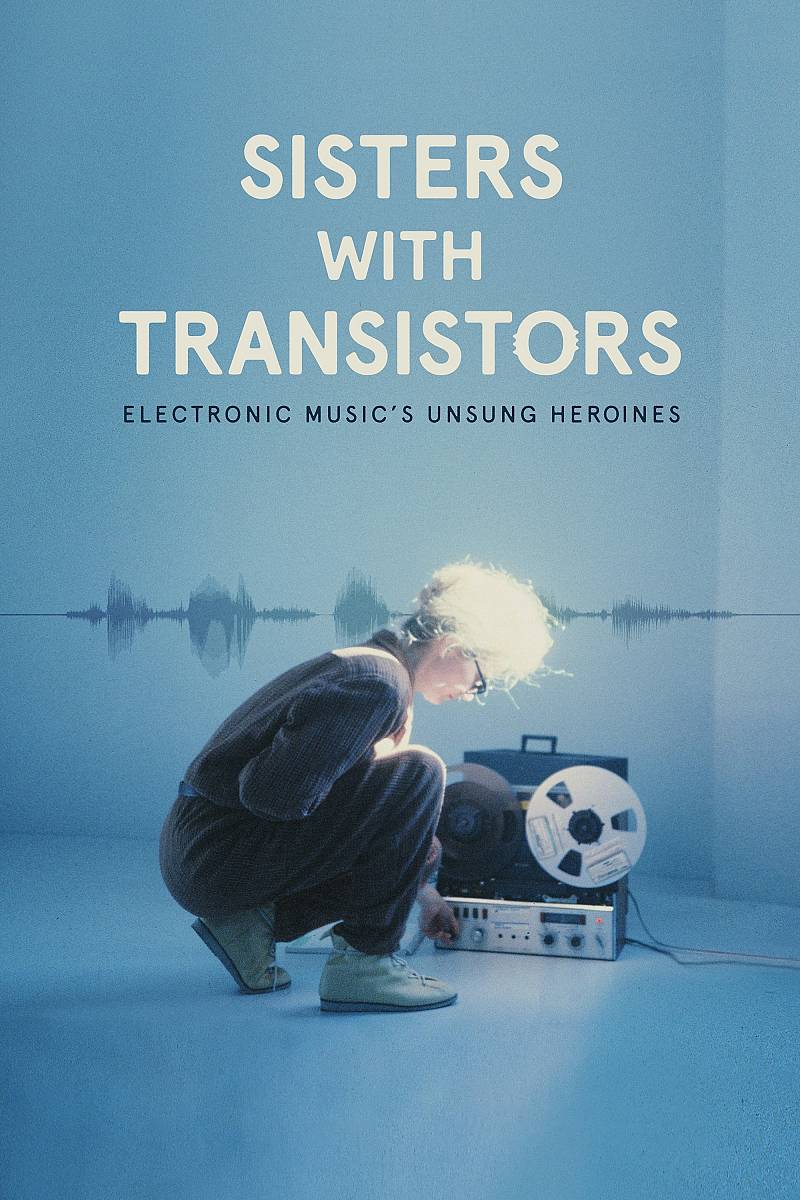
Sisters with Transistors

A woman squats in front of an old reel to reel recording device. Her hair appears white in a bright light and a sound wave rests behind her. The cover is a

by Robyn E.

“The history of women has been a story of silence, of breaking through the silence… with beautiful noise.” 

There was a time when a harmonious sequence of bleeps and bloops would not be considered music. Nowadays, the influence and techniques of electronic music are so ubiquitous, you can hear them in most songs found on the pop charts. A good number of my favorite music artists are influenced by this broad genre umbrella. The more sonically creative and mind-bending tracks I’ve enjoyed have made me wonder: Did they hear these magnificent sounds swirling in their heads first? Or did they just emerge from trial and error, through the persistent fiddling of knobs on machinery? 

Sisters With Transistors is a documentary film that puts the spotlight on the women who contributed to the birth of electronic music but who are often relegated to the background. They brought their experiences in math, science, and art along with a passion for experimentation to create sounds that, at the time, sounded like nothing that had existed on this planet before. Through archival footage and testimonies, we get to see each creator with their own equipment and hear about their creative processes, influences, and philosophies.

One important contributor was Delia Derbyshire, who arranged the electronic version of the opening theme to Doctor Who. She credited her love of abstract and meaningful sounds to the World War II air-raid sirens she heard as a child. The duo of Bebe Barron and her husband Louis Barron created sounds by overloading homemade circuits. Strange and unique sounds emerged from the resulting burnout which they then recorded, transformed, and edited. They are best known for creating the soundtrack to the movie Forbidden Planet, considered the first movie with an all-electronic score. There are many other stories like these to be found within the film. 

Some of the equipment that could be found in these pioneers’ studio-laboratories include homemade electronic circuits, tape recorders, electronic oscillators, and synthesizers. Each of the women featured harnessed new technologies for their creative liberation, in spite of fears that these same tools might instead be used for dehumanization. There was also, in a way, freedom for these women. Since they were not accepted through more mainstream outlets such as radio stations or record companies, they ultimately had more control over what they created. Adopting a DIY mentality was essential, not because they chose to, but because of the barriers they encountered.  

While watching this film, seeing the raw creativity and curiosity on display lit something in my own brain. I was taken back to a time in my younger years when I would experiment with tape recorders (did any other fellow 90s kids have a Talkboy tape recorder??), capturing snippets of sound effects, songs, and TV audio and assembling them into a sequence to create what I thought at the time were hilarious results. To be honest, I genuinely don’t think I could listen to those tapes now if I ever found them. Still, the liberating feeling of artistic experimentation and expression is an important one to keep alive. That same spark of creativity can be so difficult for me to capture these days, but I love to experience it vicariously through others. 

While certainly only a cross-section of the musicians who contributed to the genre, Sisters With Transistors offers a fascinating look at the women who helped lay the foundations for the evolution of electronic music that followed. Here’s to those who follow the call of the unknown and answer with unearthly and beautiful noise. 

Robyn is a Customer Service Specialist at the East Columbia Branch. She enjoys various media that paint a surreal or dark picture, animation, drawing, cats, and drinking coffee out of her Moomin mugs. 

Cozy Graphic Novels about Being Friends

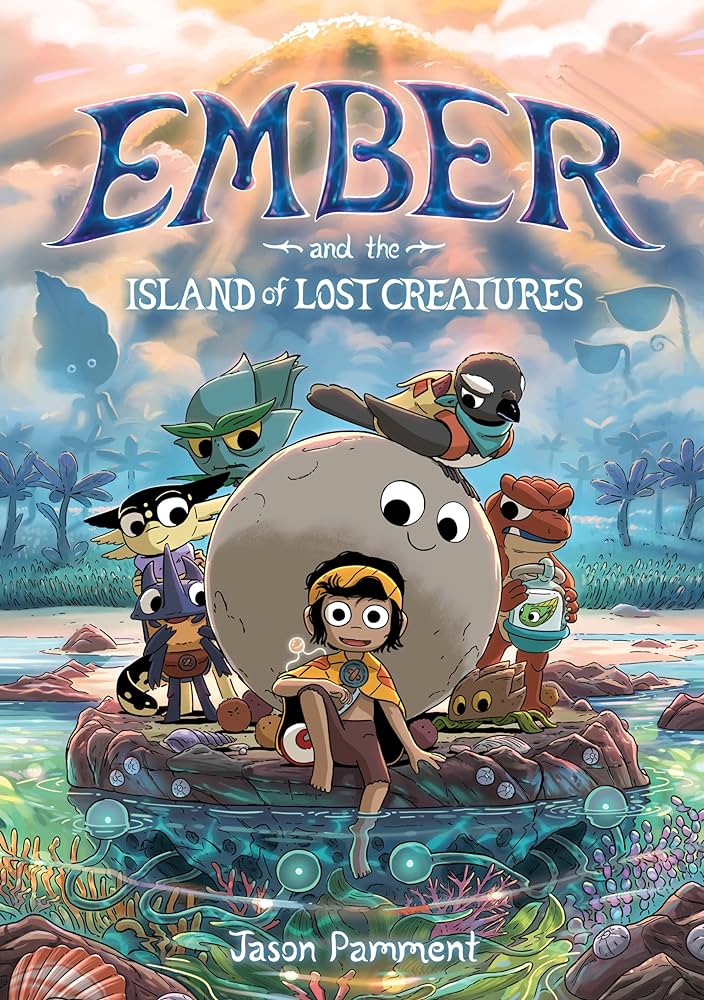
A group of odd but friendly creatures perch on a rock in an alien swamp.

by Monae R.

If you love reading about friendship, mystery, and character growth, take a chance with Ember and the Island of Lost Creatures and Treasure in the Lake. Jason Pamment wrote both of these stand-alone books, and they convey a similar message. Both stories feature the main character learning something about themselves and how they perceive others. A lot of readers, including myself, recommend these titles for those who love the Aquicorn Cove and Tea Dragon Society series by Kay O’Neill.

In Treasure in the Lake, main character Iris and her best friend Sam have become distant over the years. They decide to reconnect but get trapped in the tiny town of Bugden…in the past. As they fight to return to their own time before a flood destroys them, they find themselves crossing paths with the young from long ago and learn about a long-lost friendship. They learn that you never know or appreciate what you have until it’s taken away.

In Ember and the Island of Lost Creatures, our main character lives in a world of giants. Ember is a tiny boy living among giants and it isn’t easy to fit in. With the help of his friend Lua, a kind turtle, he travels across the ocean to a school for little creatures, which is on an island filled with ferocious storms and strange cave dwellers. Ember has trouble here, too, as he tries to adapt and befriend his classmates. He stumbles upon a curious sea creature, and when it attacks, Ember and his classmates must band together to survive.

Monae is a Children’s Instructor and Research Specialist at HCLS East Columbia Branch.

Meet the Author: Ira Marcks

A group of kids are posed in a movie poster group with a large shark behind them and a lighthouse below. It's a colorful cover with sunset colors above a clear

Wednesday, Apr 3
5 – 6 pm
HCLS Central Branch
Ages 10-17.

Mystery, Adventure, and Friendship in Ira Marcks’ Graphic Novels: Shark Summer and Spirit Week

by Ahmad Ndir

Ira Marcks’ graphic novels Shark Summer and Spirit Week combine mystery, adventure, and friendship in different settings. Both books feature young protagonists who are drawn into solving a local legend or curse with the help of unlikely allies. The stories are fast-paced, engaging, and full of twists and turns that keep readers on the edge of their seats.

Shark Summer is set on Martha’s Vineyard, where a Hollywood film crew arrives with a mechanical shark and a youth film contest. Gayle, a disgraced pitcher, sees a chance to turn her bad season into the best summer ever by making a movie about the island’s phantom shark. Along the way, she teams up with Elijah, an aspiring cinematographer, and Maddie, a moody director. Together, they uncover the truth behind the shark and the history of the island. The book has a vivid sense of place and a nostalgic vibe that pays homage to classic movies like Jaws and The Goonies.

Spirit Week takes place in the Underlook Hotel in Estes Park, Colorado, a famous landmark that belongs to the reclusive horror writer Jack Axworth. Suzy, an aspiring engineer, is invited to tutor Jack’s son, Danny, but instead she finds herself investigating a local curse that threatens the hotel. With the help of Elijah, an amateur filmmaker, and Rena, the hotel’s caretaker, Suzy tries to save the hotel and the town from the shadows of the past. The book has a creepy and dark tone that draws inspiration from horror stories like The Shining and The Haunting of Hill House.

Both books are well-written and illustrated, with expressive characters and colorful scenes. The themes of acceptance, belonging, and finding your family intertwine throughout the stories, as the characters overcome their personal challenges and grow closer to each other. The books are suitable for middle grade and young adult readers who enjoy graphic novels, mystery, and horror. I would recommend them to anyone who likes a good scare along with a good laugh.

Author is posed in front of a book case and he is adjusting the collar of his sweater.

Award-winning graphic novelist Ira Marcks visits HCLS on April 3 at 5 pm at Central Branch. He discusses how he plans, writes, and draws a long form comic story by engaging hands-on using the three essential elements of storytelling – characters, setting, and theme. Followed by book sales and signing.

Ahmad Ndir is a Teens’ Instructor & Research Specialist at the Central Branch at HCLS. Along with helping young learners discover new books, he is an avid reader of teen fiction and nonfiction titles on different aspects of psychology. He strives for positivity for himself and those around him, in both his personal and work life.